



 Chat with AI
Exam 9: Microbiology

Exam 1: Anatomy291 Questions
Exam 2: Behavioral science240 Questions
Exam 3: Biochemistry156 Questions
Exam 4: Biostatistics117 Questions
Exam 5: Embryology52 Questions
Exam 6: Genetics103 Questions
Exam 7: Histology24 Questions
Exam 8: Immunology129 Questions
Exam 9: Microbiology336 Questions
Exam 10: Pathology816 Questions
Exam 11: Pathophysiology464 Questions
Exam 12: Pharmacology538 Questions
Exam 13: Physiology272 Questions
Select questions type


A 32-year-old Caucasian male presents with low grade fever, cough and generalized malaise. The patient has otherwise been healthy and has no significant medical history. His past surgical history includes tonsillectomy and tympanostomy tube placement at the age of 8. Careful questioning reveals that the patient recently came back from an "outdoor adventure" trip in the Great Lakes, and began feeling sick only after returning. Microscopic examination of a KOH preparation of an exudate specimen reveals a large yeast cell with a single bud. When incubated in a specific medium at 75.2ºF (24ºC), a multicellular structure with branching, tubular cells grows. The patient is most likely infected with which of the following:
(Multiple Choice)
4.8/5  (82)
(82) A 2-month-old boy is brought to the clinic for irritability, poor feeding, and frequent vomiting. Weight is at the 15th percentile, and head circumference is at the 96th percentile. Lung sounds are clear throughout, and heart auscultation reveals no murmurs. The abdomen is soft and nondistended. There is hepatosplenomegaly. Diffusely reduced muscle tone is present in all extremities. Funduscopy reveals white-yellow chorioretinal lesions in both eyes. MRI of the brain shows enlarged ventricles and scattered intracranial calcifications. Which of the following is the most likely cause of this patient's condition?
(Multiple Choice)
4.8/5 (75)
(75) An 8-year-old boy is brought to the emergency department due to 24 hours of fever and chills. Temperature is 38.3 C (101 F). On examination, the patient is lethargic with dry mucous membranes. There are no oropharyngeal lesions, and tympanic membranes are normal. The lungs are clear on auscultation, and heart sounds are normal. The abdomen is soft and nontender. There is no skin rash. Laboratory testing shows a leukocyte count of 24,000/mm3 with 15% bands, 80% neutrophils, and 5% lymphocytes. Peripheral blood smear is shown in the exhibit. 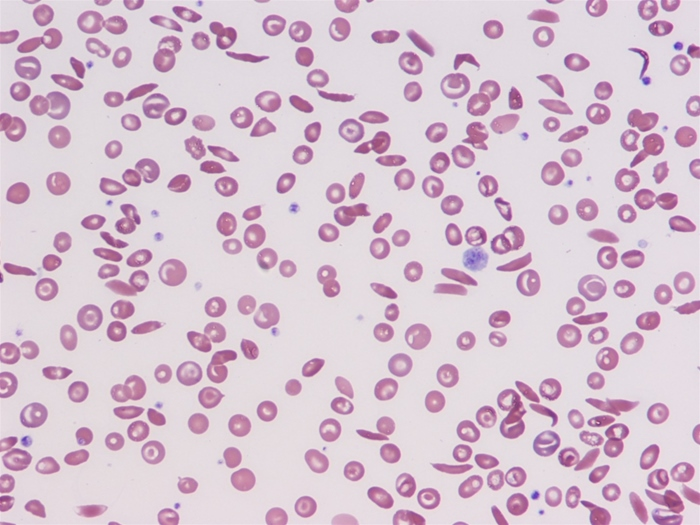 Blood cultures are obtained and intravenous fluids and empiric antibiotics are initiated. The patient's blood cultures are most likely to grow which of the following organisms?
 (Multiple Choice)
4.9/5 (74)
(74) A 45-year-old man comes to the office with groin pain and swelling. About a month ago, he noticed a sore on his penis but did not seek medical attention because the ulcer was not painful and disappeared within a week. Several days ago, he began to experience painful swelling in his inguinal region, with inflammation of the overlying skin and eventual formation of several draining ulcers. He also has mild fever and malaise that began around the same time as his groin symptoms. The patient is a sailor. His other medical problems include well-controlled hypertension and hyperlipidemia. Cell scrapings from his lesions show cytoplasmic inclusion bodies. Which of the following is the most likely cause of this patient's condition?
(Multiple Choice)
4.8/5 (80)
(80) An infant is evaluated at the office after developing prominent oral thrush, interstitial pneumonia, and severe lymphopenia during the first year of life. The patient was born full-term to a 25-year-old woman who received no prenatal care and has substance use disorder with intravenous drug use. She breastfed her son for the first month but then switched to formula feedings. The mother is currently unwilling to undergo any kind of testing. She tells the health care provider, "Just take care of my son." Which of the following prenatal interventions would have most likely prevented this infant's condition?
(Multiple Choice)
4.8/5 (72)
(72) A 46-year-old man comes to the office due to skin lesions that developed on his left arm over the past few days. The lesions are not particularly painful. The patient has never had similar symptoms. He has had no fevers and otherwise feels fine. Past medical history is insignificant. The patient takes no medications and has no allergies. Temperature is 37.1 C (98.8 F). The lesions are shown in the image below. 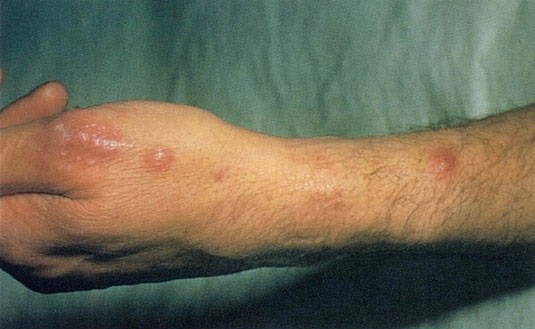 Following pathologic sampling, the lesions are determined to be fungal in etiology. Which of the following scenarios is most likely a component of this patient's history?
 (Multiple Choice)
4.8/5 (67)
(67) A 32-year-old man is brought to the emergency department due to fever, agitation, and disorientation. According to his family, the patient has been acting strangely and seeing and hearing things that do not exist. He also drools excessively and has severe, painful throat spasms when he attempts to eat or drink. The patient returned 4 weeks ago from a camping trip in New Mexico. Physical examination shows a confused and combative patient with mydriasis and neck rigidity. Which of the following acts as an entry receptor for the causative agent of this patient's condition?
(Multiple Choice)
4.9/5 (85)
(85) A 63-year-old woman comes to the office during the winter due to shortness of breath and cough productive of thick, green sputum for the past 2 days. The patient has chronic obstructive pulmonary disease and mild dyspnea on exertion at baseline. The dyspnea has worsened over the past several days, and she is now also short of breath at rest. Other medical conditions include hypertension, gastroesophageal reflux, and seasonal allergies. She has been using her albuterol rescue inhaler more frequently than usual. The patient says she has cut down to 4 or 5 cigarettes per day and is trying to quit. Pulse oximetry shows 91% on room air. She appears to be in mild respiratory distress. Lung examination demonstrates diffuse bilateral wheezes. Chest x-ray reveals hyperinflation. Which of the following triggers is most likely responsible for the worsening of this patient's symptoms?
(Multiple Choice)
5.0/5 (81)
(81) A 26-year-old man comes to the office due to a 3-day-history of dysuria and urethral discharge. The symptoms developed about 2 weeks after he had unprotected sexual intercourse with a new partner. His temperature is 37.1 C (98.8 F). On physical examination, a mucoid discharge is expressed with gentle milking of the penis. Gram stain of the discharge reveals numerous neutrophils with intracellular diplococci. A sample of the discharge is placed on an antibiotic-containing medium, and bacterial colonies are cultured. Which of the following terms best describes the medium?
(Multiple Choice)
4.7/5 (73)
(73) A 4-year-old boy is brought to the office due to high fever, nasal discharge, and cough for 3 days. His family recently returned from a vacation in Mexico. Physical examination shows an ill-appearing, febrile child. The patient has bilateral conjunctival injection and several small white spots with an erythematous base on his buccal mucosa. A review of the medical record shows parental refusal of preventive health services in favor of a "natural" approach to the child's health. Over the next several days, which of the following is most likely to develop?
(Multiple Choice)
4.8/5 (77)
(77) A 49-year-old man comes to the office due to 4 months of cough and weight loss. His medical history is otherwise unremarkable and he takes no medications. The patient is a farmer who lives in Mississippi. He does not use tobacco, alcohol, or illicit drugs. His temperature is 37.9 C (100.2 F). Examination shows right lobe crackles. Chest x-ray reveals a pulmonary infiltrate in the right upper lobe. Bronchoscopy with transbronchial biopsy shows granulomatous inflammation. HIV testing is negative. Which of the following is most likely causing this patient's symptoms?
(Multiple Choice)
4.8/5 (82)
(82) A 25-year-old man with multiple injuries sustained in a motorcycle accident develops osteomyelitis while in the hospital. The organism is identified as methicillin-sensitive Staphylococcus aureus, and antibiotics are started. Which of the following is the most important measure to reduce the risk of transmission to other patients?
(Multiple Choice)
4.7/5 (85)
(85) A 31-year-old man is brought to the emergency department after a tonic-clonic seizure. The patient has no known medical conditions. He grew up in a rural part of Guatemala and immigrated to the United States 3 years ago. The patient works as an architect and owns a cat. He has no history of tuberculosis. On examination, the patient is afebrile and has no focal neurologic deficits or meningeal signs. HIV antibody test and interferon-gamma release assay are negative. Chest x-ray is normal. MRI of the head reveals a 1.5-cm cyst within the left sylvian fissure that has minimal enhancement and no associated edema. Which of the following is the most likely means of acquisition of the infection responsible for this patient's findings?
(Multiple Choice)
4.9/5 (88)
(88) A 66-year-old man comes to the emergency department due to a 3-day history of fever, chills, dysuria, and perineal pain. The patient has never had similar symptoms before, although he has had occasional nocturia and urinary hesitancy over the last 2 years. His other medical conditions include type 2 diabetes mellitus and hypertension. The patient does not use tobacco, alcohol, or illicit drugs. He has not traveled recently and is not sexually active. Temperature is 39 C (102.2 F), blood pressure is 124/78 mm Hg, and pulse is 106/min. The abdomen is soft and nontender with no costovertebral angle tenderness. Digital rectal examination shows a smoothly enlarged and tender prostate. External genitalia are normal with no scrotal tenderness. There is no urethral discharge. The remainder of the examination shows no abnormalities. Urinalysis reveals bacteriuria and pyuria. Which of the following pathogens is most likely responsible for this patient's current symptoms?
(Multiple Choice)
4.9/5 (81)
(81) A 45-year-old man comes to the office due to a sore throat for the past 3 months. The patient also has pain with swallowing. He has never smoked, drinks alcohol occasionally, and does not use illicit drugs. On physical examination, the right tonsil is enlarged with a small area of ulceration. The rest of the physical examination is unremarkable. Biopsy of the right tonsil is shown in the image below: 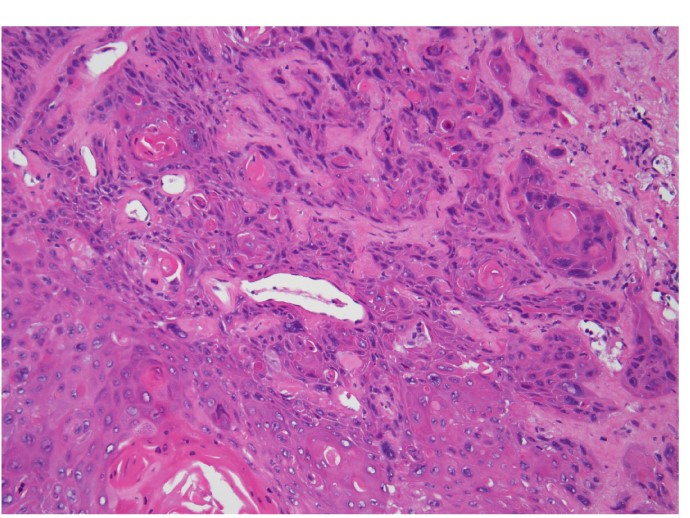 Which of the following most likely played the most significant role in the pathogenesis of this patient's condition?
 (Multiple Choice)
4.8/5 (66)
(66) A 4-year-old, previously healthy boy is brought to the emergency department due to fever, abdominal pain, and frequent bloody diarrhea for 2 days. A few children at day care have developed diarrhea over the past week as well. He takes no medications and has not traveled outside the United States. Temperature is 39 C (102.2 F), blood pressure is 110/70 mm Hg, and pulse is 90/min. Physical examination shows increased bowel sounds and left sided abdominal tenderness. Which of the following is the most likely causal organism?
(Multiple Choice)
4.8/5 (90)
(90) A 23-year-old man comes to the physician due to a 2-month history of fatigue, malaise, and abdominal discomfort. He is found to have tender hepatomegaly with elevated liver function tests. The patient has never been vaccinated against hepatitis. He has had no raw or uncooked foods recently and recalls no ill contacts. There is no history of blood transfusion. The patient is a graduate student who immigrated to the United States 2 years ago and has not traveled outside the country since. He smokes 2 packs of cigarettes a day and consumes 1 or 2 bottles of beer on weekends. The patient does not use illicit drugs. He has had several episodes of unprotected sex with different female partners within the past year. Which of the following is most likely to be present in this patient?
(Multiple Choice)
4.8/5 (79)
(79) A 46-year-old HIV-positive man is hospitalized with fever, cramping abdominal pain, and watery diarrhea. Evaluation shows high fever, hypotension, tachycardia, and lower abdominal distension and tenderness. Abdominal x-ray reveals free intraperitoneal air, and the patient is taken for urgent exploratory laparotomy. Operative findings include an erythematous and dilated colon. A focus of bowel wall necrosis with perforation is resected. Histopathologic analysis reveals acute inflammatory changes, epithelial necrosis, and a layer of denuded epithelium, fibrin, and inflammatory cells overlaying the mucosa. Which of the following pathogens is most likely responsible for this patient's current condition?
(Multiple Choice)
4.7/5 (58)
(58) A 74-year-old man with end-stage renal disease who is receiving hemodialysis is found to have elevated liver transaminase levels. He has had no fever or jaundice. The patient does not drink alcohol and has received a complete vaccine series for hepatitis B. Vital signs are normal. BMI is 24 kg/m2. Physical examination shows anicteric sclerae and no hepatosplenomegaly. Laboratory results are positive for hepatitis C virus RNA. Six months previously, he tested negative for hepatitis C. Without treatment, which of the following is the most likely outcome in this patient?
(Multiple Choice)
4.7/5 (91)
(91) A 24-year-old woman comes to the emergency department due to joint pain. A week ago, the patient had a flu-like illness with fever, malaise, and fleeting joint aches in her wrists, ankles, and knees. Over the past 2 days, the joint pain worsened, and she developed new swelling of the right knee. The patient has no chronic medical problems and has had no similar symptoms in the past. She does not use tobacco, alcohol, or injection drugs. She is sexually active, uses an oral contraceptive for birth control, and her last menstrual period was a week ago. Temperature is 38 C (100.4 F). On examination, there is no scleral icterus, facial rash, or oral ulcers but a few scattered painless vesiculopustular lesions are present on the upper extremities. The right knee is warm, swollen, and tender with decreased range of motion. Both ankles and the left wrist are mildly tender to palpation but not swollen or erythematous. Arthrocentesis of the right knee joint yields 20 mL of cloudy fluid with a leukocyte count of 50,000/mm3 (90% neutrophils). Additional evaluation of the joint fluid is most likely to show which of the following?
(Multiple Choice)
4.8/5 (84)
(84) 
Filters
- Essay(0)
- Multiple Choice(0)
- Short Answer(0)
- True False(0)
- Matching(0)