



 Chat with AI
Exam 9: Microbiology

Exam 1: Anatomy291 Questions
Exam 2: Behavioral science240 Questions
Exam 3: Biochemistry156 Questions
Exam 4: Biostatistics117 Questions
Exam 5: Embryology52 Questions
Exam 6: Genetics103 Questions
Exam 7: Histology24 Questions
Exam 8: Immunology129 Questions
Exam 9: Microbiology336 Questions
Exam 10: Pathology816 Questions
Exam 11: Pathophysiology464 Questions
Exam 12: Pharmacology538 Questions
Exam 13: Physiology272 Questions
Select questions type


A 5-year-old boy is brought to the emergency department with worsening somnolence, lethargy, and decreased urine output. The patient has no prior medical conditions but had abdominal cramps and diarrhea several days ago that later became frankly bloody. Physical examination shows mild pallor and moist mucous membranes. Laboratory studies reveal elevated blood urea nitrogen and serum creatinine levels. Peripheral blood smear shows fragmented erythrocytes. This patient's condition is most likely related to consumption of which of the following foods?
(Multiple Choice)
4.8/5  (68)
(68) A 36-year-old man comes to the office due to 2 months of fatigue, intermittent arthralgias, and poor appetite. The patient has no prior medical conditions and takes no medications. He does not use tobacco or illicit drugs, and he drinks alcohol occasionally. The patient has had multiple sexual partners and uses condoms inconsistently. Physical examination shows no abnormalities. Liver aminotransferases are elevated. Hepatitis serology shows the following: 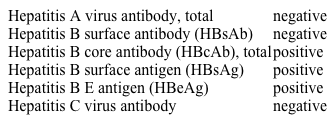 Which of the following genome replicative processes is most likely used by the virus infecting this patient?
 (Multiple Choice)
5.0/5 (94)
(94) A 46-year-old man comes to the emergency department due to fever. He returned from a vacation in Southeast Asia a week ago and began having symptoms toward the end of his trip. The patient describes continuous fever that has risen slowly to reach a high plateau and is relieved only by antipyretics. He has also had headaches and abdominal discomfort; he initially had constipation but has had loose stools for the past several days. Temperature is 40 C (104 F), blood pressure is 114/68 mm Hg, and pulse is 62/min. No oropharyngeal lesions, cervical lymphadenopathy, or neck rigidity is present. Lungs are clear on auscultation, and heart sounds are normal. Abdominal examination shows mild distension and generalized tenderness with hepatosplenomegaly. There is a faint, erythematous, macular skin rash over the trunk and abdomen. Laboratory studies reveal mild, normocytic, normochromic anemia and leukopenia with left shift. Peripheral blood smear is normal. Which of the following is the most likely route of transmission of this patient's infection?
(Multiple Choice)
5.0/5 (77)
(77) A 38-year-old woman comes to the emergency department due to abdominal discomfort and diarrhea. Her symptoms began after she returned yesterday from a Caribbean cruise. She consumed bottled water but ate raw, local seafood when visiting one of the islands. The cruise line has reported no other passengers with abdominal illness. On examination, the abdomen is soft with mild, generalized tenderness and hyperactive bowel sounds. A comma-shaped, oxidase-positive, gram-negative rod naturally found in salt water is implicated in her illness. Stool microscopy is most likely to demonstrate which of the following findings?
(Multiple Choice)
4.8/5 (71)
(71) A 45-year-old man comes to the emergency department due to 2 weeks of chest pain and cough. He has a history of advanced HIV and has taken his antiretroviral medications inconsistently over the past few months. Temperature is 38.1 C (100.6 F). Crackles are heard on pulmonary examination. CD4 cell count is 98/mm3. Chest x-ray reveals nodules and hilar lymphadenopathy. A bronchoscopy is performed. Mucicarmine staining of the patient's bronchoalveolar fluid shows budding yeast forms with thick capsules. Symptomatic infection with the organism causing this patient's condition most commonly manifests as which of the following?
(Multiple Choice)
4.9/5 (85)
(85) Bacteria isolated from the lung tissue of a 32-year-old Caucasian male fail to decolorize with hydrochloric acid and alcohol after staining carbolfuchsin. Which of the following cell wall components is most likely responsible for this staining phenomenon?
(Multiple Choice)
4.8/5 (68)
(68) A 6-month-old boy is brought to the emergency department due to poor feeding, irritability, and rash. He was well-appearing until 2 days ago, when he developed little interest in drinking and a progressive rash. Physical examination reveals diffuse erythema and desquamation that is most prominent at the neck, axillae, inguinal folds, and perioral region. The perioral area also has crusting and the lips are dry and cracked, but the mucosal membranes are normal. The epidermis easily comes off with gentle pressure at the erythematous areas. Which of the following is the most likely cause of this patient's symptoms?
(Multiple Choice)
4.7/5 (84)
(84) A 45-year-old woman comes to the emergency department due to 2 days of fever, chills, malaise, and fatigue. The patient returned from an African jungle safari 3 weeks ago. She received mefloquine chemoprophylaxis during the travel, which she stopped taking upon arrival in the United States. Temperature is 38.9 C (102 F), blood pressure is 122/68 mm Hg, pulse is 110/min, and respirations are 20/min. Physical examination shows mucosal pallor. Laboratory results reveal mild anemia and thrombocytopenia. Peripheral blood smear shows intraerythrocytic Plasmodium falciparum. Which of the following is the most likely underlying cause of this patient's infection?
(Multiple Choice)
4.8/5 (85)
(85) A 42-year-old woman is brought to the office in summer due to 2 weeks of personality changes. Her family reports that she has become withdrawn and does not talk as much as before. She has also had difficulty picking things up with her right hand. The patient has HIV infection and does not take her antiretroviral therapy consistently. She is a former smoker and used injection drugs in the past. The patient works in a food-processing facility and has not traveled recently. Temperature is 37 C (98.6 F), blood pressure is 126/78 mm Hg, pulse is 82/min, and respirations are 14/min. The patient is oriented to time, place, and person but is slow to respond to questions. Motor strength is decreased in her right upper extremity, with an exaggerated biceps reflex. CD4 count is 78 cells/mm3, and plasma HIV RNA (viral load) is 400,000 copies/mL. CT scan of the head shows a small hypodense area in the left frontal lobe with ring enhancement after intravenous contrast administration. Two similar lesions are present in the basal ganglia and cerebellum. Which of the following is the most likely route of transmission of the infectious agent causing this patient's current condition?
(Multiple Choice)
4.8/5 (75)
(75) A 38-year-old woman comes to the office for evaluation of a skin lesion. It began as a pink papule on her right arm and has progressively enlarged over several weeks. The lesion is not pruritic or painful and has not been associated with fever or other systemic symptoms. The patient returned from a trip to Costa Rica 5 weeks ago. During her travel, she stayed at a beachside resort and hiked in the rainforest. Skin examination findings are shown below. Biopsy of the lesion reveals intracellular, round-oval protozoa with rod-shaped kinetoplasts. Which of the following most likely led to this patient's current condition? 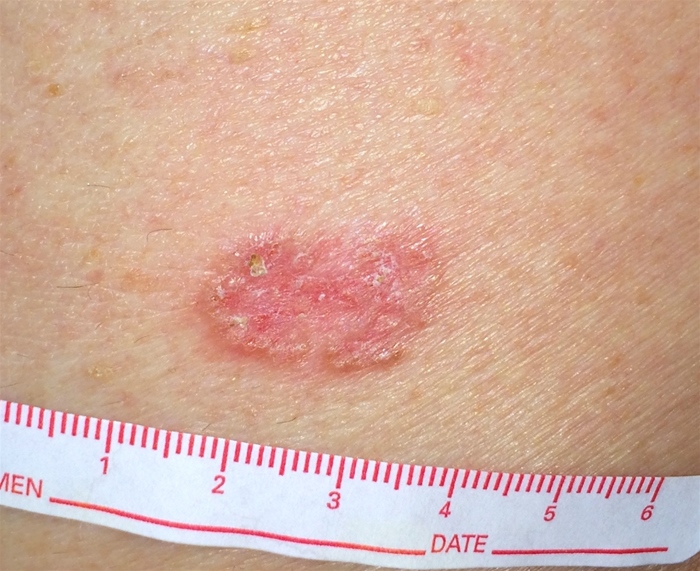
(Multiple Choice)
4.8/5 (74)
(74) A 21-year-old woman volunteers in a research study evaluating the effects of viral infection on immunoglobulin production. The patient is a college student who has no past medical history and does not take any medications. She has not felt ill recently. Her lymphocytes are isolated from whole blood and cultured. The mature B lymphocytes exposed to a specific virus in vitro acquire the ability to proliferate indefinitely while maintaining the capacity to secrete immunoglobulins. Which of the following tests is used to diagnose an in vivo infection with this virus?
(Multiple Choice)
4.9/5 (77)
(77) A 44-year-old man is brought to the emergency department by his wife because of confusion that began a few hours ago. Earlier in the day, he complained of a severe headache and nausea. On physical examination, his temperature is 38.3 C (101 F) and nuchal rigidity is present. Lumbar puncture and cerebrospinal fluid (CSF) examination show: 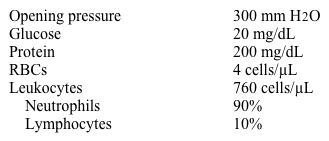 Gram stain of the CSF would most likely reveal which of the following?
 (Multiple Choice)
4.7/5 (77)
(77) A 31-year-old man comes to the office due to a week of fever, night sweats, sore throat, malaise, and extreme fatigue. He has no prior medical conditions and takes no medications. The patient has had multiple sexual partners over his lifetime and uses condoms inconsistently. Temperature is 38 C (100.4 F), blood pressure is 110/80 mm Hg, pulse is 92/min, and respirations are 20/min. Physical examination shows multiple shallow ulcers on the oropharyngeal mucosa, and the tonsils are enlarged and hyperemic. Cervical and axillary lymphadenopathy is present, and there is a generalized, erythematous, maculopapular skin rash. HIV testing shows the following results: 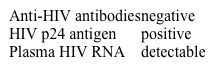 Which of the following best explains this patient's laboratory findings?
 (Multiple Choice)
4.7/5 (85)
(85) A 23-year-old woman participates in a research study evaluating the effect of monoclonal antibodies on viral infection. The patient has no past medical history and takes no medications. She has not been ill recently. During the study, a peripheral blood specimen is obtained. CD19 positive cells are isolated, purified, and exposed to monoclonal antibodies against cell surface complement receptor CD21. The cells are subsequently incubated along with several viruses being studied. Initial exposure to monoclonal antibodies against CD21 is most likely to prevent cell infection with which of the following viruses?
(Multiple Choice)
4.8/5 (78)
(78) The patient is hospitalized, and appropriate treatment is begun. After discussing the underlying cause of his condition-immunosuppression due to HIV infection-the patient agrees to take antiretroviral therapy consistently. One of the medications in his treatment regimen leads to the production of immature, noninfectious virions containing large polyproteins. Which of the following viral processes is most likely directly inhibited by this agent?
(Multiple Choice)
4.9/5 (77)
(77) A 27-year-old man comes to the emergency department due to 2 weeks of low-grade fever, malaise, and loss of appetite. The patient has no prior medical conditions and takes no medications. He does not smoke cigarettes or drink alcohol but regularly injects illicit drugs. The patient is sexually active and uses condoms inconsistently. Physical examination reveals scleral icterus. A smooth and mildly tender liver edge is palpable 4 cm below the right costal margin. Laboratory results are as follows: 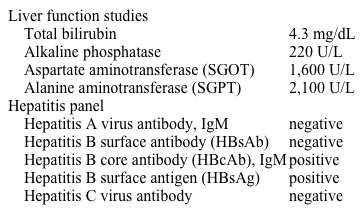 Which of the following is an essential step in the replication cycle of the virus infecting this patient?
 (Multiple Choice)
4.8/5 (95)
(95) A 58-year-old asymptomatic woman comes to the office for a health checkup prior to starting volunteer work at a hospital. She has a history of hypothyroidism and takes levothyroxine. She does not use tobacco, alcohol, or illicit drugs. Her examination findings are unremarkable. During a laboratory test, her white blood cells are incubated with mycobacterial antigens. Compared to the control, a large amount of interferon-gamma is detected in her blood sample. Which of the following cell types is most directly responsible for this finding?
(Multiple Choice)
4.7/5 (65)
(65) A 33-year-old man is admitted to the hospital due to new-onset seizures. He has no significant medical history. Vital signs are normal. Neurologic examination shows no abnormalities. CT scan of the head reveals a 3-cm cystic lesion in the temporal lobe. The mass is excised, and histopathology is shown in the image below: 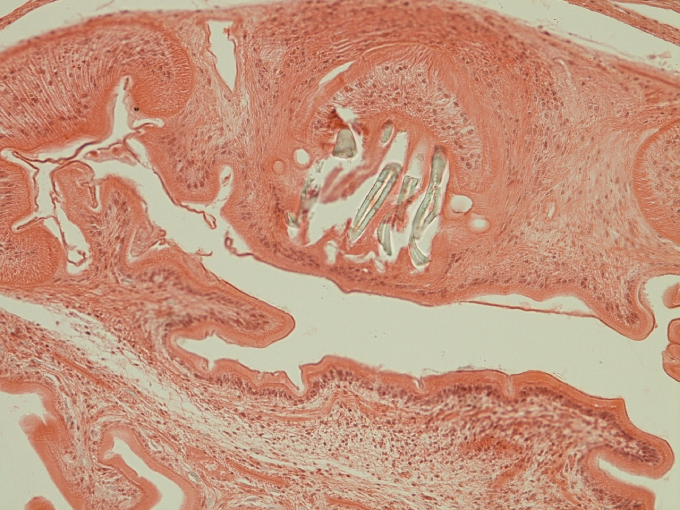 Which of the following is the most likely diagnosis?
 (Multiple Choice)
5.0/5 (80)
(80) Researchers studying fungal pathogens isolated an ergosterol biosynthetic gene by polymerase chain reaction. Using homologous recombination, they then developed a new strain of Candida with a mutated allele for that gene. The mutant strain was cultured in the presence of several different antifungal agents. Compared to isolates from the wild-type strain, isolates from the mutant Candida strain exhibited enhanced growth in the presence of drug X. Further investigation revealed that the mechanism of resistance to drug X was a decrease in ergosterol incorporation into the cell membrane. Based on this data, drug X is likely to be most closely related to which of the following antifungal agents?
(Multiple Choice)
4.8/5 (72)
(72) A 29-year-old man is hospitalized due to a flulike illness. His symptoms abruptly began 3 days ago with fever, rigors, malaise, headache, and myalgia. The patient has no prior health conditions and is usually very active, participating in multiple outdoor sports. Temperature is 38.9 C (102 F), blood pressure is 124/84 mm Hg, and pulse is 110/min. Physical examination shows an ill-appearing man with bilateral conjunctival suffusion. Lung and heart sounds are normal, but abdominal examination reveals mild hepatosplenomegaly. Generalized lymphadenopathy is also present. A test for influenza antigen is negative, and blood cultures in routine growth media are negative. The patient subsequently develops progressive jaundice and renal failure. Further testing detects an infection with a highly motile, corkscrew-shaped pathogen. This patient most likely acquired the infection via which of the following?
(Multiple Choice)
4.8/5 (79)
(79) 
Filters
- Essay(0)
- Multiple Choice(0)
- Short Answer(0)
- True False(0)
- Matching(0)