



 Chat with AI
Exam 13: Physiology

Exam 1: Anatomy291 Questions
Exam 2: Behavioral science240 Questions
Exam 3: Biochemistry156 Questions
Exam 4: Biostatistics117 Questions
Exam 5: Embryology52 Questions
Exam 6: Genetics103 Questions
Exam 7: Histology24 Questions
Exam 8: Immunology129 Questions
Exam 9: Microbiology336 Questions
Exam 10: Pathology816 Questions
Exam 11: Pathophysiology464 Questions
Exam 12: Pharmacology538 Questions
Exam 13: Physiology272 Questions
Select questions type


A 43-year-old obese woman presents to the emergency room with severe epigastric pain that started after a heavy meal. She has had several milder episodes before related to fatty food consumption. Physical examination reveals marked tenderness in the right subcostal area. Which of the following hormones most likely provoked the current attack in this patient?
(Multiple Choice)
4.9/5  (76)
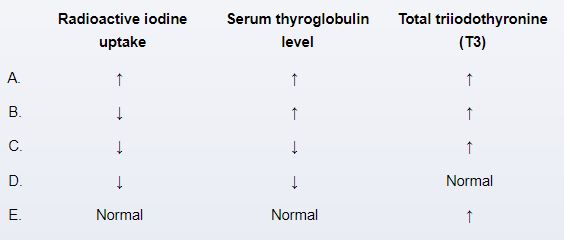
(76) A 34-year-old woman comes to the office with a 2-week history of palpitations, excessive sweating, and anxiety. The patient has obesity and has been unsuccessful in achieving significant weight loss with diet and exercise. In an attempt to lose weight, she has been taking excessive amounts of levothyroxine given to her by a friend. Pulse is 110/min. Physical examination shows sweaty palms and a soft, nontender, normal-sized thyroid gland. Laboratory evaluation reveals suppressed TSH and elevated free thyroxine (T4). Which of the following additional findings is most likely to be present in this patient?
(Multiple Choice)
4.9/5 (91)
(91) A 10-year-old boy is brought to the clinic by his parents due to chronic fatigue, shortness of breath, and failure to gain weight. The child was recently adopted from an orphanage in Asia. He weighs 20 kg (44.2 lb). Vital signs are within normal limits. Physical examination reveals a loud systolic murmur. Echocardiogram shows pulmonary stenosis and subaortic ventricular septal defect with deviation of the origin of the aorta to the right. The mother describes occasional episodes of severe dyspnea and cyanosis, during which the child quickly assumes a squatting position. Which of the following mechanisms during squatting relieves this child's symptoms?
(Multiple Choice)
4.8/5 (81)
(81) A 54-year-old missionary traveling alone in a remote region of Southern Asia becomes lost. After several days, he arrives at a small village. However, he has gone 24 hours without food or water, and his urine osmolarity is 1150 mOsm/L. The majority of the total amount of water filtered by this individual's glomeruli is reabsorbed in which of the following portions of the nephron?
(Multiple Choice)
4.8/5 (88)
(88) A 55-year-old man undergoes an elective surgery under general anesthesia. Two hours into the surgery, his left ventricular pressure-volume loop has changed from the solid line to the dashed line, as shown in the image below (the loop is unchanged in areas where there is no dashed line): 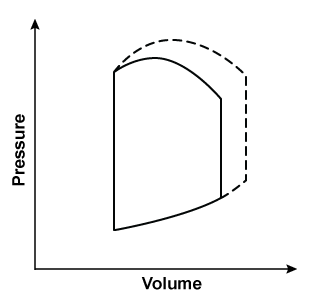 Which of the following is most likely responsible for this patient's hemodynamic change?
 (Multiple Choice)
4.8/5 (77)
(77) A clinical trial of a novel drug X is being conducted. Animal studies have shown that the drug is eliminated primarily by the kidneys. A healthy volunteer of body weight 60 kg (132.3 lb) is recruited, and his glomerular filtration rate is 100 mL/min. In this volunteer, plasma concentration of the drug, immediately after intravenous administration, is 0.5 mg/mL. Urinary excretion rate of the drug is found to be 75 mg/min. When another medication, drug Y, is coadministered, urinary excretion rate of the drug X is 50 mg/min. Which of the following effects of drug Y on the pharmacokinetics of drug X best explains the findings in this study?
(Multiple Choice)
4.8/5 (91)
(91) A prospective observational study is performed to determine factors affecting bone mass and fracture risk. Detailed demographic and clinical information is obtained from a large number of volunteers, and bone mass is monitored over time. The data obtained from 2 specific groups of women are shown below. 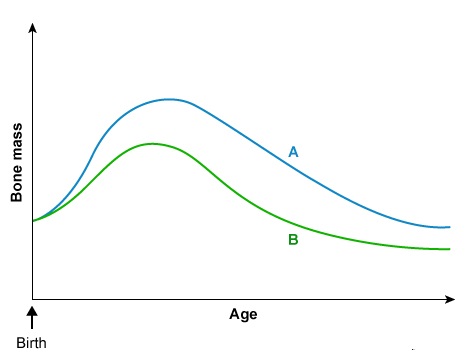 Which of the following factors is most likely present in group A?
 (Multiple Choice)
4.9/5 (86)
(86) Researchers studying the pathophysiology of diabetes mellitus identify a family with an inherited mutation in the insulin gene. The mutation results in a single amino acid substitution in the proinsulin molecule. However, affected family members are asymptomatic, and most have completely normal blood glucose levels. Analysis of the mature insulin molecule shows that it is identical to normal human insulin. The researchers conclude that the amino acid substitution affects a segment of proinsulin removed during post-translational processing of the protein. The polypeptide segment containing the mutation is most likely to undergo which of the following processes within pancreatic beta cells?
(Multiple Choice)
4.8/5 (77)
(77) A 43-year-old man is being evaluated for occasional retrosternal chest pressure that develops with moderate exertion and sometimes occurs when resting. He does not use alcohol, tobacco, or illicit drugs. The patient has an extensive family history of coronary artery disease. His temperature is 36.7 C (98 F), blood pressure is 124/72 mm Hg, pulse is 81/min, and respirations are 14/min. Physical examination shows no abnormalities. Coronary angiography shows mild luminal irregularities but no significant obstructive lesions. Acetylcholine infusion during the procedure results in dilation of epicardial coronary vessels. A reaction involving which of the following amino acids is most likely responsible for the observed dilation?
(Multiple Choice)
4.8/5 (85)
(85) Membrane potential changes in an isolated cardiac muscle cell are recorded along with ion movements across the cell membrane (see graph below). 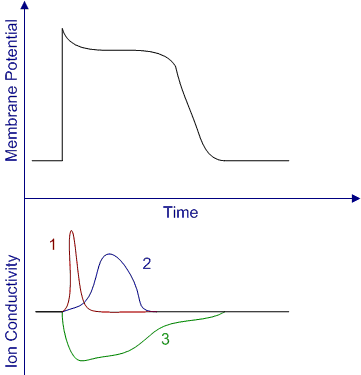 Which of the following ion sequences corresponds to regions 1-2-3 on the graph, respectively?
 (Multiple Choice)
4.8/5 (85)
(85) A 1-week-old newborn is seen for abnormal thyroid function tests that were performed as part of routine screening. Serum thyroxine (T4) was low and serum TSH was normal. The patient was born by spontaneous vaginal delivery at 40 weeks of gestation to a 28-year-old primigravida. During the pregnancy, the mother took acetaminophen intermittently for low back pain. Examination of the newborn shows no abnormal findings. Repeat thyroid function test results are as follows: 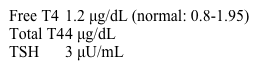 Which of the following is the most likely cause of the patient's abnormal thyroid function tests?
 (Multiple Choice)
4.9/5 (76)
(76) A 50-year-old man comes to the emergency department due to intermittent palpitations over the last 6 months. The patient describes them as "very uncomfortable" and says the episodes occur randomly, last for several hours, and resolve spontaneously or with sleep. The current episode started an hour ago and has been accompanied by lightheadedness. He has no medical history and says that he does not like seeing doctors. He is a lifetime nonsmoker. The patient drinks beer on weekends. He has no family history of cardiovascular disease. Temperature is normal and blood pressure is 122/75 mm Hg. BMI is 30 kg/m2. Chest examination reveals no murmurs and the lungs are clear on auscultation. There is trace peripheral edema. Cardiac rhythm strip obtained in the emergency department is shown in the exhibit.
 Aberrant electrical activity in which of the following anatomic structures is the most likely trigger for this patient's current condition?
 (Multiple Choice)
4.8/5 (80)
(80) A 45-year-old woman participates in a cardiovascular health study. She undergoes continuous 24-hour ECG monitoring with a wearable device. A few instances of the following pattern were found on her ECG: 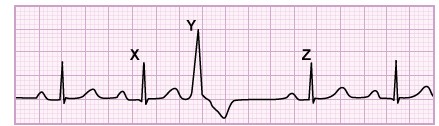 Which of the following best represents the relative left ventricular end-diastolic volumes just prior to the heart beats represented by the letters?
 (Multiple Choice)
4.9/5 (77)
(77) A 24-year-old healthy college student enrolls into a research study investigating the factors affecting blood oxygen content. The study is performed at sea level, on room air with no additional oxygen. A technique is devised to measure the accurate partial pressure of oxygen in the blood as it flows through the circulation. Blood samples are obtained from the vena cavae, alveolar capillaries, and the aorta. All data are plotted, and the curve obtained is shown in the graph below. 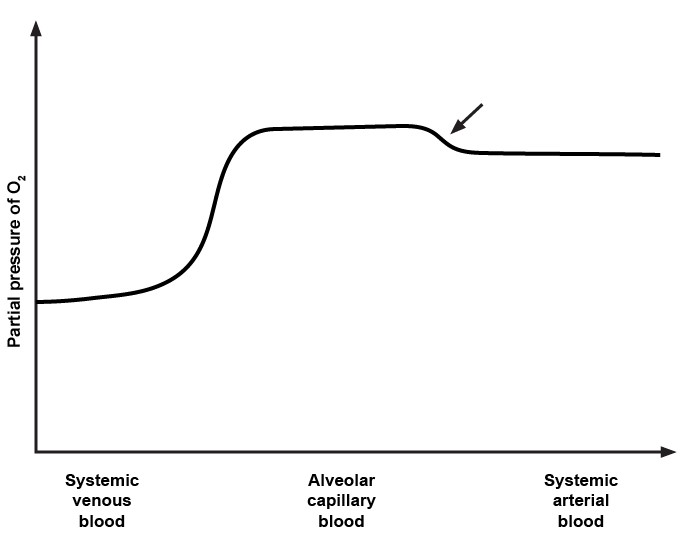 Which of the following factors most likely explains the change in partial pressure indicated by the arrow?
 (Multiple Choice)
4.8/5 (85)
(85) Researchers are studying the structure and function of hemoglobin. Arterial and venous blood samples are obtained from enrolled volunteers with no health problems. Red blood cells are isolated from whole blood by differential centrifugation, and the contents of the intact red blood cells are analyzed. It is found that the concentration of chloride is much lower in the red blood cells in the arterial sample compared to the venous sample. The activity of which of the following enzymes is most likely responsible for the observed finding?
(Multiple Choice)
4.9/5 (97)
(97) A 45-year-old man is evaluated for a progressively enlarging neck mass and hoarseness. Physical examination shows an enlarged and nontender left thyroid lobe. Fine-needle aspiration biopsy is positive for papillary thyroid cancer, and a thyroidectomy is subsequently performed. On the second postoperative day, the patient develops tingling around the mouth and muscle cramps in his lower extremities. Blood pressure is 120/80 mm Hg, pulse is 82/min, and respirations are 14/min. Physical examination shows normal muscle strength and deep tendon reflexes. Light tapping anterior to the ear elicits twitching of the lower facial muscles. An increase in which of the following best explains this patient's current symptoms?
(Multiple Choice)
4.7/5 (83)
(83) A 32-year-old woman comes to the office due to 6 months of persistent diarrhea. She has had 8-10 episodes a day of tea-colored, odorless, watery stools. The symptoms have persisted despite a lactose-free diet and a fasting trial. The patient has had no abdominal pain, fever, or vomiting. Temperature is 36.7 C (98 F). Abdominal examination is unremarkable. Sampling of her gastric contents shows a total lack of gastric acid secretion. Somatostatin treatment promptly relieves the symptoms. An excess of which of the following hormones is most likely responsible for this patient's symptoms?
(Multiple Choice)
4.8/5 (78)
(78) A 36-year-old man with type 1 diabetes mellitus comes to the office due to recurrent hypoglycemic episodes. He previously had difficulty controlling his high blood glucose levels, but over the past several weeks his blood glucose has intermittently dropped to <50 mg/dL with accompanying symptoms of tremulousness and headache. There have been no recent changes in his diet, activity level, insulin dosage, or other medical therapy. The patient's other medical conditions include chronic kidney disease from diabetic nephropathy. His estimated glomerular filtration rate has declined to 20 mL/min in recent months, and he is under consideration for initiation of hemodialysis. Physical examination findings are unchanged from the previous office visit 3 months ago. Which of the following is most likely contributing to this patient's current glycemic disturbances?
(Multiple Choice)
4.8/5 (74)
(74) Researchers are observing how coronary blood flow changes in response to progressive increases in the mean arterial blood pressure (see graph below). 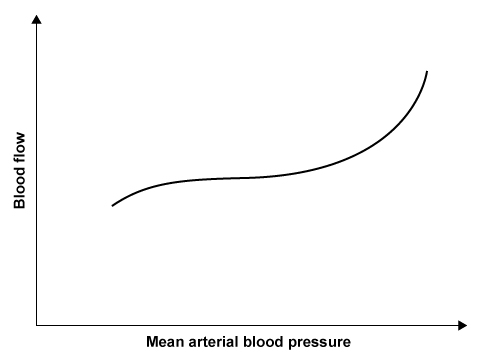 The mostly horizontal portion of the slope indicates a region where coronary blood flow is relatively insensitive to blood pressure changes. Within this zone of autoregulation, the metabolic demands of the myocardium are the main determinant of coronary blood flow. Which of the following endogenous factors is most responsible for controlling coronary blood flow within this range?
 (Multiple Choice)
4.9/5 (84)
(84) A neonate is found to have increased TSH and low thyroxine (T4) on routine screening. He was born by vaginal delivery to a 32-year-old woman at 39 weeks gestation. Apgar scores were 8 and 9 at 1 and 5 minutes, respectively. Physical examination reveals an enlarged thyroid gland in the normal position. Neck ultrasound confirms thyroid enlargement. Which of the following is the most likely cause of this patient's findings?
(Multiple Choice)
4.9/5 (80)
(80) 
Filters
- Essay(0)
- Multiple Choice(0)
- Short Answer(0)
- True False(0)
- Matching(0)