



 Chat with AI
Exam 13: Physiology

Exam 1: Anatomy291 Questions
Exam 2: Behavioral science240 Questions
Exam 3: Biochemistry156 Questions
Exam 4: Biostatistics117 Questions
Exam 5: Embryology52 Questions
Exam 6: Genetics103 Questions
Exam 7: Histology24 Questions
Exam 8: Immunology129 Questions
Exam 9: Microbiology336 Questions
Exam 10: Pathology816 Questions
Exam 11: Pathophysiology464 Questions
Exam 12: Pharmacology538 Questions
Exam 13: Physiology272 Questions
Select questions type


An 8-month-old previously healthy infant is brought to the urgent care clinic due to vomiting and watery diarrhea for the past 3 days. He attends a day care where recently several other children had similar symptoms. His mother states that the infant is less active and has no interest in feeding. Physical examination shows a listless infant with tachycardia, dry mucous membranes, and decreased skin turgor. The abdomen is nontender with hyperactive bowel sounds. Compared to pre-illness levels, which of the following sets of laboratory findings are most likely present in this patient?
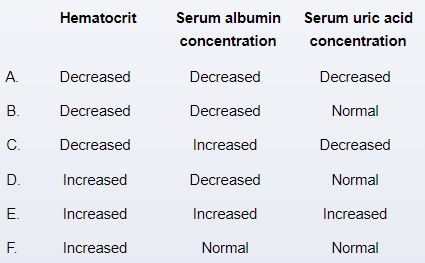
(Multiple Choice)
4.9/5  (83)
(83) A 17-year-old boy is brought to the emergency department after passing out. The patient was standing behind the dugout watching his friends play baseball when he suddenly felt warm and light-headed. Then he remembers awakening on the ground. Bystanders reported that the patient was unresponsive for approximately 2 minutes. He feels fatigued but does not have chest pain or shortness of breath. The patient has no significant medical history and does not use alcohol or drugs. Temperature is 36.7 C (98.1 F), supine blood pressure is 105/60 mm Hg and standing blood pressure is 110/65 mm Hg, pulse is 84/min, and respirations are 16/min. Pulse oximetry is 100% on room air. The patient is awake and alert. Pupils are equal and reactive. Heart and lung examinations are normal. The abdomen is soft and nontender. Neurologic examination is normal. ECG is unremarkable. Which of the following is the most likely cause of this patient's syncope?
(Multiple Choice)
4.7/5 (87)
(87) A 34-year-old missionary in southern Asia is traveling to a remote village and becomes stranded when his bus breaks down. He has no access to water for 36 hours, during which his urine osmolality reaches 1100 mOsm/L. Urine concentration depends primarily on the serum level of vasopressin, which is regulated by the neurohypophysis in response to plasma osmolality and blood volume. Which of the following nephron segments responds to vasopressin by increasing absorption of a specific solute that is important for generating a high medullary concentration gradient?
(Multiple Choice)
4.8/5 (79)
(79) A 19-year-old man comes to the office due to frequent episodes of disorientation, palpitations, tremulousness, and excessive sweating over the past 3 months. He says the symptoms resolve quickly after drinking some juice or a carbonated beverage. The patient was diagnosed with type 1 diabetes mellitus at age 12 and takes short- and long-acting insulin. He has had no dose changes in the past 2 years or diabetic complications and follows up with an ophthalmologist frequently. The patient is a college student and reports some stress due to an upcoming midterm examination. He does not use tobacco, alcohol, or illicit drugs. Vital signs and physical examination are within normal limits. Laboratory results show a hemoglobin A1c of 6.8% and no proteinuria. Which of the following factors most likely precipitated this patient's current symptoms?
(Multiple Choice)
4.8/5 (89)
(89) A 65-year-old man reports multiple episodes of lightheadedness while buttoning a tight shirt collar. During 2 episodes, he passed out briefly but sustained no injuries. His blood pressure was 70/40 mm Hg and pulse was 45/min during one of the episodes. Past medical history is significant for hypertension and diet-controlled diabetes mellitus. The patient is a lifetime nonsmoker and drinks alcohol on social occasions. On physical examination, his blood pressure is 125/72 mm Hg and pulse is 76/min without orthostatic changes. Stimulation of afferent sensory fibers in which of the following nerves is most likely responsible for this patient's symptoms?
(Multiple Choice)
4.8/5 (78)
(78) A 26-year-old woman comes to the clinic due to worsening generalized weakness, myalgias, and unintentional weight loss. She has primary hypothyroidism for which she takes levothyroxine. Blood pressure is 110/70 mm Hg supine and 90/60 mm Hg standing. She appears mildly emaciated. Cardiopulmonary examination reveals no abnormalities. Laboratory studies show mild normochromic, normocytic anemia; eosinophil count of 15%; and serum glucose of 65 mg/dL. Which of the following additional changes is most likely in this patient?
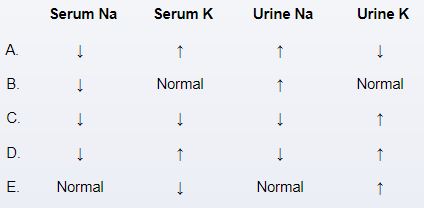
(Multiple Choice)
4.9/5 (82)
(82) A 67-year-old man comes to the office with right tibial pain that started 3 months ago and has increased in intensity over time. He also has had progressive hearing impairment for the last year. Physical examination reveals local tenderness and a lumpy protuberance over the right tibia. After extensive evaluation, the patient undergoes a bone biopsy. The pathologist identifies numerous multinucleated cells, some containing over 100 nuclei. Which of the following factors is essential for the differentiation of the cells described by the pathologist?
(Multiple Choice)
4.7/5 (81)
(81) A 54-year-old woman comes to the clinic due to difficulty hearing for the past few weeks. During the neurologic examination, the physician assesses her hearing using a vibrating tuning fork. The handle of the tuning fork is placed on her left mastoid process until the sound is no longer audible. The tines are then quickly placed near the patient's left auditory meatus, and she reports hearing no sound. When the handle of the vibrating fork is placed on the middle of her forehead, she hears the vibration more strongly in her left ear than her right. This patient is most likely experiencing which of the following types of hearing loss?
(Multiple Choice)
4.8/5 (88)
(88) A 46-year-old woman comes to the office for follow-up. Six months ago, the patient underwent total thyroidectomy followed by radioactive iodine ablation for invasive follicular thyroid cancer with distant metastasis. After surgery, she was prescribed levothyroxine to prevent thyroid cancer regrowth. Over the past 4 months, the patient has had a 4.5-kg (10 lb) unintentional weight loss despite having a normal appetite. She also feels unusually hot and sweaty. Temperature is 37 C (98.6 F), blood pressure is 150/70 mm Hg, pulse is 110/min, and respirations are 17/min. Examination reveals a fine hand tremor and sweaty palms. Serum thyroid function testing would most likely reveal which of the following?
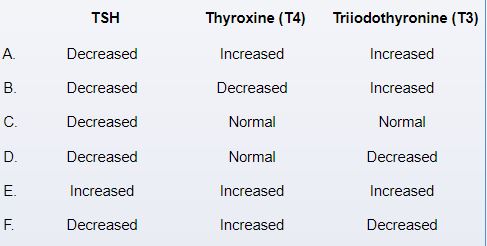
(Multiple Choice)
4.8/5 (97)
(97) A 43-year-old woman comes to the emergency department due to nausea and vomiting with left-sided chest pain. She states that the pain began 30 minutes ago while playing with her children. She has a history of dyslipidemia and hypertension. The patient's mother died from a myocardial infarction at age 51. Physical examination reveals mild tenderness to palpation over the left chest. An ECG and cardiac biomarkers are normal. She is scheduled for an exercise stress test. During the test, which of the following parameters is likely to be the most similar between the systemic and pulmonary circulation?
(Multiple Choice)
4.8/5 (78)
(78) A 3-month-old boy is evaluated for large-volume diarrhea and failure to thrive. The patient was born via spontaneous vaginal delivery at 38 weeks gestation. His mother reports that the pregnancy was uncomplicated and there is no family history of gastrointestinal disease. Physical examination shows mild abdominal distension, muscle wasting, and pitting edema. Histochemical evaluation reveals absence of enteropeptidase activity in the proximal intestinal villi. Activity of which of the following substances is most likely impaired in this patient?
(Multiple Choice)
4.8/5 (78)
(78) A 33-year-old man comes to the office due to fatigue and decreased exercise tolerance over the past 6 months. The patient was diagnosed with infective endocarditis in the setting of intravenous drug use a year ago and completed a course of antibiotic therapy. He has not used drugs since then. The patient has no other medical problems and takes no medications. A cardiac murmur is heard on auscultation. Both carotid arteries demonstrate a rapid rise and fall of the arterial pulse. Partial compression of the femoral arteries by the stethoscope elicits a systolic-diastolic bruit. Which of the following sets of pressure findings is most likely to be observed during cardiac catheterization of this patient?
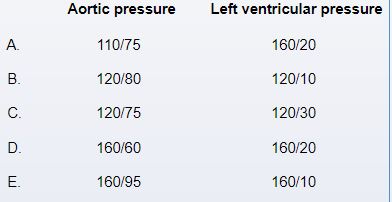
(Multiple Choice)
5.0/5 (67)
(67) An 80-year-old man has been participating in a longitudinal study of aging. He has no major medical conditions. Arterial blood gas samples are obtained every decade, on room air at sea level, to monitor long-term changes in pulmonary gas exchange. Compared to 30 years ago, which of the following results is most consistent with normal aging?
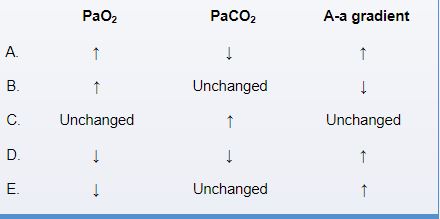
(Multiple Choice)
4.9/5 (78)
(78) A 64-year-old man is evaluated for worsening dyspnea on exertion. He has a 40-pack-year smoking history. The lungs are hyperresonant on percussion and there is diffuse wheezing on auscultation. Chest x-ray reveals a flattened diaphragm with a narrow mediastinum, and there are decreased bronchovascular markings in the peripheral lung region. Which of the following lung volume patterns is most likely to be present in this patient? (Each bar represents total lung capacity with different volumes as marked.) 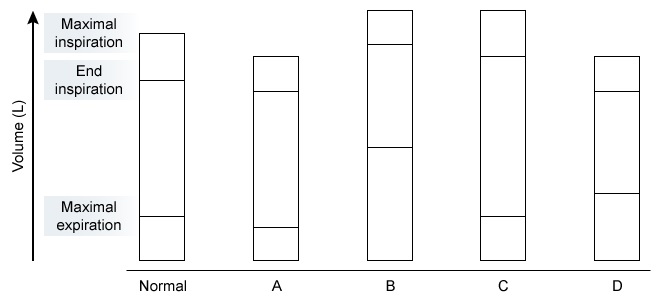
(Multiple Choice)
4.8/5 (78)
(78) A 46-year-old man comes to the office for an annual examination. He has an uncomfortable heartbeat sensation at night that he tries to decrease by sleeping on his right side. The patient has had mild shortness of breath with exertion over the last 6 months, but he has no chest pain. He was told during a wellness check approximately 2 years ago that he had a heart murmur. The patient has no other medical problems. Physical examination reveals bounding femoral pulses and carotid pulsations that are accompanied by head bobbing. Which of the following is the most likely diagnosis?
(Multiple Choice)
4.9/5 (86)
(86) A 32-year-old woman comes to the office due to a persistent sensation of warmth. For the last 6 months she has felt unusually warm compared to others in the room. The patient has no medical problems and takes no medications or supplements. She does not use tobacco, alcohol, or illicit drugs. Family history is significant for hypothyroidism in her mother. Temperature is 36.7 C (98 F), blood pressure is 130/60 mm Hg, and pulse is 104/min. BMI is 20 kg/m2. On physical examination, the patient appears anxious and has a staring gaze. There is exophthalmos, lid lag, and a diffusely enlarged thyroid with an audible thyroid bruit. The patient has a fine tremor on outstretched arms, and the skin is warm and moist. Antibodies directed against which of the following are most likely to be found in this patient?
(Multiple Choice)
4.9/5 (81)
(81) A 50-year-old man is seen in the office for new-onset constipation. Family history is unremarkable. Vital signs are within normal limits. Physical examination reveals normal findings. Serum laboratory results are as follows: 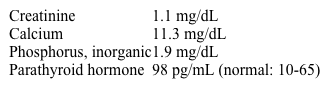 Which of the following is the most likely mechanism causing this patient's low serum phosphate?
 (Multiple Choice)
4.8/5 (80)
(80) Electrophysiologists conduct a study in which they record the membrane potential changes of cardiac cells while exposing them to various agents. A tracing from one of the experiments is shown below. 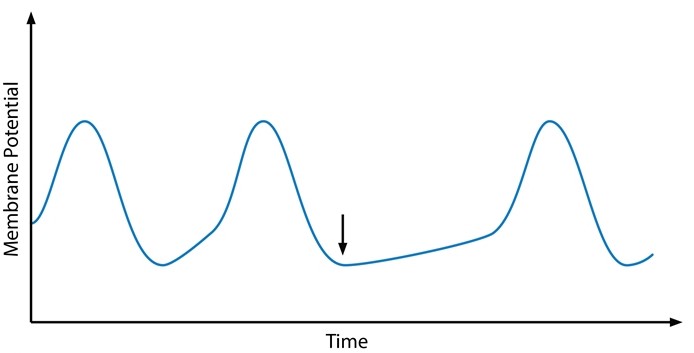 Which of the following substances was most likely applied to the cells at the point indicated by the arrow?
 (Multiple Choice)
4.8/5 (72)
(72) Researchers find that repeated stimulation of hippocampal neurons involved in memory and learning leads to potentiation of synaptic transmission. Patch-clamp recordings of stimulated neurons are shown below (dotted line: baseline; solid line: after repeated stimulation [potentiated]). 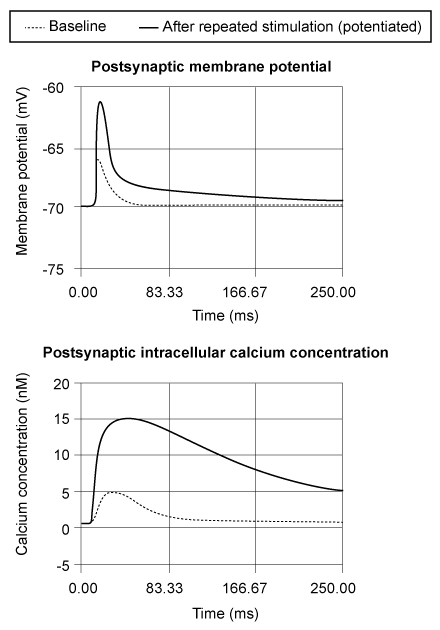 Which of the following neurotransmitter receptors on the postsynaptic membrane is most likely involved in this process?
 (Multiple Choice)
4.8/5 (84)
(84) A 32-year-old woman comes to the office for bloating, intermittent diarrhea, and abdominal cramps. Her symptoms have been ongoing for many years and are usually triggered by meals. Medical history and family history are both unremarkable. Vital signs are within normal limits. BMI is 27 kg/m2. The patient is well-appearing, and the abdomen is soft and nontender. Laboratory analysis is unremarkable. The patient is diagnosed with irritable bowel syndrome, and it is recommended that she take loperamide and consume an adequate amount of dietary fiber. After reading about her disorder on the internet, the patient decides to manage her symptoms with a strict vegan diet. Which of the following should be provided as a nutritional supplement for this patient?
(Multiple Choice)
4.7/5 (84)
(84) 
Filters
- Essay(0)
- Multiple Choice(0)
- Short Answer(0)
- True False(0)
- Matching(0)