



 Chat with AI
Exam 13: Physiology

Exam 1: Anatomy291 Questions
Exam 2: Behavioral science240 Questions
Exam 3: Biochemistry156 Questions
Exam 4: Biostatistics117 Questions
Exam 5: Embryology52 Questions
Exam 6: Genetics103 Questions
Exam 7: Histology24 Questions
Exam 8: Immunology129 Questions
Exam 9: Microbiology336 Questions
Exam 10: Pathology816 Questions
Exam 11: Pathophysiology464 Questions
Exam 12: Pharmacology538 Questions
Exam 13: Physiology272 Questions
Select questions type


A newborn boy is found to have markedly elevated serum TSH and low thyroxine on routine screening. Laboratory findings using a venous blood sample confirm the diagnosis. The patient was born at 39 weeks gestation to a 34-year-old healthy woman, who had been taking prenatal vitamins regularly. He has no symptoms or abnormal findings on clinical examination. Imaging studies reveal an ectopic thyroid gland just below the tongue. Which of the following is the most likely cause of this patient's otherwise normal physical examination despite abnormal thyroid laboratory findings?
(Multiple Choice)
4.9/5  (71)
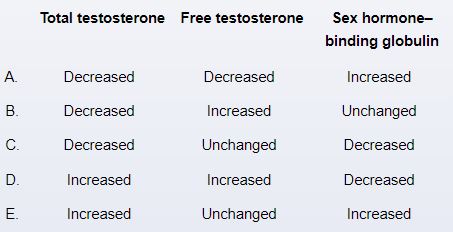
(71) A 66-year-old man comes to the office to discuss his sexual health. He thinks that he has symptoms of low testosterone, similar to those described in an article he recently read in a health magazine. The patient has normal sexual desire but reduced spontaneous erections and reduced semen volume with ejaculation. He requires more stimulation to achieve a satisfactory erection and has a longer sexual refractory period than before. The patient has no known medical conditions and takes no medications. He does not use tobacco, alcohol, or illicit drugs. Vital signs are normal. BMI is 24.5 kg/m2. Physical examination, including examination of the testes, is normal. After laboratory testing is completed, the physician finds no evidence of organic disease and concludes that the results are consistent with normal aging. Compared to a healthy young man, which of the following sets of test results would be most consistent with the physician's conclusion?
(Multiple Choice)
4.8/5 (98)
(98) On physical examination, jugular venous pressure is elevated, breath sounds are decreased at the right lung base with dullness to percussion, and 2+ bilateral lower extremity pitting edema is present. Chest x-ray shows cephalization of the blood vessels, Kerley B lines, and a right pleural effusion. Thoracentesis is performed for pleural fluid analysis. In comparison to plasma fluid, which of the following pleural fluid findings is most likely to be observed?
(Multiple Choice)
4.8/5 (78)
(78) A muscle biopsy obtained from a healthy volunteer consists mainly of myoglobin-rich, glycogen-poor fibers with many mitochondria. Which of the following is the most likely biopsy site?
(Multiple Choice)
4.8/5 (72)
(72) An individual with a point mutation affecting the gene responsible for neurophysin synthesis is most likely to suffer from:
(Multiple Choice)
4.8/5 (82)
(82) A 23-year-old man comes to the emergency department with sudden onset of heart palpitations that started while he was at his desk at work. The patient has no known medical problems and does not use tobacco or illicit drugs. He drinks alcohol occasionally on the weekends. Initial blood pressure is 110/70 mm Hg and pulse is 160/min and regular. Gentle neck massage just below the angle of the right mandible provides immediate improvement of his condition. His blood pressure is now 120/80 mm Hg and pulse is 75/min. Which of the following mechanisms is responsible for improvement of this patient's condition?
(Multiple Choice)
4.9/5 (69)
(69) A researcher is conducting an experiment to determine factors affecting vascular resistance. Experiment animals are anesthetized, intubated, and attached to a controlled ventilation system. A catheter is placed into a small artery in various organs in each animal. The catheter is connected to a manometer for recording pressure and to an oximeter for continuous recording of oxygen saturation. The fraction of inspired oxygen is gradually changed, and arteriolar resistance is calculated from the manometer readings at regular intervals. The results shown below were most likely obtained from which of the following organs? 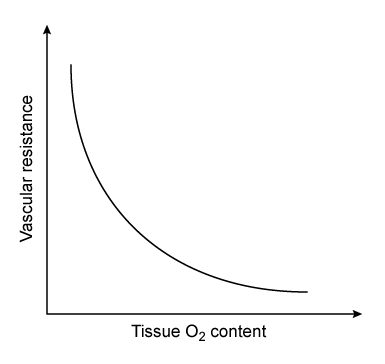
(Multiple Choice)
4.9/5 (70)
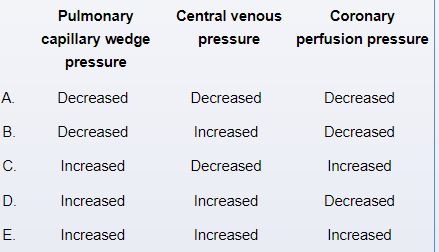
(70) A 55-year-old man is immediately brought to the hospital after experiencing a sudden collapse at home 20 minutes ago. The patient reported chest pain and then collapsed to the floor while trying to sit down. Medical history is significant for type 2 diabetes mellitus and hypertension. Temperature is 36.7 C (98.1 F), blood pressure is 80/50 mm Hg, pulse is 120/min, and respirations are 22/min. On examination, the patient is in marked respiratory distress. Bilateral crackles are present. An S3 is audible. ECG reveals ST-segment elevation in leads V2 through V6. Which of the following hemodynamic changes are most likely present in this patient?
(Multiple Choice)
4.9/5 (81)
(81) A 34-year-old woman who recently emigrated from Russia comes to the physician due to weakness, exertional dyspnea, and orthopnea. On cardiac auscultation, a snap followed by a rumbling diastolic murmur is heard over the cardiac apex. The snap most likely occurs nearest to which of the following points on the cardiac pressure-volume loop? 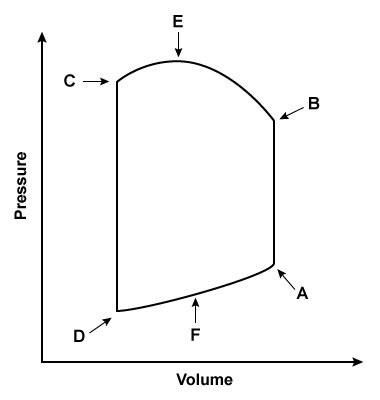
(Multiple Choice)
4.8/5 (78)
(78) A 24-year-old woman, gravida 1 para 0, at 28 weeks gestation comes to the office for a routine prenatal visit. She feels well and has had no vaginal bleeding, contractions, or leakage of fluid. Fetal movement is normal. The patient has no chronic medical conditions and her pregnancy has been uncomplicated. She previously had heavy menstrual periods that were managed with oral contraceptives. Blood pressure is 126/84 mm Hg and pulse is 78/min. Fundal height and fetal heart tones are normal. Today's third-trimester complete blood count is as follows: 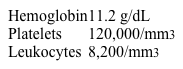 Coagulation studies and peripheral smear are within normal limits. The patient's first-trimester platelet count was 160,000/mm3. Urine dipstick today is negative for protein. Which of the following is the most likely cause of this patient's thrombocytopenia?
 (Multiple Choice)
4.9/5 (80)
(80) In an experiment, 3 L of isotonic saline are infused intravenously into a healthy volunteer after multiple baseline physiologic parameters are recorded. Serial blood pressure measurements show an increase in the systolic and diastolic blood pressure. Ultrasonography reveals an increase in the left ventricular volume and engorgement of the inferior vena cava. Blood levels of a peptide hormone have also increased compared to baseline. This hormone is most likely to increase which of the following in this test subject?
(Multiple Choice)
4.9/5 (92)
(92) A 4-year-old boy is brought to the hospital after several episodes of vomiting. The boy's mother reports that he was playing at a local park prior to the onset of illness. While cleaning him after the first episode of emesis, she found several small brown mushrooms clenched in his hands and brought samples with her. The boy is otherwise healthy and takes no medications. He is intubated due to somnolence and admitted to the intensive care unit. Analysis of the mushroom samples determines that the main poison stimulates muscarinic receptors. Which of the following is the most direct effect of this poison?
(Multiple Choice)
4.9/5 (78)
(78) A 66-year-old man with hypertension and stage IV chronic kidney disease comes to the office for follow-up. The patient has had worsened fatigue and low energy over the past several months but no chest pain or shortness of breath. He was previously nonadherent with antihypertensive therapy but has been following treatment recommendations since renal dysfunction was diagnosed 2 years ago. Blood pressure is 126/78 mm Hg and pulse is 68/min. Cardiac auscultation reveals an S4 sound. The rest of the physical examination is unremarkable. Laboratory results show normocytic, normochromic anemia with a low reticulocyte count. Serum iron studies are within normal limits. Treatment with a recombinant glycoprotein hormone is begun, and repeat laboratory testing several weeks later shows an improvement in hemoglobin level. The effects of the hormone prescribed for this patient are most likely mediated by which of the following pathways?
(Multiple Choice)
4.9/5 (75)
(75) A 70-year-old man comes to the office due to palpitations. He has felt an irregular and fast heartbeat on multiple occasions over the last month. The patient has not had chest pain, dyspnea, dizziness, or weakness. His medical history includes hypertension and type 2 diabetes mellitus. Temperature is 36.7 C (98.1 F), pulse is 102/min and irregular, blood pressure is 140/82 mm Hg, and respirations are 16/min. Cardiopulmonary auscultation reveals clear lungs and no heart murmurs. ECG shows an irregularly irregular rhythm with absent P waves. The patient is started on metoprolol and apixaban. Which of the following is likely to be directly affected as the result of this therapy?
(Multiple Choice)
4.7/5 (89)
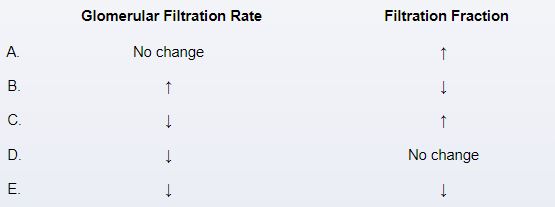
(89) An experimental substance is infused intravenously at a constant rate into a healthy volunteer. The substance is known to selectively constrict the efferent arteriole in renal glomeruli. The rate of infusion is closely controlled during the experiment to allow for only mild constriction of the efferent arteriole. Which of the following changes in glomerular filtration rate (GFR) and filtration fraction (FF) is most likely to occur during the infusion of this substance?
(Multiple Choice)
4.8/5 (80)
(80) Physiologists conducting research on the electrical properties of the heart measure action potential conduction velocity at 4 different points within normal cardiac tissue. The results, expressed in terms of speed of conduction (meters per second), are as follows:Point 1 - 0.05 m/sec
Point 2 - 0.3 m/sec
Point 3 - 1.1 m/sec
Point 4 - 2.2 m/secFrom the following list of locations, which most likely corresponds to the order of points 1-2-3-4 (AV = atrioventricular)?
(Multiple Choice)
4.7/5 (88)
(88) A 48-year-old woman is evaluated for postcoital bleeding and vaginal discharge. Pelvic examination shows a friable mass at the cervix that bleeds easily on touch. Cervical biopsy confirms invasive squamous cell cancer confined to the cervix and uterus. Lymph node metastases are not seen. A radical hysterectomy is performed during which the right ureter is accidentally injured but then repaired. Imaging studies performed after the surgery show a partial obstruction of the right ureter with mild dilation of the proximal collecting system. Which of the following changes are most likely to be seen in the right kidney?
(Multiple Choice)
4.9/5 (82)
(82) Many drugs and toxins act by inhibiting substance flow across cell membranes. Which of the following inhibits primary active transport?
(Multiple Choice)
4.7/5 (78)
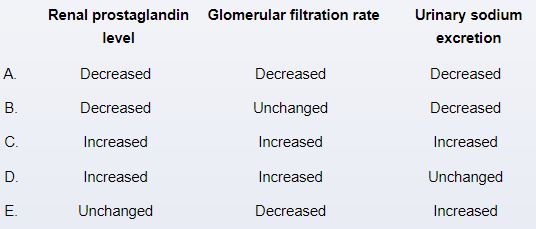
(78) A 43-year-old man comes to the office due to swelling of the legs and abdomen. The patient has a history of alcohol-induced cirrhosis, and his ascites had been well controlled with furosemide. Over the past week, he has had increasing bilateral lower extremity and abdominal swelling despite taking a diuretic as prescribed. The patient reports no change in dietary sodium or water intake but states he has been taking over-the-counter ibuprofen after injuring his back recently. He stopped drinking alcohol 2 years ago and does not use tobacco or illicit drugs. Physical examination shows 3+ bilateral lower extremity edema and moderate ascites. Which of the following changes most likely contributed to the acute deterioration in this patient's condition?
(Multiple Choice)
4.8/5 (86)
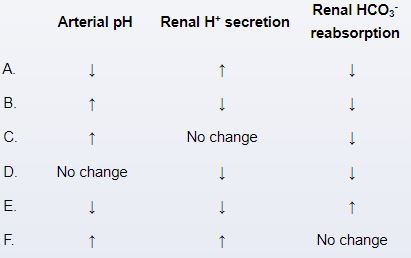
(86) A 24-year-old man who lives at an elevation near sea-level goes hiking in the Colorado mountains and ascends to an altitude of 4,000 m (13,123 ft). He stays on the mountain overnight and develops diffuse headache, nausea, and difficulty sleeping. The patient also notes mild fatigue and slight dizziness with changes in position. He has no medical conditions and currently takes no medications. He does not use alcohol, tobacco, or illicit drugs. Physical examination is within normal limits. Which of the following changes in this patient's acid-base physiology is most likely to be seen?
(Multiple Choice)
4.9/5 (68)
(68) 
Filters
- Essay(0)
- Multiple Choice(0)
- Short Answer(0)
- True False(0)
- Matching(0)