



 Chat with AI
Exam 13: Physiology

Exam 1: Anatomy291 Questions
Exam 2: Behavioral science240 Questions
Exam 3: Biochemistry156 Questions
Exam 4: Biostatistics117 Questions
Exam 5: Embryology52 Questions
Exam 6: Genetics103 Questions
Exam 7: Histology24 Questions
Exam 8: Immunology129 Questions
Exam 9: Microbiology336 Questions
Exam 10: Pathology816 Questions
Exam 11: Pathophysiology464 Questions
Exam 12: Pharmacology538 Questions
Exam 13: Physiology272 Questions
Select questions type


A 20-year-old woman is brought to the emergency department by her boyfriend after being found unresponsive in her apartment. She has a medical history of major depression and generalized anxiety disorder. There is no evidence of trauma. On examination, the patient is obtunded and responds only to painful stimuli. There are no indications of recent vomiting. Lungs are clear to auscultation. Toxicology screen is positive for benzodiazepines. Which of the following sets of arterial blood gas findings (in mm Hg) are most likely present in this patient?
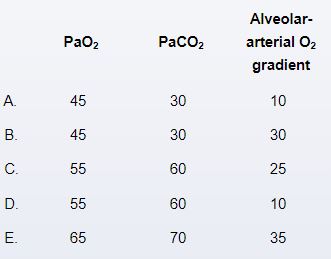
(Multiple Choice)
4.8/5  (89)
(89) A 6-year-old boy playing in a dusty field in windy weather inhales many small particles that become lodged in his terminal bronchioles. Which of the following respiratory components is most important in clearing these particles?
(Multiple Choice)
4.9/5 (88)
(88) A 17-year-old boy is referred to a clinic for ongoing muscle weakness. He has noticed difficulty climbing stairs at home over the last several months, and he recently stopped playing basketball due to difficulty lifting the ball over his head. The patient takes no medications and does not know of any family members with muscle weakness. On neurologic examination, he is unable to lift his arms or legs against resistance when fully outstretched. He undergoes a muscle biopsy to evaluate the cause of his proximal muscle weakness. Electron microscopy of the specimen reveals sparse transverse tubules in some of the muscle fibers. Which of the following is the most likely consequence of this patient's biopsy findings?
(Multiple Choice)
4.9/5 (81)
(81) A 56-year-old woman with polycystic kidney disease comes to the office for follow up. Her renal function has been gradually declining, and she is being considered for hemodialysis in the near future. The patient has recently experienced increasing exertional dyspnea and fatigue but has had no fever, dysuria, or flank pain. Other medical conditions include hypertension and renal calculi. Blood pressure is 130/86 mm Hg and pulse is 80/min. Physical examination shows mucosal pallor. The lungs are clear on auscultation and heart sounds are normal. Abdominal examination reveals palpably enlarged kidneys. There is no lower extremity edema. Laboratory results show normocytic, normochromic anemia, which is attributed to insufficient hormone production by the kidneys. This hormone is predominantly secreted by which of the following parts of the kidney?
(Multiple Choice)
4.8/5 (81)
(81) A 28-year-old woman, gravida 1 para 0, at 16 weeks gestation comes to the office for a prenatal visit. The patient feels well and has no concerns. Medical history is significant for recurrent urinary tract infections. Her only medication is a prenatal multivitamin. Blood pressure is 116/68 mm Hg and pulse is 80/min. Physical examination shows no abnormalities and fetal heart tones are normal. Urine dipstick reveals no blood or leukocyte esterase but is positive for protein. Laboratory testing shows the following: 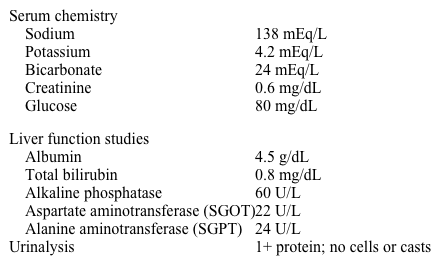 A 24-hour urinary protein excretion is 200 mg. Which of the following processes is most likely contributing to this patient's urinary findings?
 (Multiple Choice)
4.9/5 (77)
(77) In an animal experiment the levels of various endogenous compounds are measured in the spinal fluid after application of noxious stimuli. One of the compounds that increase as a result of the experiment is a pentapeptide with a strong affinity to delta- and mu-receptors. Which of the following substances is most likely to have a common molecular origin with the pentapeptide described above?
(Multiple Choice)
4.9/5 (84)
(84) A 58-year-old woman comes to the emergency department due to cramping mid-abdominal pain. Imaging shows a small bowel obstruction. Vital signs and laboratory studies, including complete blood count and comprehensive metabolic panel, are within normal limits. The patient is admitted to the hospital for nonsurgical management. Oral intake is withheld to promote bowel rest, and an isotonic saline infusion is administered for hydration. She has no vomiting or diarrhea and after 2 days the abdominal pain improves. Total administration of sodium chloride infusion was approximately 6 L. Which of the following changes have most likely occurred in this patient since the onset of her hospitalization?
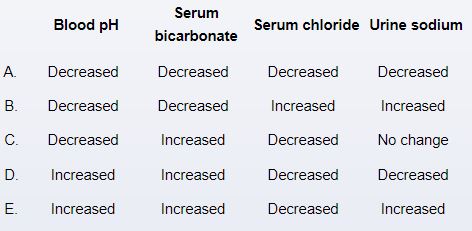
(Multiple Choice)
4.9/5 (67)
(67) Special electrodes are used to detect the change in membrane potential of a specific type of cardiac cell. These changes are recorded on the graph below. 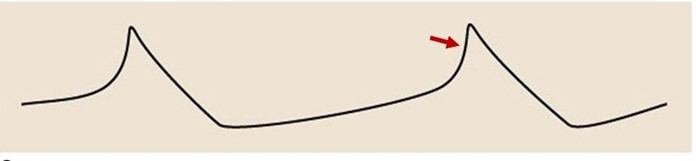 The deflection indicated by the arrow is most likely caused by movement of which of the following ions?
 (Multiple Choice)
4.8/5 (77)
(77) A multinational research institute conducting experiments on human circulatory physiology enrolls a healthy 30-year-old male volunteer to assess the oxygen consumption rate of various organs. During the study, the blood oxygen content of the aorta and several other vessels is measured at rest. The greatest difference in these measurements will most likely be between the aorta and which of the following blood vessels?
(Multiple Choice)
4.9/5 (90)
(90) A 54-year-old man comes to the office due to shortness of breath that has slowly worsened over the last 6 months. He also has a persistent, nonproductive cough. The patient does not use alcohol, tobacco, or illicit drugs. Temperature is 36.8 C (98 F), blood pressure is 132/78 mm Hg, pulse is 74/min, and respirations are 16/min. Physical examination reveals fine crackles bilaterally on pulmonary auscultation and drumstick-shaped fingers. Chest x-ray reveals diffuse reticular opacities. Pulmonary function testing shows decreased FVC, increased FEV1/FVC ratio, and expiratory flow rates that are higher than normal when corrected for lung volume. This patient's supernormal expiratory flow rates are best explained by an increase in which of the following parameters?
(Multiple Choice)
4.9/5 (82)
(82) A 50-year-old woman comes to the office concerned that her menstrual periods have stopped. She took oral contraceptive pills for the past 17 years, which she discontinued 3 months ago, and her menses have not returned. The patient had one spontaneous abortion at age 27 and otherwise has never been pregnant. She is monogamous with her husband, and they have sexual intercourse regularly. The patient has some vaginal dryness but no pain or discomfort with intercourse. BMI is 21 kg/m2 and vital signs are normal. Speculum examination shows a normal vaginal mucosa and cervix. Bimanual examination shows a normal uterus and ovaries. Urine pregnancy test is negative. Which of the following hormones is most likely elevated in this patient?
(Multiple Choice)
4.7/5 (66)
(66) The mother of a 2-year-old boy calls the office for guidance regarding his recent illness. He has passed 4-6 stools daily over the last 2 days. The feces are liquid and contain no blood or mucus. His highest temperature reading at home was 37.8 C (100 F). He is eating, drinking, and being playful as usual. The patient has no prior medical problems and is up to date with vaccinations. He recently began going to day care. The mother is advised to bring the patient to the office for further evaluation. While awaiting medical evaluation, which of the following oral fluids is most effective to prevent dehydration in this patient?
(Multiple Choice)
5.0/5 (77)
(77) A 12-day-old girl is evaluated in the neonatal intensive care unit (NICU) due to a murmur. The patient was born at 25 weeks gestation and was admitted to the NICU for respiratory support. She was born to a 21-year-old primigravida whose pregnancy was complicated by preeclampsia. Cardiac auscultation reveals a continuous murmur at the left sternal border, and bounding femoral and palmar pulses are palpable. Echocardiography confirms the diagnosis. Compared with a normal infant, this patient most likely has which of the following changes in cardiac parameters?
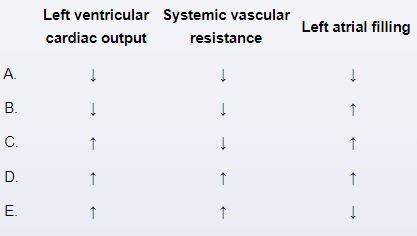
(Multiple Choice)
4.8/5 (77)
(77) Scientists investigating the specifics of kidney function in humans develop a new technique allowing them to measure the concentration of various compounds along the length of the proximal tubule. During an experiment, they record the concentrations of several endogenous substances in the fluid traversing the proximal tubule. Tubular fluid/plasma ultrafiltrate concentration ratios for the measured substances are shown in the image below: 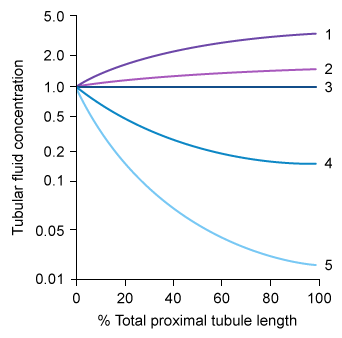 Which of the following substances are most likely to produce lines 2 and 4, respectively?
 (Multiple Choice)
4.8/5 (74)
(74) A 34-year-old woman with polycystic ovary syndrome comes to the office with her husband for treatment of infertility. The patient has been unable to conceive despite having unprotected sexual intercourse several times a week for the past 2 years. Her menses are irregular and occur every 2-3 months, consistent with chronic anovulation. She does not use tobacco, alcohol, or illicit drugs. The patient takes no medications and has no allergies. BMI is 32 kg/m2. Physical examination shows coarse hair on her chin and abdomen. The patient is initially prescribed clomiphene therapy but fails to conceive. She then receives ovulation induction therapy with a short course of menotropins followed by a single injection of human chorionic gonadotropin (hCG). The use of hCG therapy primarily mimics which of the following physiologic events?
(Multiple Choice)
4.8/5 (72)
(72) Researchers measure the serum insulin levels of healthy volunteers after equivalent loads of oral and intravenous glucose. The following curves are observed: 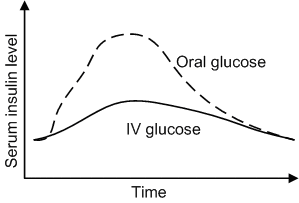 Which of the following endogenous substances best explains the difference between the curves?
 (Multiple Choice)
4.7/5 (73)
(73) A 36-year-old man comes to the office due to chronic, mild dyspnea and fatigue. The patient also says that his mind seems "foggy" all the time and he is not able to think clearly. He has no significant past medical history and does not take any medication. He lives a sedentary lifestyle and has smoked a half-pack of cigarettes a day for 5 years. Blood pressure is 140/85 mm Hg, pulse is 84/min, and respirations are 18/min. BMI is 32 kg/m2. Lung auscultation is unremarkable. Chest x-ray is normal. Arterial blood gas analysis shows partial pressure of oxygen (PaO2) is 66 mm Hg and partial pressure of carbon dioxide (PaCO2) is 58 mm Hg. His estimated alveolar to arterial oxygen gradient is 10 mm Hg. Which of the following best explains this patient's laboratory findings?
(Multiple Choice)
4.8/5 (75)
(75) A 27-year-old woman in her 2nd trimester of pregnancy comes to the office due to constipation. Her stools have become increasingly hard and pellet-like over the past few weeks; bowel movements before then were always regular. She also has mild crampy abdominal pain and bloating, both of which improve after defecation. Medical history and family history are both unremarkable. This is the patient's first pregnancy and has so far been uncomplicated. On physical examination, the abdomen appears gravid but nontender. Which of the following best explains this patient's symptoms?
(Multiple Choice)
4.8/5 (74)
(74) An 80-year-old man comes to the office for evaluation of persistent dry mouth and difficulty chewing food. He has had no dry eyes or joint pains. The patient has no chronic medical conditions and takes no medications. On examination, there is decreased saliva production but no tenderness or swelling of the salivary glands. Extensive dental caries are present. Laboratory results show negative anti-Ro/SSA and anti-La/SSB antibodies. Which of the following age-related changes is most likely responsible for this patient's symptoms?
(Multiple Choice)
4.9/5 (73)
(73) A 30-year-old woman comes to the office due to excessive weight gain without any changes in her diet or physical activity. She has also been feeling more tired lately and has had frequent constipation. The patient has no prior medical problems and takes no medications. She has been pregnant once and gave birth to a healthy infant 3 years ago. Family history is significant for a thyroid disorder in her mother. Blood pressure is 116/90 mm Hg and pulse is 58/min. BMI is 28.5 kg/m2. Physical examination reveals a diffusely enlarged and nontender thyroid with no nodules. There is delayed relaxation of deep tendon reflexes. Her hair is thin and the skin appears dry. Which of the following sets of laboratory findings is most likely to be seen in this patient?
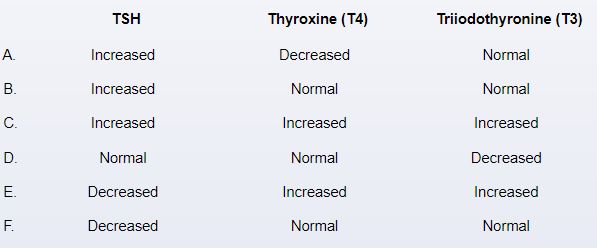
(Multiple Choice)
4.7/5 (80)
(80) 
Filters
- Essay(0)
- Multiple Choice(0)
- Short Answer(0)
- True False(0)
- Matching(0)