



 Chat with AI
Exam 13: Physiology

Exam 1: Anatomy291 Questions
Exam 2: Behavioral science240 Questions
Exam 3: Biochemistry156 Questions
Exam 4: Biostatistics117 Questions
Exam 5: Embryology52 Questions
Exam 6: Genetics103 Questions
Exam 7: Histology24 Questions
Exam 8: Immunology129 Questions
Exam 9: Microbiology336 Questions
Exam 10: Pathology816 Questions
Exam 11: Pathophysiology464 Questions
Exam 12: Pharmacology538 Questions
Exam 13: Physiology272 Questions
Select questions type


A healthy 32-year-old man enrolls in a clinical study investigating potassium handling by the kidney. During the study period, he is given oral potassium supplements and potassium levels in the serum and urine are closely monitored. Compared to the amount of potassium delivered to the glomerular capillaries, the percentage of potassium remaining in this individual's tubular fluid is most likely to vary by which of the following amounts?
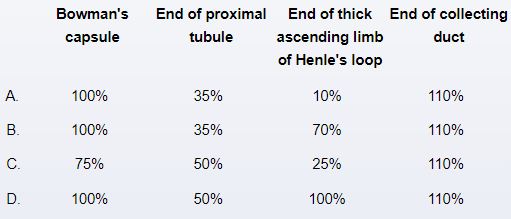
(Multiple Choice)
4.8/5  (61)
(61) A 25-year-old man comes to the physician because he and his wife have been unable to conceive for the last 2 years. They have no children. Infertility evaluation is begun, and laboratory studies show a low sperm count. A more thorough evaluation elucidates a rare genetic abnormality that leads to permanently inactive FSH receptors. Which of the following substances is most likely decreased in this patient?
(Multiple Choice)
4.8/5 (79)
(79) A 28-year-old woman, gravida 1 para 0, at 12 weeks gestation comes to the office for follow-up. During the first trimester, the patient had mild nausea, which has now resolved, and the patient feels well. She has a history of epilepsy for which she is taking lamotrigine; her only other medication is a prenatal vitamin with folic acid. Vital signs and physical examination show no abnormalities. Fetal heart tones are normal. In addition to routine prenatal care, the patient's serum lamotrigine level is being closely monitored because the drug is eliminated primarily by the kidneys. Which of the following renal changes are expected in this patient during her pregnancy?
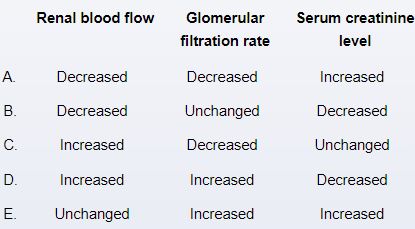
(Multiple Choice)
5.0/5 (75)
(75) A 50-year-old woman who has had mild myopia for decades comes to the office for a routine physical examination. The patient has no chronic medical conditions and eats a healthy diet consisting of a variety of organically grown foods. She is excited because she rarely has to wear glasses or contacts anymore. Her visual acuity at 20 feet is 20/30 in both eyes without wearing her glasses. Which of the following conditions has the same etiology as the changes causing this patient's visual improvement?
(Multiple Choice)
4.8/5 (86)
(86) A 6-week-old infant is brought to the office due to difficulty feeding. The patient was born at 39 weeks gestation via spontaneous vaginal delivery. He is breastfeeding for 5 minutes per side every 3 hours. The patient has profuse sweating and difficulty breathing with feeds. Weight is at the 5th percentile. On examination, the patient is tachypneic. Cardiac examination shows a holosystolic murmur at the left lower sternal border; a palpable thrill is present at the left sternal border. Compared to a healthy infant, this patient likely has which of the following intracardiac pressure changes?
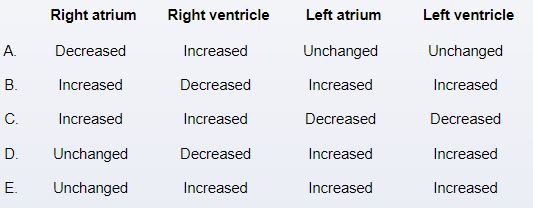
(Multiple Choice)
4.9/5 (86)
(86) A 26-year-old woman, para 0, comes to the office for follow-up of irregular menstrual periods. She has a period every 15-90 days that lasts 2-14 days and ranges from spotting to quarter-sized clots. The patient and her husband have been trying to conceive, but it has been difficult to time intercourse given her erratic menstrual cycles. She has been exercising and losing weight and now has a BMI of 32 kg/m2. Gynecologic examination shows normal external genitalia, a small mobile uterus, and normal adnexa. Endometrial sampling reveals coiled glands filled with carbohydrate-rich mucus, edematous stroma, and tortuous spiral arteries. At which time point on the graph below was the endometrial sampling most likely obtained? 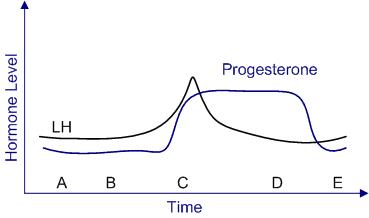
(Multiple Choice)
4.8/5 (76)
(76) A 70-year old man comes to the office due to persistent aspiration. Two weeks ago, he had a stroke that impacted his speech, voice, and swallowing. Modified barium swallow study reveals aspiration of liquids without nasal regurgitation. Aspiration is ameliorated when the patient flexes his neck to put his chin to his chest during swallowing. This maneuver is most likely augmenting which of the following airway-protective mechanisms?
(Multiple Choice)
4.8/5 (89)
(89) A 28-year-old man comes to the physician with muscle weakness and headaches for the last 2 months. He denies palpitations, tremors, or increased sweating. His blood pressure is 190/120 mm Hg and his pulse is 68/min. His serum potassium level is 2.8 mEq/L. The patient's plasma renin activity is high and his serum aldosterone levels are elevated. A 24-hour urine collection shows increased potassium excretion. Which of the following is the most likely cause of this patient's symptoms?
(Multiple Choice)
4.9/5 (76)
(76) A 28-year-old woman comes to the office for a preconception visit. She has never been pregnant and would like to know how to improve her chances of conceiving. The patient has no family history of genetic abnormalities or infertility. Menarche was at age 13. She menstruates every 28 days, and bleeding lasts for 4 days. She has had no prior surgeries or sexually transmitted infections. Her husband has not fathered a child and has no urogenital problems. The couple has intercourse several times a month. Which of the following hormones would increase the most in concentration after ovulation?
(Multiple Choice)
4.9/5 (70)
(70) A 32-year-old woman comes to the outpatient clinic due to shortness of breath for the past 6 months. The patient says she can walk only 3-4 blocks on level ground before feeling out of breath. She also has an occasional dry cough at night. The patient denies any chest pain, palpitations, syncope, weight loss, or lower extremity swelling. She immigrated from Guatemala 8 years ago. Medical history is unremarkable. On physical examination, the patient appears comfortable. Blood pressure is 128/75 mm Hg and pulse is 78/min and regular. Peripheral pulses are full and symmetric. The lungs are clear on auscultation. S1 is loud. With the patient positioned on her left side and breath held at the end of expiration, a diastolic murmur is heard at mid- and end diastole. Otherwise, examination is unremarkable. Which of the following are the most likely left ventricular hemodynamic findings at rest in this patient?
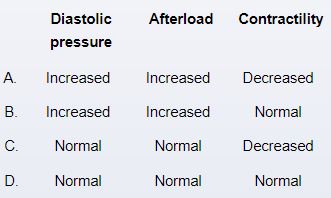
(Multiple Choice)
4.8/5 (68)
(68) A 56-year-old man with chronic kidney disease is seen for a routine follow-up visit. The patient also has type 2 diabetes, hypertension, and hyperlipidemia. His serum creatinine level has been increasing over the past 2 years. Blood pressure is 144/90 mm Hg and pulse is 88/min. Weight is 80 kg (176 lb). Physical examination is normal except for trace pitting ankle edema. Serum creatinine level is 1.8 mg/dL; 1 year ago, serum creatinine was 1.4 mg/dL. Serum calcium and phosphorus levels are in the normal range. Which of the following is most likely responsible for maintaining the serum phosphorus within normal range despite declining renal function?
(Multiple Choice)
4.8/5 (69)
(69) A 45-year-old woman comes to the office due to polyuria and nocturia. She has no fever, dysuria, or abdominal pain. The patient has no significant medical problems and takes no medications. Her temperature is 36.7 C (98 F), blood pressure is 120/80 mm Hg, and pulse is 76/min. The patient's mucous membranes appear dry. The remainder of her physical examination is normal. Her urine output and osmolality remain unchanged with water deprivation for several hours, but after administration of desmopressin, urine output decreases and urine osmolality increases. Renal clearance of which of the following substances would decrease the most after this patient's injection?
(Multiple Choice)
4.9/5 (86)
(86) A 23-year-old man with a history of type 1 diabetes mellitus is brought to the emergency department due to confusion and weakness. His symptoms began 2 days ago after he started having mild diarrhea. He has missed several doses of insulin because his appetite has been poor. On examination, his breath has a fruity odor. This patient is most likely to demonstrate which of the following urine chemistry patterns?
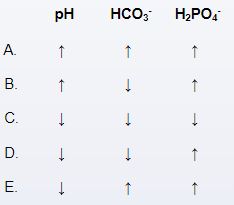
(Multiple Choice)
4.9/5 (78)
(78) A 26-year-old man collapsed while playing basketball and could not be resuscitated. Prior to the episode, he had exertional dyspnea and lightheadedness. Autopsy is performed. The lungs are completely normal. The heart is shown in the exhibit.
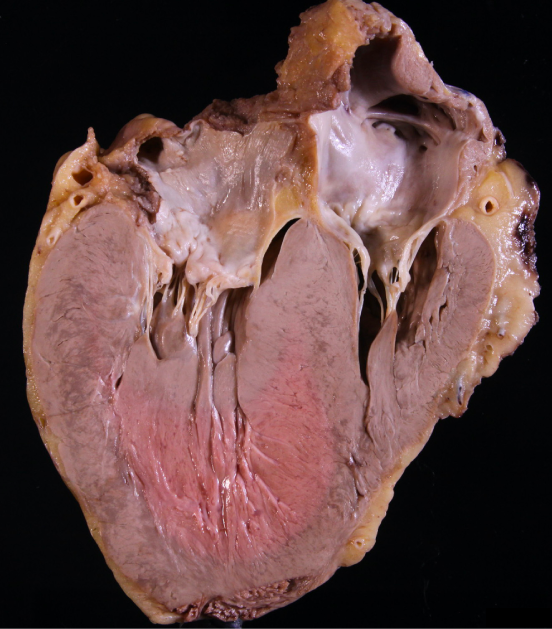 If the patient had been examined prior to death, which of the following would most likely have been present?
 (Multiple Choice)
4.7/5 (85)
(85) A 28-year-old woman comes to the office due to a 4-month history of amenorrhea. She has also had a whitish nipple discharge from both breasts. The patient has taken several pregnancy tests at home that have been negative. She has also had increased fatigue, depressed mood, and weight gain over this time. The patient has had no headaches or vision changes. She has no prior medical problems and takes no medications. On physical examination, there is thinning of the outer third of the eyebrows. The thyroid is enlarged and nontender to palpation. Abdominal and pelvic examinations are normal. The skin appears dry. Laboratory results are as follows: 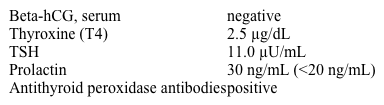 Which of the following is the most likely mechanism causing this patient's elevated prolactin level?
 (Multiple Choice)
4.8/5 (77)
(77) A 7-year-old boy is brought to the clinic for a well-child visit. Over the past year, the patient has become fidgety, impulsive, inattentive, and restless, leading to a progressive decline in his grades. Height and weight are at the 50th and 5th percentiles for his age, respectively. The patient takes no medications or supplements. The thyroid gland is diffusely enlarged to palpation without tenderness or bruit. Neurologic examination reveals no focal findings. Results of thyroid function tests are as follows: 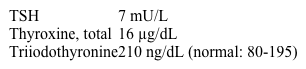 Which of the following is the most likely etiology of this patient's thyroid function test abnormalities?
 (Multiple Choice)
4.9/5 (74)
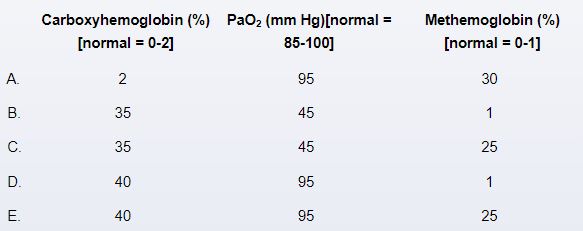
(74) A 35-year-old man is brought to the emergency department after collapsing in his garage. He recently bought a classic 1960s convertible and was repairing it when he collapsed. The patient was inside the garage but had the door half-open. He lost consciousness after working on the car for 2 hours with the engine running. The patient has no known medical problems and takes no medications. He does not use tobacco, alcohol, or illicit drugs. Which of the following best reflects the combination of findings that would have been expected in an arterial blood sample taken when the patient lost consciousness?
(Multiple Choice)
4.9/5 (78)
(78) Physiologists are studying how the plasma concentration of various substances affects the degree to which they are excreted in the urine. During one experiment, a substance freely filtered at the glomerulus is infused intravenously at various rates. The plasma concentration (mg/mL) and urinary excretion rate (mg/min) of the substance are monitored. Assuming a constant glomerular filtration rate (GFR) of 100 mL/min, the following observations are made:  Which of the following substances is most likely to demonstrate a similar pattern of filtration and excretion in a healthy adult?
 (Multiple Choice)
5.0/5 (83)
(83) A 63-year-old man with long-standing hypertension has undergone multiple changes in his antihypertensive regimen over the years with only minimal improvement in his blood pressure. A CT study of his thoracolumbar spine is performed for evaluation of chronic back pain, and the study incidentally reveals a small right kidney. Angiography demonstrates atherosclerotic narrowing of the right renal artery. The left renal artery is intact. You conclude that the flow in the right-sided artery is decreased by a factor of 16 compared to the left. By what percentage has the radius of the lumen been reduced?
(Multiple Choice)
4.8/5 (87)
(87) A 56-year-old man comes to the emergency department due to chest palpitations. He feels that his heartbeat is fast and very irregular. The patient has no chest pain, shortness of breath, or dizziness. Physical examination confirms the presence of an irregularly irregular rhythm with a heart rate of 120/min. He hosted a party last night for his wife's birthday and consumed a large amount of alcohol. The patient normally drinks only 2-3 times a year. He is otherwise healthy and takes no medications. Which of the following ECG findings is most likely in this patient?
(Multiple Choice)
4.8/5 (82)
(82) 
Filters
- Essay(0)
- Multiple Choice(0)
- Short Answer(0)
- True False(0)
- Matching(0)