



 Chat with AI
Exam 13: Physiology

Exam 1: Anatomy291 Questions
Exam 2: Behavioral science240 Questions
Exam 3: Biochemistry156 Questions
Exam 4: Biostatistics117 Questions
Exam 5: Embryology52 Questions
Exam 6: Genetics103 Questions
Exam 7: Histology24 Questions
Exam 8: Immunology129 Questions
Exam 9: Microbiology336 Questions
Exam 10: Pathology816 Questions
Exam 11: Pathophysiology464 Questions
Exam 12: Pharmacology538 Questions
Exam 13: Physiology272 Questions
Select questions type


A 46-year-old man develops episodes of "dizzy spells" accompanied by palpitations and sweating during exercise. His symptoms improve after drinking orange juice or eating a protein bar. The patient was diagnosed with type 2 diabetes 6 months ago and advised to lose weight with dietary modification and exercise. Since then, he has been working out intensively and has lost 10 kg (22 lb). Which of the following mechanisms is responsible for this patient's symptoms when exercising?
(Multiple Choice)
4.9/5  (79)
(79) Renal physiologists are studying how hydration status affects the mechanisms of urine concentration and dilution in humans. To do this, they developed a technique in experimental animals that permits sampling of tubular fluid in different parts of the nephron. A tubular fluid sample with an osmolarity of 110 mOsm/L is obtained from a healthy animal after 12 hours of water deprivation. Assuming the physiology of this animal mirrors human physiology, which of the following sites along the nephron was most likely sampled? 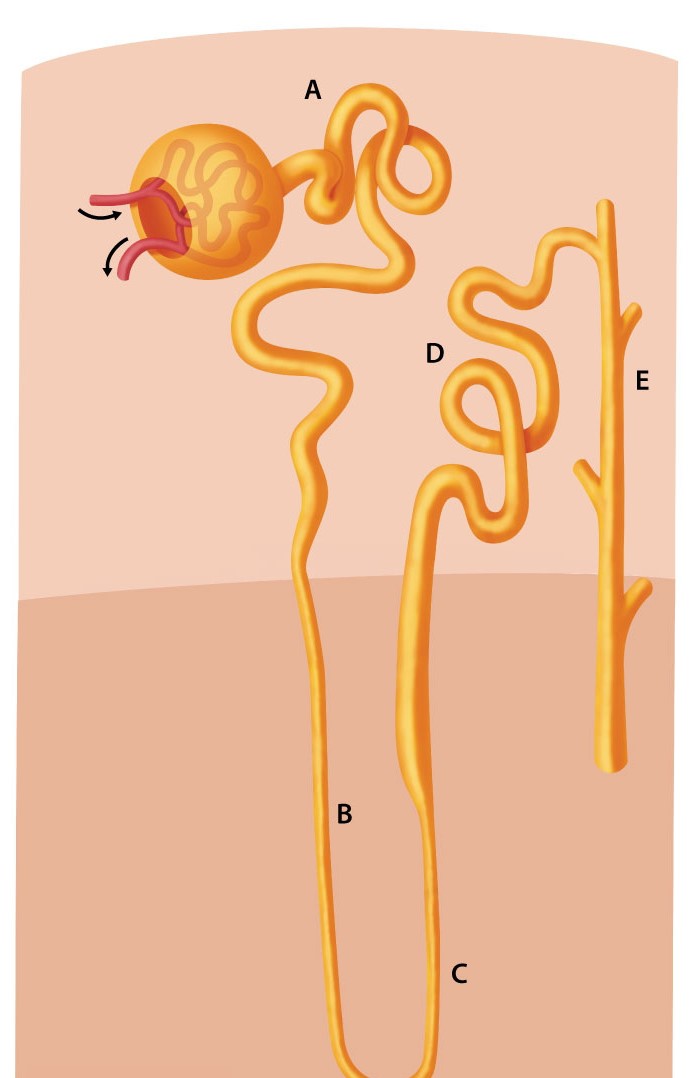
(Multiple Choice)
4.8/5 (86)
(86) A 23-year-old man comes to the emergency department due to abdominal pain and nausea for the last few hours. He also reports an episode of vomiting and has noticed that his urine has a fruity odor. The patient has had increased thirst and urination for the past several days along with weight loss. He has no known medical problems and takes no medications. Physical examination reveals pallor with cool extremities. The abdomen is soft, without tenderness to palpation. Laboratory studies are ordered to confirm the diagnosis. Which of the following points on the graph below best corresponds to this patient's acid-base status? 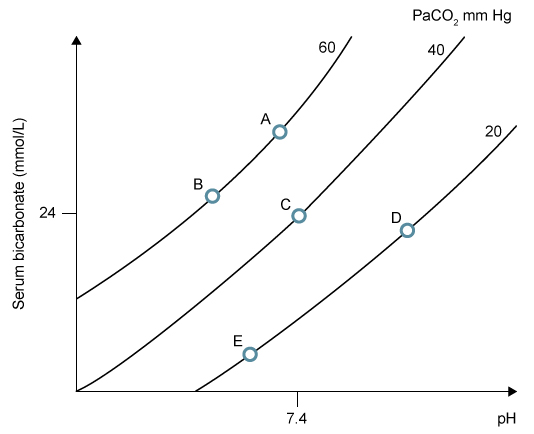
(Multiple Choice)
4.8/5 (65)
(65) A 34-year-old man comes to the office for a follow-up visit. The patient has had type 1 diabetes since age 12 and is diligent in taking insulin to achieve good glycemic control. Over the past few months, he has had more frequent episodes of hypoglycemia despite no changes in his treatment, diet, or physical activity, but the episodes have been associated with less severe hypoglycemic symptoms compared to prior episodes. Physical examination is unremarkable. Laboratory results show normal basic metabolic panel and serum TSH level. Hemoglobin A1c is 7.0%. Which of the following factors is primarily responsible for this patient's increased frequency of hypoglycemia?
(Multiple Choice)
4.7/5 (81)
(81) A 38-year-old woman, gravida 1 para 0, at 34 weeks gestation comes to the office due to increasing swelling in her hands and legs. The patient first noticed the swelling a few weeks ago but now cannot stand for more than an hour without needing to elevate her legs. She has no orthopnea, dyspnea, or chest pain. The patient has no chronic medical conditions and takes no daily medications. Vital signs are normal. Cardiac examination is within normal limits. Lungs are clear to auscultation. Bilateral lower extremities have 2+ pitting edema to the midshin. Urine dipstick shows no protein. Compared to a healthy nonpregnant woman, which of the following parameters is most likely to be decreased in this patient?
(Multiple Choice)
4.8/5 (83)
(83) A 24-year-old, healthy woman volunteers for an exercise research study. In the study, various radiolabeled compounds are used to determine the source of skeletal muscle ATP during exercise. The participants are given carbohydrate-rich food and are asked to run on a treadmill at high speed. Which of the following is the most likely source of ATP represented by the red curve on the graph below? 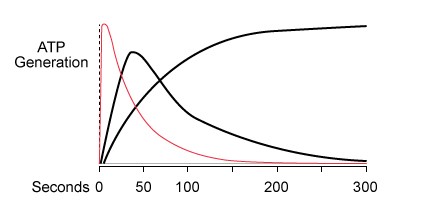
(Multiple Choice)
4.9/5 (89)
(89) A 58-year-old man comes to the emergency department due to generalized weakness, anorexia, and nausea for the past several weeks. He also reports lower extremity swelling but has had no dyspnea or chest pain. The patient was diagnosed with hypertension several years ago but did not follow up and takes no medications. Blood pressure is 182/100 mm Hg and pulse is 84/min. Physical examination shows pitting edema of the bilateral lower extremities. Laboratory studies reveal elevated serum creatinine and blood urea nitrogen levels. During evaluation of renal dysfunction, total urinary creatinine is measured over a 24-hour period, and creatinine clearance is calculated using the serum and urine creatinine concentrations and urinary volume. Compared to the calculated creatinine clearance, this patient's true glomerular filtration rate is most likely to be:
(Multiple Choice)
4.9/5 (75)
(75) A 21-year-old man undergoes a routine pre-employment physical examination. During testicular examination, he is found to have only 1 testis in his scrotum. Further evaluation reveals an elevated serum FSH level and a normal serum LH level. Production of which of the following substances is likely to be impaired in this patient?
(Multiple Choice)
4.9/5 (90)
(90) A 43-year-old man is evaluated for occasional palpitations provoked by anxiety. The patient describes a sudden-onset pounding sensation in the chest followed by lightheadedness and shortness of breath. He has never had syncope. The patient has no history of heart disease, and family history is unremarkable. After initial evaluation, he is treated with verapamil and reports marked improvement in the frequency of palpitation episodes. The tracing below shows the electrical activity of a specific type of cardiac cell in the patient's heart.  Which of the following effects would verapamil administration most likely have on these cells?
 (Multiple Choice)
5.0/5 (75)
(75) A 52-year-old man comes to the office with a 2-week history of shortness of breath and dry cough. The patient has noticed decreased exercise tolerance that limits his daily activities. A Doppler probe placed at the cardiac apex reveals the following blood flow pattern across the patient's mitral valve. 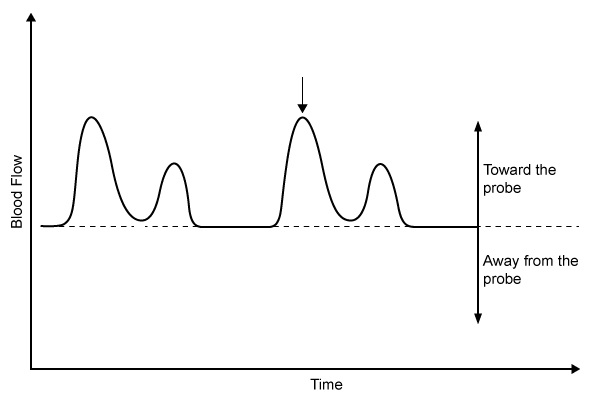 The point marked by the arrow would best correspond to which of the following auscultation findings?
 (Multiple Choice)
4.9/5 (79)
(79) A longitudinal study is conducted to assess changes in renal function over time in patients with recently diagnosed type 2 diabetes mellitus. An initial set of laboratory tests is obtained in newly enrolled patients to establish baseline renal function parameters. The following measurements are taken from a 42-year-old male volunteer. 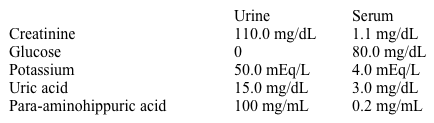 Which of the following is the best estimate of the filtration fraction in this patient assuming a urine flow of 1.0 mL/min?
 (Multiple Choice)
4.9/5 (75)
(75) A 25-year-old man is found to have small testes on physical examination. He has normal male pattern facial and pubic hair. Further laboratory testing reveals a decreased sperm count and normal serum testosterone level. Which of the following is the most likely cause of these findings?
(Multiple Choice)
4.8/5 (76)
(76) A 44-year-old man is hospitalized with multiple injuries following a motor vehicle collision. An arteriovenous fistula created by an injury would most likely result in which of the following changes to the left ventricular pressure-volume loop?Solid line = preinjury
Dashed line = postinjury
(Multiple Choice)
4.8/5 (83)
(83) A 26-year-old man comes to the emergency department due to a 10-hour history of progressively worsening right-sided scrotal pain. Clinical and radiological evaluations confirm testicular torsion with significant ischemic damage and the patient undergoes unilateral orchiectomy. Three months later, he comes to the office for follow-up. The patient is otherwise healthy and takes no medications but is worried about the risk of sexual dysfunction and infertility. Further evaluation is most likely to show which of the following sets of findings in this patient?
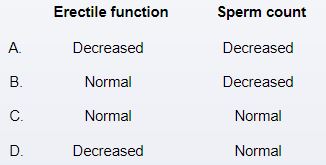
(Multiple Choice)
4.8/5 (87)
(87) A 4-week-old boy undergoes cardiac catheterization for closure of a patent ductus arteriosus. The patient was born at 26 weeks gestation due to placental abruption. He has been cared for in the neonatal intensive care unit since delivery. Pulse oximetry shows 99% in the right hand and left foot. Echocardiography shows a moderately sized patent ductus arteriosus. After catheterization but before closure, blood gases are obtained from several locations. Compared with the partial pressure of oxygen (PaO2) of a normal infant, this patient would be expected to have a higher PaO2 in which of the following locations?
(Multiple Choice)
4.7/5 (84)
(84) A 2-year-old, previously healthy boy is brought to the emergency department due to a 4-day history of poor feeding, diarrhea, and abdominal pain. The patient has had 5-7 bowel movements every day for the past 4 days. Temperature is 36.8 C (98.2 F) and blood pressure is 65/42 mm Hg. On physical examination, the patient is lethargic. Mucous membranes are dry, and the eyes are sunken. The lungs are clear to auscultation. No murmurs are heard. Abdominal examination shows distension and tenderness; bowel sounds are hyperactive throughout. Which of the following changes is most likely present in this patient?
(Multiple Choice)
4.9/5 (81)
(81) A 23-year-old woman is referred to a neurologist due to recent-onset diplopia and ataxia. She has not had similar symptoms before. However, about a year ago, she experienced numbness and paresthesia involving her left leg that have since resolved. After a comprehensive neurological examination, the physician orders an MRI of the brain, which reveals several areas of T2 hyperintensity consistent with axonal demyelination. A diagnosis of multiple sclerosis is made. Which of the following neuronal properties is most likely to decrease as a direct result of demyelination?
(Multiple Choice)
4.8/5 (70)
(70) Researchers are studying the coronary circulation in various healthy and diseased states. They measure blood flow and pressure (blue circle) in one of the epicardial coronary arteries of an experimental animal with cardiovascular physiology similar to that of humans. Then they clamp the artery to simulate 60% atherosclerotic stenosis and remeasure the flow and pressure distal to the lesion. Which of the following changes are most likely to be observed once steady state is achieved? 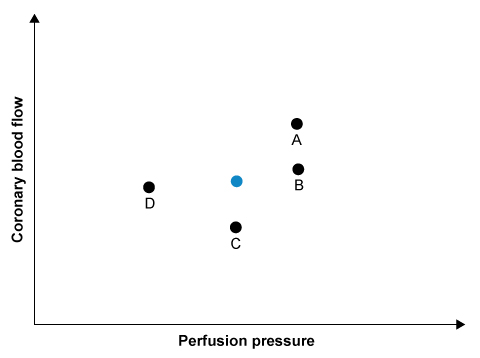
(Multiple Choice)
4.8/5 (85)
(85) A 45-year-old man is evaluated for persistent cough and progressive dyspnea on exertion. The patient has no medical issues but has been exposed to large quantities of coal dust while working as a miner for the past 15 years. Chest imaging reveals small, nodular opacities in the upper lobes. Lung biopsy shows fine carbon particles within the patient's respiratory bronchioles and alveolar ducts. Which of the following mechanisms is most directly responsible for clearing the foreign particles from this patient's respiratory tract?
(Multiple Choice)
4.9/5 (77)
(77) A newborn boy is found to have micropenis at birth. Genetic analysis identifies a specific mutation in the NR5A1/SF-1 gene that results in selective impairment in Sertoli cell function. The remainder of the hypothalamic-pituitary-gonadal axis is unaffected. The patient undergoes regular follow-up with a pediatric endocrinologist during childhood and has otherwise normal childhood and pubertal development. When he is 16 years old, serum hormone levels are obtained. Which of the following patterns of blood hormone levels are most likely to be seen as a result of this patient's condition?
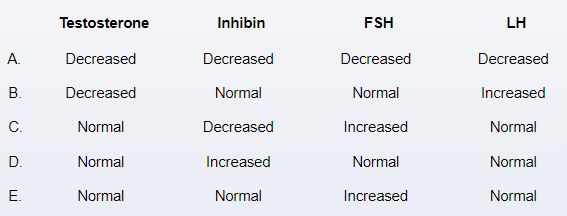
(Multiple Choice)
4.8/5 (71)
(71) 
Filters
- Essay(0)
- Multiple Choice(0)
- Short Answer(0)
- True False(0)
- Matching(0)