Multiple Choice
A 43-year-old man is evaluated for occasional palpitations provoked by anxiety. The patient describes a sudden-onset pounding sensation in the chest followed by lightheadedness and shortness of breath. He has never had syncope. The patient has no history of heart disease, and family history is unremarkable. After initial evaluation, he is treated with verapamil and reports marked improvement in the frequency of palpitation episodes. The tracing below shows the electrical activity of a specific type of cardiac cell in the patient's heart. 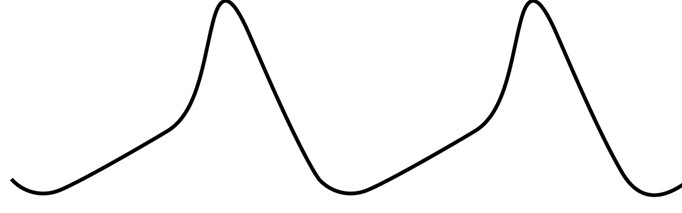 Which of the following effects would verapamil administration most likely have on these cells?
A) Decreased excitation and contraction coupling
B) Increased action potential amplitude
C) Lowered threshold potential
D) Reduced refractory period
E) Slowed spontaneous depolarization
Correct Answer:

Verified
Correct Answer:
Verified
Q64: A 34-year-old man comes to the office
Q65: A 38-year-old woman, gravida 1 para 0,
Q66: A 24-year-old, healthy woman volunteers for an
Q67: A 58-year-old man comes to the emergency
Q68: A 21-year-old man undergoes a routine pre-employment
Q70: A 52-year-old man comes to the office
Q71: A longitudinal study is conducted to assess
Q72: A 25-year-old man is found to have
Q73: A 44-year-old man is hospitalized with multiple
Q74: A 26-year-old man comes to the emergency