



 Chat with AI
Exam 13: Physiology

Exam 1: Anatomy291 Questions
Exam 2: Behavioral science240 Questions
Exam 3: Biochemistry156 Questions
Exam 4: Biostatistics117 Questions
Exam 5: Embryology52 Questions
Exam 6: Genetics103 Questions
Exam 7: Histology24 Questions
Exam 8: Immunology129 Questions
Exam 9: Microbiology336 Questions
Exam 10: Pathology816 Questions
Exam 11: Pathophysiology464 Questions
Exam 12: Pharmacology538 Questions
Exam 13: Physiology272 Questions
Select questions type


A 34-year-old woman comes to the physician complaining of frequent urination. She has tried limiting her fluid intake but found it difficult because she got very thirsty. The physician assesses the water-conserving function of her kidneys by performing a water restriction test, which shows inappropriately dilute urine. Laboratory studies drawn during the period of water deprivation show low vasopressin levels. The physician diagnoses the patient with central diabetes insipidus and explains that her kidneys are unable to absorb the proper amount of water due to defective hormone production. Which of the following areas of the nephron is normally impermeable to water regardless of serum vasopressin levels? 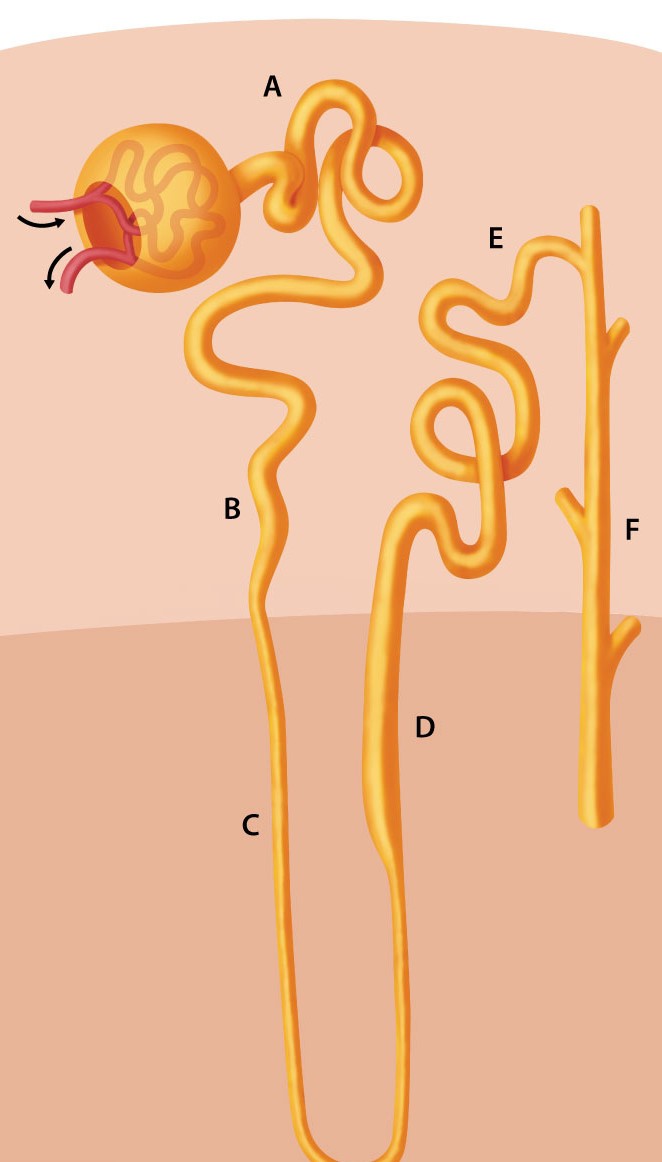
(Multiple Choice)
5.0/5  (77)
(77) Researchers conduct an experiment to determine hemodynamic changes during exercise. Invasive monitoring of various parameters is performed to obtain a left ventricular pressure-volume loop. Compared to at rest, which of the following changes is most likely to be observed during moderate to heavy exercise?(solid line: at rest; dashed line: during exercise)
(Multiple Choice)
5.0/5 (71)
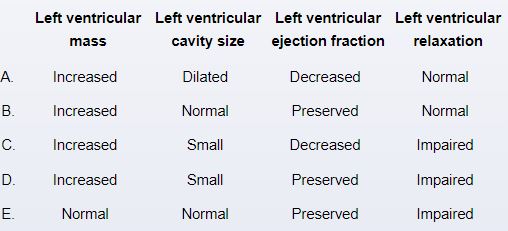
(71) A 22-year-old man comes to the clinic for a routine physical. The patient has no medical problems and takes no medication. He does not use tobacco, alcohol, or illicit drugs. He plays on his college football team and participates in intense training sessions and weekly games. Review of systems is unremarkable. Blood pressure is 120/76 mm Hg, pulse is 68/min, and respirations are 15/min. BMI is 28 kg/m2. Blood pressures in the upper and lower extremities are equal. There is no jugular venous distension. Carotid upstrokes are brisk. There is a grade 2/6 early systolic murmur along the left sternal border. The murmur decreases in intensity with hand grip and passive leg elevation. Lung sounds are normal without crackles or wheezes. Echocardiogram is most likely to demonstrate which of the following findings?
(Multiple Choice)
4.8/5 (84)
(84) A 43-year-old man comes to the emergency department after experiencing 4 episodes of coffee ground emesis that started earlier this morning. He also describes epigastric pain over the last 3-4 months that was relieved by over-the-counter antacids. He has no other past medical history. The patient has smoked a pack of cigarettes daily for the last 20 years but does not use alcohol or illicit drugs. Blood pressure is 70/40 mm Hg and pulse is 130/min and regular. Extremities are cool to the touch with loss of skin turgor. Intravenous access is obtained via 2 large-bore peripheral catheters, and rapid infusion of 2 liters of normal saline is initiated. This intervention is most likely to increase which of the following hemodynamic parameters?
(Multiple Choice)
4.7/5 (89)
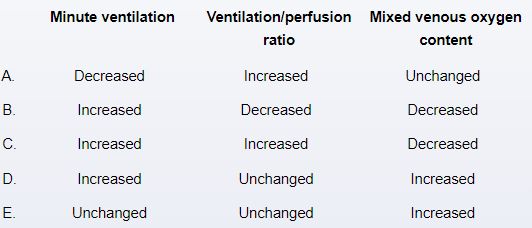
(89) A 28-year-old professional athlete participates in a sports physiology study. She runs on a treadmill at an incrementally increasing speed. After 15-minutes, her pulse is 90% of the maximal heart rate based on her age, and several physiologic parameters are measured. Which of the following changes have most likely occurred compared to at rest?
(Multiple Choice)
4.9/5 (75)
(75) A newborn boy is found to have a serum TSH above and serum thyroxine below the normal range for his age. The patient was born at 39 weeks gestation via spontaneous vaginal delivery. His mother has no medical conditions. On examination, the patient's length and weight are normal, and he has no apparent congenital abnormalities. Ultrasound of the neck shows a normal-sized thyroid gland in the appropriate location. Which of the following is the most likely cause of this patient's condition?
(Multiple Choice)
4.8/5 (71)
(71) A 24-year-old primigravid woman at 36 weeks gestation comes to the physician complaining of lightheadedness and nausea at bedtime. Her pregnancy has been uncomplicated and her past medical history is unremarkable. She takes one multivitamin and one iron tablet daily. Her blood pressure is 115/75 mm Hg when sitting, 110/70 mm Hg when standing, and 80/60 mm Hg when supine. Physical examination shows a uterus consistent in size with 36 weeks gestation. Which of the following is the most likely explanation for this patient's hypotension while supine?
(Multiple Choice)
4.7/5 (85)
(85) A 67-year-old woman is hospitalized due to worsening abdominal pain. The patient has long-standing end-stage renal disease from diabetic nephropathy for which she undergoes hemodialysis 3 times a week. Temperature is 37 C (98.6 F), blood pressure is 159/79 mm Hg, pulse is 97/min, and respirations are 16/min. Abdominal examination shows high-pitched bowel sounds and mild distension without rebound tenderness. Laboratory results show elevated blood urea nitrogen and creatinine. Noncontrast CT scan of the abdomen shows a small bowel obstruction. The patient also has the findings demonstrated by the arrows in the abdominal CT scan below: 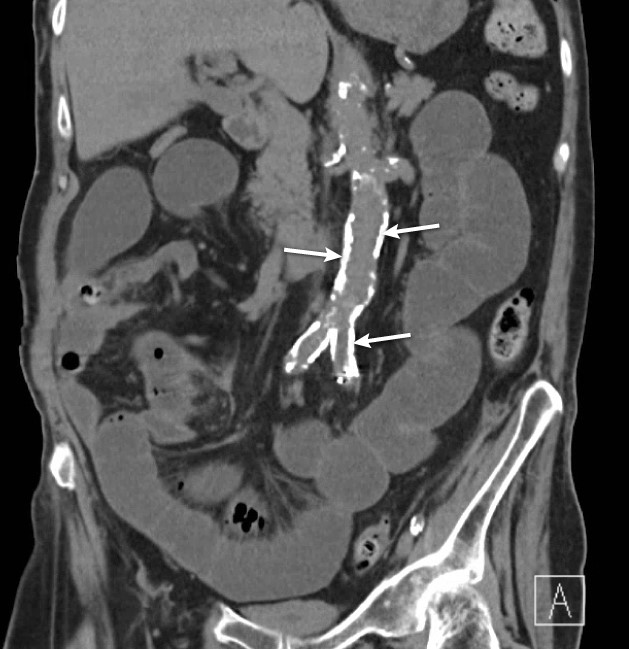 Which of the following most likely contributed to the observed findings?
 (Multiple Choice)
5.0/5 (92)
(92) A 44-year-old man comes to the hospital due to acute onset of central chest pain radiating to the left arm. He used cocaine a few hours ago. Blood pressure is 160/100 mm Hg, pulse is 98/min, and respirations are 18/min. On examination, the patient appears anxious and diaphoretic. Electrocardiogram shows ST-segment elevation in the anterior leads. Laboratory studies reveal an elevated cardiac troponin level and a serum potassium concentration of 3.1 mEq/L. Which of the following is the most likely cause of this patient's hypokalemia?
(Multiple Choice)
4.7/5 (77)
(77) A 45-year-old man comes to the emergency department due to a 2-day history of dyspnea, orthopnea, and ankle swelling. This morning, he also had nausea, vomiting, and a headache. Blood pressure is elevated, and physical examination shows pulmonary crackles and bilateral pitting edema up to the knees. A sodium nitroprusside infusion is begun. Which of the following left ventricular pressure/volume relationships best represents the effects of this therapy?*Solid line = before nitroprusside; dashed line = during nitroprusside infusion.
(Multiple Choice)
4.9/5 (93)
(93) As part of an experiment, radiolabeled ATP is injected into skeletal muscle. During muscle contraction, the labeled ATP is observed to attach to the sarcomere. This attachment causes immediate:
(Multiple Choice)
4.9/5 (76)
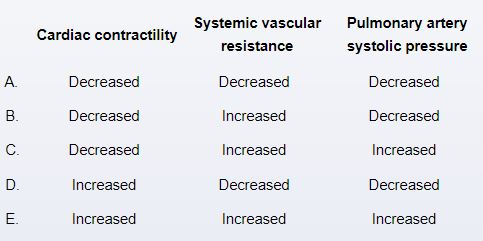
(76) A 65-year-old woman is brought to the hospital due to sudden-onset chest heaviness and shortness of breath that began an hour ago. Her medical history is significant for type 2 diabetes mellitus, obesity, and hypertension. Temperature is 36.7 C (98.1 F), blood pressure is 80/50 mm Hg, pulse is 110/min, and respirations are 20/min. Extremities are cold and clammy. Diaphoresis is present. ECG shows ST-segment elevation in the lateral leads. Which of the following hemodynamic changes are most likely present in this patient?
(Multiple Choice)
4.7/5 (78)
(78) A 44-year-old man with progressive dyspnea is diagnosed with dilated cardiomyopathy. Despite optimal medical therapy, he continues to have symptoms and disease progression is noted. He undergoes cardiac transplantation after a suitable donor becomes available. Permission is obtained from the patient to study his diseased heart for intracellular calcium regulation. Microelectrodes placed into cardiac muscle cells detect a rapid decrease in cytoplasmic calcium level immediately preceding relaxation. Which of the following proteins is most likely responsible for the observed change in electrolyte levels?
(Multiple Choice)
4.8/5 (72)
(72) A group of researchers is developing new drugs for osteoporosis. They are testing a new drug, Substance X, that exhibits the following metabolic effects when given via an infusion in varying doses (as shown in the graphs below). 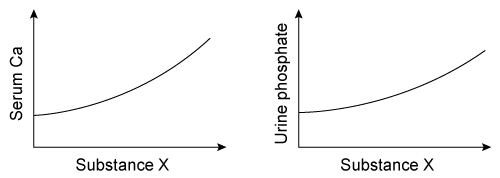 Which of the following most closely resembles the metabolic effects of Substance X?
 (Multiple Choice)
4.8/5 (85)
(85) A study is conducted to standardize laboratory equipment in a hospital network. In one hospital, 2 healthy volunteers undergo testing. Both are found to have a serum creatinine level of 1.1 mg/dL. Glomerular filtration rate is estimated using the same equation and reveals values of 118 mL/min in one volunteer and 70 mL/min in the other. A difference in which of the following parameters best explains the observed laboratory findings in these volunteers?
(Multiple Choice)
4.7/5 (71)
(71) A 25-year-old woman comes to the office due to a 2-week history of neck pain. The patient had an upper respiratory infection a month ago, during which she experienced nasal congestion, rhinorrhea, and a cough productive of clear sputum; her respiratory symptoms lasted for 5 days and resolved spontaneously. The patient then felt well until 2 weeks ago, when she developed pain in the anterior neck associated with mild fever, palpitations, and excessive sweating. She is otherwise healthy and takes no medications. Pulse is 110/min. The thyroid gland is tender to palpation and diffusely enlarged. Other findings include sweaty palms, fine hand tremor, and brisk deep tendon reflexes. Laboratory studies show suppressed TSH and elevated free thyroxine levels. Erythrocyte sedimentation rate is 70 mm/hr. Which of the following additional findings is most likely to be present in this patient at this time?
(Multiple Choice)
5.0/5 (83)
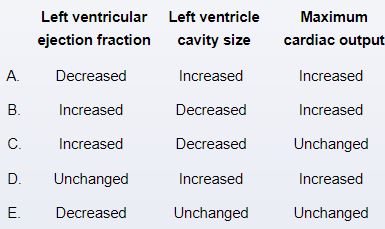
(83) A 32-year-old woman comes to the office for preconception medical evaluation. She feels well, reports no health issues, and has had regular menstruations. The patient is an elite long-distance swimmer and recently retired from professional career of 10 years. She still continues to practice swimming regularly. The patient does not use tobacco, alcohol, or illicit drugs. Blood pressure is 114/66 mm Hg and pulse is 60/min. Physical examination shows no abnormalities. Compared to a person of similar age and sex with sedentary lifestyle, which of the following cardiac changes are most likely present in this patient?
(Multiple Choice)
4.8/5 (81)
(81) Nephrologists at a research hospital are investigating the physiologic changes that occur in diabetes insipidus. The group develops a technique that permits sampling of tubular urine in experimental animals with physiology similar to that of humans. The animals then undergo hypophysectomy, after which tubular fluid samples are obtained from multiple sites throughout the nephron. In the absence of antidiuretic hormone, fluid from which of the following sampling sites is most likely to have the highest osmolarity? 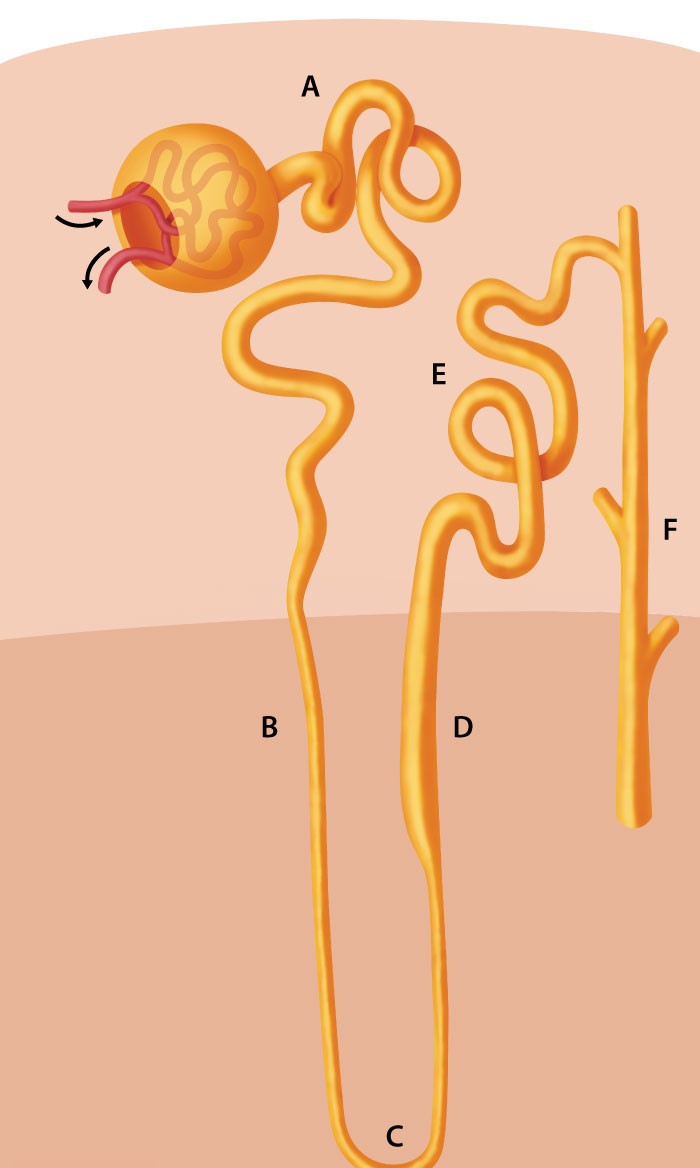
(Multiple Choice)
4.8/5 (93)
(93) A 56-year-old man comes to the office due to chronic cough and fatigue. The patient has smoked 2 packs of cigarettes daily since age 18. Physical examination shows cyanosis and expiratory wheezes scattered throughout the lungs. During evaluation for long-term oxygen therapy, his respiratory rate decreases shortly after he begins nasal cannular oxygen supplementation. This patient's reduced respiratory rate is most likely caused by a sudden decrease in stimulation of which of the following sensory receptors?
(Multiple Choice)
4.9/5 (71)
(71) A 43-year-old patient comes to the physician due to dyspnea. The black curve shown below represents the pressure/volume relationship in normal lung tissue. The blue curve represents the pressure/volume relationship in the patient's lung tissue. 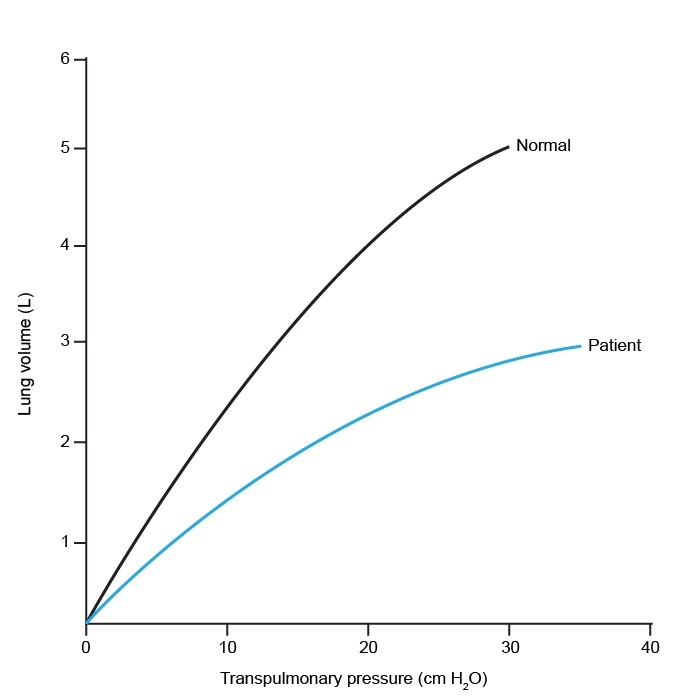 Which of the following is the most likely cause of this patient's symptoms?
 (Multiple Choice)
4.7/5 (97)
(97) 
Filters
- Essay(0)
- Multiple Choice(0)
- Short Answer(0)
- True False(0)
- Matching(0)