



 Chat with AI
Exam 10: Pathology

Exam 1: Anatomy291 Questions
Exam 2: Behavioral science240 Questions
Exam 3: Biochemistry156 Questions
Exam 4: Biostatistics117 Questions
Exam 5: Embryology52 Questions
Exam 6: Genetics103 Questions
Exam 7: Histology24 Questions
Exam 8: Immunology129 Questions
Exam 9: Microbiology336 Questions
Exam 10: Pathology816 Questions
Exam 11: Pathophysiology464 Questions
Exam 12: Pharmacology538 Questions
Exam 13: Physiology272 Questions
Select questions type


Certain patients with non-small cell lung cancer develop constitutive tumor kinase activity due to the production of echinoderm microtubule-associated protein-like 4 - anaplastic lymphoma kinase (EML4-ALK), a fusion protein that contributes to carcinogenesis. This is most similar to the molecular pathophysiology of which of the following disorders?
(Multiple Choice)
4.9/5  (72)
(72) A 46-year-old Caucasian male presents to your office with a slowly growing neck mass. The mass is stony hard on palpation and seems to be fixed to the adjacent tissues. After initial evaluation, combination chemotherapy is prescribed to the patient. Several weeks later the mass significantly decreases in size, and biopsy demonstrates many shrunken eosinophilic cells within the tumor. Which of the following substances released from mitochondria most likely triggered the observed cellular changes?
(Multiple Choice)
4.7/5 (92)
(92) A 30-year-old man comes to the emergency department with a 4-day history of progressively worsening abdominal pain and bloody diarrhea. He was started on mesalamine therapy 6 months ago after being diagnosed with ulcerative colitis but has been noncompliant with treatment. His temperature is 38.8 C (102 F), blood pressure is 100/70 mm Hg, and pulse is 130/min. The patient is lethargic and has dry mucous membranes. There is marked abdominal distension and tenderness without rebound or guarding. Rectal examination shows guaiac-positive, maroon-colored, liquid stool. Which of the following is the best next step in this patient's workup?
(Multiple Choice)
4.9/5 (85)
(85) A 15-year-old girl comes to the office with gait instability. Since age 12, the patient has had mild weakness and "clumsiness" in her lower limbs that have progressed. She has to hold on to the railing when walking down stairs due to several recent falls. Physical examination reveals kyphoscoliosis, pes cavus, and bilateral lower extremity ataxia. Joint position and vibration sense are also impaired. Further evaluation reveals that she is suffering from an inherited disease. This patient is at greatest risk of dying from which of the following conditions?
(Multiple Choice)
4.9/5 (82)
(82) A 50-year-old woman comes to the office for a preventive examination. She feels well and has no ongoing symptoms. Medical and family histories are unremarkable. The patient does not use tobacco or alcohol. Blood pressure is 132/76 mm Hg and pulse is 72/min. BMI is 25 kg/m2. Physical examination is normal. The patient is up to date on breast and cervical screening but has not undergone colon cancer screening. She is referred for colonoscopy, during which a single colon polyp is discovered. The polyp is removed and sent for histologic analysis. Which of the following pathologic findings is associated with the greatest risk of malignant transformation in this patient?
(Multiple Choice)
4.9/5 (81)
(81) A 5-year-old boy is brought to the emergency department due to diarrhea and a low-grade fever. He attends a day care center where other children developed similar symptoms. The boy has no known medical problems. He is up to date with age-appropriate vaccinations. He has not traveled abroad. Physical examination shows abdominal tenderness on deep palpation but no rigidity. Stool is sent for culture, and the patient is diagnosed with Shigella sonnei infection. The outbreak is reported to public health authorities and is traced to consumption of a potato salad handled by a food worker who recently had a mild diarrheal illness. Which of the following cells are primarily responsible for uptake of the bacteria that initiated the infection in this boy?
(Multiple Choice)
5.0/5 (76)
(76) A 70-year-old white woman is brought to the emergency department due to acute right hip pain after a fall. She was walking in her house when she tripped on a floor rug and fell, landing on her hip. The patient has been unable to bear weight on the right leg since the fall and had to call for emergency transport to the hospital. She has no significant medical history and does not use tobacco, alcohol, or illicit drugs. The patient's only medication is an over-the-counter multivitamin. Family history is notable for a hip fracture in her mother. Blood pressure is 150/90 mm Hg and pulse is 112/min. The patient is in moderate pain and her right leg appears shortened and externally rotated. There is tenderness and swelling of the right hip. Radiographs reveal a right femoral neck fracture. Which of the following changes in bone structure is most likely responsible for this patient's condition?
(Multiple Choice)
4.9/5 (90)
(90) A 45-year-old man comes to the emergency department due to sudden-onset vomiting and severe upper abdominal pain that radiates to his back. The patient's total bilirubin is 0.9 mg/dL, aspartate aminotransferase (AST) is 98 U/L, alanine aminotransferase (ALT) is 32 U/L, and alkaline phosphatase is 98 U/L. Serum lipase is markedly increased. Abdominal ultrasound reveals a normal gallbladder and common bile duct. The diagnosis of acute pancreatitis is made, and a specific etiology is established. Which of the following additional laboratory findings is most specific for the underlying cause of this patient's pancreatitis?
(Multiple Choice)
4.9/5 (73)
(73) A 52-year-old woman comes to the office due to pain in the right knee for the past several months. The pain is typically better in the morning but worsens by the end of the day. There is no history of trauma to the joint. Medical history is significant for hypertension, type 2 diabetes mellitus, and hypercholesterolemia. The patient is a lifetime nonsmoker. She works as an office clerk. Family history is significant for stroke in her mother and gout in her father. Temperature is 37.2 C (99 F), blood pressure is 145/95 mm Hg, and pulse is 90/min. BMI is 37 kg/m2. Physical examination shows crepitation on flexion and extension of the right knee; range of motion is otherwise normal, and there is no swelling, warmth, or redness. Which of the following pathologic processes is most likely occurring in this patient's knee joint?
(Multiple Choice)
4.9/5 (83)
(83) A 31-year-old woman comes to the emergency department due to worsening right upper quadrant pain, fever, nausea, and vomiting for a day. The pain increases with deep inspiration. Other medical conditions include uterine fibroids and sickle cell anemia. The patient does not use tobacco, alcohol, or illicit drugs. Temperature is 38.6 C (101.5 F), blood pressure is 120/70 mm Hg, and pulse is 102/min. BMI is 24 kg/m2. On examination, the patient appears uncomfortable because of the pain; there is no jaundice. Tenderness and guarding are present over the right upper quadrant. Bowel sounds are decreased. Hemoglobin is 10.1 g/dL and white blood cell count is 18,000/mm3 with 7% band forms. Abdominal ultrasound shows evidence of cholelithiasis and gallbladder wall thickening. Gross inspection of the specimen obtained during laparoscopic cholecystectomy is shown in the image below: 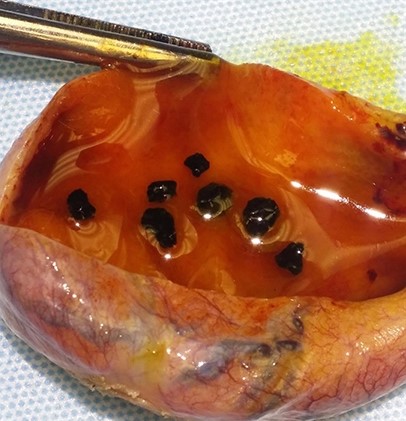 Which of the following is most likely responsible for this patient's symptoms?
 (Multiple Choice)
4.9/5 (90)
(90) A 38-year-old woman comes to the emergency department due to severe headache. An hour ago, she experienced a sudden, explosive headache followed by a brief loss of consciousness. Since regaining consciousness spontaneously, she has had persistent global headache and nausea. Head movement or bright light worsens the pain. Temperature is 37.2 C (99 F), blood pressure is 142/90 mm Hg, and pulse is 98/min. The patient is somnolent but easily rouses to voice. She is well oriented to time, place, and person. There is increased resistance to neck flexion, which elicits pain. The pupils are equal and reactive to light. Deep tendon reflexes and sensory examination are normal. Brain imaging would most likely reveal which of the following?
(Multiple Choice)
4.9/5 (77)
(77) A 59-year-old man comes to the office due to progressive weakness for the past several weeks. The patient has had difficulty getting out of bed and climbing stairs in the morning, which improves gradually as he "warms up the muscles" with continued use. He has also had to drink water more frequently due to dry mouth and has had episodic double vision. The patient also reports difficulty achieving erections despite having a good libido. Neurologic examination shows decreased strength of the hip flexors and diminished knee reflexes. Repeat examination after lower extremity isometric exercise shows normalization of the muscle strength and deep tendon reflexes. Which of the following conditions is most closely associated with this patient's current disease process?
(Multiple Choice)
4.9/5 (83)
(83) A 13-year-old boy comes to the office for evaluation of worsening scoliosis. He lost the ability to walk a year ago and has since been wheelchair bound. He has significant back pain and difficulty sitting in his wheelchair for extended periods. The patient also feels "too weak" to cough or take a deep breath. Review of medical records shows genetic studies confirming a mutation of the dystrophin gene on X chromosome p21. Histopathology of the patient's calf most likely indicates which of the following findings?
(Multiple Choice)
4.8/5 (78)
(78) A 65-year-old man is referred to a gastroenterology clinic by his primary care provider after he develops symptoms suspicious for colorectal cancer. The patient has a history of obesity, diabetes mellitus, and chronic obstructive pulmonary disease. He often eats steaks and hamburgers but avoids vegetables as "they have no flavor." The patient has smoked a pack of cigarettes daily for the past 40 years and occasionally consumes alcohol. He undergoes a colonoscopy and is found to have a mass lesion in the ascending colon. The mass is biopsied, and the histopathologic findings are consistent with colon adenocarcinoma. This patient most likely initially presented with which of the following clinical symptoms?
(Multiple Choice)
4.8/5 (79)
(79) A 28-year-old woman is brought to the emergency department by her family due to acute left flank pain. The pain radiates to her groin and is associated with pink hematuria and urinary urgency. Past medical history is unremarkable, and the patient has never experienced similar symptoms. CT scan of the urinary system confirms the presence of a stone at the ureterovesical junction. The patient is given intravenous morphine sulfate for pain relief. Fifteen minutes later, she develops diffuse itching involving the arms, legs, and back. Which of the following is the most likely mechanism causing this patient's adverse reaction?
(Multiple Choice)
4.8/5 (71)
(71) A 70-year-old female presents to your office complaining of easy fatigability, exertional dyspnea and weight loss. She also complains of frequent falls. Physical examination reveals symmetrically decreased vibratory sensation to the lower extremities. Her hemoglobin is 7.8 g/dL and a peripheral blood smear shows hypersegmented neutrophils. Which of the following is the best treatment for this patient?
(Multiple Choice)
4.8/5 (87)
(87) A 53-year-old woman comes to the clinic due to a skin rash. For the last 3 weeks, she has had a pruritic rash of worsening severity involving the posterior thighs. The patient recently began an exercise program to lose weight and has been applying a topical analgesic cream to her thighs and buttocks after her workouts. Her past medical history is unremarkable, and she does not use tobacco, alcohol, or illicit drugs. On physical examination, there is an erythematous rash with blisters, ulcers, and weeping drainage involving the posterior thighs bilaterally, as shown in the image below. 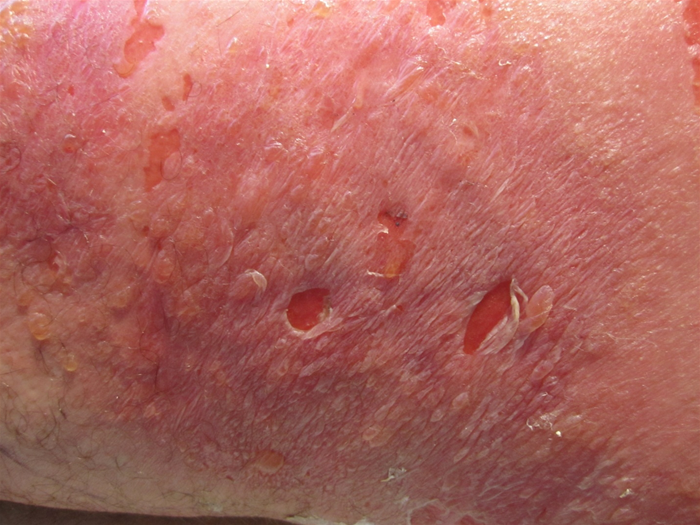 Which of the following is the most likely finding on skin biopsy?
 (Multiple Choice)
4.8/5 (78)
(78) A 62-year-old, obese woman is brought to the hospital due to acute-onset chest pain and shortness of breath. Medical history includes hyperlipidemia, diet-controlled type 2 diabetes mellitus, and peripheral artery disease. Two years ago, she had an ischemic stroke but had no residual neurologic deficits. The patient is a current smoker with a 30-pack-year history. After initial evaluation, she is taken to the cardiac catheterization laboratory where she has a cardiac arrest due to ventricular arrhythmia and cannot be resuscitated. Autopsy reveals thrombotic occlusion of the left anterior descending artery. In addition, it shows 95% atherosclerotic narrowing of the proximal right renal artery but no significant stenosis of the left renal artery. Compared with the right kidney, this patient's left kidney is more likely to demonstrate which of the following findings?
(Multiple Choice)
5.0/5 (81)
(81) A 4-year-old girl developed acute-onset colicky abdominal pain, vomiting, and loose bloody stools during a family vacation. She was treated with supportive care and began to feel better. A few days later, her parents bring her to the emergency department because she has urinated only once in the past 10 hours and the urine was red. Physical examination shows conjunctival pallor but is otherwise normal. Laboratory studies are as follows: 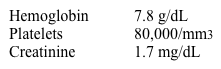 Urinalysis shows proteinuria and hematuria. Which of the following mechanisms is the most likely cause of this patient's condition?
 (Multiple Choice)
4.8/5 (78)
(78) A 62-year-old man is brought to the emergency department after a new-onset, generalized tonic-clonic seizure. His wife reports that for the past several weeks he has been having episodic headaches, nausea, and progressive weakness. The headaches are particularly worse at night and occasionally awaken him from sleep. His other medical problems include well-controlled hypertension and osteoarthritis. On physical examination, the patient is postictal but follows simple commands. He is admitted to the hospital for further evaluation but dies several days later due to aspiration pneumonia and septic shock. A brain section obtained during postmortem examination is shown in the image below. 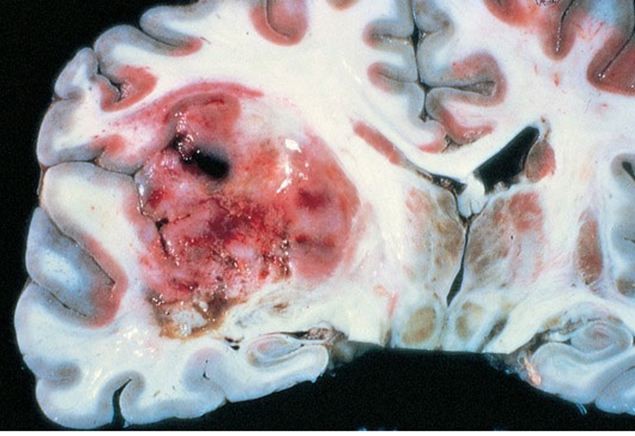 This patient most likely had which of the following conditions?
 (Multiple Choice)
4.9/5 (86)
(86) 
Filters
- Essay(0)
- Multiple Choice(0)
- Short Answer(0)
- True False(0)
- Matching(0)