



 Chat with AI
Exam 10: Pathology

Exam 1: Anatomy291 Questions
Exam 2: Behavioral science240 Questions
Exam 3: Biochemistry156 Questions
Exam 4: Biostatistics117 Questions
Exam 5: Embryology52 Questions
Exam 6: Genetics103 Questions
Exam 7: Histology24 Questions
Exam 8: Immunology129 Questions
Exam 9: Microbiology336 Questions
Exam 10: Pathology816 Questions
Exam 11: Pathophysiology464 Questions
Exam 12: Pharmacology538 Questions
Exam 13: Physiology272 Questions
Select questions type


An 18-year-old woman comes to the emergency department for evaluation of a rash. The patient developed mild aches involving her knees and ankles 2 days ago. Before going to sleep last night, she noticed purplish spots around her right knee. Today, the rash involves both of the lower extremities. She has had no fever, weight loss, sore throat, abdominal pain, vomiting, or diarrhea. The patient has no chronic medical conditions and takes no medications. Temperature is 37 C (98.6 F), blood pressure is 146/90 mm Hg, pulse is 90/min, and respirations are 20/min. Cardiopulmonary examination is unremarkable. The patient has pain with passive range of motion of the knees and ankles. Skin examination is seen in the exhibit.Laboratory results are as follows: 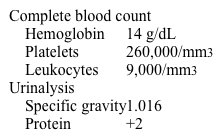 Histologic examination of the rash is most likely to show which of the following?
 (Multiple Choice)
4.8/5  (67)
(67) A 32-year-old woman is brought to the emergency department due to "bruising." She has a chronic mental disability and lives in a group home. Care staff members accompanying the patient report that she fell 3 days ago but has not mentioned any pain. No signs of injury were noted until a large area of discoloration was seen at the upper arm during bathing. Past medical history is unremarkable, and the patient takes no medications. Vital signs are normal. Skin examination findings are shown in the image below. There is no associated warmth, and the patient shows no signs of discomfort during palpation of the affected area. 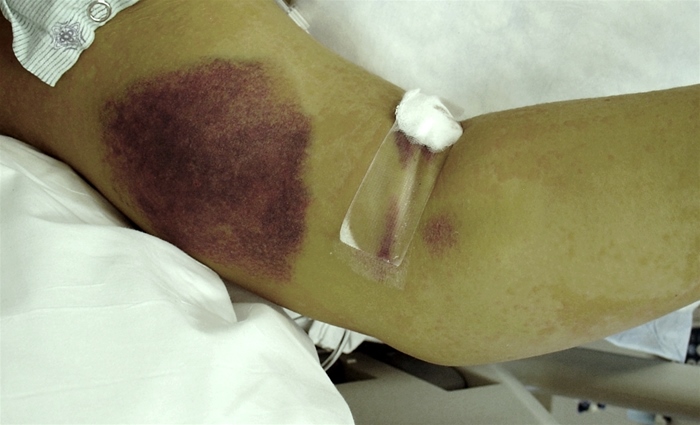 Which of the following terms best describes this abnormality?
 (Multiple Choice)
4.7/5 (91)
(91) A 55-year-old, right-handed woman is brought to the emergency department due to acute-onset headache and difficulty with vision. En route to the hospital, she becomes unconscious. Medical history is significant for hypertension. Blood pressure is 150/90 mm Hg and pulse is 90/min and regular. CT scan of the head without contrast demonstrates an acute hemorrhage in the left temporal lobe with compression of the anterior medial temporal lobe against the free margin of the tentorium cerebelli. Which of the following cranial nerves is most likely to be compromised in this patient?
(Multiple Choice)
4.9/5 (79)
(79) A 56-year-old man comes to the office for upper abdominal pain occurring with meals for the last month. His symptoms improve when fasting. The patient's other medical problems are coronary artery disease and osteoarthritis. His medications include aspirin, simvastatin, and acetaminophen as needed. The patient drinks 1 or 2 beers daily but does not use tobacco or illicit drugs. Upper endoscopy is performed and reveals a gastric ulcer with a smooth, rounded border and an exudative base. A biopsy of the ulcer is taken and placed into a urea-containing solution that includes phenol red, a pH indicator. Thirty minutes later, the solution has turned pink, indicating a pH increase. This test result suggests that which of the following processes is occurring?
(Multiple Choice)
4.9/5 (75)
(75) A 34-year-old woman comes to the office due to a 1 week history of mood swings, difficulty concentrating, and hand tremors. She also has pain at the front of her neck that radiates to her ears and is worse with swallowing. The patient initially attributed her symptoms to a flu-like illness that she had a few weeks earlier. She has no other medical conditions and takes no medications. Blood pressure is 140/80 mm Hg and pulse is 105/min. The thyroid gland is very tender on palpation. After initial laboratory testing, a thyroid scan is performed and reveals diffusely decreased radioiodine uptake. Erythrocyte sedimentation rate is 105 mm/hr. Which of the following pathological changes would be most likely on biopsy of this patient's thyroid gland?
(Multiple Choice)
4.9/5 (76)
(76) A 54-year-old man comes to the office due to increasing pain in the right upper quadrant, nausea, and unintentional weight loss. Vitals signs are within normal limits. BMI is 21 kg/m2. The patient appears cachectic and there is scleral icterus. The liver is palpable 3 cm below the right costal margin. No ascites is present. Laboratory studies reveal elevated bilirubin and alkaline phosphatase. Contrast CT scan of the abdomen demonstrates moderately dilated right and left intrahepatic bile ducts, with a vague area of delayed enhancement at their convergence. Biopsy of the lesion reveals columnar cells with hyperchromatic oval nuclei with prominent nucleoli arranged in glandular structures; mucin production with surrounding desmoplastic reaction is present. Which of the following is the most likely diagnosis?
(Multiple Choice)
4.9/5 (76)
(76) A 35-year-old man comes to the office for evaluation of a rash on his elbows. The patient has had this rash intermittently for several months, but lately, it has become more persistent and bothersome. He has had mild associated itching but no pain and has tried a topical moisturizing lotion without relief. The patient installs tile floors for a residential construction company. He has no chronic medical conditions and takes no regular medications. The patient does not use tobacco, alcohol, or illicit drugs. Vitals signs are within normal limits. The rash on his elbow is shown below, and a similar rash is present on the other elbow. 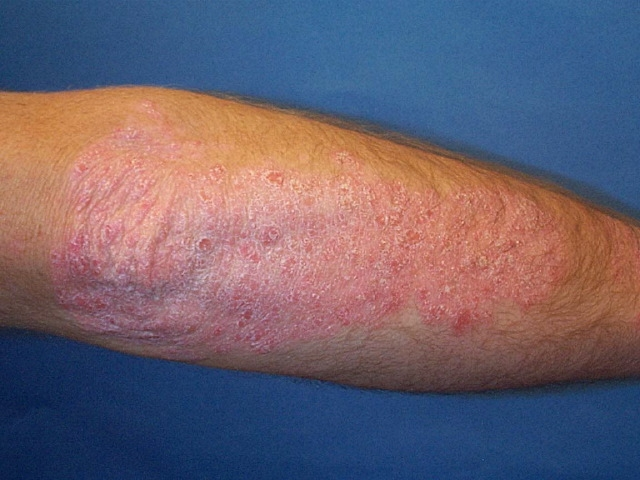 Which of the following histologic changes would be most likely if this patient's skin lesion were biopsied?
 (Multiple Choice)
4.8/5 (86)
(86) A 63-year-old man is brought to the emergency department due to an episode of syncope. The patient was recently discharged back to a nursing home after being hospitalized for a urinary tract infection. He has a history of coronary artery disease and takes aspirin, clopidogrel, and atorvastatin. His other medical conditions include type 2 diabetes mellitus and hypertension. The patient does not use tobacco, alcohol, or illicit drugs. Blood pressure is 68/32 mm Hg and pulse is 118/min. Invasive hemodynamic monitoring reveals an elevated right atrial pressure of 17 mm Hg and a pulmonary capillary wedge pressure of 7 mm Hg (normal: 8-10 mm Hg). Which of the following is the most likely cause of this patient's current condition?
(Multiple Choice)
4.9/5 (78)
(78) A 56-year-old man comes to the clinic for a routine checkup. Medical history includes hypertension, type 2 diabetes mellitus, hyperlipidemia, and mild intermittent asthma. The patient currently takes no medications and has not seen a physician in 7 years. He reports feeling well. Blood pressure is 152/101 mm Hg and pulse is 87/min. Waist circumference is 110 cm (43 in). Laboratory results are as follows: 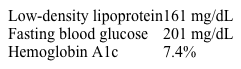 Which of the following vascular beds is most likely to carry the highest atherosclerotic burden in this patient?
 (Multiple Choice)
4.7/5 (91)
(91) A 53-year-old man with nocturnal cough undergoes an upper endoscopy with esophageal biopsy. Light microscopy of the tissue specimen shows elongation of the lamina propria papillae with several eosinophils and neutrophils scattered within the squamous epithelium. The patient takes metformin and enalapril for diabetes mellitus and hypertension, respectively. He is started on pantoprazole, and after 2 weeks his cough symptoms resolve. Which of the following was the most likely cause of his symptoms?
(Multiple Choice)
4.9/5 (84)
(84) A 70-year-old man comes to the office due to abdominal pain that began 1 month ago. He has also experienced fatigue and weight loss. He has no chronic medical conditions and takes no daily medications. The patient worked in a factory that produced polyvinyl chloride for several decades and is now retired. Physical examination shows hepatomegaly. Imaging demonstrates a liver mass, which is subsequently resected. Immunohistochemical staining of the tumor cells is positive for CD31. Which of the following is the most likely diagnosis?
(Multiple Choice)
4.9/5 (82)
(82) A 43-year-old woman comes to the office due to episodic confusion, blurred vision, tremors, and sweating. The episodes have increased in intensity in the past few months and seem to occur any time during the day. Her symptoms are relieved by drinking orange juice. During a recent episode, the patient's blood glucose level was 32 mg/dL as measured by her husband's home glucose meter. Medical history includes major depression and irritable bowel syndrome. Laboratory studies performed during the next episode of symptoms show the following results: 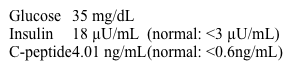 Which of the following is the most likely cause of this patient's symptoms?
 (Multiple Choice)
4.9/5 (71)
(71) A 64-year-old man comes to the office with fatigue. He has hypertension and poorly controlled diabetes complicated by nephropathy and peripheral neuropathy. His renal function has declined steadily over the last few years. On examination, his conjunctivae are pale and he has bilateral 1+ peripheral edema. Laboratory results are as follows: 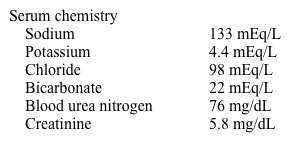 On the graph below, area "C" shows the normal relationship between serum concentrations of free calcium and parathyroid hormone. Which of the following areas most likely represents this patient's current metabolic state?
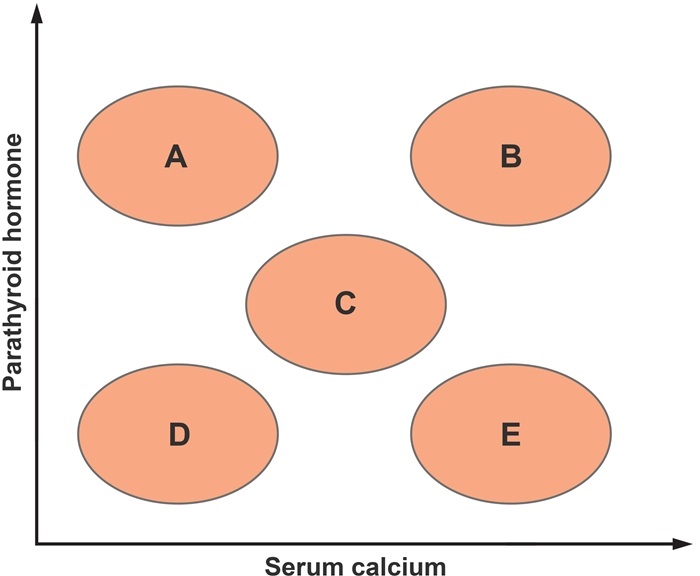
On the graph below, area "C" shows the normal relationship between serum concentrations of free calcium and parathyroid hormone. Which of the following areas most likely represents this patient's current metabolic state? (Multiple Choice)
4.7/5 (85)
(85) A 75-year-old man is brought to the emergency department due to 2 hours of left-sided chest pain and dyspnea. The patient has lived in a skilled nursing facility since developing right-sided hemiplegia, hemi-sensory loss, and aphasia 4 months ago. He has a history of diabetes mellitus, hypertension, and hypercholesterolemia. As an ECG is being obtained, the patient develops ventricular fibrillation and dies despite resuscitative efforts. An autopsy is performed; a coronal section of the brain is shown in the image below. 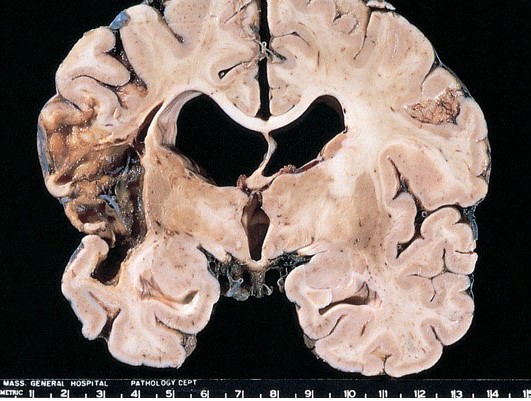 The walls of the brain lesion are most likely composed of which of the following?
 (Multiple Choice)
4.9/5 (82)
(82) A 4-month-old girl is brought to the office for a well-child evaluation. The girl has been growing and developing normally and her parents have no concerns. When questioned about the home environment, the parents say that they both smoke cigarettes but "try to smoke outside the house." The patient's mother smoked a pack of cigarettes a day until her second trimester, when she found out she was pregnant. However, she resumed smoking shortly after delivery and says that the stress of sleep deprivation and difficulty with postpartum weight loss have made it difficult for her to quit. The parents are counseled on the risks of secondhand smoke exposure. Which of the following conditions is the infant at highest risk for developing from exposure to cigarette smoke?
(Multiple Choice)
4.8/5 (71)
(71) A 68-year-old woman is evaluated after recurrent episodes of bright red blood per rectum. She has had no abdominal pain, nausea, vomiting, or hematemesis. Her medical conditions include hypertension and obesity. She is a smoker, has a sedentary lifestyle, and consumes processed food and red meat frequently. Abdominal examination shows no abnormalities. Colonoscopy reveals numerous mucosal outpouchings in the sigmoid colon, and sigmoid colectomy is performed. Histopathology of this patient's colonic lesions is most likely to reveal which of the following findings?
(Multiple Choice)
4.8/5 (73)
(73) A 54-year-old man comes to the office due to 2 days of redness and pain in his right arm. He was recently diagnosed with superficial thrombophlebitis involving the left lower and upper extremities. His symptoms then subsided within days of nonsteroidal anti-inflammatory drug therapy only. The patient has no other past medical history. He has some abdominal discomfort that he attributes to gastroesophageal reflux disease. Temperature is 37.6 C (99.7 F). On examination, there is erythema and tenderness extending linearly from the right forearm to just anterior to the right antecubital fossa. No fluid collection is palpable. Complete blood count shows mild leukocytosis. The patient's symptoms may indicate the presence of which of the following?
(Multiple Choice)
4.8/5 (75)
(75) A 48-year-old woman comes to the office due to a sore throat for the past 3 months. On examination, she is found to have an enlarged, ulcerated left tonsil and a firm, nontender, nonmobile left neck mass. The patient undergoes biopsy of the tonsil. Pathology is consistent with squamous cell carcinoma. Further analysis of the biopsy specimen shows expression of viral genome proteins. Which of the following most likely predisposed the patient to the development of this malignancy?
(Multiple Choice)
4.7/5 (76)
(76) A 25-year-old woman comes to the office with a 3-month history of fatigue, myalgias, arthralgias, and a 5-kg (11-lb) weight loss. She has also recently experienced leg pain with activity, which resolves with rest. The patient has no other medical conditions and takes no medications. Temperature is 37.6 C (99.7 F), and blood pressure is 160/90 mm Hg in the right arm and 120/80 mm Hg in the left. A bruit is heard over the left subclavian artery. Left radial pulse and dorsalis pedis pulses in both legs are weak. The remainder of the examination shows no abnormalities. Laboratory results reveal a hemoglobin level of 9.8 g/dL and an erythrocyte sedimentation rate of 110 mm/hr. Which of the following most likely underlies this patient's current condition?
(Multiple Choice)
4.8/5 (82)
(82) A 29-year-old woman is evaluated for severe left hip pain after twisting her leg. She has bony deformities of the lower extremities, and her mobility is limited. The patient has a history of hyperthyroidism, which was managed with radioiodine therapy. Menarche was at age 7, and she has regular 30-day cycles. Physical examination shows large, hyperpigmented macules with irregular borders located on the left shoulder, left side of the neck, and left buttock. X-ray findings are shown in the image below. 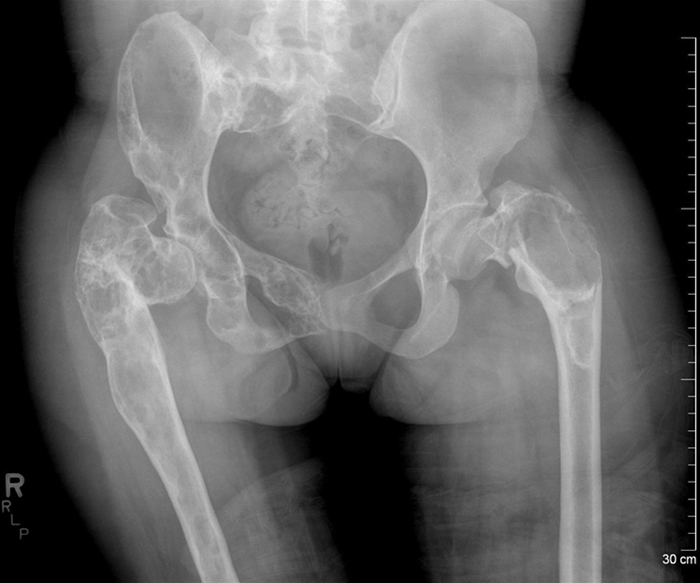 Which of the following is the most likely diagnosis?
 (Multiple Choice)
4.9/5 (76)
(76) 
Filters
- Essay(0)
- Multiple Choice(0)
- Short Answer(0)
- True False(0)
- Matching(0)