



 Chat with AI
Exam 10: Pathology

Exam 1: Anatomy291 Questions
Exam 2: Behavioral science240 Questions
Exam 3: Biochemistry156 Questions
Exam 4: Biostatistics117 Questions
Exam 5: Embryology52 Questions
Exam 6: Genetics103 Questions
Exam 7: Histology24 Questions
Exam 8: Immunology129 Questions
Exam 9: Microbiology336 Questions
Exam 10: Pathology816 Questions
Exam 11: Pathophysiology464 Questions
Exam 12: Pharmacology538 Questions
Exam 13: Physiology272 Questions
Select questions type


A 68-year-old man comes to the office due to severe fatigue for the last few months. He has also had 6.8-kg (15-lb) of unintentional weight loss over the same period. The patient has no significant medical history and has not seen a physician in many years. He takes no medications and does not use tobacco, alcohol, or illicit drugs. Physical examination shows mucosal pallor with no scleral icterus. The lungs are clear on auscultation, and heart sounds are normal. Abdominal examination shows mild hepatomegaly and a markedly enlarged spleen. Stool guaiac testing is negative. Laboratory results show pancytopenia, and peripheral blood smear is shown below. 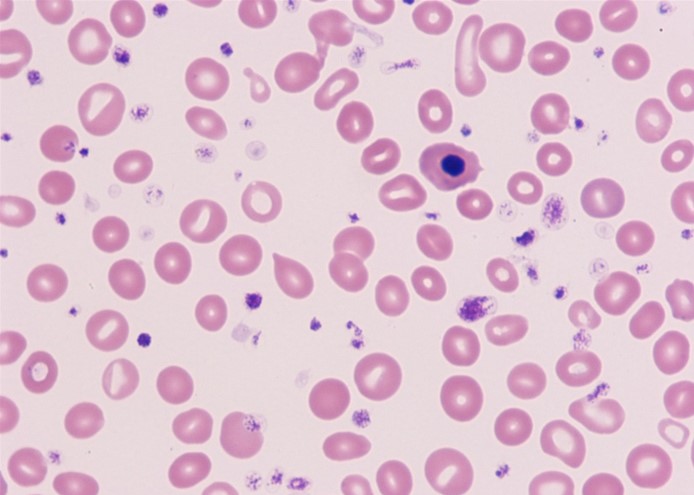 Bone marrow aspiration is attempted but yields no marrow, and a bone marrow biopsy is subsequently performed. Which of the following findings is most likely to be observed in this patient's bone marrow?
 (Multiple Choice)
4.9/5  (81)
(81) A 65-year-old man comes to the physician because of a non-healing ulcer on his right foot. His past medical history is significant for recurrent high blood glucose readings for the last several years, because he has failed to comply with appropriate treatment. His BMI is 37 kg/m2. Physical examination is significant for a bilateral symmetric decrease in vibration sensation over the feet and ankles. Which of the following is most likely to be associated with this patient's condition?
(Multiple Choice)
4.8/5 (85)
(85) A 4-year-old Caucasian boy is evaluated for difficulty walking. Past medical history includes frequent respiratory infections. Cultured cells from this patient demonstrate a high rate of radiation-induced genetic mutation. This patient is most likely to experience which of the following?
(Multiple Choice)
4.7/5 (70)
(70) A 65-year-old man comes to the office due to tremors. He was diagnosed with idiopathic Parkinson disease 10 years ago and has since been successfully treated with levodopa/carbidopa. However, over the last several months, he has developed frequent "freezing" episodes characterized by a sudden loss of mobility. More recently, the patient's tremors worsened after he reduced his levodopa dose following the development of excessive body movements. On examination, he has a bilateral resting tremor that is worse on the right, bradykinesia, and cogwheel rigidity. He is interested in discussing surgical options. This patient would most likely benefit from high-frequency deep brain stimulation targeted at suppressing neuronal activity in which of the following brain structures?
(Multiple Choice)
4.8/5 (68)
(68) A 30-year-old man with a history of epilepsy comes to the office for follow-up. He has a history of recurrent seizures that start as jerky, rhythmic movements of his left leg and gradually spread to involve the entire left side of his body. The patient frequently loses consciousness and has been witnessed to have a generalized tonic-clonic seizure. Neuroimaging has revealed a focal lesion in the right motor area. He has been treated with several antiepilepsy drugs, but his seizures have remained poorly controlled. Surgery is performed to remove the lesion, and the excised brain tissue shows a 1.5-cm mass composed of engorged purplish clusters. Microscopy shows numerous dilated capillaries with an endothelial lining separated by a thin layer of fibrous connective tissue. Which of the following is the most likely diagnosis?
(Multiple Choice)
4.9/5 (77)
(77) A 32-year-old woman comes to the office due to a small amount of malodorous vaginal discharge. She is sexually active with a male partner and uses condoms sporadically. The patient also requests testing for all sexually transmitted diseases because she is unsure if her partner is monogamous. She drinks a glass of wine every night with dinner and has had an abnormal Pap test in the past. Speculum examination reveals thin, gray discharge. Wet mount microscopy of the discharge shows large, atypical vaginal epithelial cells and no protozoa. Application of potassium hydroxide solution to the discharge yields a strong odor. Which of the following is the best treatment option for this patient?
(Multiple Choice)
4.8/5 (82)
(82) A 5-week-old boy is being evaluated for a week-long history of rapid breathing and tiring with feeds. The infant was born at home after an uneventful pregnancy. The mother declined all prenatal testing and ultrasound evaluations. His temperature is 36.7 C (98 F), blood pressure is 76/38 mm Hg, pulse is 124/min, and respirations are 66/min. The patient's cardiovascular examination is notable for a hyperdynamic precordium, a mid-diastolic rumble at the left sternal border, and a 3/6 holosystolic murmur in the apex that radiates to the left axilla. An echocardiogram shows defects in the lower part of the interatrial septum and the interventricular septum. This patient's condition is most likely associated with which of the following genetic conditions?
(Multiple Choice)
4.8/5 (65)
(65) A 36-year-old woman comes to the office due to arthralgias and nodules on her legs. She has no prior medical conditions and takes no medications. On physical examination, there is moderate hepatomegaly. A representative skin rash is shown in the image below. The lesions are tender and present predominantly on the anterior surface of the lower extremities. 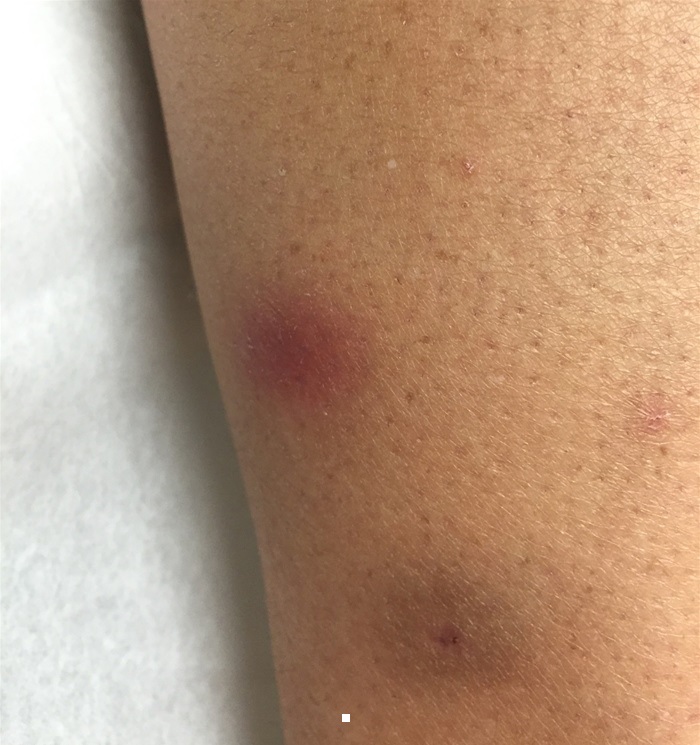 Chest x-ray demonstrates enlarged hilar lymph nodes, and laboratory testing reveals an elevated ACE level. Which of the following would most likely be found on liver biopsy in this patient?
 (Multiple Choice)
4.8/5 (81)
(81) A 50-year-old man is scheduled to undergo a colonoscopy for routine colorectal cancer screening. He has no abdominal pain, gross blood in the stool, constipation, change in stool caliber, or unintentional weight loss. He also has no family history of colon cancer. The procedure is uncomplicated, but the patient is found to have a small mucosal lesion (~1 cm) in his sigmoid colon. The lesion is biopsied and its histology is shown in the image below. 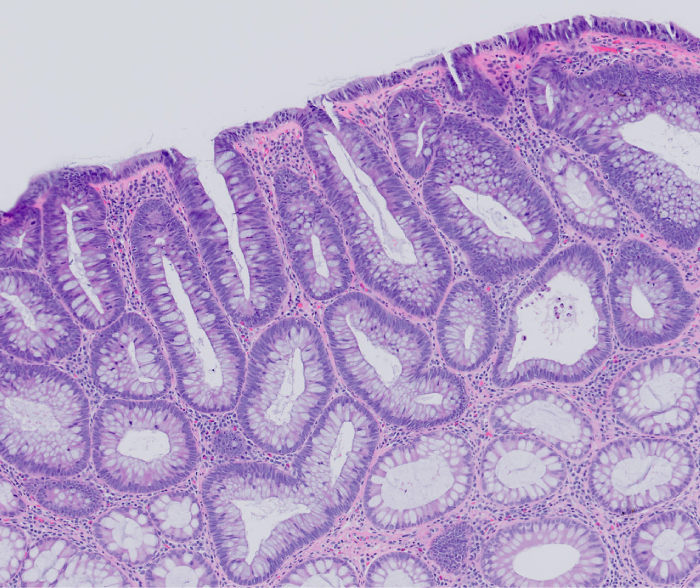 The pathogenesis of this patient's lesion most likely began with a mutation involving which of the following genes?
 (Multiple Choice)
4.8/5 (76)
(76) A 20-year-old man comes to the office due to pain in the left thigh. Three months ago, a horse kicked him in the left midthigh, resulting in deep pain and swelling in the thigh muscles; x-ray was normal, and, over the next several days, the symptoms resolved with rest and ice packs. However, a few weeks later, the patient gradually developed recurrent pain and swelling in the same area. Vital signs are normal. Examination shows a solitary, hard, mobile, oval mass of approximately 4 × 5 cm in the anterior aspect of the left thigh. Excision of the mass is performed. Histologic examination is likely to show which of the following?
(Multiple Choice)
4.8/5 (88)
(88) A 44-year-old woman, gravida 2, para 2, is being evaluated after having several episodes of painless postcoital bleeding. She emigrated from Guatemala 5 years ago and has not received any preventative health care. The patient is married and gave birth to two girls via vaginal delivery at home in Guatemala. Her menstrual periods have been regular, and she uses barrier contraceptives. Speculum examination reveals an ulcerative lesion at the external cervical os. Cervical biopsy shows malignant squamous cells invading the underlying stroma. Further analysis of the malignant cells reveals that a double-stranded DNA virus, which encodes several proteins including E6 and E7, has integrated into the host genome. Which of the following is the most likely mechanism by which these viral proteins are involved in this patient's condition?
(Multiple Choice)
4.9/5 (73)
(73) A 54-year-old man is brought to the office by his friend because of worsening memory impairment over the past several months. The patient is also withdrawn and not focused during conversations. He is slow to answer questions or carry out instructions. The patient has a prolonged history of HIV infection and has had several opportunistic infections due to inconsistent antiretroviral medication use. On physical examination, he is alert and oriented. Muscle strength, deep tendon reflexes, and sensation are normal. MRI of the head shows diffuse cerebral atrophy with no focal mass lesions or areas of demyelination. Viral proliferation in which of the following central nervous system cells is most likely involved in this patient's disease process?
(Multiple Choice)
4.9/5 (86)
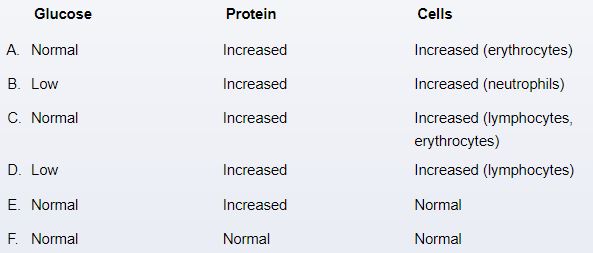
(86) A 23-year-old man with no prior history of seizure is brought to the emergency department after experiencing a generalized tonic-clonic seizure. His roommate says that the patient has had a fever and headache for the past 2 days and that today he was talking nonsensically. The patient works for a fast-food chain and occasionally smokes cigarettes on his breaks. He does not use alcohol or illicit drugs. Temperature is 38.6 C (101.5 F). MRI of the brain shows swelling of the temporal lobes. CSF analysis is most likely to reveal which of the following?
(Multiple Choice)
4.8/5 (84)
(84) A 59-year-old woman comes to the office due to recurrent facial pain for the past month. The pain occurs only on the left side. It starts just in front of the ear as a shock-like sensation that quickly radiates down the jaw over 4-8 seconds, then resolves. It is most commonly triggered by chewing, so the patient sometimes skips meals to avoid the pain. Vital signs are normal. The patient has lost 4.5 kg (10 lb) since she was last seen 6 months ago. Physical examination of the oral cavity shows no dental caries. Severe pain is reproduced with light touch of the left cheek. Neurologic examination is otherwise normal. Which of the following is the most likely cause of this patient's condition?
(Multiple Choice)
4.8/5 (72)
(72) A 7-year-old boy is brought to the emergency department due to bloody stools. The patient first developed colicky abdominal pain 2 days ago, and he had blood in a bowel movement today. His urine also appeared red. He has had no diarrhea, vomiting, or dysuria. The boy has no significant medical history, and his vaccinations are up to date. Temperature is 37.2 C (99 F), pulse is 120/min, and respirations are 20/min. The oropharynx is clear, and the neck is supple. Cardiopulmonary examination is unremarkable. The abdomen is diffusely tender with active bowel sounds. There are raised, purple-red skin lesions along the buttocks and lower extremities. Which of the following additional findings is most likely present in this patient?
(Multiple Choice)
4.8/5 (85)
(85) A 55-year-old man is brought to the emergency department due to severe substernal chest pain that is accompanied by sweating and mild dyspnea. The pain started as midline chest discomfort several hours ago but then progressively worsened such that the patient could not fall asleep. He received sublingual nitroglycerin in the ambulance without significant pain relief. His medical history includes hypertension, type 2 diabetes mellitus, and hyperlipidemia. ECG demonstrates normal sinus rhythm and ST-segment elevation in leads I, aVL, and V1-V4, with deep Q wave development over the next several hours. Cardiac catheterization in this patient would most likely show which of the following?
(Multiple Choice)
4.8/5 (80)
(80) A 65-year-old man comes to the emergency department with right upper and lower extremity weakness and slurred speech. The patient went to bed in his usual state of health and woke up with these symptoms. His medical problems include type 2 diabetes mellitus, hypertension, and hyperlipidemia. He takes atorvastatin, metformin, lisinopril, and low-dose aspirin. The patient has smoked a pack of cigarettes daily for the past 40 years. His temperature is 36.7 C (98 F), blood pressure is 160/90 mm Hg, and pulse is 118/min. He is mildly dysarthric with a right lower facial droop and right-sided hemiparesis. A noncontrast head CT is normal. Brain MRI reveals an acute subcortical infarct in the left internal capsule. Six months later, which of the following findings is most likely to be observed in the affected pyramidal tracts of this patient?
(Multiple Choice)
4.8/5 (74)
(74) A 61-year-old man comes to the emergency department due to fever, chills, and a productive cough with thick, blood-tinged sputum for the past several days. His temperature is 38.8 C (102 F), blood pressure is 90/60 mm Hg, and pulse is 110/min. On examination, the patient is lethargic and ill appearing. Bronchial breath sounds and crackles are present in the right lung. Blood and sputum cultures grow Klebsiella pneumoniae. It is determined that the bacteria express a lipopolysaccharide on their outer membrane surface that stimulates toll-like receptors in the inflammatory cells. This in turn leads to degradation of the IκB inhibitor protein, which normally binds to a latent transcription factor found in the cytoplasm. Which of the following factors is most likely to be directly activated by the removal of this inhibitor protein?
(Multiple Choice)
4.8/5 (90)
(90) A 6-year-old boy with no chronic medical conditions is brought to the emergency department due to confusion and intractable vomiting. His symptoms began a few hours ago and have gradually worsened. The patient's mother reports that he contracted a febrile illness from his younger brother 2 days ago. She gave the patient one tablet of an over-the-counter cold medication yesterday, and his fever resolved. While the mother is speaking, the patient lapses into a coma. If a liver biopsy were performed, light microscopy of the specimen would most likely reveal which of the following?
(Multiple Choice)
4.7/5 (80)
(80) A 48-year-old man dies in a motor vehicle crash. He had a history of intravenous drug use and had recently been released from prison. The patient's other medical conditions included hepatitis C and hypertension. On autopsy, he is found to have a small, fibrotic focus in the upper portion of the lower lobe of the right lung and a calcified right hilar lymph node. These autopsy findings are most consistent with which of the following?
(Multiple Choice)
4.7/5 (68)
(68) 
Filters
- Essay(0)
- Multiple Choice(0)
- Short Answer(0)
- True False(0)
- Matching(0)