



 Chat with AI
Exam 10: Pathology

Exam 1: Anatomy291 Questions
Exam 2: Behavioral science240 Questions
Exam 3: Biochemistry156 Questions
Exam 4: Biostatistics117 Questions
Exam 5: Embryology52 Questions
Exam 6: Genetics103 Questions
Exam 7: Histology24 Questions
Exam 8: Immunology129 Questions
Exam 9: Microbiology336 Questions
Exam 10: Pathology816 Questions
Exam 11: Pathophysiology464 Questions
Exam 12: Pharmacology538 Questions
Exam 13: Physiology272 Questions
Select questions type


A 54-year-old male presents with an enlarged left-sided supraclavicular lymph node. The node is painless and stony hard on palpation. The node biopsy reveals anaplastic cells that stain positive for keratin. Which of the following is the most likely origin of the cells detected on the biopsy?
(Multiple Choice)
4.9/5  (86)
(86) A 60-year-old man comes to the office due to a 4-month history of increasing midthoracic back pain, which is aggravated by coughing. The patient has also had right thigh pain but no numbness or weakness in the legs and no bowel or bladder incontinence. He has no other medical conditions. Vital signs are within normal limits. On examination, there is tenderness over the eighth and ninth thoracic vertebrae. Neurologic examination is normal. The prostate is normal in size and has no palpable nodules. Imaging studies reveal enlarged vertebral bodies with cortical thickening. Serum testing for which of the following would most likely help establish a diagnosis in this patient?
(Multiple Choice)
4.9/5 (79)
(79) A 9-month-old boy is brought to the clinic by his parents for a well-child check. The mother says that he cannot roll over, sit without support, or crawl. The patient can reach for toys with his left hand but not with his right. He was born at 28 weeks gestation, and Apgar scores were 5 and 6 at 1 and 5 minutes, respectively. The patient's birth weight was 1.2 kg (2 lb 10 oz), and he was admitted to the neonatal intensive care unit for 3 months. Head circumference and length are at the 50th percentile; weight is at the 15th percentile. Vital signs are normal. On examination, the patient keeps his right hand fisted shut. Muscle tone and deep tendon reflexes are increased in the right arm and leg. Which of the following is the most likely cause of this patient's condition?
(Multiple Choice)
4.9/5 (78)
(78) A 50-year-old woman, gravida 0 para 0, comes to the office for a well visit. She has no family history of cancer. Breast examination is normal. The patient has a screening mammography that reveals microcalcifications. Due to this finding, she undergoes a breast biopsy. Histopathology reveals ducts distended by pleomorphic cells with prominent central necrosis. The lesion does not extend beyond the ductal basal membrane. Which of the following is most likely the origin of the lesion? 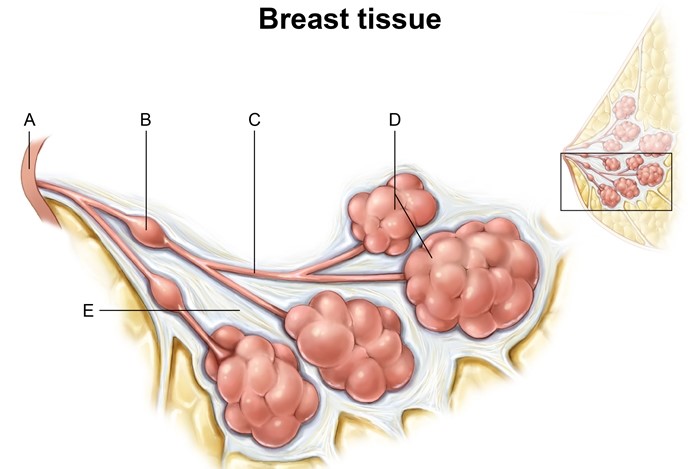
(Multiple Choice)
4.9/5 (78)
(78) A 44-year-old man is evaluated in the clinic for occasional chest discomfort that is not consistently related to exertion. The patient's past medical history is significant for hypertension and hyperlipidemia. His grandfather experienced a myocardial infarction at age 50. Coronary CT angiography reveals several nonobstructive atherosclerotic plaques in the coronary arteries. One plaque in the proximal left anterior descending artery appears extensive, has a large hypodense core, and occupies 40% of the lumen. No intervention is performed. One year later, the patient comes to the emergency department with acute severe chest pain and is found to have thrombotic occlusion of the proximal left anterior descending artery. High intraplaque activity of which of the following enzymes most likely resulted in this patient's myocardial infarction?
(Multiple Choice)
4.8/5 (74)
(74) A 43-year-old woman comes to the office due to progressive fatigue and intermittent pain in the hands, feet, and knee joints. The pain caused the patient to stop her daily yoga routine 2 months ago, and she has had difficulty performing daily household activities. She has had no fever, rash, or oral ulcers but frequently drinks water or chews gum due to her mouth feeling dry. The patient has no prior medical conditions and takes no medications or herbal supplements. She does not use tobacco, alcohol, or illicit drugs. Vital signs are within normal limits. Physical examination shows no muscle tenderness or joint swelling. The thyroid gland is normal to palpation. There is nontender diffuse swelling of the parotid glands. Laboratory evaluation reveals mild normocytic normochromic anemia and an elevated erythrocyte sedimentation rate. A salivary gland biopsy image representative of this patient's disease process is shown in the exhibit. 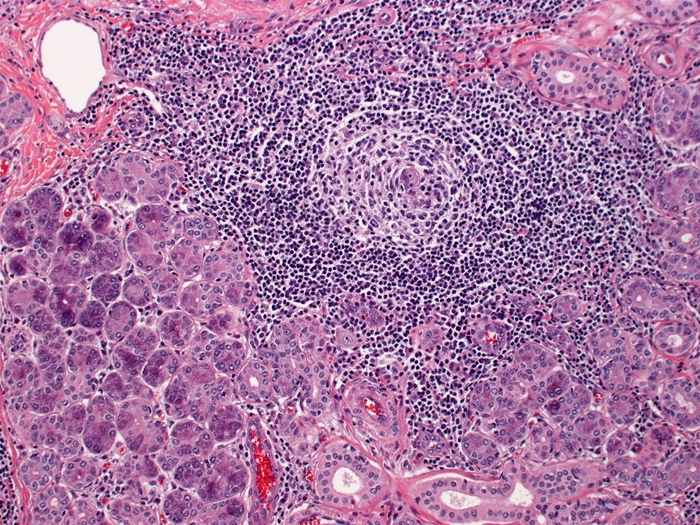 This patient is at greatest risk for which of the following due to her current condition?
 (Multiple Choice)
4.8/5 (73)
(73) A 26-year-old woman dies shortly after a sudden-onset, severe headache. She was recently diagnosed with hypertension but otherwise had no medical problems. The patient was a lifetime nonsmoker and did not use illicit drugs. Autopsy reveals evidence of intracranial hemorrhage. Both carotid arteries appear tortuous distally with alternating areas of fibrotic webs and aneurysmal dilation. On microscopic examination, the aneurysmal segments of the carotid arteries lack an internal elastic lamina. Which of the following is the most likely additional finding in this patient?
(Multiple Choice)
4.9/5 (90)
(90) A 41-year-old previously healthy woman comes to the office due to weakness and easy fatigability. She also has had several episodes of epistaxis and gum bleeding. Physical examination reveals mucosal pallor. Further evaluation demonstrates that the patient has a clonal proliferation of white blood cells containing an abnormal protein. In an experiment, the abnormal cells from the patient are purified and cultured in 2 different plates, one with a vitamin A derivative (plate 1) and the other with control (plate 2). After several days of incubation, cells in plate 1 are well differentiated compared to those in plate 2, and clonal proliferation is inhibited. This patient most likely has which of the following conditions?
(Multiple Choice)
4.8/5 (84)
(84) A 3-year-old boy is being evaluated for recurrent generalized seizures and developmental delay. Physical examination is notable for scattered hypopigmented skin patches. MRI of the head reveals multiple masses, most of which line the ependymal surfaces of the lateral ventricles, and some are calcified, as shown in the below image. 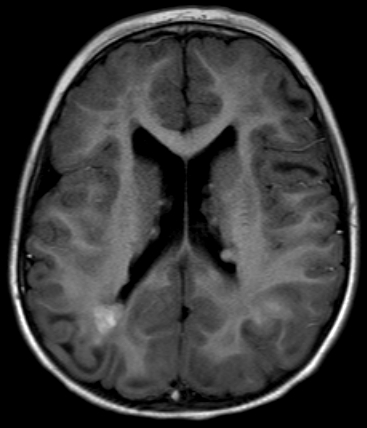 Which of the following is the most likely underlying cause of this patient's brain lesions?
 (Multiple Choice)
4.9/5 (78)
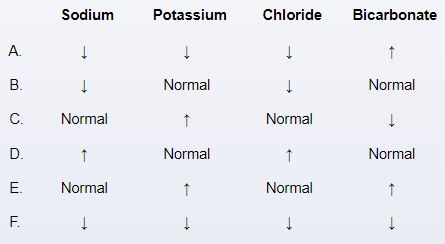
(78) A 35-year-old pregnant woman at 8 weeks gestation comes to the emergency department due to persistent nausea and vomiting. The patient has had intermittent nausea for the past week and vomiting for the past 3 days. Now, she is unable to tolerate solids or liquids. Temperature is 36.7 C (98 F), blood pressure is 90/64 mm Hg, pulse is 108/min, and respirations are 14/min. Mucous membranes are dry and capillary refill time is delayed. Cardiac examination shows sinus tachycardia and no murmurs. The abdomen is nontender and nondistended. Compared to her baseline, which of the following sets of serum electrolyte concentration abnormalities are most likely present in this patient?
(Multiple Choice)
4.9/5 (73)
(73) An 81-year-old woman reports progressively increasing bilateral shoulder pain for 2 months. Over the past 2 weeks, she has developed burning pain in her right thumb, index, and middle fingers. Medical history is significant for type 2 diabetes mellitus and end-stage renal disease due to diabetic nephropathy. The patient has received hemodialysis for the past 10 years. Vital signs are normal. Examination reveals normal heart and lung sounds. There is no organomegaly. Both shoulders are hypertrophied. There is thenar atrophy on the right hand and soft tissue fullness at the right wrist. Which of the following is most likely responsible for this patient's current condition?
(Multiple Choice)
4.9/5 (68)
(68) A 62-year-old woman comes to the office due to a vague feeling of heaviness in her legs, especially when standing for long periods. She has no history of trauma to the legs. The patient's other medical problems include osteoarthritis and gastroesophageal reflux disease. She has worked as a cashier at a department store for the last 20 years. Vital signs are normal. Jugular venous pressure is normal. The heart has regular rate and rhythm with no murmurs or extra sounds. Lung sounds are clear with normal air movement. The abdomen is soft and without masses. Examination of the lower extremities shows dilated, tortuous veins at the calves and ankles bilaterally, with no erythema or edema. Upper extremity examination is unremarkable. This patient's current condition increases the risk for which of the following?
(Multiple Choice)
4.8/5 (81)
(81) A 58-year-old man with dyspnea and chronic exertional angina is evaluated for coronary revascularization. He has a history of hypertension, type 2 diabetes mellitus, and hypercholesterolemia. His blood pressure is 130/80 mm Hg and pulse is 72/min and regular. Cardiopulmonary examination is normal with the exception of a fourth heart sound. Echocardiogram reveals hypokinesia of the anterior wall of the left ventricle and a left ventricular ejection fraction (LVEF) of 35%. The patient undergoes coronary artery bypass grafting. Repeat echocardiogram 10 days after the surgery shows that hypokinesia is no longer evident and LVEF has increased to 50%. Which of the following best explains the changes in the cardiac contractility and wall motion seen in this patient?
(Multiple Choice)
4.9/5 (85)
(85) A 42-year-old man is hospitalized due to fever and persistent sore throat. Temperature is 38.3 C (100.9 F), blood pressure is 120/80 mm Hg, pulse is 94/min, and respirations are 16/min. There are several bruises on his trunk, and blood oozes from his intravenous catheter venipuncture sites. Blood fibrinogen level is 110 mg/dL (normal: 150-400). Bone marrow aspirate shows a predominance of immature myeloid cells with numerous azurophilic, needle-shaped cytoplasmic granules. Chromosomal analysis of these immature cells is most likely to show which of the following abnormalities?
(Multiple Choice)
4.9/5 (77)
(77) A Caucasian male who suffers from a severe neurological disease dies of an overwhelming respiratory infection. Autopsy shows an atrophic precentral gyrus and thin anterior roots of the spinal cord. Light microscopy reveals a severe loss of neurons in the anterior horn of the spinal cord and in the hypoglossal and ambiguous cranial nerve nuclei; corticospinal tracts stain only faintly, indicating demyelinization. The patient most likely suffered from which of the following?
(Multiple Choice)
4.8/5 (72)
(72) A 56-year-old man is admitted to a tertiary care center after being involved in a high-speed motor vehicle accident. The patient was thrown from his vehicle and suffered severe head trauma along with multiple fractures involving his ribs and extremities. Despite aggressive treatment, he dies the following day from massive cerebral edema and brainstem herniation. Autopsy shows the following heart findings:Left atrium: enlarged
Left ventricular myocardial mass: increased
Left ventricular wall thickness: increasedThe structural changes observed in this patient's heart are most likely associated with which of the following conditions?
(Multiple Choice)
4.7/5 (75)
(75) A 56-year-old man comes to the office after 2 episodes of low-volume hemoptysis. He describes it as "streaks of blood" in his sputum. The patient has had a chronic cough over the last several years, most prominently in the morning. He has also had several recent respiratory infections. The patient has smoked a pack of cigarettes daily for the last 40 years. Chest x-ray shows hyperinflated lungs but no infiltrates or masses. Bronchoscopy is performed and several suspicious foci of bronchial mucosa are biopsied. Microscopy of the biopsy sample reveals areas of stratified squamous epithelium. The pathogenesis of this patient's microscopic findings is most similar to which of the following conditions?
(Multiple Choice)
4.8/5 (73)
(73) A 20-year-old man is evaluated for recurrent episodes of jaundice. He was separated from his parents at a young age and is unaware of any family medical history. The patient resided in several foster homes throughout his childhood but currently lives alone. His temperature is 36.7 C (98 F), blood pressure is 120/80 mm Hg, and pulse is 72/min. Physical examination shows pallor, icterus, and mild splenomegaly. There is no lymphadenopathy or hepatomegaly. The remainder of the physical examination is normal. Laboratory test results are as follows: 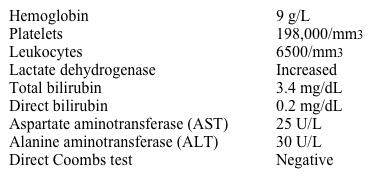 When the patient's red blood cells are incubated in a hypotonic solution with glycerol, hemoglobin is released. The control sample does not release hemoglobin. This patient is at greatest risk of developing which of the following?
 (Multiple Choice)
4.9/5 (63)
(63) A 17-year-old girl is evaluated due to decreased exercise tolerance and fatigue. She has no known medical conditions and takes no medications. Blood pressure is 110/60 mm Hg and pulse is 88/min. The lungs are clear on auscultation. Cardiac examination reveals a parasternal heave, and a widely split second heart sound is heard throughout the respiratory cycle. A systolic ejection murmur is present at the left upper sternal border. Distal pulses are normal. Echocardiography of this patient is most likely to demonstrate which of the following findings?
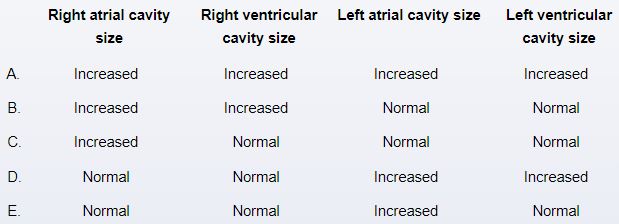
(Multiple Choice)
4.8/5 (87)
(87) A 36-year-old man comes to the office due to a 2-month history of a pruritic rash over the elbows and knees. The patient has been using skin emollients, but the lesions have not improved. He also has a prolonged history of episodic abdominal discomfort, flatulence, and voluminous greasy stools. Cardiopulmonary examination is normal. The abdomen is soft and nontender. Skin examination shows a papulovesicular skin rash in groups with erosion and excoriations. Which of the following is most likely to be seen in this patient?
(Multiple Choice)
4.7/5 (69)
(69) 
Filters
- Essay(0)
- Multiple Choice(0)
- Short Answer(0)
- True False(0)
- Matching(0)