



 Chat with AI
Exam 10: Pathology

Exam 1: Anatomy291 Questions
Exam 2: Behavioral science240 Questions
Exam 3: Biochemistry156 Questions
Exam 4: Biostatistics117 Questions
Exam 5: Embryology52 Questions
Exam 6: Genetics103 Questions
Exam 7: Histology24 Questions
Exam 8: Immunology129 Questions
Exam 9: Microbiology336 Questions
Exam 10: Pathology816 Questions
Exam 11: Pathophysiology464 Questions
Exam 12: Pharmacology538 Questions
Exam 13: Physiology272 Questions
Select questions type


A 64-year-old man develops diarrhea, abdominal pain, nausea, vomiting, and anorexia 3 weeks after starting radiation therapy for prostate cancer. Physical examination shows abdominal tenderness. Sigmoidoscopy reveals hyperemia, edema, erosion, and ulceration of the intestinal mucosa. Stool and serum chemistries are normal. Radiation enteritis is suspected. Which of the following is most likely the primary mechanism responsible for this patient's intestinal changes?
(Multiple Choice)
4.9/5  (89)
(89) A 72-year-old man comes to the office after several days of mild headache and lethargy. He has also had weakness, chronic cough, and decreased appetite. He drinks 2 or 3 beers each weekend and has a 40-pack-year smoking history. Temperature is 37 C (98.6 F), blood pressure is 120/84 mm Hg, pulse is 78/min, and respirations are 24/min. Lung examination shows mildly prolonged expiration with end-expiratory wheezes. Laboratory results are as follows: 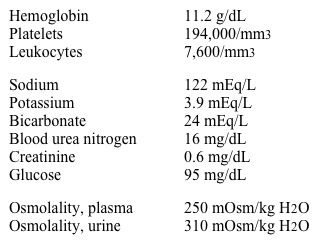 Chest x-ray reveals overinflated lung fields and a 2.5-cm left hilar mass. Biopsy of the mass would most likely show which of the following?
 (Multiple Choice)
4.9/5 (85)
(85) A 5-year-old Caucasian boy is brought to the physician's office with recent-onset gait instability and gait ataxia. MRI of the brain shows a midline posterior fossa mass. Biopsy of the mass reveals sheets of primitive cells and many mitotic figures. This patient most likely suffers from which of the following?
(Multiple Choice)
4.9/5 (76)
(76) A 35-year-old woman comes to the office due to trouble seeing out of her right eye. The patient started having blurry vision and pain with eye movement 2 days ago. She has no headache, vertigo, slurred speech, numbness, or weakness. Two years ago, the patient had an episode of double vision that spontaneously resolved after a few weeks. On physical examination, she has an afferent pupillary defect with markedly reduced visual acuity on the right. Funduscopy reveals blurring of the optic disk margins in the right eye. MRI of the brain reveals multiple, ovoid white matter lesions with perpendicular orientation to the lateral ventricles. This patient's condition is most likely caused by an inappropriate immune response directed against which of the following cells?
(Multiple Choice)
5.0/5 (90)
(90) A 17-year-old boy is brought to the emergency department for progressive fatigue. The patient developed a cough 2 weeks ago, and for the past few days, he has become more tired due to difficulty breathing, particularly when lying down at night. Temperature is 38.2 C (100.8 F), pulse is 120/min, and respirations are 34/min. Examination shows distended neck veins. The lungs have diminished breath sounds, particularly on the left side. Bruising and diffuse petechiae are present on the trunk, and the mucous membranes appear pale. Chest radiography reveals a large mediastinal mass with a left pleural effusion. The effusion is drained, and examination of the fluid shows many immature hematopoietic cells, consistent with blast forms. Immunophenotyping of these cells would most likely reveal which of the following predominant markers?
(Multiple Choice)
4.7/5 (93)
(93) A 73-year-old woman comes to the emergency department with a 3-day history of worsening breathlessness and cough productive of thick, rust-colored sputum. The patient has a longstanding history of hypertension. Temperature is 38.3 C (101 F), blood pressure is 130/68 mm Hg, pulse is 102/min, and respirations are 24/min. BMI is 27 kg/m2. Jugular venous pressure is normal and there is no lower extremity edema. Heart sounds are normal with no murmur. Lung auscultation reveals left lower lobe crackles and bronchial breath sounds. Leukocyte count is 14,000/mm3 with 80% neutrophils and 7% bands, hemoglobin is 13.6 g/dL, and platelets are 400,000/mm3. Serum levels of which of the following are most likely to be elevated in this patient?
(Multiple Choice)
4.9/5 (73)
(73) A 15-year-old girl is evaluated due to persistent fever, fatigue, and sore throat. Physical examination reveals splenomegaly and symmetric posterior cervical lymphadenopathy. Peripheral blood smear results are shown in the image below: 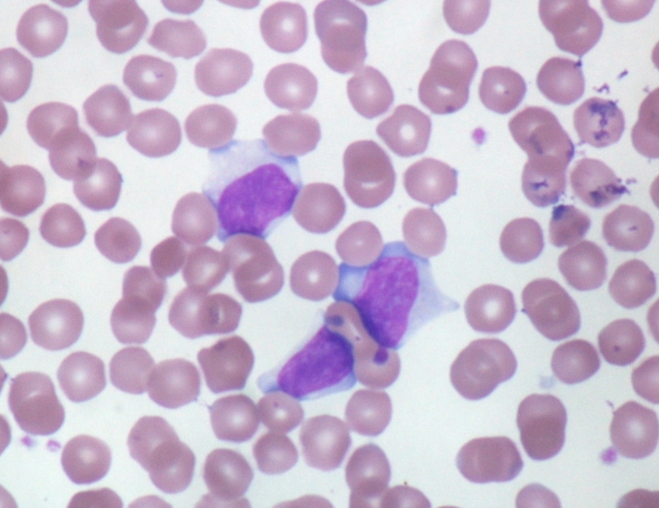 The atypical cells seen here are most likely an activated form of which of the following?
 (Multiple Choice)
4.8/5 (74)
(74) A 55-year-old man comes to the clinic due to gradual, progressive weakness of the right upper extremity over the past 6 months. Over the last month, he has also noticed weakness in the left upper extremity. Vital signs are normal. Physical examination shows fasciculations and atrophy of the intrinsic muscles of the right hand and the muscles of the forearm. Reflexes are brisk in the upper extremities, and the plantar responses are extensor. Mild gait ataxia is present. Over the course of his illness, this patient will most likely develop which of the following?
(Multiple Choice)
4.8/5 (68)
(68) A 60-year-old African-American female is evaluated for fatigue. Past surgical history includes mitral valve repair with a mechanical valve due to severe mitral insufficiency. She has 30-pack year history of smoking and occasionally drinks alcohol. Examination shows pallor. Laboratory studies show the following:Complete blood count 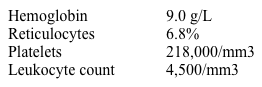 Serum chemistries are within normal limits. Her peripheral smear shows red blood cell fragments, "burr cells," and "helmet cells". Which of the following is the most likely cause of her condition?
 (Multiple Choice)
4.9/5 (93)
(93) A 55-year-old Caucasian male is found on colonoscopy to have a solitary mass in his sigmoid colon. Biopsy is consistent with colon cancer, and surgery is scheduled. Which of the following features would carry the worst prognosis in this patient?
(Multiple Choice)
4.8/5 (85)
(85) A 63-year-old man collapses at home after experiencing severe retrosternal chest pain. The emergency medical team finds him with no pulse, and cardiac monitoring shows ventricular fibrillation. Cardiopulmonary resuscitation is performed, and the patient regains spontaneous circulation after several minutes. On arrival at the hospital, he has stable vital signs but does not follow commands or respond to strong stimuli. Which of the following areas is most likely to be affected first by ischemic damage in this patient?
(Multiple Choice)
4.8/5 (84)
(84) A 21-year-old woman with type 1 diabetes mellitus comes to the office for a follow-up appointment. She has been using daily long-acting and short-acting insulin injections from the time she was diagnosed 6 years ago. The patient was seen by her ophthalmologist 2 weeks ago and had no signs of diabetic retinopathy. She eats a balanced diet and jogs every morning for 40 minutes. On examination, the skin of her extremities is intact and peripheral pulses are palpable. Sensory examination shows normal pinprick, vibration, and temperature sensation in her lower extremities. Laboratory evaluation shows normal renal function and lipid profile. The patient's hemoglobin A1c level is 7%. Screening for early-stage diabetic nephropathy in this patient would best be accomplished by measuring the urinary concentration of which of the following substances?
(Multiple Choice)
4.9/5 (77)
(77) A 16-year-old girl comes to the office due to 2 days of a burning sensation with urination. She had sexual intercourse with her partner last week and used a condom for contraception. The patient says, "I always urinate right after sex." She has no vaginal discharge, and vital signs are normal. Examination shows suprapubic tenderness. Urinalysis reveals positive nitrites, positive leukocyte esterase, 50 white blood cells/hpf, and many bacteria. Urine β-hCG is negative. Which of the following is the most likely cause of this patient's infection?
(Multiple Choice)
4.9/5 (87)
(87) After initial assessment, the appropriate interventions are initiated. Targeted suppression of which of the following hormones is the best next step to limit androgen overproduction?
(Multiple Choice)
4.9/5 (95)
(95) An 80-year-old woman is evaluated for blisters that have developed on both feet over the past week. The patient lives in a nursing home due to dementia but has no other chronic medical conditions and takes no medication. Vital signs are within normal limits. There are no oral lesions. Examination findings are shown in the exhibit. 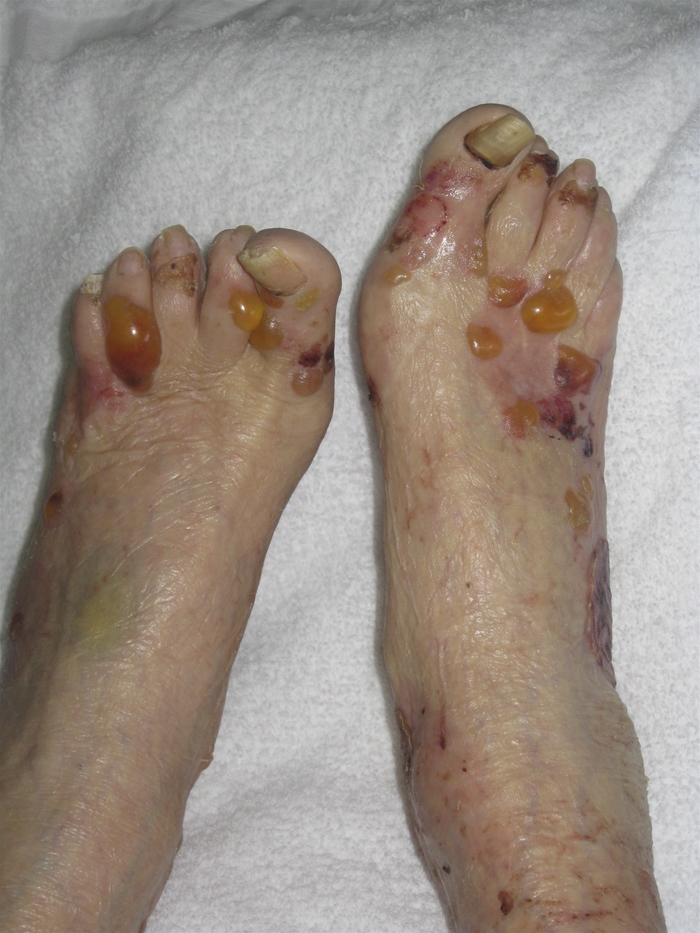 Which of the following is most likely involved in the pathogenesis of this patient's condition?
 (Multiple Choice)
4.9/5 (81)
(81) A 27-year-old woman comes to the office due to almost daily headaches for the past 3 months. The patient describes constant "dull pressure" in her head that is worse at the end of the day. She is an office manager and is able to work through the pain. The patient has a history of seasonal allergies and her sister has migraine headaches. Which of the following is the most likely diagnosis?
(Multiple Choice)
4.7/5 (88)
(88) A 12-year-old boy is brought to the office by his mother due to headaches and gait instability. His symptoms began several months ago and have progressively worsened. MRI of the brain is shown in the image below. 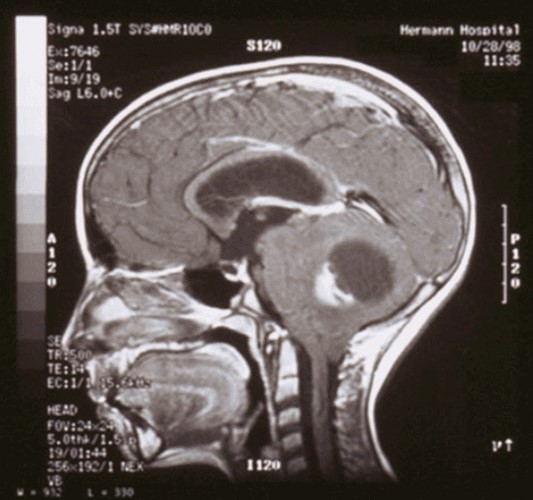 Which of the following is the most likely diagnosis?
 (Multiple Choice)
4.8/5 (90)
(90) A 34-year-old man comes to the emergency department due to severe headache. The patient describes unbearable, throbbing pain around his right eye that awakened him. Over the past week, he has had several similar episodes, which spontaneously resolved after 20-30 minutes. He has no other medical conditions and takes no medications. The patient smokes a pack of cigarettes daily and drinks alcohol on social occasions. On physical examination, he appears restless and paces in the room. There is mild conjunctival injection and miosis of the right eye. Neurologic examination shows no abnormalities. Which of the following is the most likely cause of this patient's current symptoms?
(Multiple Choice)
4.7/5 (80)
(80) An 18-year-old woman is referred to a cardiologist after a heart murmur is discovered during a routine checkup. The patient is healthy and has no symptoms. Medical history is unremarkable. She runs daily and wants to start actively training for a half marathon. The patient is concerned that the murmur is a sign of heart disease. She has no family history of sudden cardiac death. Auscultation reveals a midsystolic click followed by a short late-systolic murmur at the cardiac apex. The murmur disappears with squatting. This patient's condition is most likely related to an abnormality involving which of the following tissues?
(Multiple Choice)
4.9/5 (84)
(84) A 5-week-old boy is brought to the emergency department after having tonic-clonic movements of his left upper and lower extremity that lasted approximately 3 minutes. The patient was born at home at 38 weeks gestation to a 23-year-old primigravida. The patient's mother received prenatal care, took prenatal vitamins, and had a healthy diet during pregnancy. The infant's newborn screen was positive for cystic fibrosis, and confirmatory testing is pending. The infant has been breastfeeding and gaining weight well. He has never taken any medications and also has received no vaccinations. On examination, the infant is postictal but no longer seizing. A head CT scan shows a right-sided intracranial hemorrhage. Which of the following is the most likely cause of this infant's presentation?
(Multiple Choice)
4.9/5 (81)
(81) 
Filters
- Essay(0)
- Multiple Choice(0)
- Short Answer(0)
- True False(0)
- Matching(0)