



 Chat with AI
Exam 10: Pathology

Exam 1: Anatomy291 Questions
Exam 2: Behavioral science240 Questions
Exam 3: Biochemistry156 Questions
Exam 4: Biostatistics117 Questions
Exam 5: Embryology52 Questions
Exam 6: Genetics103 Questions
Exam 7: Histology24 Questions
Exam 8: Immunology129 Questions
Exam 9: Microbiology336 Questions
Exam 10: Pathology816 Questions
Exam 11: Pathophysiology464 Questions
Exam 12: Pharmacology538 Questions
Exam 13: Physiology272 Questions
Select questions type


A 4-year-old boy is brought to the office due to hoarseness. The parents report that he has had worsening hoarseness for the past year, and his voice now sounds very raspy and rough. Flexible laryngoscopy is performed and shows bilateral lesions on the true vocal cords. Removal of these lesions is performed via direct laryngoscopy. Histopathologic analysis shows a fibrovascular core with benign squamous cells. The physician explains to the parents that this is likely due to a viral infection acquired through which of the following routes of transmission?
(Multiple Choice)
4.8/5  (76)
(76) A 67-year-old man comes to the office due to severe fatigue for the past several months. The patient cannot eat as much as he used to and has lost nearly 10 kg (22 lb) in the past 6 months. Physical examination shows mucosal pallor, hepatomegaly, and massive splenomegaly. Further evaluation reveals a gain-of-function mutation of a non-receptor tyrosine kinase protein in hematopoietic cells, leading to persistent activation of signal transducers and activators of transcription (STAT) proteins. This patient is most likely suffering from which of the following disorders?
(Multiple Choice)
4.8/5 (80)
(80) A 44-year-old woman comes to the office due to a breast mass. Physical examination reveals a hard, fixed mass in the right breast with palpable ipsilateral axillary lymphadenopathy. Mammography demonstrates a spiculated right-sided breast lesion. The patient undergoes mass resection and axillary lymph node dissection. Histopathologic examination shows ductal adenocarcinoma with local spread to the axillary nodes. The ability of the tumor to reach draining lymph nodes is facilitated by which of the following changes at the primary tumor site?
(Multiple Choice)
4.8/5 (84)
(84) A 54-year-old man comes to the office due to difficulty maintaining an erection for the last several weeks. He says, "One night I was having sex with my wife and could not maintain an erection. Since then, it has continued to be a problem." The patient still has morning erections. His medical history is significant for hypertension, coronary artery disease, and depression. He has been married for 20 years but reports that he and his wife have been arguing since he began spending more time at work following a promotion 2 months ago. His current medications include amlodipine, lisinopril, and bupropion. Physical examination is unremarkable. Which of the following is the most likely cause of this patient's erectile dysfunction?
(Multiple Choice)
4.7/5 (90)
(90) A 68-year-old man comes to the office due to a weak urinary stream, hesitancy, and straining on micturition. These symptoms have been present for the past 2 years but have gradually become more severe and are beginning to affect his quality of life. The patient recently started noticing continuous urine leakage, nocturia, frequent urination, and urgency. He has no other medical problems and takes no medications. The patient does not use tobacco or alcohol. He is a business management consultant and motivational speaker. Vital signs are normal. BMI is 27 kg/m2. The patient's kidneys are most likely to demonstrate which of the following findings?
(Multiple Choice)
5.0/5 (82)
(82) A 15-year-old boy is evaluated for progressive lower extremity weakness. The patient has had difficulty running and keeping up with peers for the past several years and has sprained his ankles on multiple occasions. His father also experienced similar symptoms beginning at the same age and became wheelchair bound. Physical examination shows weakness and atrophy of the distal lower extremity muscles. There is bilateral pes cavus deformity. Ankle reflexes are absent, and sensation to vibration is also absent in the feet. Abnormal function of which of the following is the most likely cause of this patient's condition?
(Multiple Choice)
4.9/5 (69)
(69) A 38-year-old woman, gravida 1 para 0, at 32 weeks gestation comes to the office due to a progressively worsening headache. The patient also reports increased leg swelling and a 4.54-kg (10-lb) weight gain since her last visit 2 weeks ago. She has no chronic medical conditions, and her pregnancy has been uncomplicated. Review of medical records shows that blood pressure was 130/80 mm Hg at 30 weeks gestation. Today, blood pressure is 165/100 mm Hg. There is 2+ pitting edema to the knees. Serum creatinine is 0.9 mg/dL. Which of the following findings would most likely be present in this patient's urinalysis?
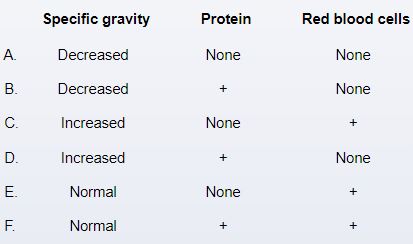
(Multiple Choice)
4.9/5 (70)
(70) A 35-year-old man comes to the physician because of a skin rash. Six months ago, the patient was treated in the hospital for Pneumocystis pneumonia and painful oral ulcers. He takes no medications but drinks alcohol frequently and uses recreational drugs. Physical examination demonstrates a widespread rash consisting of lesions similar to that shown in the image below. 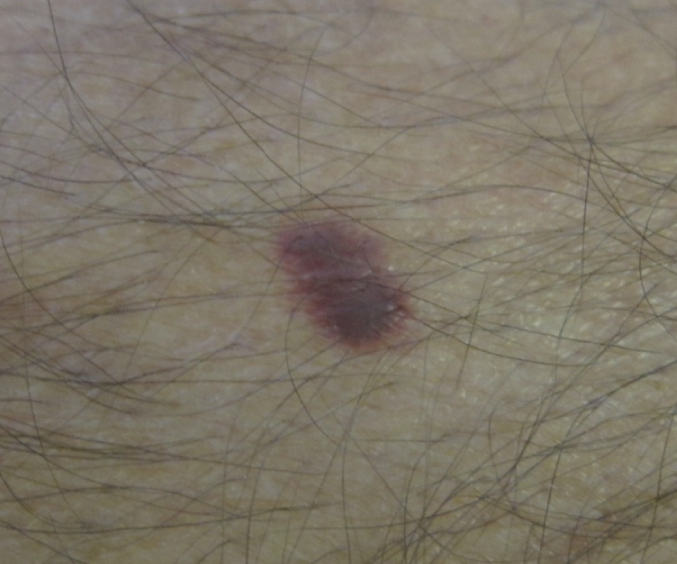 Which of the following is the most likely cause of this patient's current condition?
 (Multiple Choice)
4.7/5 (65)
(65) A 42-year-old man comes to the office for evaluation of progressive generalized edema and weight gain for the past several weeks. He has no chest pain or shortness of breath. The patient has no chronic medical conditions and takes no medications. He last saw a physician a year ago for an upper respiratory infection. The patient does not use tobacco, alcohol, or illicit drugs. Blood pressure is 130/80 mm Hg and pulse is 84/min. Mild ascites is present. There is bilateral lower extremity pitting edema to the knees.Laboratory results are as follows: 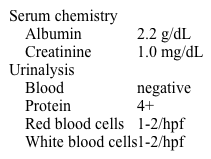 Urinary protein excretion is 6.0 g/24 hr. A kidney biopsy is performed, and electron microscopy of a glomerular capillary is shown below:
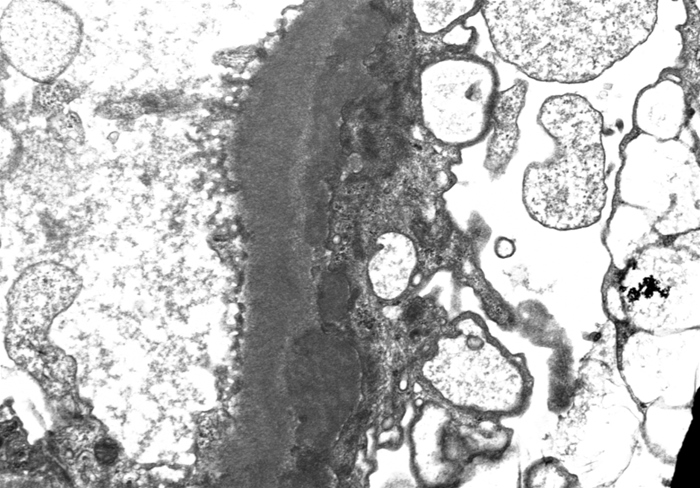 Which of the following is the most likely diagnosis?
Urinary protein excretion is 6.0 g/24 hr. A kidney biopsy is performed, and electron microscopy of a glomerular capillary is shown below: Which of the following is the most likely diagnosis? (Multiple Choice)
4.9/5 (80)
(80) A 45-year-old man is brought to the emergency department due to new-onset seizure. His family witnessed an episode of blank staring followed by a generalized tonic-clonic convulsion with tongue biting and urinary incontinence. The patient has a past medical history of seasonal asthma and takes no prescription medications. He does not use alcohol or illicit drugs. Vital signs and neurologic examination are normal. Noncontrast head CT and brain MRI are consistent with a diagnosis of cavernous hemangioma. This patient is at greatest risk of developing which of the following complications?
(Multiple Choice)
4.9/5 (75)
(75) A 50-year-old woman with a history of systemic lupus erythematosus is admitted with fever, chills, vomiting, and burning pain when urinating. Temperature is 39.3 C (102.7 F), blood pressure is 80/50 mm Hg, pulse is 120/min, and respirations are 20/min. On examination, costovertebral angle tenderness is present. The patient is given intravenous antibiotics. Over the next several hours, she has decreased urine output despite aggressive intravenous hydration. Blood is oozing around the central venous catheter. Laboratory results are as follows: 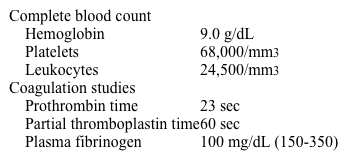 Which of the following is the most likely cause of this patient's hematologic abnormalities?
 (Multiple Choice)
4.8/5 (91)
(91) A 65-year-old man comes to the office due to 4 months of worsening fatigue. The patient feels tired with simple household chores. He has a 15-pack-year smoking history and drinks 2 or 3 beers daily. Temperature is 37 C (98.6 F), blood pressure is 134/86 mm Hg, and pulse is 76/min. Physical examination reveals a late systolic ejection murmur with a soft S2. The lungs are clear to auscultation. The abdomen is soft and nontender with no hepatosplenomegaly. There are no focal neurological deficits. Laboratory testing reveals hemoglobin is 9 g/dL and mean corpuscular volume is 93 µm3. Peripheral blood smear is shown below: 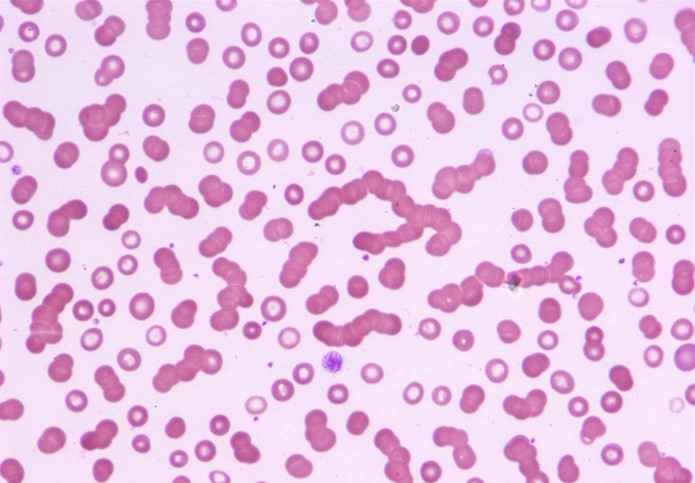 Which of the following best explains the observed erythrocyte findings in this patient?
 (Multiple Choice)
4.8/5 (85)
(85) A 64-year-old woman comes to her nephrologist for a regular follow-up appointment. The patient's medical problems include diabetes mellitus for 20 years and stage IV chronic kidney disease with a glomerular filtration rate <30 mL/min. She takes daily insulin and has made lifestyle modifications. Recently, her blood glucose has been well controlled. The patient's other medical problems include hypertension and dyslipidemia, which are controlled with medication. Her BMI is 27 kg/m2. Cardiopulmonary examination is normal. Lower extremity examination shows trace bilateral edema and 2+ pulses. This patient is at greatest risk for which of the following long-term complications of her renal disease?
(Multiple Choice)
4.9/5 (82)
(82) The age-adjusted mortality trends for 5 cancers in women in the United States are shown in the graph below. 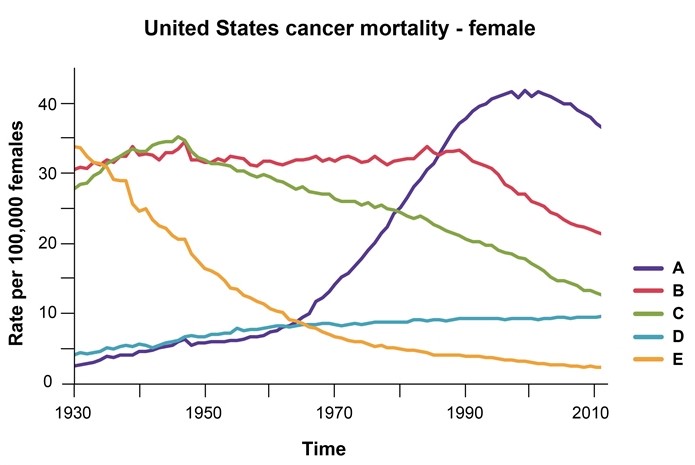 Which of the following curves best corresponds to lung cancer?
 (Multiple Choice)
4.7/5 (78)
(78) A 12-year-old boy is brought to the office due to a week of nonproductive cough and rash. He has also had low-grade fevers, malaise, and headaches. The patient has no prior medical conditions and is up to date with immunizations. Lung examination reveals bilateral crackles and wheezes. There is a diffuse rash on his torso and extremities as shown in the exhibit. 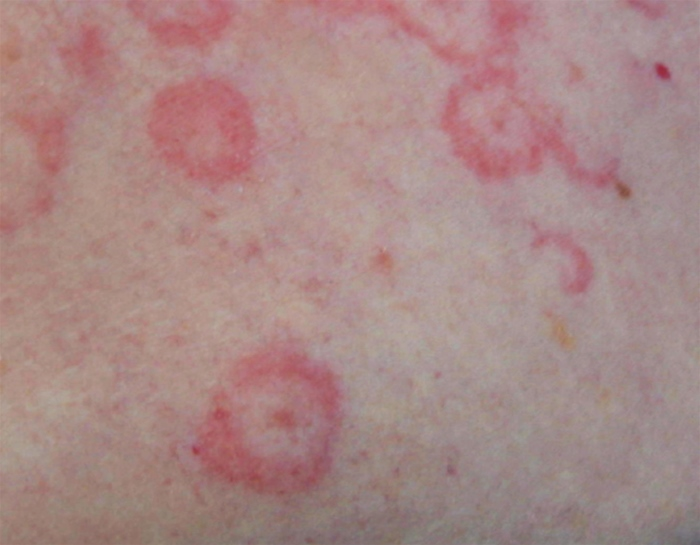 Which of the following is the most likely cause of this patient's skin lesions?
 (Multiple Choice)
4.8/5 (79)
(79) A 68-year-old woman comes to the office due to tingling and numbness affecting her hands and legs. The patient's symptoms began 2 years ago with a "pins-and-needles" sensation in the soles of her feet, which has since progressed slowly upward to the mid-calf level. Lately, she has also had similar symptoms in her fingers. The patient has a 15-year history of type 2 diabetes mellitus complicated by diabetic retinopathy. Other medical conditions include hypertension and osteoarthritis. On physical examination, ankle reflexes are absent and sensation of joint position is decreased in the toes. Romberg sign is present. A lesion involving which of the following best explains this patient's findings?
(Multiple Choice)
4.8/5 (75)
(75) A 65-year-old man comes to the office due to several weeks of nonproductive cough. The patient also has anorexia and unintentional weight loss. His medical history includes hypothyroidism due to Hashimoto thyroiditis and a 50-pack-year smoking history. Examination shows an enlarged right supraclavicular lymph node. Imaging reveals a large mediastinal mass causing tracheal deviation. The enlarged node is biopsied, and microscopy demonstrates clusters of small, ovoid cells with scant cytoplasm and a high mitotic count. Immunohistochemical staining is positive for chromogranin. This patient most likely has which of the following conditions?
(Multiple Choice)
4.7/5 (69)
(69) A 72-year-old man is brought into the hospital by paramedics after he was found disoriented and wandering in the street. He has a past medical history of dementia, hypertension, and stroke. Physical examination reveals a disoriented, thin-appearing male. His gingivae are swollen and bleed easily. Ecchymoses are noted on his legs. The laboratory values are provided below: 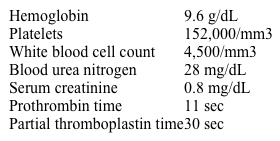 Which of the following is most likely responsible for this patient's ecchymoses?
 (Multiple Choice)
4.8/5 (83)
(83) A 16-year-old boy is evaluated in the office due to leg cramps. He plays soccer but frequently stops in the middle of practice due to cramps in both legs. The patient is afebrile. Blood pressure is 170/90 mm Hg bilaterally in upper extremities. Point of maximal impulse is nondisplaced. S1 is normal, and S2 is physiologically split. An S4 is heard, as well as a continuous murmur best auscultated over the back at the left paravertebral area. Distal pulses in the radial arteries are prominent. Dorsalis pedis and posterior tibial pulses are difficult to palpate. The rest of the physical examination is unremarkable. Which of the following is the most likely cause of this patient's continuous murmur?
(Multiple Choice)
4.9/5 (81)
(81) A 10-year-old boy is brought to the office due to dark brown urine that he first noticed yesterday after swimming practice. Blood pressure is 130/80 mm Hg. Physical examination is normal with the exception of bilateral periorbital edema. Laboratory results are as follows: 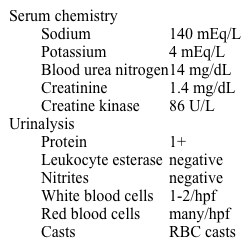 Which of the following is the most likely diagnosis?
 (Multiple Choice)
4.9/5 (71)
(71) 
Filters
- Essay(0)
- Multiple Choice(0)
- Short Answer(0)
- True False(0)
- Matching(0)