



 Chat with AI
Exam 10: Pathology

Exam 1: Anatomy291 Questions
Exam 2: Behavioral science240 Questions
Exam 3: Biochemistry156 Questions
Exam 4: Biostatistics117 Questions
Exam 5: Embryology52 Questions
Exam 6: Genetics103 Questions
Exam 7: Histology24 Questions
Exam 8: Immunology129 Questions
Exam 9: Microbiology336 Questions
Exam 10: Pathology816 Questions
Exam 11: Pathophysiology464 Questions
Exam 12: Pharmacology538 Questions
Exam 13: Physiology272 Questions
Select questions type


A 26-year-old woman is being treated for glomerulonephritis, photosensitive skin rash, and arthralgias. Rapid plasma reagin (RPR) test is repeatedly positive in this patient despite negative Treponema pallidum enzyme immunoassay (TP-EIA) testing. Coagulation study results are as follows: 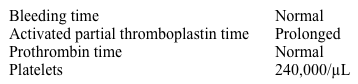 This patient is at greatest risk for which of the following complications?
 (Multiple Choice)
4.9/5  (86)
(86) A 65-year-old man comes to the office with a 2-day history of skin rash and low-grade fever. He has had no cough, shortness of breath, chest pain, vomiting, dysuria, or urinary frequency. The patient was recently diagnosed with acute gouty arthritis and has been taking indomethacin for the past 10 days. Temperature is 38.1 C (100.6 F), blood pressure is 130/90 mm Hg, and pulse is 86/min. Examination shows a diffuse, maculopapular skin rash. Mucosal surfaces are moist without any lesions. Cardiopulmonary examination shows no abnormities. There is no costovertebral angle tenderness. Serum creatinine is 2.3 mg/dL (baseline 1.1 mg/dL, 2 weeks ago). Urinalysis shows numerous white blood cells/hpf. Which of the following is the most likely cause of this patient's acute renal dysfunction?
(Multiple Choice)
5.0/5 (74)
(74) A 12-year-old boy is evaluated for chronic headaches and visual changes. The headaches have progressively worsened over the past year and are associated with nausea. The patient's parents are especially concerned as his symptoms have been interfering with his coursework in middle school. An intracranial calcified mass is detected on brain imaging. The mass is surgically removed and on gross inspection shows cystic spaces filled with thick, brownish-yellow fluid that is rich in cholesterol. This mass is most likely derived from cells responsible for forming which of the following structures?
(Multiple Choice)
4.8/5 (65)
(65) A 27-year-old man comes to the office due to a 2-week history of genital papules that are not painful or pruritic. Over this period, he has also had fatigue and mild, generalized arthralgia but no urethral discharge or dysuria. The patient had gonococcal urethritis 3 months ago, which was adequately treated, and tests for other sexually transmitted infections at that time were negative. He is sexually active with several male and female partners and reports using condoms consistently after the episode of gonorrhea. Temperature is 37.6 C (99.6 F). Physical examination shows a faint, diffuse maculopapular skin rash involving the trunk, extremities, palms, and soles. There are several enlarged, nontender inguinal lymph nodes. Genital examination reveals multiple elevated lesions on the scrotum and perineal region. Histopathologic evaluation of these lesions would most likely reveal which of the following in this patient?
(Multiple Choice)
4.9/5 (94)
(94) A 63-year-old man comes to the office due to fatigue and easy bruising. He has no lymphadenopathy on physical examination. Laboratory results are as follows: 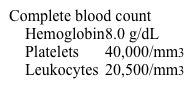 The patient's peripheral blood smear is shown in the image below:
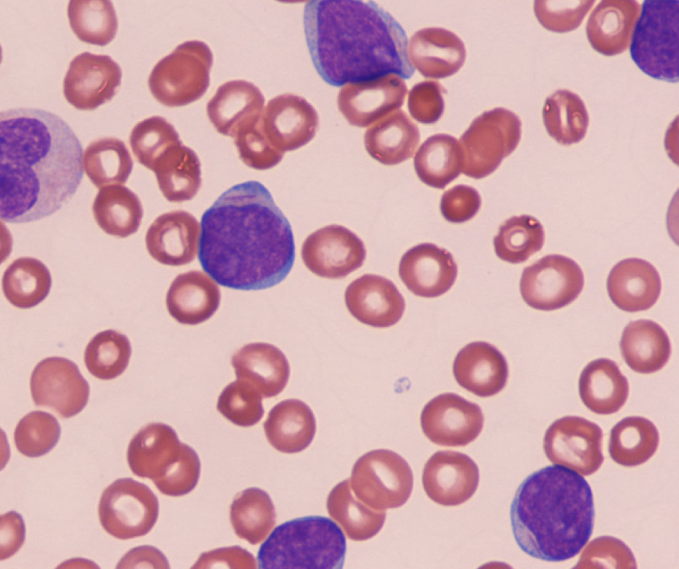 Which of the following is the most likely diagnosis?
The patient's peripheral blood smear is shown in the image below: Which of the following is the most likely diagnosis? (Multiple Choice)
4.8/5 (68)
(68) A 65-year-old woman is being evaluated following an episode of syncope that occurred after prolonged standing. She used to exercise in the local gym but has become easily fatigued recently. The patient has had occasional dark stools. She has lost 5 kg (11 lb) in the past few weeks due to "poor appetite." She does not smoke, drink alcohol, or use illicit drugs. Family history is negative for cancers. Vital signs reveal mild orthostatic hypotension. Physical examination is unremarkable, but stool is positive for occult blood. Colonoscopy reveals 2 polyps. The pathology report shows advanced adenomatous changes in one polyp and adenocarcinoma in the other. A mutation in which of the following genes is most likely responsible for the transformation from advanced adenoma to adenocarcinoma in this patient?
(Multiple Choice)
4.9/5 (73)
(73) A 32-year-old Caucasian woman experiences three episodes of deep venous thrombosis in a six year period. She has a history of pulmonary embolism as well. The patient's partial thromboplastin time (PTT) is within normal limits, and remains unchanged when activated protein C is added to her plasma. The most likely cause of this patient's problem is:
(Multiple Choice)
4.8/5 (81)
(81) A 45-year-old man with diabetes mellitus is admitted to the intensive care unit due to community-acquired pneumonia, septic shock, and respiratory failure. Two days ago, he developed fever, productive cough, and shortness of breath that has progressively worsened. The patient is intubated and placed on mechanical ventilation. He is also started on intravenous fluids, broad-spectrum antibiotics, and a norepinephrine infusion. On the third day of hospitalization, hemoglobin level drops from 14 g/dL to 12 g/dL. Nasogastric suctioning reveals bright red blood. This patient's bleeding is most likely a result of which of the following processes?
(Multiple Choice)
4.8/5 (74)
(74) A 62-year-old woman comes to the physician after finding a lump in her breast. Physical examination reveals a firm, immovable, irregularly shaped mass. Mammography is performed and shows a spiculated, calcified lesion that was not seen on prior studies. A tissue biopsy is diagnostic for infiltrating ductal carcinoma. Malignant tumors such as infiltrating ductal carcinoma are typically associated with varying degrees of disordered differentiation and maturation. Which of the following findings is most characteristic of an anaplastic tumor?
(Multiple Choice)
4.8/5 (85)
(85) A 43-year-old woman says she cannot sleep due to pain and tingling affecting the first three digits of both hands. She has no problems with her legs. The patient suffers from chronic renal failure due to uncontrolled hypertension and receives hemodialysis. On examination, she has bilaterally diminished sensation over the thumb, index and middle fingers, and the radial half of her ring finger. Which of the following is the most likely mechanism of this patient's condition?
(Multiple Choice)
4.7/5 (79)
(79) A 35-year-old man comes to the office due to worsening shortness of breath. The patient is an avid hiker; he began to have shortness of breath 18 months ago on challenging hikes, but it now occurs even while he is walking. He has also had mild wheezing and sputum production recently. The patient takes an antihistamine as needed without much improvement. He has no other medical problems. The patient has smoked half a pack of cigarettes daily for the past 5 years. His father died from lung and liver disease at a young age. Spirometry shows decreased forced expiratory volume in 1 second (FEV1), decreased forced vital capacity (FVC), and a decreased FEV1/FVC ratio. This patient's lower lung lobes are most likely to demonstrate which of the following findings?
(Multiple Choice)
4.8/5 (79)
(79) A 42-year-old man is found dead at home. His medical problems included hypertension and dyslipidemia, but he had been noncompliant with his medications. The patient had a lengthy smoking history and, despite constant urging from his physicians to stop smoking, he had only quit recently. An autopsy is requested by the family. Pathological examination shows complete thrombotic occlusion of the left main coronary artery and diffuse atherosclerotic vascular disease characterized by multiple atheromas. Along with a lipid core, these atheromas have a fibrous cap formed from dense deposition of collagen. Which of the following cells are directly responsible for synthesizing this fibrous cap?
(Multiple Choice)
4.7/5 (73)
(73) A 42-year-old man comes to the office due to progressive fatigue, nausea, and itchiness. On review of systems, the patient admits that he occasionally has bloody stools. Medical history is unremarkable. Examination shows scleral icterus. Percutaneous liver biopsy is performed, and histologic analysis of the tissue sample reveals fibrous obliteration of intrahepatic small bile ducts with concentric replacement by connective tissue. Which of the following is the most likely diagnosis?
(Multiple Choice)
4.8/5 (90)
(90) A 10-year-old boy is brought to the physician by his parents due to restlessness and involuntary jerking. He takes no medications and his vaccinations are up-to-date. His parents do not recall any recent injuries or illnesses other than a sore throat 3 months ago. On examination, the patient has rapid, irregular jerking movements involving his face, arms, and legs. This patient is at greatest risk for developing which of the following conditions?
(Multiple Choice)
4.9/5 (87)
(87) A researcher is studying autopsy findings in patients diagnosed with neurodegenerative disorders. In some of the brain specimens, a neuronal protein that primarily exists in an alpha-helical secondary structure is found to be in a beta-sheet conformation. The altered protein is resistant to protease and has accumulated in large quantities within the cells. Further investigation shows that the abnormal isoform can perpetually induce the same conformational change within normally folded proteins. Which of the following histopathological changes are most likely present in the brains of these patients?
(Multiple Choice)
4.9/5 (76)
(76) A 54-year-old Sudanese immigrant is evaluated for several months of intermittent dysuria and gross hematuria. The patient notes that he passes blood at the end of urination but has no associated pain. Cystoscopy reveals erythematous areas in the bladder mucosa. Multiple biopsies are taken from the affected sites; histopathological findings are shown in the image below. 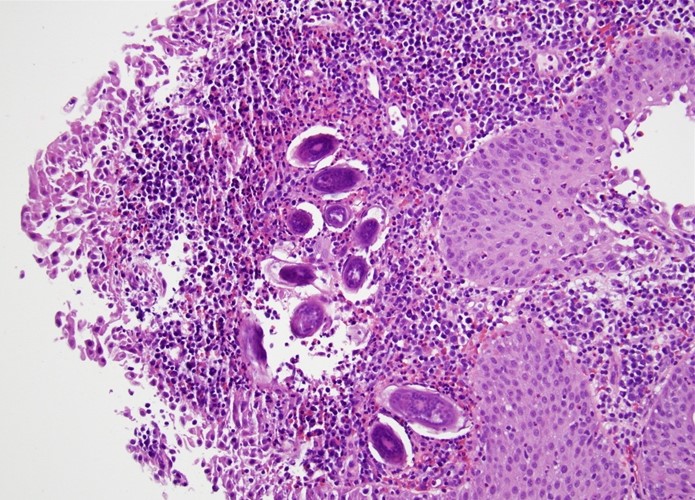 Which of the following most likely predisposed this patient to his current condition?
 (Multiple Choice)
4.9/5 (82)
(82) A 14-year-old boy is brought to the physician by his mother. She is concerned because although tall, her son looks much younger than his peers and shows no signs of "masculinity." On physical examination, the boy has poorly developed secondary sexual characteristics. He is unable to distinguish smells but has good visual acuity. Which of the following pathways is most likely defective in this patient? 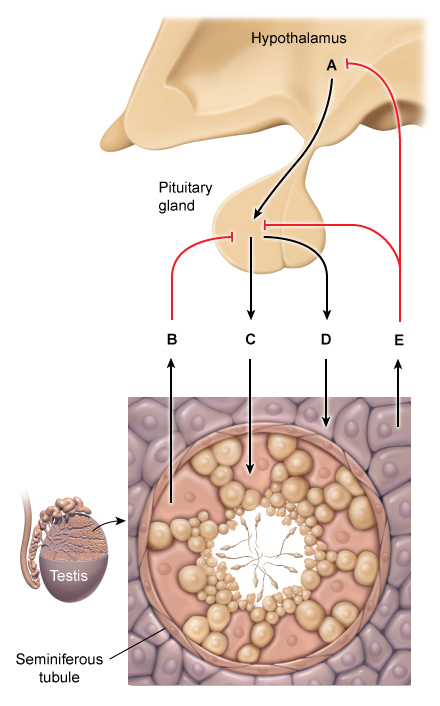
(Multiple Choice)
4.7/5 (86)
(86) A 65-year-old man is found dead at his home due to a suspected suicide. The family reports that the patient has been having difficulty swallowing, dyspnea on exertion, and arm and leg weakness for the past several months and had undergone a medical workup. They suspect the physician may have given bad news and the patient ended his life so he would not have to live with the diagnosed condition. External examination shows atrophy of the muscles of the right lower and left upper extremities. Autopsy would most likely reveal which of the following additional findings?
(Multiple Choice)
4.8/5 (78)
(78) A 38-year-old woman comes to the hospital with 4 hours of abdominal pain, nausea, and vomiting. Her pain started in the periumbilical area and is now localized to the right lower quadrant. Temperature is 38.3 C (101 F). On examination, the patient has right lower quadrant tenderness with guarding. An appendectomy is performed, and light microscopy of the appendix shows infiltrating neutrophils in the muscularis propria, consistent with the diagnosis of acute appendicitis. Further evaluation reveals abnormal islands of small cells, as shown in the image below. 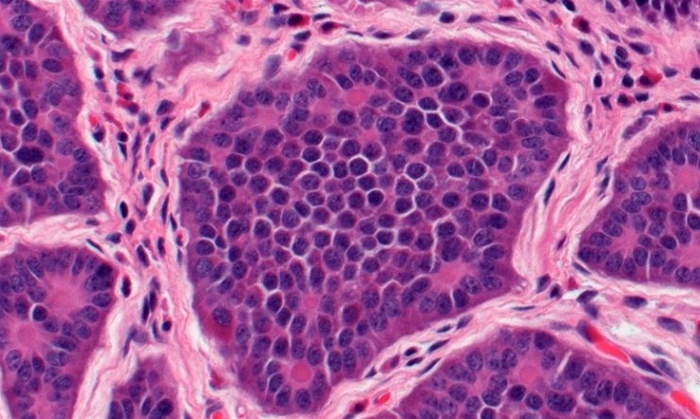 These cells are most likely derived from which of the following sources?
 (Multiple Choice)
4.8/5 (84)
(84) A 55-year-old man comes to the emergency department due to several weeks of productive cough with occasional hemoptysis, weight loss, and low-grade fever. He has lost 7 kg (15.4 lb) over the past 3 months. Medical history is significant for type 2 diabetes mellitus and chronic kidney disease, and the patient works as a prison guard. Temperature is 37.8 C (100 F), blood pressure is 110/70 mm Hg, pulse is 78/min, and respirations are 18/min. Chest x-ray reveals a right apical lung infiltrate and cavitary lesion. He is placed in respiratory isolation, and appropriate empiric therapy is started. The cavitary lesions seen in this patient most likely formed through which of the following pathogenic mechanisms?
(Multiple Choice)
4.8/5 (71)
(71) 
Filters
- Essay(0)
- Multiple Choice(0)
- Short Answer(0)
- True False(0)
- Matching(0)