



 Chat with AI
Exam 10: Pathology

Exam 1: Anatomy291 Questions
Exam 2: Behavioral science240 Questions
Exam 3: Biochemistry156 Questions
Exam 4: Biostatistics117 Questions
Exam 5: Embryology52 Questions
Exam 6: Genetics103 Questions
Exam 7: Histology24 Questions
Exam 8: Immunology129 Questions
Exam 9: Microbiology336 Questions
Exam 10: Pathology816 Questions
Exam 11: Pathophysiology464 Questions
Exam 12: Pharmacology538 Questions
Exam 13: Physiology272 Questions
Select questions type


A 57-year-old male presents to your office complaining of fatigue and low energy. He also notes experiencing intermittent back pain that responds to ibuprofen. He has no significant past medical history. His family history is significant for his father dying of a heart attack at age 60. Fecal occult blood testing is negative. Laboratory studies reveal: 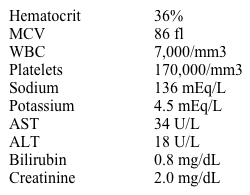 Plasma protein electrophoresis reveals a high peak corresponding to gamma-globulins. The most likely diagnosis is:
 (Multiple Choice)
4.9/5  (81)
(81) A 46-year-old woman comes to the emergency department due to sudden-onset, severe occipital headache and nausea. The patient has a history of hypertension and cigarette smoking. Physical examination shows mild disorientation but no focal weakness, sensory loss, or cranial nerve abnormalities. Noncontrast CT scan of the head reveals diffuse hyperdensity in the subarachnoid space. CT angiography reveals a ruptured anterior communicating artery aneurysm. The patient undergoes endovascular coiling of the aneurysm. Four days later, there is sudden deterioration in her level of consciousness and new, right-sided hemiparesis is observed. Repeat CT scan shows no significant changes. Which of the following is the most likely cause of this patient's neurological deterioration?
(Multiple Choice)
4.8/5 (73)
(73) A 32-year-old woman comes to the office due to left eye pain that is accentuated by ocular movements. She also has periodic dimming of vision in the same eye. The patient has had several such episodes over the last month, most often after a hot shower or intense workout. A year ago, she had an episode of numbness and tingling in her left arm that resolved spontaneously. The patient has no other medical issues and takes no medication. She smokes half a pack of cigarettes a day and does not use alcohol or illicit drugs. Vital signs are normal. BMI is 26 kg/m2. Ophthalmologic examination shows swelling of the optic disc on the left. Neurologic examination shows a mild intention tremor and broad-based gait. Which of the following is the most likely cause of the patient's current condition?
(Multiple Choice)
4.8/5 (73)
(73) A 62-year-old hospitalized man is evaluated for new-onset renal failure. The patient was admitted 3 days ago due to precordial chest pain. He was found to have an elevated troponin I level but no ST-segment elevation on ECG. Percutaneous catheterization revealed 3-vessel coronary artery disease, and no coronary interventions were performed. The patient has continued to receive medical treatment while awaiting coronary artery bypass graft surgery. Today, he was noted to have elevated blood urea nitrogen and serum creatinine levels. The patient has had no fever, and blood pressure and heart rate have been within normal limits. Physical examination shows no new findings. Which of the following pathologic findings is most likely present in this patient?
(Multiple Choice)
4.7/5 (88)
(88) A 67-year-old man comes to the office for a routine health maintenance evaluation. He feels well and has no specific symptoms. Vital signs are within normal limits. Digital rectal examination reveals a firm prostatic nodule. The patient undergoes transrectal prostate biopsy, and microscopy reveals sheets of tumor cells infiltrating the stroma with no glandular differentiation; the tumor cells have large vesicular nuclei and prominent nucleoli. Imaging shows enlargement of several iliac lymph nodes. Which of the following is the best description of this patient's tumor?
(Multiple Choice)
4.9/5 (91)
(91) A 65-year-old man is admitted to the hospital with an acute ST-segment elevation myocardial infarction. The patient undergoes coronary angiography with stent placement in the left circumflex artery, and he is started on therapy with a beta blocker and antiplatelet agents. On day 3 of hospitalization he experiences chest pain. The pain, described as sharp and radiating to his neck and shoulders, is exacerbated by coughing and swallowing. He has no shortness of breath, lightheadedness, or abdominal pain. Temperature is 37.5 C (99.5 F), blood pressure is 130/80 mm Hg, pulse is 90/min and regular, and respirations are 20/min. The lungs are clear on auscultation. There is no peripheral edema. Which of the following is the most likely cause of this patient's chest pain?
(Multiple Choice)
4.9/5 (81)
(81) A 74-year-old man is hospitalized with acute urinary retention complicated by urosepsis. He has a urinary catheter placed and is started on intravenous antibiotics. The patient requires endotracheal intubation and mechanical ventilation for 24 hours but is extubated successfully on the second hospitalization day. On the third day of hospitalization, he develops fever and right jaw pain. Physical examination shows firm swelling of the preauricular area on the right side extending to the angle of the mandible. Which of the following serum markers is most helpful for confirming the diagnosis?
(Multiple Choice)
4.8/5 (68)
(68) A 16-year-old previously healthy boy is brought to the office due to fever, malaise, and sore throat. The patient says that he gets tired even by simply getting out of bed. Physical examination shows palatal petechiae, cervical lymphadenopathy, and splenomegaly. His peripheral blood smear is shown in the image below. 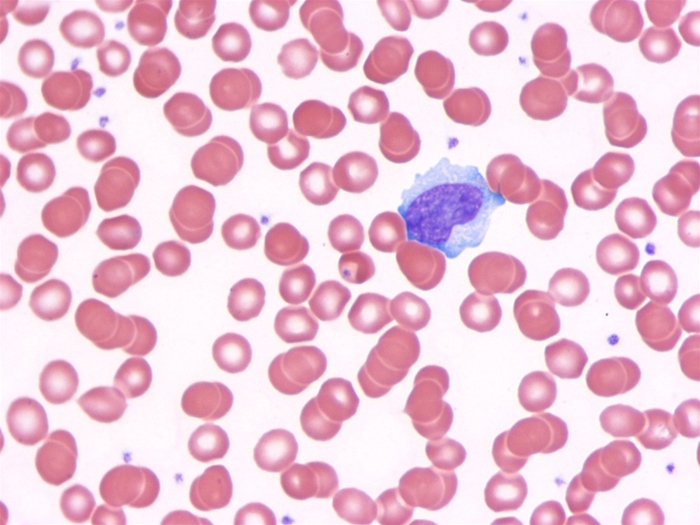 Horse erythrocytes agglutinate when exposed to the patient's serum. The agent causing this patient's disease is most strongly associated with which of the following malignancies?
 (Multiple Choice)
4.9/5 (86)
(86) A 10-year-old boy is brought to the emergency department due to shortness of breath and palpitations for the past day. He also has associated fever and fatigue. Vital signs indicate tachypnea, tachycardia, and hypotension. On cardiac auscultation, the patient has a new holosystolic murmur. He is admitted to the hospital for further workup and management. A cardiac biopsy is performed due to decompensation and an unclear diagnosis. Light microscopy of the tissue specimen is shown in the image below. 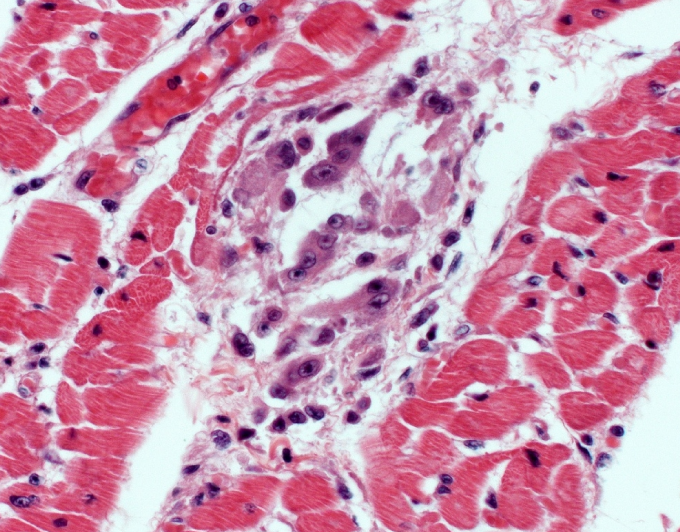 Which of the following most likely preceded development of this patient's current condition?
 (Multiple Choice)
4.9/5 (99)
(99) A 34-year-old man is brought to the emergency department with new-onset confusion and lethargy. Laboratory studies, including an arterial blood gas, are obtained. The changes in his blood gas parameters are shown in the graph below. Point A represents these parameters at the patient's physiologic baseline, and point B indicates his state on arrival in the emergency department. 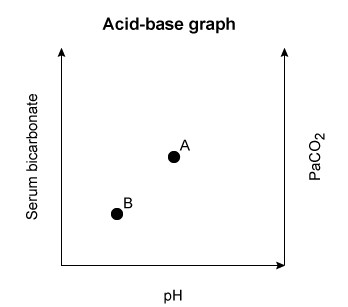 Which of the following is the most likely diagnosis?
 (Multiple Choice)
5.0/5 (84)
(84) A 55-year-old woman comes to the office due to a persistent cough, exertional dyspnea, and recent, unintentional weight loss. She has no chronic medical problems and takes no medication regularly. She has never smoked and has no history of exposure to industrial pollutants. She works as an accountant at a large accounting firm. Vital signs are normal. Physical examination reveals decreased breath sounds and dullness to percussion at the left lung base. Imaging studies show an irregular mass in the lower lobe of the left lung and a left pleural effusion. A diagnostic thoracocentesis is performed and the aspirated fluid is sent for cytological evaluation. If a malignancy is diagnosed, it is most likely to be which of the following types?
(Multiple Choice)
4.8/5 (72)
(72) A 53-year-old man comes to the physician due to frequent headaches and dizziness. He has a history of hypertension and peptic ulcer disease. His medications include daily chlorthalidone and antacids as needed. The patient's temperature is 37 C (98.6 F), blood pressure is 146/92 mm Hg, pulse is 89/min, and respirations are 16/min. His BMI is 26 kg/m2. Physical examination shows facial plethora and moderate splenomegaly. Laboratory results are as follows: 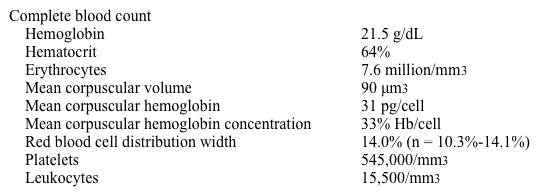 This patient most likely has a mutation in which of the following types of proteins?
 (Multiple Choice)
4.8/5 (75)
(75) A 31-year-old woman comes to the office due to a 4-month history of left hip and groin pain. She has a constant, dull, achy pain at rest that is exacerbated by movement of the hip or weight bearing. The patient has had no recent falls or other trauma. Medical history is significant for sickle cell disease, pneumococcal pneumonia, and acute chest syndrome. There is no redness, warmth, or tenderness over the hip joint, but decreased active and passive internal and external rotation, extension, and abduction are noted. Imaging of the hip is shown in the exhibit. 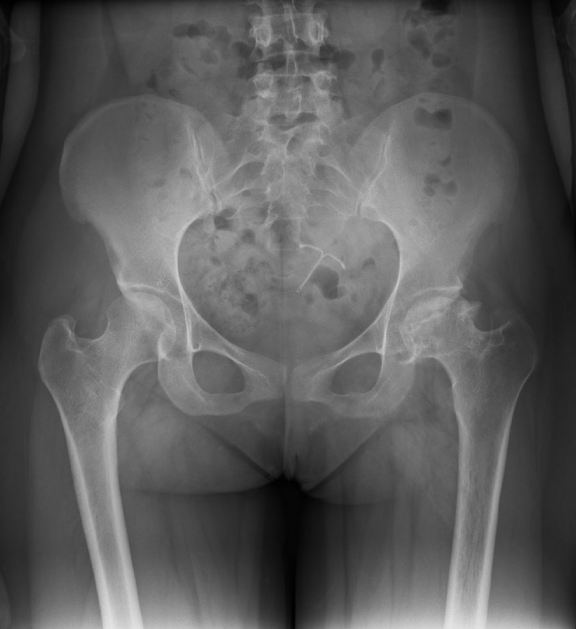 Which of the following is the most likely cause of this patient's pain?
 (Multiple Choice)
4.8/5 (77)
(77) A 27-year-old man comes to the office due to cough, chest discomfort, and dyspnea on exertion. Symptoms began approximately a month ago and were initially mild but have gradually worsened. He has also lost 4.5 kg (10 lb) over the past 2 months. The patient has no chronic medical conditions. He smokes a pack of cigarettes a day and drinks an average of 4 beers each weekend. The patient does not use illegal drugs and has not had multiple sexual partners. Physical examination is unremarkable. Chest imaging reveals a large, anterior mediastinal mass. Subsequent blood work shows elevated levels of β-hCG and alpha fetoprotein. Which of the following is the most likely diagnosis?
(Multiple Choice)
4.9/5 (81)
(81) A 16-year-old boy is brought to the emergency department with sudden onset of left-sided abdominal pain and blood in his urine. The pain waxes and wanes in intensity and does not improve with rest or position changes. He has a lengthy history of similar pain episodes, but this is the first time he has had gross hematuria. Physical examination shows costovertebral angle tenderness on the left side. Microscopic examination of the urine is shown below. 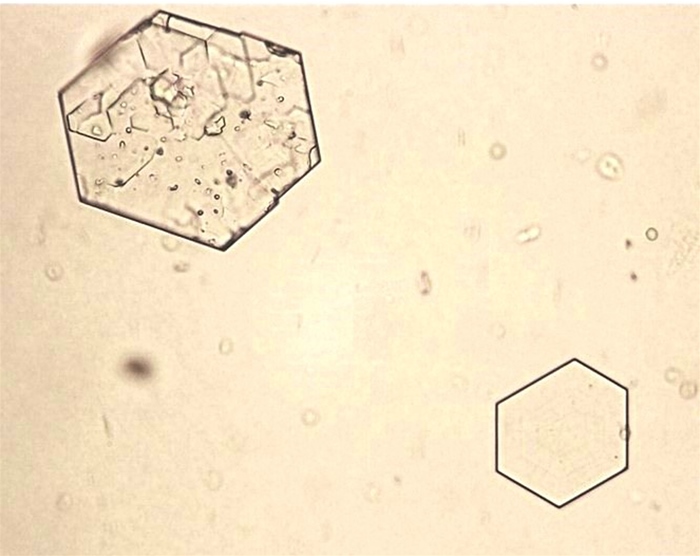 Further quantitative laboratory evaluation is most likely to detect which of the following abnormalities in this patient?
 (Multiple Choice)
4.9/5 (85)
(85) A 65-year-old man with a long history of smoking comes to the emergency department with shortness of breath and a chronic mild cough. His symptoms progressed gradually over the last week and today have become suddenly worse. The patient has hypertension that is controlled with hydrochlorothiazide. On examination, his temperature is 36.7 C (98 F), blood pressure is 135/85 mm Hg, pulse is 94/min, and respirations are 24/min. Pulse oximetry shows 86% on room air. He has decreased breath sounds over the right chest. His chest x-ray is shown in the image below. 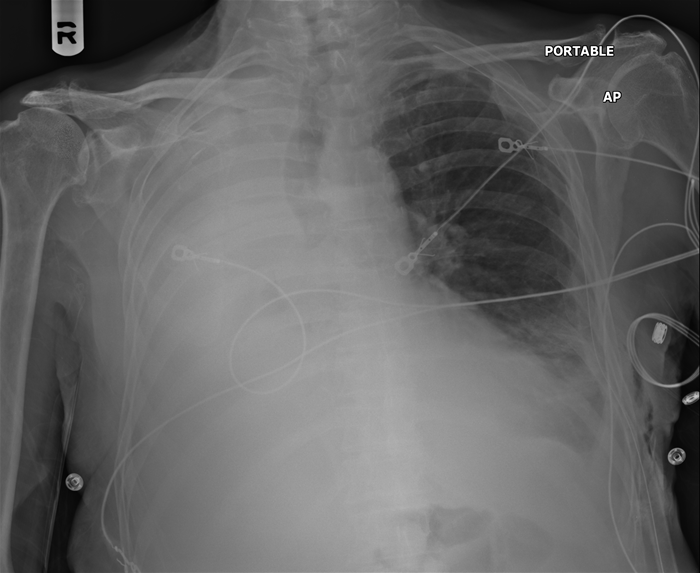 Which of the following is the most likely cause of this patient's radiographic findings?
 (Multiple Choice)
4.9/5 (76)
(76) A 53-year-old man comes to the emergency department due to severe heartburn and difficulty swallowing for the last few weeks. He has had mild to moderate heartburn for several years and has tried weight loss, elevating the head of his bed while sleeping, and several months of proton pump inhibitor therapy. Other medical problems include hypertension and hypothyroidism. Temperature is 36.7 C (98.1 F), blood pressure is 130/80 mm Hg, pulse is 78/min, and respirations are 16/min. BMI is 25 kg/m2. Physical examination is unremarkable. An upper gastrointestinal endoscopy is performed, and esophageal biopsy shows columnar epithelium with interspersed goblet cells. A similar adaptive response can be seen in which of the following scenarios?
(Multiple Choice)
4.9/5 (78)
(78) A 20-year-old woman comes to the emergency department due to bloody stools. Approximately an hour ago, the patient had a bowel movement that appeared grossly bloody. For the past month, she has also had decreased energy. Temperature is 37 C (98.6 F), blood pressure is 110/60 mm Hg, pulse is 110/min, and respirations are 20/min. The patient appears tired. Cardiopulmonary examination reveals mild tachycardia. The abdomen is soft without organomegaly. Skin examination shows pallor and scattered bruises in various stages of healing throughout the trunk. Complete blood count results are as follows: 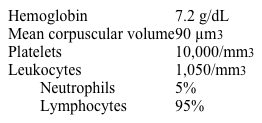 Which of the following is the most likely cause of this patient's condition?
 (Multiple Choice)
4.9/5 (83)
(83) A 43-year-old man is evaluated in the hospital for a medical illness. He has traveled to various countries on missionary trips and recently returned from South America. The patient has no prior medical history and takes no medications. His father has a history of alcohol dependence complicated by cirrhosis and portal hypertension. A liver biopsy is performed, and light microscopy of the tissue demonstrates spotty hepatocyte necrosis and inflammatory cell infiltration, as shown in the image below. 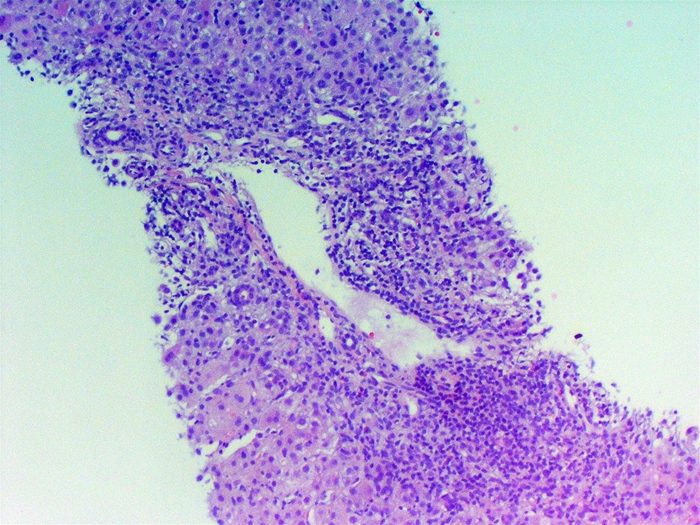 Which of the following is the most likely initial clinical presentation of this patient?
 (Multiple Choice)
4.8/5 (71)
(71) A 43-year-old male with advanced HIV is hospitalized for evaluation of recent-onset headaches and personality changes. Imaging of the brain shows a solitary mass within the temporal lobe. Biopsy of the mass reveals uniform cells containing the Epstein-Barr virus genome. This patient most likely suffers from which of the following?
(Multiple Choice)
4.7/5 (77)
(77) 
Filters
- Essay(0)
- Multiple Choice(0)
- Short Answer(0)
- True False(0)
- Matching(0)