



 Chat with AI
Exam 10: Pathology

Exam 1: Anatomy291 Questions
Exam 2: Behavioral science240 Questions
Exam 3: Biochemistry156 Questions
Exam 4: Biostatistics117 Questions
Exam 5: Embryology52 Questions
Exam 6: Genetics103 Questions
Exam 7: Histology24 Questions
Exam 8: Immunology129 Questions
Exam 9: Microbiology336 Questions
Exam 10: Pathology816 Questions
Exam 11: Pathophysiology464 Questions
Exam 12: Pharmacology538 Questions
Exam 13: Physiology272 Questions
Select questions type


A 62-year-old man is brought to the emergency department by a friend due to severe shortness of breath. He is agitated and gasping for air and is unable to provide history. His friend says the patient has a history of chronic alcohol use and attends Alcoholics Anonymous meetings. He is unaware of any other medical history. Temperature is 36.7 C (98 F), blood pressure is 110/70 mm Hg, pulse is 104/min, and respirations are 32/min. Due to worsening respiratory distress, immediate endotracheal intubation is performed and mechanical ventilation is begun. The patient is admitted to the intensive care unit and, despite appropriate therapy, dies several hours later. Autopsy examination is performed, and histopathology of the lungs reveals engorged pulmonary capillaries and intraalveolar, acellular, pink material that is more prominent at the bases. This patient most likely had which of the following conditions?
(Multiple Choice)
4.7/5  (68)
(68) A 33-year-old, previously healthy woman comes to the emergency department due to sudden-onset shortness of breath and left-sided chest pain. The symptoms began an hour ago while she was doing yard work, and she nearly passed out at symptom onset. The patient takes no medications or supplements other than ibuprofen for occasional headaches. She does not use tobacco, alcohol, or illicit drugs. Temperature is 37.1 C (98.8 F), blood pressure is 84/58 mm Hg, pulse is 122/min, and respirations are 24/min. Pulse oximetry is 86% on room air. On physical examination, the patient is in moderate distress. The jugular veins are distended. Heart sounds are rapid and regular with no murmurs. Lungs are clear to auscultation bilaterally with no crackles or wheezes. Arterial blood gas results are pH 7.52, PaCO2 28 mm Hg, and PaO2 54 mm Hg. Which of the following is most likely to be seen on bedside echocardiography?
(Multiple Choice)
4.8/5 (87)
(87) A 45-year-old previously healthy man comes to the office for evaluation of a neck lump. The patient first noticed the swelling a month ago while shaving, and it has progressively enlarged. He has had no fever, neck pain, hoarseness, or difficulty breathing or swallowing. The patient does not use tobacco, alcohol, or illicit drugs. Temperature is 36.7 C (98 F), blood pressure is 110/70 mm Hg, and pulse is 78/min. On physical examination, there is a nontender, firm nodule in the upper portion of the left thyroid lobe. Laboratory studies reveal a normal serum TSH and elevated serum calcitonin levels. Neck ultrasonography shows a 2-cm hypoechoic thyroid nodule with microcalcifications. Fine-needle aspiration of the nodule reveals spindle-shaped cells in an amorphous background. Which of the following gene alterations most likely contributed to this patient's current condition?
(Multiple Choice)
4.8/5 (86)
(86) A 75-year-old man comes to the office due to worsening dyspnea and fatigue on exertion over the last 6 months. Recently, he has had severe lightheadedness during physical activity. Blood pressure is 125/65 mm Hg and pulse is 65/min and regular. Physical examination reveals a harsh ejection-type systolic murmur at the base of the heart radiating to the neck. The second heart sound is diminished in intensity. A fourth heart sound is heard at the cardiac apex. Which of the following is the most likely cause of this patient's heart condition?
(Multiple Choice)
4.9/5 (91)
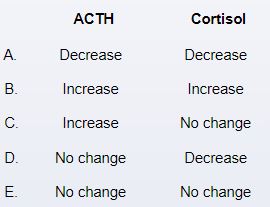
(91) A 60-year-old woman comes to the office due to difficulty climbing stairs and dyspnea on exertion over the last 6 weeks. The patient has a 40-pack-year smoking history. Blood pressure is 160/90 mm Hg and pulse is 78/min. Auscultation of the chest reveals decreased breath sounds over the right lung base. Proximal muscle strength is 4 on a scale of 0-5. Skin examination shows scattered ecchymoses. Laboratory results show mild hyperglycemia and elevated 24-hour urinary free cortisol. Serum cortisol level is at the upper limit of normal and is not suppressed following administration of low-dose dexamethasone. Serum ACTH level is elevated. Chest x-ray reveals a right lower lobe lung mass. Which of the following changes are most likely to occur after administration of high-dose dexamethasone in this patient?
(Multiple Choice)
4.9/5 (80)
(80) A 79-year-old woman comes to the office due to bleeding from an ulcerative lesion on her right nipple. The lesion is itchy, has been there for several months, and is slowly increasing in size. Examination shows a crusty, thickened, erythematous, and ulcerated nodule with evidence of hyperpigmentation. Changes extend to the surrounding areola. Excisional biopsy reveals relatively well-circumscribed aggregates of large, polygonal, pleomorphic cells with abundant mitotic activity and surrounding necrosis. S-100 and HMB-45 stains are diffusely positive. Which of the following is the most likely diagnosis?
(Multiple Choice)
4.9/5 (77)
(77) A 64-year-old Caucasian female presents to your office with headache followed by sudden onset of blindness in her right eye. She was recently admitted to the hospital for fever, pelvic and shoulder girdle pain and weight loss. This patient's condition is most likely caused by:
(Multiple Choice)
4.8/5 (73)
(73) A 64-year-old man dies suddenly while playing tennis. In the preceding months, he experienced fatigue and some exertional dyspnea. Autopsy is performed. The heart examination shows left ventricular septal thickness of 1.6 cm (normal: <1.1), posterior wall thickness of 1.6 cm (normal: <1.1), and an internal left ventricular diameter of 3.2 cm (normal: 3.5-5.9). No focal myocardial scarring is seen. Which of the following is the most likely cause of the cardiac findings seen in this individual?
(Multiple Choice)
4.8/5 (83)
(83) A mass resected from the liver of a 32-year-old woman has the morphology demonstrated on the slide below. 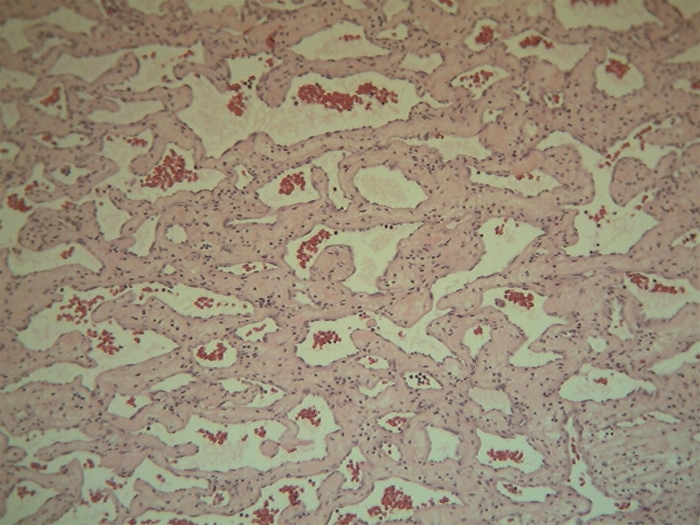 Which of the following is the most accurate statement concerning this patient's condition?
 (Multiple Choice)
4.8/5 (71)
(71) A researcher conducts a study to evaluate the morphological changes of various cerebral pathologies using live animal models. In an experiment, histopathological examination of the brain after an inciting event shows neurons with intensely eosinophilic cytoplasm and condensed basophilic nuclei. Serial biopsies are obtained to evaluate progressive changes. Which of the following is most likely to be seen in the affected brain area in the subsequent weeks?
(Multiple Choice)
4.9/5 (83)
(83) A 5-year-old boy is brought to the office by his mother, who notes that her son's eyes and feet have looked puffy over the last several weeks. She is unaware of exactly when this began but says the patient had a mild upper respiratory tract infection several weeks ago. The boy has no pain but mentions that his shoes seem to fit tightly and bother him, especially when he runs outside during recess at school. The mother also remarks that the boy's urine has been excessively foamy recently. On further questioning, the mother states that she has seasonal allergies and asks whether her child also has allergies. Physical examination is remarkable for periorbital edema and lower extremity edema. Urinalysis shows 4+ proteinuria but is otherwise unremarkable. Which of the following secondary changes is most likely in this patient?
(Multiple Choice)
4.8/5 (69)
(69) A 28-year-old man with vague abdominal pain, low-grade fever, and diarrhea is treated with antibiotics without significant improvement in his symptoms. Several weeks after symptom onset, the patient develops a skin lesion over the abdomen. His temperature is 37.8 C (100 F), blood pressure is 120/70 mm Hg, and pulse is 88/min. On physical examination, the abdomen is mildly distended and tender to palpation. Bowel contents appear to be draining to the surface of the skin in the right lower abdominal quadrant. This patient most likely suffers from which of the following conditions?
(Multiple Choice)
4.8/5 (77)
(77) A 35-year-old woman comes to the hospital due to sudden-onset numbness in her left arm and face. The patient has had generalized headache, dyspnea on exertion, and easy fatigability for several days but no weakness. She has a history of well-controlled asthma. Temperature is 37.7 C (99.9 F), blood pressure is 110/60 mm Hg, and pulse is 80/min. Light touch sensation is decreased in the left upper extremity and the lower left side of the face. Strength and reflexes are normal. Cardiopulmonary and abdominal examinations are unremarkable. There is no skin rash. Laboratory results are as follows: 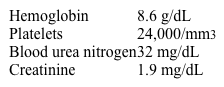 PT and PTT are normal. Peripheral blood smear shows numerous schistocytes. Urinalysis is positive for mild proteinuria. Which of the following is the most likely underlying cause of this patient's current condition?
 (Multiple Choice)
4.9/5 (70)
(70) A 28-year-old man comes to the office due to a bump on his right testicle. The patient is otherwise asymptomatic and healthy. Vital signs are normal. A solid mass is palpated in the right testicle. The rest of the examination is unremarkable. A scrotal ultrasound reveals a suspicious, partially necrotic mass. Serum lactate dehydrogenase and alpha-fetoprotein levels are markedly elevated. The patient undergoes a right radical inguinal orchiectomy. Which of the following is the most likely histologic diagnosis?
(Multiple Choice)
4.7/5 (67)
(67) A 68-year-old man comes to the office due to fatigue, weight loss, and constipation. He has refused to undergo screening colonoscopy for several years because "nobody in my family had colon cancers." Past medical history is notable for emphysema and stable angina. The patient has smoked a pack of cigarettes daily for 50 years and drinks alcohol occasionally. Physical examination is unremarkable. He is referred for colonoscopy, which reveals a circumferential mass encircling the sigmoid colon. Pathology is positive for adenocarcinoma. CT scan of the chest, abdomen, and pelvis is negative for signs of metastasis. Serum carcinoembryonic antigen assay is ordered. The results of this assay would be most useful for which of the following aspects of this patient's care?
(Multiple Choice)
4.9/5 (75)
(75) "Moldy" grains in some regions of China contain a substance that causes a specific G-to-T mutation in gene p53. The population in these regions is expected to be at an increased risk of which of the following diseases?
(Multiple Choice)
4.8/5 (83)
(83) A 60-year-old woman comes to the emergency department due to left flank pain and hematuria. Medical history is significant for recurrent urinary tract infections and hypothyroidism. Blood pressure is 130/80 mm Hg and pulse is 80/min. Physical examination shows left flank tenderness. CT scan of the abdomen is shown below: 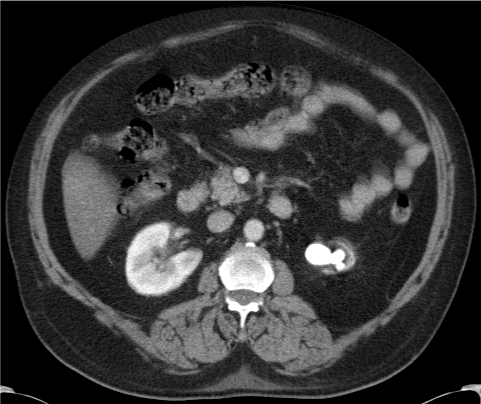 Urinalysis for this patient would most likely show which of the following?
 (Multiple Choice)
4.8/5 (79)
(79) A 4-year-old male dies in the hospital from overwhelming infection. Autopsy findings include bone deformities and hepatosplenomegaly. Clumps of erythroid precursor cells are found in the liver and the spleen. The presence of these precursor cells is most likely related to which of the following conditions?
(Multiple Choice)
4.9/5 (89)
(89) A 65-year-old man is evaluated for progressive shortness of breath. He has had exertional dyspnea for the past year and has been experiencing weight gain and peripheral edema for the last several weeks. He has no previous history of cardiac or pulmonary disease. Cardiac biopsy of the left ventricle shows the histopathologic findings on the slide below. 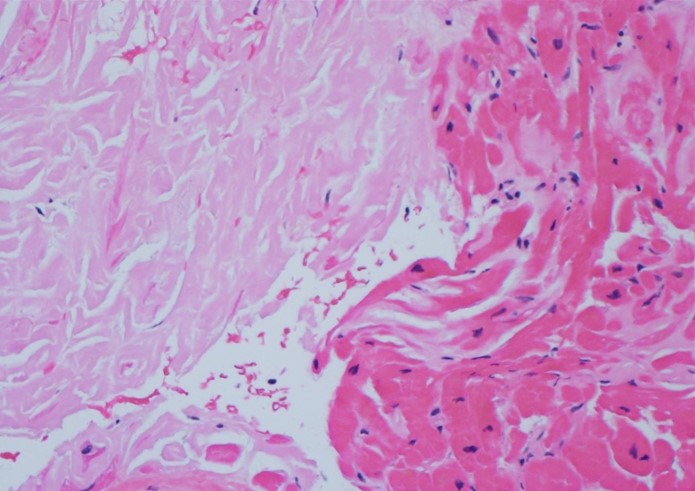 Which of the following are the most likely echocardiographic findings in this patient?
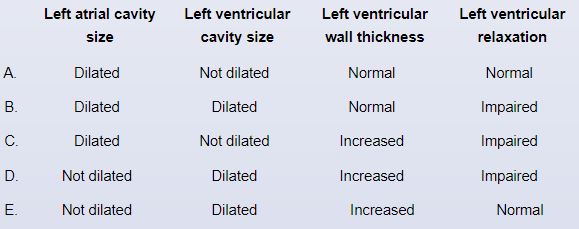
Which of the following are the most likely echocardiographic findings in this patient?
(Multiple Choice)
4.9/5 (88)
(88) A 50-year-old man comes to the office for evaluation of abdominal fullness and mild right flank pain. He also reports a weight loss of 4.5 kg (10 lb) over the past 2 months. The patient has no other medical issues and works in a local industrial chemical manufacturing facility. Examination shows a soft abdomen. Ultrasound reveals a mass in the right kidney. A subsequent abdominal CT scan confirms the presence of a large right renal mass with evidence of necrosis. The patient undergoes a right total nephrectomy. The specimen is shown below. 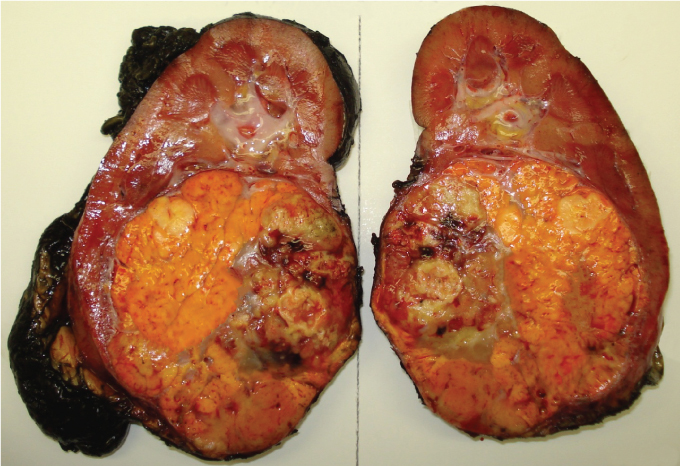 This patient's lesion most likely originated from which of the following portions of the kidney?
 (Multiple Choice)
4.8/5 (71)
(71) 
Filters
- Essay(0)
- Multiple Choice(0)
- Short Answer(0)
- True False(0)
- Matching(0)