



 Chat with AI
Exam 10: Pathology

Exam 1: Anatomy291 Questions
Exam 2: Behavioral science240 Questions
Exam 3: Biochemistry156 Questions
Exam 4: Biostatistics117 Questions
Exam 5: Embryology52 Questions
Exam 6: Genetics103 Questions
Exam 7: Histology24 Questions
Exam 8: Immunology129 Questions
Exam 9: Microbiology336 Questions
Exam 10: Pathology816 Questions
Exam 11: Pathophysiology464 Questions
Exam 12: Pharmacology538 Questions
Exam 13: Physiology272 Questions
Select questions type


A 62-year-old man comes to the office due to gnawing epigastric pain radiating to the back, which started 3 months ago and has become increasingly intense. He has also experienced a 10-kg (22-lb) weight loss and yellowing of the eyes. The patient has smoked 4 or 5 cigarettes a day for most of his life. Vital signs are within normal limits. The patient appears cachectic. Examination shows scleral icterus. The abdomen is tender to deep palpation. Abdominal CT scan is shown in the image below: 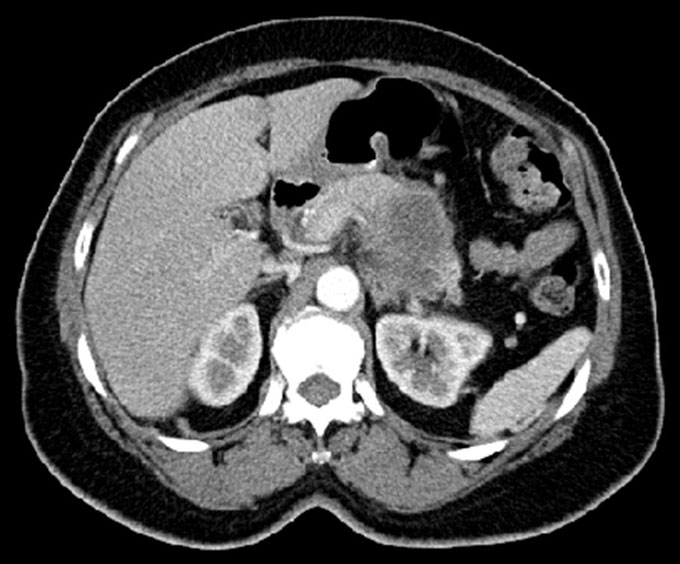 This patient's abdominal lesion most likely originated from which of the following?
 (Multiple Choice)
4.8/5  (75)
(75) A 73-year-old man comes to the office due to blood in his urine. He has noted bright red blood at the end of micturition on several occasions but has had no urinary frequency or pain with urination. The patient has a history of hypertension and chronic bronchitis. He has smoked a pack of cigarettes daily for 30 years. Temperature is 37 C (98.6 F). Abdominal, external genital, and rectal examinations are unremarkable. Urinalysis shows hematuria. Urine cytology is positive for malignant cells. Cystoscopy is planned for visualization and biopsy of suspected urinary tract cancer. Which of the following features would be most suggestive of a poor prognosis?
(Multiple Choice)
4.8/5 (86)
(86) A 42-year-old woman comes to the office with her husband for evaluation of abnormal movements. The patient has been having involuntary facial grimaces and extremity fidgeting. She has no prior medical or psychiatric conditions, but her husband says she has had frequent anger outbursts over the past year. The patient takes no medications. She smoked cigarettes and used illicit drugs for several years during college but not since then. Her father died of a neurological disorder at age 55. Physical examination shows intermittent, fidgety, jerky movements of the hands. MRI of the brain is ordered. Which of the following neuroimaging findings is most likely to be seen in this patient?
(Multiple Choice)
4.8/5 (81)
(81) A 73-year-old woman is brought to the clinic by her niece due to a 10-day history of abdominal pain and loss of appetite. The patient does not like "going to the doctor" and has not been seen by a physician in many years. Frequent loose stools and loss of appetite have been present since the pain began. Family history is significant for colon cancer in a maternal aunt. Temperature is 37.8 C (100 F) and pulse is 98/min. Abdominal examination is significant for tenderness on deep palpation of the left lower quadrant, along with an appreciable mass. There is no inguinal lymphadenopathy. White blood cell count is 15,000/mm3. Which of the following is the most likely cause of the abdominal pain in this patient?
(Multiple Choice)
4.9/5 (77)
(77) A 42-year-old previously healthy woman comes to the office due to fever and sore throat. She has no cough. Physical examination shows tonsillar exudate and a nontender cervical lymph node that measures 3.5 cm in diameter. Oral antibiotic therapy is started and on a follow-up visit a week later, the patient reports that her symptoms have resolved. The previously enlarged cervical lymph node has decreased slightly in size. On several follow-up visits over the following year, the patient remains asymptomatic and the size of the lymph node fluctuates but does not disappear completely. Referral to a surgeon is made and excisional biopsy of the lymph node is performed. Which of the following is the most likely diagnosis?
(Multiple Choice)
4.9/5 (69)
(69) A 35-year-old man comes to the office for evaluation of red skin lesions under his nipple that were first noticed by his wife. The lesions are not itchy or painful, and no other family members have skin lesions. He has not used any new soaps, lotions, or detergents. The patient has no known medical problems and takes no medications. He drinks 4-6 beers every night. He does not use tobacco or illicit drugs. Body mass index is 32kg/m2, and vital signs are normal. The skin findings are shown below. 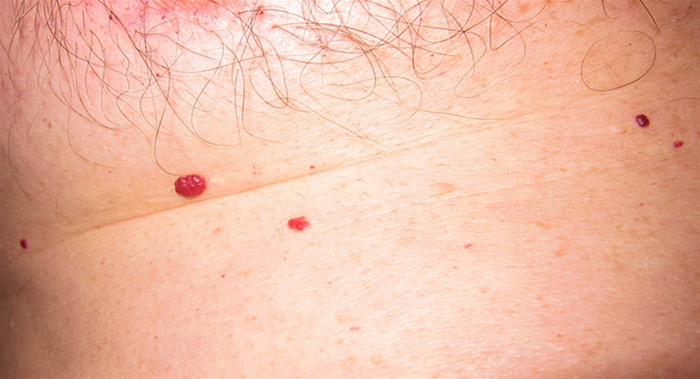 Which of the following is the most likely diagnosis in this patient?
 (Multiple Choice)
4.8/5 (83)
(83) A 29-year-old African American woman is being evaluated for exertional dyspnea and dry cough. She has no significant medical history and takes no medications. The patient works part-time as a bird keeper at a zoo. Chest x-ray reveals bilateral hilar adenopathy and reticular pulmonary infiltrates. Serum ACE levels and calcium levels are elevated. Purified protein derivative testing is negative. A bronchoscopy is scheduled to help determine the diagnosis. Which of the following is most likely to be the predominant cell type in this patient's bronchoalveolar lavage fluid?
(Multiple Choice)
4.9/5 (86)
(86) A 44-year-old woman comes to the emergency department due to acute-onset, severe, right lower quadrant abdominal pain, nausea, vomiting, and hematuria over the last 4 hours. She had a similar episode of acute pain a year ago, but it resolved in a few hours and she did not seek medical intervention. The patient has no other medical conditions and takes no medication. She smokes a pack of cigarettes daily. She is sexually active and has never been pregnant. Temperature is 36.9 C (98.4 F), blood pressure is 140/90 mm Hg, and pulse is 102/min. There is mild tenderness to deep palpation in the right lower quadrant. Laboratory results are as follows: 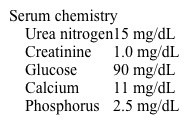 Which of the following is the most likely cause of this patient's current condition?
 (Multiple Choice)
4.9/5 (71)
(71) A 34-year-old obese man presents to your office complaining of fatigue, daytime sleepiness and occasional headaches. When you inquire about his sleeping habits, he reports that he sleeps in a separate room from his wife because she finds his snoring annoying. On physical examination, his blood pressure is 160/90 mmHg and his heart rate is 80/min. His abdomen is soft and non-tender, his liver span is 9 cm, and his spleen is not palpable. Laboratory findings are: 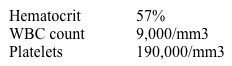 Decreased oxygen delivery to which of the following organs is responsible for his increased hematocrit?
 (Multiple Choice)
4.9/5 (73)
(73) A 23-year-old man comes to the office due to 3 weeks of malaise and fatigue. He says, "I've been sick with the flu for the last 3 weeks. I don't know why I'm not getting better." The patient also has profound fatigue causing difficulty with day-to-day activities. His temperature is 38.4 C (101.2 F). Cardiac auscultation reveals an apical holosystolic murmur radiating to the axilla, which was not heard during previous office visits. Laboratory evaluation shows serum creatinine of 2.3 mg/dL. Mild proteinuria and microscopic hematuria with red cell casts are present on urinalysis. Which of the following is the most likely pathogenesis of this patient's renal findings?
(Multiple Choice)
4.8/5 (78)
(78) A 65-year-old man comes to the office due to 2 months of fatigue and persistent, nonproductive cough. He has a history of coronary artery disease and myocardial infarction. Three years ago, he underwent wide local excision of a melanoma on his posterior neck. The patient has a 50-pack-year smoking history. Vital signs are within normal limits. Chest radiograph reveals multiple lung lesions and hilar lymphadenopathy. Histopathology from one of the biopsied lung lesions is shown below after staining with hematoxylin and eosin. 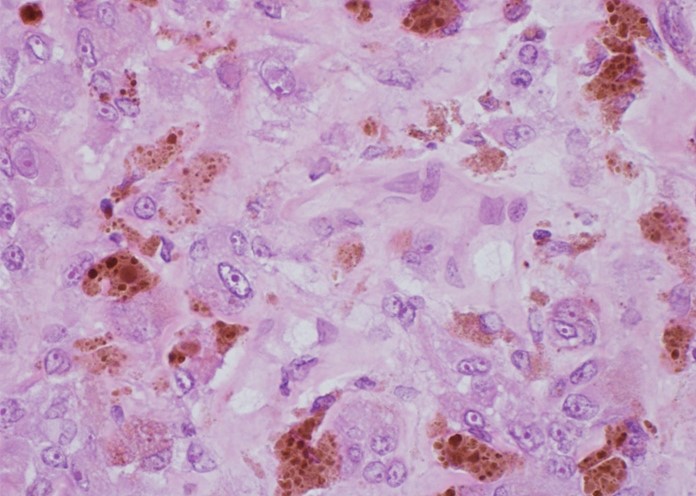 These histopathologic findings are most consistent with which of the following diagnoses?
 (Multiple Choice)
4.7/5 (87)
(87) A 50-year-old man comes to the office for evaluation of a mass on his back. He has had the mass for several years, and it has increased only slightly in size during that time. The patient has 2 other similar lesions, one on his arm and the other on his leg. The lesions are painless, and he has no other symptoms. Vitals signs are normal. Examination shows multiple subcutaneous, soft, freely mobile, and nontender masses. The lesion on his back is shown in the image. 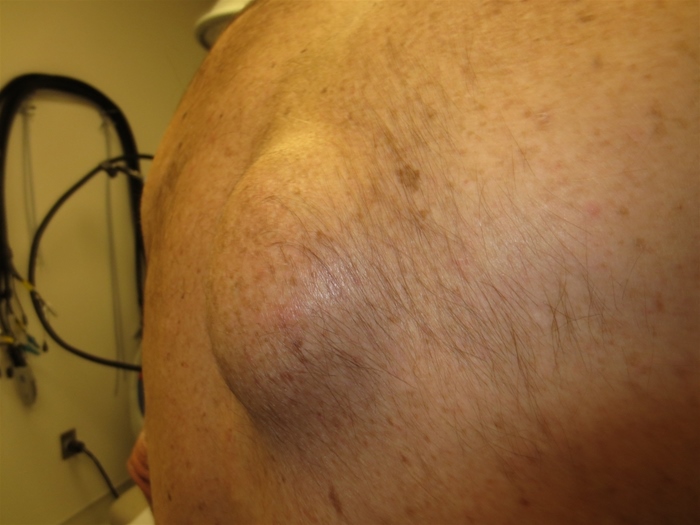 Histologic examination of the mass is most likely to show which of the following findings?
 (Multiple Choice)
4.8/5 (74)
(74) A 68-year-old man is brought to the emergency department by his daughter due to a change in mental status. Over the past 2 days, the patient has reported seeing strangers sneaking around the house when only he and his daughter were at home. He has also been intermittently confused, difficult to rouse, and distractible. The patient has had no headaches or focal weakness. He has no chronic medical or psychiatric problems other than seasonal allergies, which his daughter says have flared up since he moved in with her 2 weeks ago. Temperature is 36.7 C (98 F), blood pressure is 140/85 mm Hg, pulse is 88/min, and respirations are 12/min. On physical examination, the patient is somnolent but arousable to voice. He is not oriented to place or time. Pupils are bilaterally equal and reactive to light. Bilateral upper and lower extremity muscle strength, deep tendon reflexes, and pain sensation are normal. Blood cell counts and serum chemistry studies are within normal limits. Which of the following is the most likely cause of his current condition?
(Multiple Choice)
4.9/5 (76)
(76) A 3-year-old boy is evaluated for delayed developmental milestones, including short stature. There is no family history of bone conditions. The family recently immigrated to the United States. The patient was exclusively breastfed until age 6 months and has since had a varied diet of fruits, vegetables, and meats. He takes no medications or supplements. Vital signs are normal. Physical examination reveals frontal bossing, dental enamel defects, and bilateral, symmetric, bead-like enlargement of the costochondral junctions. If a histologic examination of the bone is performed, which of the following changes is most likely to be seen in this patient?
(Multiple Choice)
4.8/5 (77)
(77) A 65-year-old man dies while hospitalized for severe breathing difficulty. The patient had several prior episodes of dyspnea and cough requiring hospitalization. He had a history of hypertension and chronic kidney disease. The patient smoked a pack of cigarettes daily for 38 years and immigrated to the United States 20 years ago. Autopsy is performed, and microscopic examination of the lungs reveals alveolar macrophages containing aggregates of golden-brown cytoplasmic granules that turn dark blue with Prussian blue staining. Which of the following conditions is most likely associated with this patient's microscopic findings?
(Multiple Choice)
4.8/5 (73)
(73) A 68-year-old woman comes to the emergency department due to an acute vision disturbance. She had an episode of dimming of vision in the left eye that occurred abruptly and resolved spontaneously in 20 minutes. For the past several weeks, the patient has had a dull ache in the left side of her jaw while chewing that resolves when she stops eating. She has also had malaise and hip muscle aches over the last several months. The patient has a history of hypertension and hypothyroidism. On examination, her blood pressure is 130/70 mm Hg and pulse is 66/min. Neurological examination, including cranial nerves and motor and sensory functions, is unremarkable. Visual acuity, visual fields, and appearance of the ocular fundi are normal. Which of the following is the best initial test for this patient?
(Multiple Choice)
4.9/5 (72)
(72) A 46-year-old smoker presents to your office with a three week history of low-grade fever, weakness and neck swelling. Biopsy of the affected tissue reveals the following histologic findings: 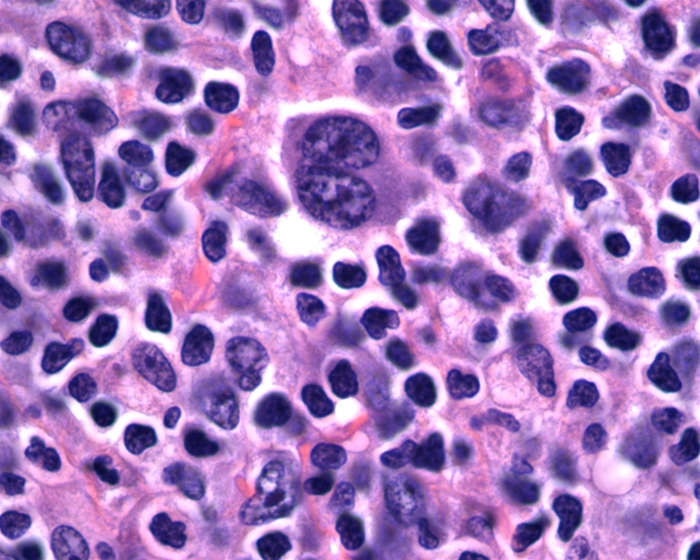 An abnormality in which of the following tissues is most likely responsible for this patient's symptoms?
 (Multiple Choice)
4.7/5 (80)
(80) A 55-year-old man is hospitalized with severe abdominal pain associated with nausea and vomiting. Laboratory studies show marked elevation of serum amylase and lipase. He has a history of heavy alcohol use. During hospitalization, his condition deteriorates and he develops severe respiratory distress. There are crackles bilaterally on physical examination and diffuse patchy infiltrates bilaterally on chest x-ray. The patient fails to improve with mechanical ventilation and 100% oxygen and dies 4 days later due to progressive respiratory failure. Which of the following autopsy findings is most likely in this patient?
(Multiple Choice)
4.8/5 (78)
(78) A 67-year-old man comes to the office due to a persistent headache and pain in the jaw when chewing food. For the past 2 months, he has been unable to eat "tough foods like steak because the pain makes it take too long to chew them." Medical history is notable for hypertension, type 2 diabetes mellitus, and hyperlipidemia. Blood pressure is 130/70 mm Hg, and pulse is 76/min and regular. Physical examination is unremarkable. Appropriate therapy is immediately started, and an arterial biopsy is performed. Histopathology shows multinuclear giant cells and internal elastic membrane fragmentation. Prompt institution of therapy in this patient most likely reduces the risk of which of the following complications?
(Multiple Choice)
4.7/5 (78)
(78) A 44-year-old man comes to the emergency department due to worsening abdominal pain and vomiting. The patient has had 3 months of fatigue, mild abdominal pain, low-grade fever, and joint pains. On examination, the abdomen is diffusely tender to palpation with rigidity and rebound. Urgent laparotomy reveals bilateral renal infarcts and multiple segments of necrosis and perforation in the small bowel. Microscopic examination of the vessel walls shows diffuse inflammation of the adventitia and marked thickening of the inner layers due to proliferation of loose connective tissue; the arterial lumen is significantly narrowed. Which of the following is the most likely diagnosis?
(Multiple Choice)
4.8/5 (82)
(82) 
Filters
- Essay(0)
- Multiple Choice(0)
- Short Answer(0)
- True False(0)
- Matching(0)