



 Chat with AI
Exam 10: Pathology

Exam 1: Anatomy291 Questions
Exam 2: Behavioral science240 Questions
Exam 3: Biochemistry156 Questions
Exam 4: Biostatistics117 Questions
Exam 5: Embryology52 Questions
Exam 6: Genetics103 Questions
Exam 7: Histology24 Questions
Exam 8: Immunology129 Questions
Exam 9: Microbiology336 Questions
Exam 10: Pathology816 Questions
Exam 11: Pathophysiology464 Questions
Exam 12: Pharmacology538 Questions
Exam 13: Physiology272 Questions
Select questions type


A 30-year-old Asian man comes to the clinic due to painful, ulcerated fingers. His symptoms began with pain and discoloration of the fingers several weeks ago, which progressed to ulceration at the fingertips. He also reports pain in the hands that occurs with activity and is relieved by rest. Medical history is unremarkable. The patient has smoked 2 packs of cigarettes a day for the last 5 years. He occasionally drinks alcohol but does not use illicit drugs. Vital signs are within normal limits. No heart murmurs are heard and the lungs are clear. Examination of the hands is shown in the exhibit. 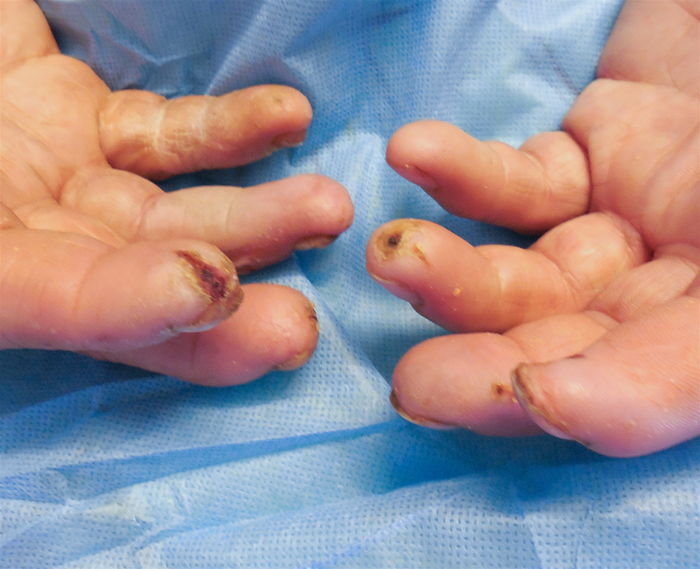 Radial pulses are diminished. There is erythema and tenderness along a superficial vein of the left forearm. Hemoglobin A1c and a fasting lipid panel are within normal limits. Which of the following pathologic findings is most likely to be seen within the affected vessels?
 (Multiple Choice)
4.9/5  (80)
(80) A 42-year-old woman comes to the emergency department for evaluation of chest pain. She was moving furniture in her summer house 2 days ago when she experienced sharp pain in the left side of the sternum that quickly subsided. Since then, the patient has had episodic pain with deep inspiration or trunk movement. She has no fever or cough. The patient has a history of hypertension. Her father died of myocardial infarction at age 67. She does not use tobacco or illicit drugs. Blood pressure is 146/85 mm Hg in the right arm and 142/80 mm Hg in the left arm, pulse is 86/min, and respirations are 12/min. She has localized tenderness to palpation at the left sternal border. Lungs are clear to auscultation, and cardiac examination reveals normal heart sounds without gallops or murmurs. The abdomen is soft and nontender. There is no peripheral edema. Which of the following is the most likely cause of this patient's symptoms?
(Multiple Choice)
4.9/5 (84)
(84) A 66-year-old man comes to the office for a routine visit. He has a history of hypertension and osteoarthritis. The patient has smoked a pack of cigarettes daily for 40 years and occasionally drinks 1 or 2 glasses of wine but does not use illicit drugs. Blood pressure is 142/82 mm Hg and pulse is 80/min. Cardiopulmonary examination is normal. There is a pulsating, central abdominal mass on physical examination. Which of the following pathologic conditions is the most likely underlying cause of this patient's abnormal findings?
(Multiple Choice)
4.8/5 (85)
(85) A 54-year-old woman is brought to the hospital due to fever, nausea, vomiting, and confusion. For the past 3 days, she has had dysuria and increased frequency of urination. Medical history is significant for recurrent urinary tract infections and primary hypertension. Family history is insignificant. Temperature is 39.2 C (102.6 F), blood pressure is 90/50 mm Hg, pulse is 102/min, and respirations are 24/min. Examination shows right flank tenderness. The patient subsequently undergoes nephrectomy, and a cut section of the resected kidney is shown in the image below. 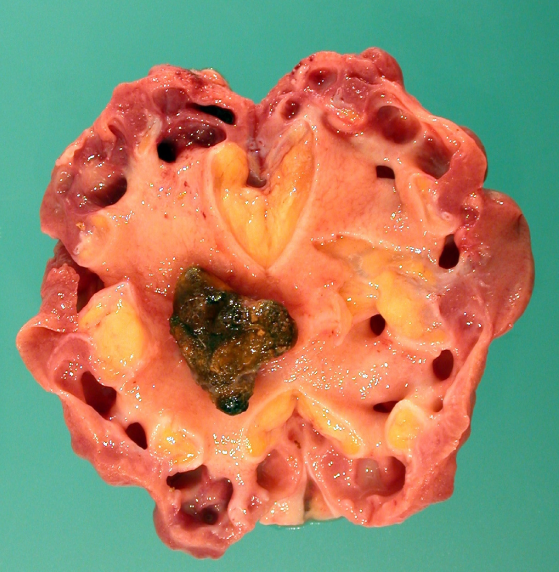 Further evaluation of this patient would most likely reveal which of the following?
 (Multiple Choice)
5.0/5 (79)
(79) A 2-week-old girl is brought to her primary care provider for a routine visit. The patient was born by normal spontaneous vaginal delivery at 39 weeks gestation. The mother is breastfeeding exclusively, and the infant has regained her birth weight. Newborn screening results from hemoglobin electrophoresis are as follows: 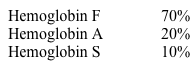 The patient's mother has sickle cell trait, and a maternal cousin has sickle cell anemia. Examination shows a well-appearing infant with no pallor or splenomegaly. Which of the following is most likely true about this patient?
 (Multiple Choice)
4.9/5 (64)
(64) A 20-year-old woman comes to the office due to gross hematuria. She otherwise feels well and has had no recent illnesses. She had a prior episode of hematuria 2 years ago that resolved spontaneously. The patient was diagnosed with type 1 diabetes mellitus approximately a year ago and is taking daily insulin injections. She works in a day care center and does not use tobacco, alcohol, or illicit drugs. Temperature is 37 C (98.6 F), blood pressure is 120/80 mm Hg, and pulse is 80/min. Physical examination shows no abnormalities. Laboratory results are as follows:  Which of the following is the most likely diagnosis?
 (Multiple Choice)
4.8/5 (83)
(83) A 64-year-old man who recently moved to the area comes to the office for a new patient evaluation. He has chronic low back pain, resulting from an injury 8 years ago, for which he uses several over-the-counter analgesics. Most recently, the patient has been taking naproxen daily. He has no other joint pain, fever, rash, urinary symptoms, or other medical conditions. Blood pressure is 135/70 mm Hg and pulse is 78/min. Examination shows trace lower extremity edema. Neurologic and musculoskeletal examinations reveal no abnormalities. Laboratory results show blood counts within normal limits, blood urea nitrogen of 12 mg/dL, and serum creatinine of 2.0 mg/dL. Urinalysis reveals 1+ protein and 3-4 white blood cells/hpf. Renal ultrasound demonstrates bilateral shrunken and irregular kidneys with a few papillary calcifications. Which of the following is the most likely cause of this patient's renal dysfunction?
(Multiple Choice)
4.8/5 (80)
(80) A 58-year-old man comes to the emergency department with abrupt-onset, severe chest pain that radiates to his back. His blood pressure is 220/130 mm Hg in the left arm and 180/100 mm Hg in the right. His heart rate is 100/min. Initial laboratory studies show normal serum troponin levels. Electrocardiogram is negative for ST-segment changes. This patient's acute condition was most likely triggered by which of the following events?
(Multiple Choice)
4.9/5 (83)
(83) A 46-year-old woman being evaluated for irregular vaginal bleeding is found to have invasive cervical carcinoma. She undergoes total abdominal hysterectomy and bilateral salpingo-oophorectomy. Pelvic lymphadenectomy was also performed, during which several enlarged nodes around the pelvic vessels were resected. A week after the surgery, the patient begins to experience left-sided flank pain that radiates to the groin. Her temperature is 36.1 C (97 F), blood pressure is 120/70 mm Hg, and pulse is 84/min. On physical examination, there is a ballotable left flank mass. Which of the following most likely accounts for this physical examination finding?
(Multiple Choice)
4.8/5 (80)
(80) A 45-year-old man comes to the emergency department due to epigastric abdominal pain and fatigue. He has had similar episodes of pain in the past. Temperature is 37.1 C (98.8 F), blood pressure is 128/69 mm Hg, pulse is 92/min, and respirations are 16/min. Physical examination shows mild epigastric tenderness and hepatomegaly. There is no jaundice or lymphadenopathy. Laboratory results are as follows: 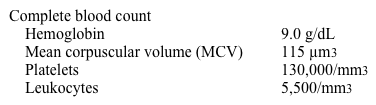 CT scan of the abdomen shows pancreatic calcifications. Right upper quadrant ultrasound reveals no evidence of gallstones. Which of the following processes is most likely responsible for this patient's anemia?
 (Multiple Choice)
5.0/5 (82)
(82) A 55-year-old man comes to the office to establish care after relocating to the area. The patient has a 6-year history of type 2 diabetes mellitus for which he takes metformin monotherapy. He feels well and has no other medical conditions. The patient does not use tobacco or alcohol. He consumes a balanced diet and jogs for 40 minutes every morning. Review of his blood glucose journal over the last few months shows fasting glucose levels of 150-180 mg/dL. Laboratory analysis shows a hemoglobin A1c level of 4%. Further evaluation with hemoglobin electrophoresis shows a hemoglobin A2 level of 7.5% (normal: 1.5%-3.5%). Which of the following is the most likely explanation for this patient's lower-than-expected hemoglobin A1c level?
(Multiple Choice)
4.8/5 (84)
(84) A 14-year-old boy is brought to the office due to painless nodules on his lips and tongue. The lesions appeared several months ago and have been progressively enlarging. The patient underwent total thyroidectomy 5 years ago following the discovery of a thyroid mass and takes thyroid hormone replacement. On physical examination, the patient is tall and slender with disproportionately long arms and legs. His fingers are also long and thin, and joint laxity is present. Eye examination is normal and oral inspection reveals several small, soft, flesh-colored papules on his lips and tongue. Serum TSH is within normal limits. This patient most likely has which of the following conditions?
(Multiple Choice)
4.7/5 (79)
(79) A 60-year-old professor is brought to the emergency department after developing right-sided weakness and numbness during a lecture an hour ago. He also has nausea and confusion. The patient smoked a pack of cigarettes daily for 20 years but quit 10 years ago. He does not drink alcohol. His father died of myocardial infarction at age 70. Blood pressure is 190/100 mm Hg, and pulse is 60 /min. On physical examination, there are no signs of head trauma. There is diminished right-sided strength (1/5) and an upgoing plantar reflex. Brain CT without contrast is obtained immediately. The image is shown below. 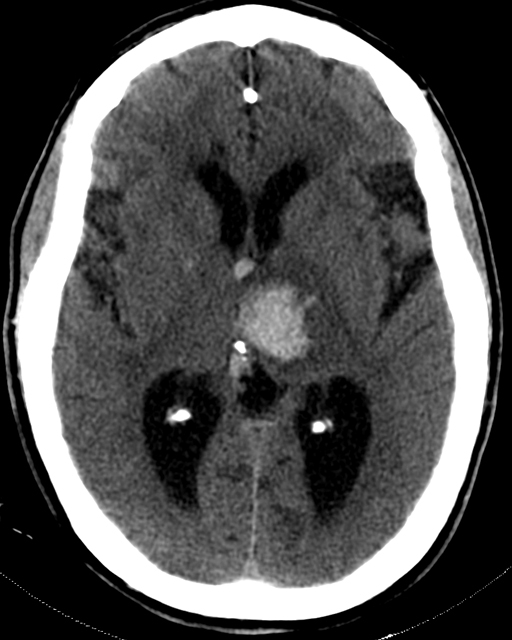 Which of the following is the most likely cause of this patient's condition?
 (Multiple Choice)
4.8/5 (91)
(91) A 38-year-old woman comes to the office due to worsening shortness of breath over the past 4 weeks. She has no chest pain or lightheadedness but has noticed some ankle puffiness. The patient can hardly do chores without having to stop to catch her breath. Medical history is unremarkable. She delivered a healthy child 2 months ago without complications. The patient is a lifetime nonsmoker and does not use alcohol. She has no family history of early heart disease or sudden cardiac death. Blood pressure is 96/60 mm Hg and pulse is 92/min and regular. The apical impulse is palpated along the anterior axillary line, and S3 is heard at the apex. There are no heart murmurs. Which of the following best describes the left ventricular changes in this patient?
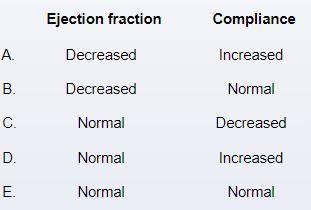
(Multiple Choice)
4.9/5 (74)
(74) A 62-year-old woman comes to the office due to activity-related joint pain in the hands and periodic morning stiffness that lasts 10-15 minutes. The pain is moderately severe and has begun to limit her activities. The patient has attempted to treat the pain with acetaminophen, which provided only partial relief. Past medical history is notable for hypertension and diabetes mellitus. Physical examination shows firm nodules over the distal interphalangeal joints bilaterally as shown in the image below. 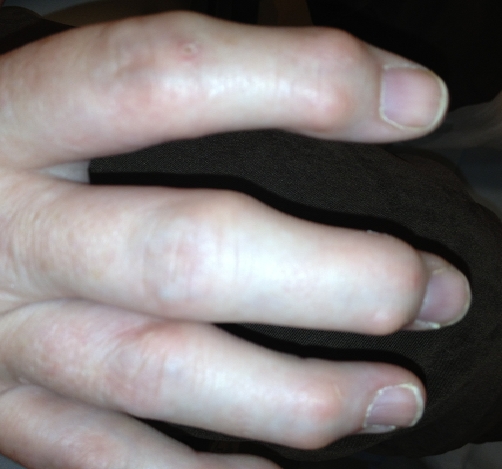 Which of the following is the most likely cause of this patient's symptoms?
 (Multiple Choice)
4.7/5 (76)
(76) A 68-year-old woman is evaluated for vision impairment. The patient has a decrease in both distant and near vision and has had occasional floaters. She has had no pain or redness in her eyes, headache, focal weakness, or sensory loss. Medical history is notable for type 2 diabetes mellitus, hypertension, and chronic kidney disease. Blood pressure is 138/84 mm Hg and pulse is 76/min. The pupils are equal and reactive to light bilaterally. Anterior chambers are clear, and there are no opacities of the cornea or lens. Funduscopic examination reveals scattered retinal microaneurysms, dot-and-blot hemorrhages, and cotton-wool spots, as well as new blood vessel formation. Which of the following contributed most to the pathogenesis of this patient's current ocular condition?
(Multiple Choice)
5.0/5 (79)
(79) A 17-year-old boy is brought to the office for evaluation of bilateral breast enlargement. He first noticed it a few months ago and says that it is slightly painful. His parents are concerned that his breasts are gradually becoming more prominent. The patient is in special education classes due to a long-standing history of learning disabilities. His father has type 2 diabetes mellitus and is on dialysis for chronic renal failure. Height is at the 95th percentile, and weight is at the 25th percentile for age and sex. Symmetrical glandular tissue is palpated under both nipple-areolar complexes. His sense of smell is normal, and his testicles are small and firm. Laboratory evaluation would most likely show which of the following findings?
(Multiple Choice)
4.8/5 (77)
(77) A 35-year-old man is evaluated for progressive fatigue and shortness of breath. Recently, he has noticed bilateral leg swelling and abdominal distension despite overall weight loss. He does not use tobacco, alcohol, or illicit drugs. Despite treatment, the patient dies several weeks later. Autopsy reveals significant endocardial thickening with dense fibrous deposits around the tricuspid and pulmonary valves as well as moderate pulmonary valve stenosis. The left-sided cardiac chambers and valves are normal. Measuring the levels of which of the following substances would have helped in diagnosing this patient?
(Multiple Choice)
4.8/5 (68)
(68) A 64-year-old man is hospitalized with abdominal pain, nausea, and vomiting. The patient has had several similar episodes in the past and was advised to avoid alcohol consumption. Evaluation reveals epigastric tenderness and elevated serum amylase and lipase levels. The patient is admitted, and treatment with bowel rest and intravenous fluids is begun. During hospitalization, he develops new-onset confusion. Physical examination shows horizontal nystagmus and gait ataxia. Brain imaging reveals abnormalities in the mammillary bodies and periaqueductal gray matter. Which of the following most likely precipitated this patient's current neurologic condition?
(Multiple Choice)
4.9/5 (77)
(77) A 57-year-old man comes to the emergency department due to a 1-day history of pain and swelling in his right knee. The pain is severe, and he has had difficulty bearing weight on the right leg. He previously felt well. Past medical history is notable for hypertension and seasonal allergies. The patient does not use tobacco and drinks 1 or 2 alcoholic beverages a week. On examination, the right knee is red and swollen. He has pain with passive range of motion at the knee. The knee ligaments show no significant laxity. Synovial fluid obtained from the involved joint shows a white blood cell count of 25,000/mm3, with a neutrophilic predominance, and numerous crystals (shown below). 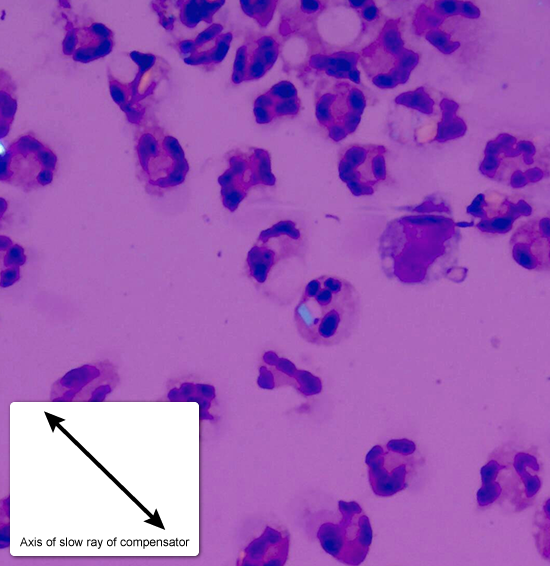 These crystals are most likely composed of which of the following substances?
 (Multiple Choice)
4.9/5 (76)
(76) 
Filters
- Essay(0)
- Multiple Choice(0)
- Short Answer(0)
- True False(0)
- Matching(0)