



 Chat with AI
Exam 10: Pathology

Exam 1: Anatomy291 Questions
Exam 2: Behavioral science240 Questions
Exam 3: Biochemistry156 Questions
Exam 4: Biostatistics117 Questions
Exam 5: Embryology52 Questions
Exam 6: Genetics103 Questions
Exam 7: Histology24 Questions
Exam 8: Immunology129 Questions
Exam 9: Microbiology336 Questions
Exam 10: Pathology816 Questions
Exam 11: Pathophysiology464 Questions
Exam 12: Pharmacology538 Questions
Exam 13: Physiology272 Questions
Select questions type


A 45-year-old man comes to the clinic due to a 2-month history of progressive left arm clumsiness and weakness. The patient initially attributed his symptoms to a left rotator cuff injury he sustained several years ago; however, he has recently developed problems with his gait. The patient's symptoms have interfered with daily activities such as bathing and dressing. He has had no recent injury, headaches, or bowel/bladder symptoms. On physical examination, there is reduced muscle strength in the left upper extremity. Further evaluation with brain MRI reveals a lesion involving the corticospinal tract. Which of the following additional signs is most likely to been seen in this patient?
(Multiple Choice)
5.0/5  (68)
(68) A 68-year-old man comes to the office due to intermittent, painless blood in his urine. He has no other symptoms. The patient uses transdermal testosterone for chronic hypogonadism and erectile dysfunction. He has smoked a pack of cigarettes daily for 40 years; he drinks 2 shots of vodka every day and 2 glasses of wine once a week. He works as an operations manager for a large beverage company and frequently travels to Mexico. Vital signs are within normal limits. Abdominal examination shows no abnormalities. On digital rectal examination, the prostate is smooth with no nodules. Urinalysis is positive for >50 red blood cells/hpf; there are no casts or dysmorphic blood cells. Urine cytology is positive for malignant cells. Renal ultrasonogram reveals normal kidneys. Which of the following is a major risk factor for this patient's current condition?
(Multiple Choice)
4.8/5 (77)
(77) A 34-year-old man is hospitalized due to trauma sustained during a motor vehicle collision. He subsequently develops worsening shortness of breath and confusion and dies despite appropriate management. Autopsy examination shows scattered petechiae on the anterior thorax. Microscopic evaluation of his pulmonary vessels reveals the findings shown below. 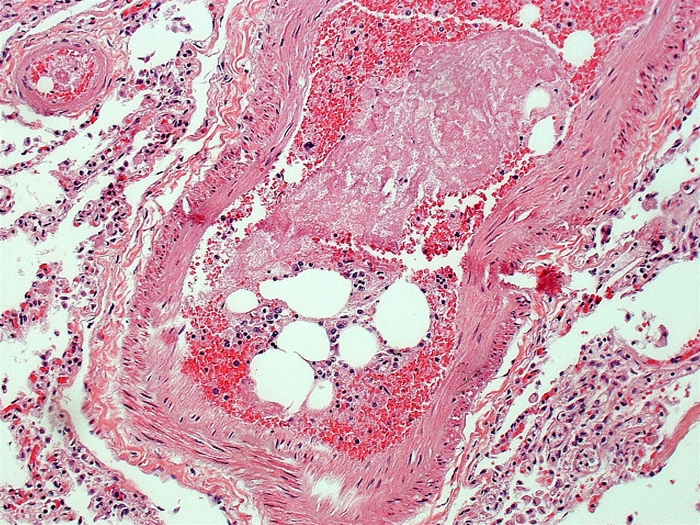 Which of the following most likely predisposed this patient to developing the observed histopathologic abnormality?
 (Multiple Choice)
4.9/5 (76)
(76) A 34-year-old Asian female is hospitalized with progressive exertional dyspnea, lower extremity edema and cough. She also describes frequent nocturnal episodes of breathlessness and recent hoarseness. She does not use tobacco, alcohol or drugs. Auscultation reveals loud first and second heart sounds and a mid-diastolic rumble best heard at the cardiac apex. This patient's hoarseness is most likely caused by:
(Multiple Choice)
4.9/5 (75)
(75) A 22-year-old woman comes to the office due to worsening dyspnea and heart pounding with exercise for the last week. She has no chronic medical conditions but reports aches and pains over the past several weeks. The patient takes ibuprofen as needed but no other medications. Temperature is 37.2 C (99 F), blood pressure is 138/86 mm Hg, and pulse is 90/min. BMI is 18 kg/m2. Physical examination shows an erythematous rash in sun-exposed regions. The lungs are clear to auscultation. A midsystolic click and systolic murmur are heard best at the apex without radiation. There is mild tenderness of joints. Laboratory results are as follows: 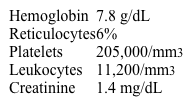 Which of the following is the most likely cause of this patient's hematologic findings?
 (Multiple Choice)
4.8/5 (74)
(74) A 20-year-old woman comes to the physician because of multiple burns on her hands. She says that she gets burned quite often when she cooks, particularly while operating the oven. She also has burned herself when picking up her morning cup of coffee and when testing the water temperature in the shower. The patient is concerned because she cannot feel when objects are "really hot" and often does not notice that she has burns until she looks at her hands. She has no significant past medical history, no recent illnesses, and no sick contacts. Her surgical history is significant only for removal of impacted wisdom teeth 1 year ago. The patient has never smoked, drinks alcohol occasionally, and does not use illicit drugs. Her family history is significant for multiple sclerosis in her mother. Examination shows diminished pinprick and temperature sensation across the upper back, shoulders, and arms bilaterally. Light touch, position, and vibration sense are preserved. Examination of the lower extremities is unremarkable. Damage to which of the following spinal cord areas is most likely responsible for this patient's symptoms? 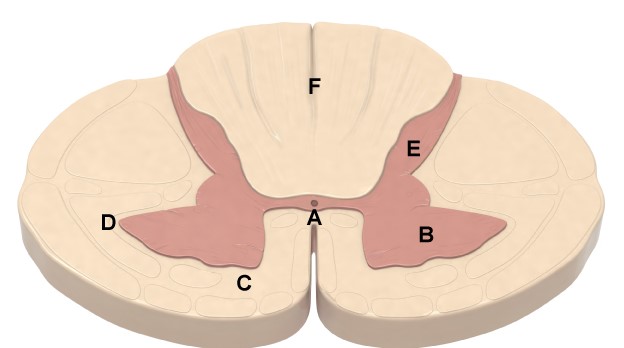
(Multiple Choice)
4.8/5 (87)
(87) A 21-year-old Caucasian male suffers from weakness and gait disturbance. He noticed that he has had difficulty releasing the doorknob lately. Physical examination shows cataracts, frontal baldness, and gonadal atrophy. Biopsy shows muscle atrophy involving mostly type 1 fibers. The patient's condition is best described as which of the following?
(Multiple Choice)
4.9/5 (86)
(86) A 68-year-old man comes to the emergency department due to lower abdominal pain and nausea. His symptoms started the prior evening, when he began to feel abdominal fullness and discomfort. This progressed to pain over the lower abdomen and constant nausea without vomiting. The patient last urinated >24 hours ago. He has had difficulty initiating urination and a feeling of incomplete voiding for the last year but avoided seeing a physician. Temperature is 36.7 C (98 F), blood pressure is 150/90 mm Hg, and pulse is 95/min. Physical examination shows suprapubic tenderness and fullness without guarding or rebound. Rectal examination reveals an enlarged, smooth prostate. Serum creatinine is 2.6 mg/dL and blood urea nitrogen is 22 mg/dL. A urinary catheter is placed, with immediate collection of 800 mL of urine and relief of the patient's symptoms. The following day, serum creatinine is improved. This patient's condition is associated with increased risk for which of the following?
(Multiple Choice)
4.9/5 (79)
(79) A 2-day-old boy develops abdominal distension and refuses to breastfeed. He was born via normal spontaneous vaginal delivery at 39 weeks gestation to a primigravid mother. Examination shows significant abdominal distension with palpable intestinal loops. The rectum has no stool and rectal tone is normal. During the examination, the infant has several episodes of dark green emesis. Plain films of the abdomen show air-fluid levels and small bowel dilation. Contrast enema fails to relieve the obstruction, and the patient is taken for emergency laparotomy, which shows an inspissated, green fecal mass obstructing the distal ileum. The infant recovers from the surgery uneventfully. Which of the following will be the most likely cause of mortality in this patient?
(Multiple Choice)
4.7/5 (88)
(88) A 60-year-old man undergoes lymph node biopsy due to persistent cervical lymphadenopathy. Histologic examination reveals a population of small lymphoid cells arranged in a follicular pattern. The cells demonstrate overexpression of the BCL2 gene. The protein encoded by this gene normally inhibits which of the following processes?
(Multiple Choice)
4.8/5 (94)
(94) A 58-year-old man comes to the office due to urinary symptoms. Over the past year, he has had difficulty initiating urination and a weakened urine stream. He also has frequent nocturnal voiding. The patient has not passed any visible blood clots and has had no dysuria, fever, recent illnesses, or urinary trauma. He has no other medical conditions and takes no medications. Vital signs are within normal limits. Rectal examination reveals a smooth, enlarged prostate with no tenderness to palpation. Prostate-specific antigen is within the normal range. Urinalysis reveals 20-30 red blood cells per high power field and no urinary casts. Cystoscopy is performed and shows increased bladder wall trabeculations with normal appearing mucosa. Which of the following is the most likely cause of this patient's hematuria?
(Multiple Choice)
4.9/5 (85)
(85) An 8-year-old boy comes to the office due to a mass in the right mandible. His family first noticed it a few months ago, and it has grown rapidly. He has had no fevers, chills, cough, or weight loss. The patient and his family recently immigrated to the United States from East Africa. He has no known medical problems. Temperature is 37 C (98.6 F). Physical examination shows a large tumor on the right mandible with palpable regional lymphadenopathy. A biopsy of the lesion is performed. Histopathologic examination shows a diffuse infiltrate of lymphoid cells with numerous mitotic figures; interspersed macrophages with clear cytoplasm are also seen. These lymphoid cells most likely have a chromosomal translocation that directly alters which of the following processes?
(Multiple Choice)
4.9/5 (87)
(87) A 57-year-old unconscious man is brought to the emergency department by his wife. Thirty minutes prior, the patient developed severe chest pain and asked to be taken to the hospital. On the way, he became unresponsive. According to his wife, the patient had been having intermittent, short-lived episodes of chest pain over the past several days. The patient's medical history is significant for hypertension, type 2 diabetes mellitus, and hypercholesterolemia. He is not adherent with medications or follow-up. In the emergency department, the patient has no spontaneous respirations or circulation and is pronounced dead. An autopsy examination is performed, and a cross-section of the mid-right coronary artery is shown in the exhibit. 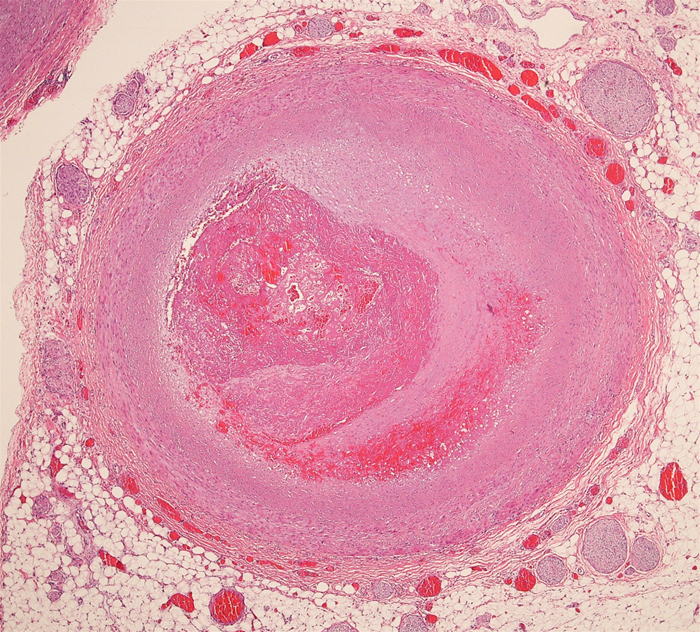 Which of the following is the most likely immediate cause of death in this patient?
 (Multiple Choice)
4.8/5 (89)
(89) A 5-year-old girl is brought to the clinic due to 2 days of dark red urine. The patient was treated for facial impetigo 1 month ago. Blood pressure is 140/90 mm Hg. Urinalysis reveals hematuria, mild proteinuria, and occasional red blood cell casts. Which of the following changes would most likely be present on this patient's renal biopsy?
(Multiple Choice)
4.9/5 (87)
(87) A 54-year-old woman comes to the physician because of multiple firm violaceous nodules on her right upper arm. She was diagnosed with right-sided breast carcinoma twelve years ago and was treated with radical mastectomy. Extensive axillary lymph node dissection performed at that time revealed no lymph node metastases. Post-operatively, the patient developed chronic lymphedema involving her right arm. Which of the following is the most likely etiology of her current skin lesions?
(Multiple Choice)
4.7/5 (69)
(69) A 24-year-old woman, gravida 1 para 1, comes to the office for postpartum follow-up 2 weeks after a term vaginal delivery. Her baby is doing well, but she is concerned because she has not yet lactated. The patient knew she would lose weight and be tired after the baby was born, but she feels excessive fatigue and has had significant weight loss. She also has nausea, loss of appetite, and postural dizziness. The patient has no headaches, visual problems, cold intolerance, constipation, or polyuria. On examination, she appears fatigued and has mild pallor. Laboratory tests are drawn the next morning at 8:00 AM, with the following results: 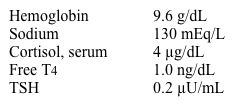 Which of the following pathologic processes is most likely responsible for this patient's symptoms?
 (Multiple Choice)
4.8/5 (101)
(101) A 36-year-old woman comes to the clinic for evaluation of a 4-month history of nonproductive cough and exertional dyspnea. Her only other medical problem is frequent heartburn, for which she takes over-the-counter antacids. Temperature is 37.1 C (98.8 F), blood pressure is 126/74 mm Hg, pulse is 88/min, and respirations are 20/min. Examination shows bilateral crackles and normal heart sounds. The remainder of the examination is unremarkable. Chest imaging shows bilateral interstitial opacities. Bronchioalveolar lavage reveals >50% of cells being lymphocytes. Which of the following is the most likely diagnosis?
(Multiple Choice)
4.7/5 (80)
(80) A 45-year-old man with a history of alcohol use disorder, chronic hepatitis C, and HIV is brought to the emergency department due to altered mental status and abdominal distension. He is disoriented and unable to provide an adequate history. He is accompanied by a friend who reports that the patient has recently been drinking heavily. The patient's breath has a sweet, sulfurous odor. Physical examination shows gynecomastia, palmar erythema, and multiple spider angiomata. The abdomen is severely distended, and dilated periumbilical veins are noted. There is 3+ bilateral lower extremity edema. Genital examination shows testicular atrophy. Neurologic examination shows disorientation and asterixis. Abdominal imaging reveals splenomegaly. Development of this patient's gynecomastia most closely resembles the pathogenesis of which of the following additional findings in this patient?
(Multiple Choice)
4.8/5 (82)
(82) Magnetic resonance imaging of the head of a young patient shows an angiomatous lesion involving the cerebellum. There is also a cystic mass in the right kidney on abdominal ultrasound. The differential diagnosis must include which of the following?
(Multiple Choice)
4.7/5 (75)
(75) A 65-year-old man is brought to the emergency department due to acute onset of a severe headache and dizziness. He describes it as a throbbing that localizes to the back of his head, with associated vertigo and mild nausea. The patient has a past medical history of type 2 diabetes mellitus, hypertension, chronic obstructive pulmonary disease, and a recent diagnosis of lung adenocarcinoma. He has smoked 1-2 packs of cigarettes daily for the past 30 years. His temperature is 36.7 C (98 F), blood pressure is 170/96 mm Hg, pulse is 80/min, and respirations are 14/min. Noncontrast head CT reveals an acute hemorrhage in the cerebellar vermis without mass effect or midline shift. Which of the following neurologic findings is most likely to be present during this patient's physical examination?
(Multiple Choice)
5.0/5 (85)
(85) 
Filters
- Essay(0)
- Multiple Choice(0)
- Short Answer(0)
- True False(0)
- Matching(0)