



 Chat with AI
Exam 10: Pathology

Exam 1: Anatomy291 Questions
Exam 2: Behavioral science240 Questions
Exam 3: Biochemistry156 Questions
Exam 4: Biostatistics117 Questions
Exam 5: Embryology52 Questions
Exam 6: Genetics103 Questions
Exam 7: Histology24 Questions
Exam 8: Immunology129 Questions
Exam 9: Microbiology336 Questions
Exam 10: Pathology816 Questions
Exam 11: Pathophysiology464 Questions
Exam 12: Pharmacology538 Questions
Exam 13: Physiology272 Questions
Select questions type


A 10-year-old boy whose family recently immigrated to the United States is brought to the physician with ataxia, myoclonus, and visual problems. His parents say that he began acting strangely and having difficulty with school work several months ago. After the appropriate workup, a brain biopsy is obtained and an RNA virus containing hemagglutinin is cultured from the tissue sample. Which of the following is the most likely diagnosis?
(Multiple Choice)
4.8/5  (72)
(72) A 36-year-old woman comes to the office due to vague epigastric abdominal pain, occasional nausea, and bloating. She has no associated weight loss. Medical history is notable for moderate obesity and chronic allergic rhinitis. The patient takes no medications and does not use tobacco, alcohol, or illicit drugs. She was a vegetarian for several years but now consumes a wide variety of foods, including meat products. The patient has traveled abroad extensively in the past. Vital signs are normal. Examination shows mild epigastric tenderness to deep palpation. Laboratory results reveal mild anemia. Upper gastrointestinal endoscopy shows diffuse erythema of the antral mucosa. Biopsy reveals an inflammatory cell infiltrate involving the superficial mucosal layers. The underlying cause of this patient's current condition can also lead to which of the following?
(Multiple Choice)
4.9/5 (99)
(99) A 28-year-old woman comes to the office after finding a lump in her right breast. Her mother died from ovarian cancer at age 34 and her maternal aunt died from breast cancer at age 32. After an appropriate workup, the patient is diagnosed with breast cancer. This patient most likely inherited a mutation in a gene normally responsible for which of the following processes?
(Multiple Choice)
4.8/5 (64)
(64) A 56-year-old man is brought to the emergency department due to progressive weakness and lethargy. The patient has also had a nonproductive cough for the past several weeks. He has no prior medical conditions and takes no medications. He has smoked a pack of cigarettes daily for 30 years. Physical examination shows no abnormalities. Chest x-ray reveals a lung mass. Further evaluation reveals an electrolyte abnormality induced by ectopic antidiuretic hormone production from a lung mass. This patient is at greatest risk of which of the following conditions if his electrolyte abnormality is corrected too quickly?
(Multiple Choice)
4.7/5 (83)
(83) A 3-year-old boy is brought to the emergency department due to high fever, vomiting, and lethargy. His symptoms started 1 day ago but rapidly worsened over the last few hours. Physical examination shows hypotension, tachycardia, neck stiffness, and a petechial rash over the trunk and lower extremities. Laboratory results are as follows: 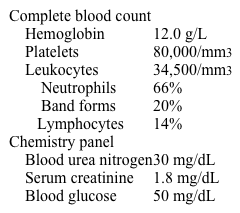 While being evaluated, the patient develops apnea and asystole. Despite aggressive resuscitation efforts, the patient dies. Autopsy would most likely reveal which of the following?
 (Multiple Choice)
4.7/5 (73)
(73) A 27-year-old Caucasian man comes to the physician with his wife for an infertility evaluation. They have been trying to conceive for the last 14 months without success. A semen analysis shows a normal sperm count but completely immobile sperm due to abnormal tail function. Which of the following additional findings is most likely associated with this patient's condition?
(Multiple Choice)
4.8/5 (76)
(76) A 32-year-old man comes to the clinic due to several months of fatigue and weight loss. The patient has no significant medical history. He drinks 1 or 2 alcoholic beverages daily and has used intravenous recreational drugs in the past. He is sexually active with his girlfriend. The patient has a maternal aunt with hypothyroidism, but his family history is otherwise unremarkable. Temperature is 36.7 C (98 F), blood pressure is 110/70 mm Hg, pulse is 65/min, and respirations are 18/min. Physical examination is normal. A liver biopsy is obtained, and light microscopy reveals large hepatocytes filled with finely granular, homogeneous, pale pink cytoplasm. Which of the following is the most likely diagnosis?
(Multiple Choice)
4.8/5 (77)
(77) A 32-year-old woman is evaluated for pain and a palpable mass in the right flank. Imaging studies reveal a large mass arising from the right kidney and similar smaller masses in the left kidney. Surgery to remove the right-sided tumor along with the right kidney is performed; a cross section of the specimen is shown in the image below. 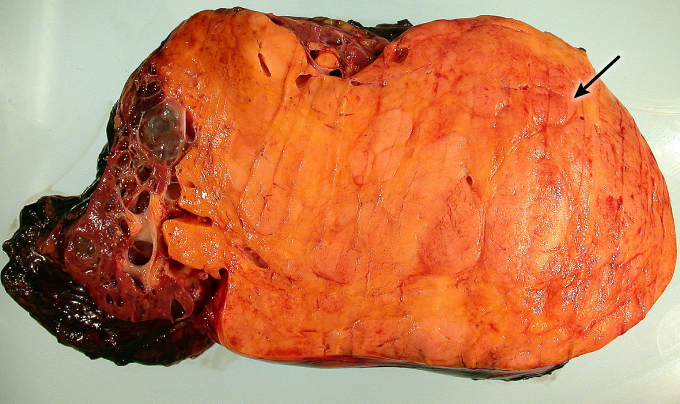 Histopathologic evaluation shows that the mass is composed of fat, smooth muscle, and blood vessels. This patient is most likely to have which of the following additional findings?
 (Multiple Choice)
4.9/5 (90)
(90) A 32-year-old African American male is diagnosed with acute prostatitis. He has no significant past medical history. He begins treatment with trimethoprim-sulfamethoxazole, but subsequently develops dark urine and anemia with a high reticulocyte count. Which of the following is the best explanation for the observed findings?
(Multiple Choice)
4.9/5 (58)
(58) A 45-year-old man comes to the office due to a 1 year history of abdominal pain and greasy stools. He has also noticed a 7-kg (15.4-lb) weight loss over the past 6 months. Medical history is significant for several years of joint pain in his knees and wrists but is otherwise unremarkable. The patient does not use tobacco or alcohol. After an initial workup, a duodenal biopsy is performed. Microscopic examination shows numerous macrophages in the lamina propria filled with inclusions positive for periodic acid-Schiff stain. Which of the following is the most appropriate treatment for this patient?
(Multiple Choice)
4.8/5 (81)
(81) A 25-year-old woman comes to the office due to progressive fatigue and dizziness for several months. She also has intermittent loose stools and abdominal cramps but no hematochezia, melena, vomiting, or abnormal menses. Vital signs are within normal limits. Conjunctival pallor is present. The abdomen is mildly distended but nontender. Laboratory evaluation reveals anemia and a low ferritin level. Fecal occult blood testing is negative. An upper endoscopy is performed and reveals no visible abnormalities of the stomach or duodenum, although biopsies of the duodenum are significant for intraepithelial lymphocytosis. Which of the following is the most likely cause of this patient's condition?
(Multiple Choice)
4.9/5 (88)
(88) A 28-year-old nulliparous woman comes to the clinic for an infertility evaluation. The patient has had unprotected intercourse with her husband for the past 12 months without conceiving and often experiences pain with deep vaginal penetration. Menarche was at age 11, and her menstrual period occurs every 26 days and lasts 5-7 days. Menstrual cycles are accompanied by moderate to severe lower abdominal pain. Pelvic examination shows a normal-sized, retroverted uterus. The posterior vaginal fornix is tender to palpation. This patient's condition most likely involves which of the following?
(Multiple Choice)
4.8/5 (68)
(68) A 35-year-old man comes to the clinic for evaluation of exertional dyspnea and dry cough for 8 months. Oxygen saturation on room air while lying down is 96% and drops to 88% after 6 minutes of walking. Examination shows fine crackles in both lower lungs. Chest x-ray reveals reticular densities in both lung fields. Lung biopsy shows an infiltration of inflammatory cells, predominantly lymphocytes, as well as poorly formed noncaseating granulomas and moderate alveolar septal fibrosis. Which of the following is the most likely diagnosis?
(Multiple Choice)
4.7/5 (74)
(74) A 73-year-old man comes to the emergency department with unstable angina. He undergoes coronary angiography via the femoral approach. A stent is placed in the right coronary artery, and the patient is discharged. He returns to the emergency department 2 days later with blue discoloration of his right toe. He has pain and mild tingling in the affected toe. Medical history is significant for hyperlipidemia and coronary artery disease. On physical examination, the right toe appears cyanotic, and there is livedo reticularis affecting the right thigh. Peripheral pulses in the lower extremities are bilaterally palpable. Serum creatinine is 2.8 mg/dL (preoperatively it was 1.0 mg/dL). Which of the following histopathologic findings would most likely be seen on biopsy of this patient's kidney?
(Multiple Choice)
4.9/5 (76)
(76) A 33-year-old woman with a 9-year history of ulcerative colitis comes to the office due to concern about her risk of colon cancer. One of her close family friends died recently from this cancer. The patient wants to "undergo all the tests for colon cancer." She has no other comorbid conditions and is under the care of a gastroenterologist who has kept her disease well controlled with sulfasalazine. Compared with sporadic colorectal carcinoma, colorectal malignancy arising in this patient would more likely exhibit which of the following features?
(Multiple Choice)
4.8/5 (88)
(88) A 46-year-old man comes to the office with the skin lesions shown in the photograph below. The patient first noticed the lesions a week ago after he returned from a trip to Hawaii. He has not had any other significant rashes or skin lesions but does have a history of autoimmune thyroiditis. 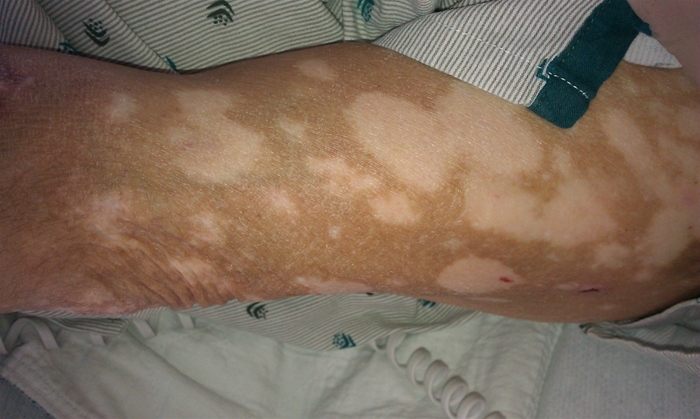 Which of the following would most likely be seen on histopathologic examination of this patient's lesions?
 (Multiple Choice)
4.8/5 (77)
(77) A 35-year-old woman comes to the office with symmetric swelling and pain of her proximal interphalangeal, wrist, and knee joints. She reports that her 5-year-old son was seen by his pediatrician last week for a facial rash and fever. The patient's family history is significant for diabetes mellitus and gout in her father and rheumatoid arthritis in her mother. Her serum rheumatoid factor is negative. Conservative management with nonsteroidal anti-inflammatory drugs is recommended. The patient returns for follow-up 4 weeks later and reports that she discontinued the medication after 2 weeks due to gastrointestinal upset. However, her pain and swelling have decreased significantly. Which of the following is the most likely diagnosis?
(Multiple Choice)
4.8/5 (70)
(70) A 64-year-old woman is hospitalized after injuring her right hip when she slipped on ice while carrying groceries. X-ray reveals a right femoral neck fracture, and the patient undergoes a total hip arthroplasty with no operative complications. Two days after surgery, the patient develops acute hemodynamic decompensation. A contrast-enhanced CT scan of the chest is immediately obtained; a sagittal view is shown below. 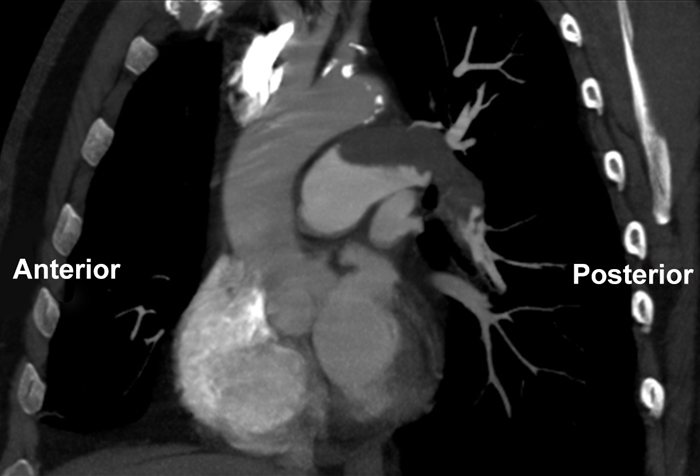 In-hospital administration of which of the following is most appropriate for reducing the risk of patients developing this complication?
 (Multiple Choice)
4.7/5 (75)
(75) A 62-year-old man is found dead in his hotel room. He was traveling for work and had checked into the hotel the night prior. No other history is available. Autopsy examination is performed; the lung findings shown below are determined to be the cause of death. 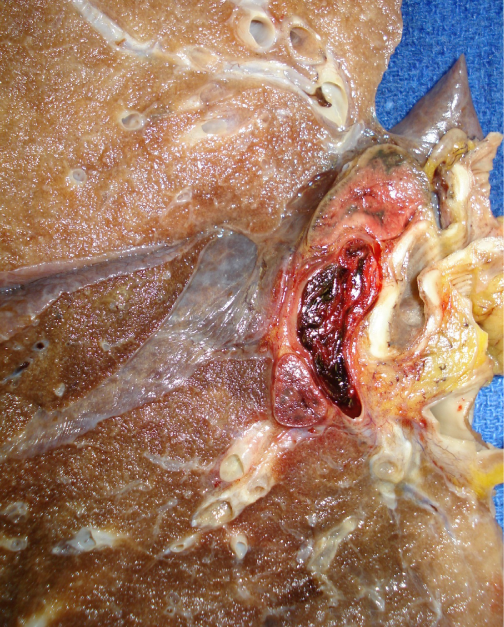 Which of the following is the most likely inciting event that led to this patient's death?
 (Multiple Choice)
4.9/5 (75)
(75) A 72-year-old woman comes to the office due to a persistent cough over the last 2 months that is occasionally associated with scant, white sputum. She has also lost 4.5 kg (10 lb) since the onset of her symptoms. The patient is an ex-smoker with a 25-pack-year history. She was diagnosed with mild chronic obstructive pulmonary disease several years ago, and she uses albuterol as needed for episodes of wheezing and shortness of breath. Physical examination shows scattered wheezes bilaterally. Chest CT scan reveals a mass in the right lung. Light microscopy of the mass is shown below: 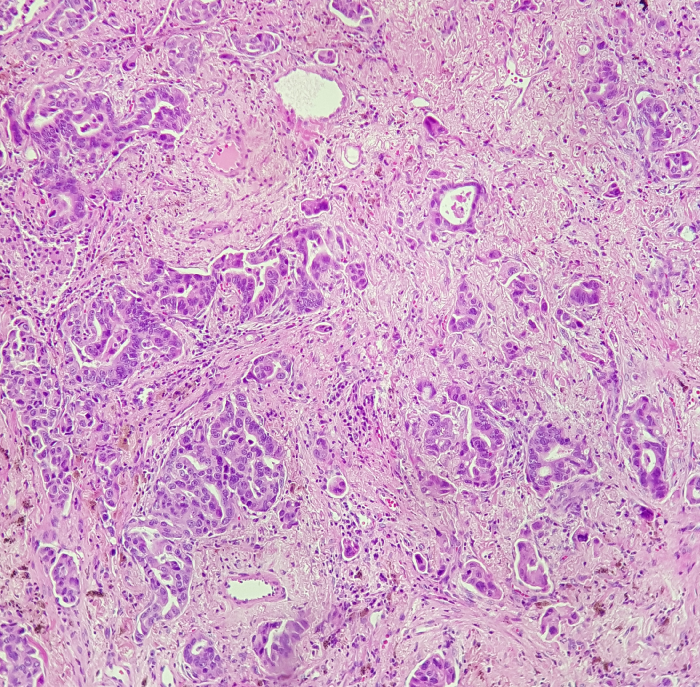 Which of the following is the most likely diagnosis?
 (Multiple Choice)
4.9/5 (73)
(73) 
Filters
- Essay(0)
- Multiple Choice(0)
- Short Answer(0)
- True False(0)
- Matching(0)