



 Chat with AI
Exam 10: Pathology

Exam 1: Anatomy291 Questions
Exam 2: Behavioral science240 Questions
Exam 3: Biochemistry156 Questions
Exam 4: Biostatistics117 Questions
Exam 5: Embryology52 Questions
Exam 6: Genetics103 Questions
Exam 7: Histology24 Questions
Exam 8: Immunology129 Questions
Exam 9: Microbiology336 Questions
Exam 10: Pathology816 Questions
Exam 11: Pathophysiology464 Questions
Exam 12: Pharmacology538 Questions
Exam 13: Physiology272 Questions
Select questions type


A 5-year-old boy is brought to the office by his parents who say that he "looks yellow" and has been uncharacteristically tired lately. He has had upper respiratory tract infection symptoms for the past 3 days, including cough, rhinorrhea, sneezing, and sore throat. The parents say that "a lot of kids at daycare have been sick lately." The patient has no prior medical problems. He is consistently at the 50th percentile for height and weight. He takes no medications, and his immunizations are up to date. Pallor, scleral icterus, and palpable splenomegaly are seen on examination. Laboratory results are as follows: 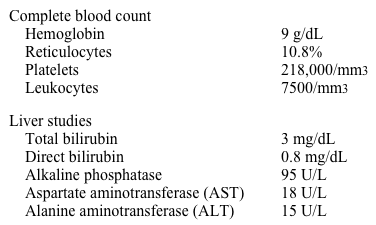 The patient recovers spontaneously after a few weeks. Peripheral smear of the boy's blood after recovery is shown in the exhibit.
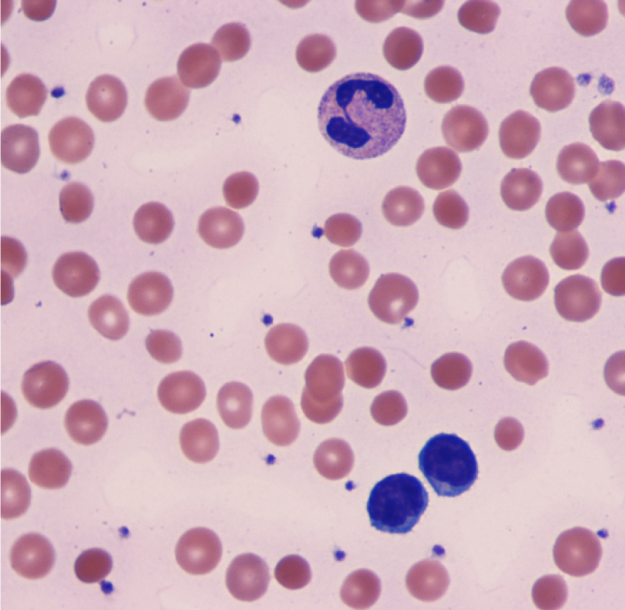 Which of the following is the most likely cause of this patient's condition?
The patient recovers spontaneously after a few weeks. Peripheral smear of the boy's blood after recovery is shown in the exhibit. Which of the following is the most likely cause of this patient's condition? (Multiple Choice)
4.8/5  (72)
(72) A 21-year-old man is brought to the emergency department due to diffuse muscle aches and weakness. He has also noticed darkening of his urine. The patient recently joined the military and was participating in rigorous training exercises in hot weather earlier in the day. He has no significant medical conditions and takes no medications. Medical evaluation and laboratory testing performed prior to military enlistment showed no abnormalities. Temperature is 36.7 C (98 F), blood pressure is 100/60 mm Hg, pulse is 105/min, and respirations are 16/min. Physical examination shows dry mucous membranes and muscle tenderness over the bilateral thighs and calves. Laboratory results are as follows: 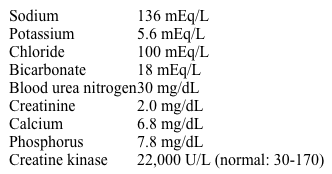 Which of the following urine microscopy findings is most likely to be seen in this patient?
 (Multiple Choice)
5.0/5 (76)
(76) A 12-year-old girl is brought to the clinic by her parents after she is found to have hypertension by her school nurse. The patient has no symptoms and reads a book during the office visit. The girl immigrated to the United States two months ago and had not received routine well-child care. She has had several episodes of fever and abdominal pain, which her parents had treated with over-the-counter antibiotics that were available in her country of origin. The patient's blood pressure is elevated on several readings in the office. There is no family history of hypertension. Renal ultrasound reveals dilated calyces with overlying cortical atrophy bilaterally, mostly in the upper and lower poles. Which of the following is the most likely cause of this patient's condition?
(Multiple Choice)
4.7/5 (72)
(72) A 26-year-old woman is evaluated for intermittent abdominal discomfort, diarrhea, and melena. The patient undergoes colonoscopy followed by total colectomy due to significant colonic abnormalities. Representative colon findings are shown in the image below. 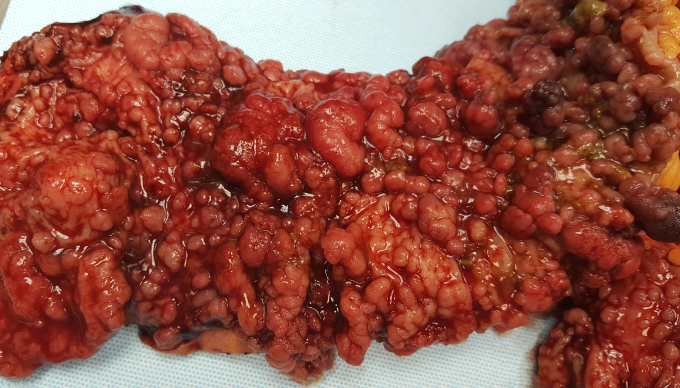 Her sister, who has the same biological parents and has no symptoms, also undergoes screening colonoscopy and has similar findings. If left untreated, which of the following is the most likely lifetime risk of colon cancer in the patient's sister?
 (Multiple Choice)
4.7/5 (64)
(64) A 56-year-old construction worker comes to the office after receiving a letter from his employer advising him of significant exposure to asbestos during a building project 25 years ago. He is currently asymptomatic and feels well. Medical conditions include hypertension and osteoarthritis, for which he takes amlodipine daily and ibuprofen as needed. The patient quit smoking 10 years ago and does not use alcohol or illicit drugs. Physical examination is within normal limits. Chest imaging is normal. He is concerned about his risk of developing cancer. Due to his occupational exposure, this patient is at greatest risk of malignancy arising from which of the following?
(Multiple Choice)
5.0/5 (77)
(77) A 72-year-old man comes to the emergency department due to severe chest tightness and dyspnea that started 20 minutes ago at a family dinner. He has never experienced similar symptoms before. The patient's medical conditions include hypertension, hyperlipidemia, type 2 diabetes mellitus, and prostate cancer. He takes multiple medications and has no drug allergies. The patient smoked a pack of cigarettes daily for 30 years and stopped smoking 10 years ago. Chest CT scan with contrast is shown in the image below. 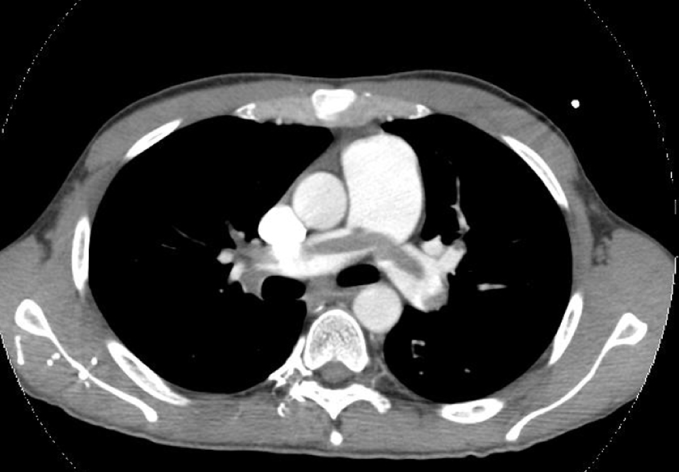 Which of the following factors most likely contributed to this patient's current condition?
 (Multiple Choice)
4.8/5 (69)
(69) A 15-year-old boy is brought to the emergency department due to hemoptysis. He has a history of amputation of the right lower extremity for "bone cancer" in Mexico. Chest imaging reveals a lung mass. Excisional biopsy of the mass shows sheets of uniform, small (slightly larger than lymphocytes), round cells with scant, clear cytoplasm. The cellular deposits are interrupted by vascular fibrous septae, with areas of hemorrhage and an abrupt transition from viable to necrotic cells. A representative sample is shown in the image. 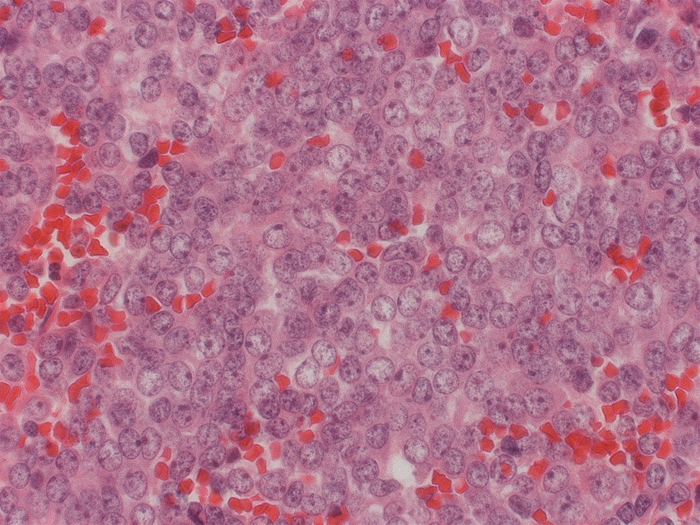 Which of the following is the most likely diagnosis?
 (Multiple Choice)
4.9/5 (83)
(83) A 60-year-old man is found to have a 5-cm exophytic mass in the ascending colon during a screening colonoscopy. Biopsy of the mass shows adenocarcinoma. The patient has no personal or family history of malignancy or colonic polyps. His medical problems include hypertension, and he does not use tobacco or alcohol. CT scan of the chest and abdomen reveals no metastatic lesions in the lungs or liver. A right colectomy is performed. The presence of which of the following indicates a poor prognosis in this patient?
(Multiple Choice)
4.7/5 (79)
(79) A 34-year-old woman is found dead in her apartment. Medical history is significant for substance use disorder and a prior hospitalization for upper extremity cellulitis. An autopsy examination is performed. A ruptured plaque in the proximal anterior descending artery with an overlying occlusive thrombus is found. Incidentally, a 4-cm hepatic mass in the right lobe of the liver is also found. The mass is lighter than the surrounding liver tissue and appears lobulated with a central, gray-white, depressed stellate scar from which fibrous septae radiate to the periphery. The rest of the liver is normal. No additional abnormalities are noted on autopsy. Which of the following is the most likely diagnosis of this patient's liver lesion?
(Multiple Choice)
4.7/5 (77)
(77) A 52-year-old man comes to the emergency department due to several days of vague chest pain and cough. He immigrated to the United States from Taiwan 20 years ago. Temperature is 37.1 C (98.8 F). Physical examination reveals a decrescendo-type diastolic murmur over the right sternal border. Pulmonary auscultation reveals normal breath sounds with no wheezes or rales. Abdominal examination shows no organomegaly. Serum fluorescent treponemal antibody absorption testing is positive. Chest x-ray reveals mediastinal widening. The pathologic process most likely responsible for this patient's symptoms starts as which of the following?
(Multiple Choice)
4.7/5 (86)
(86) A 34-year-old woman comes to the office due to a 2-day history of reduced sensation in her legs. Lately, the patient has also had significant fatigue, especially with exercise. Six months ago, she had an episode of visual blurring that resolved spontaneously after a few days. Medical history is significant for psoriasis, for which she uses a topical glucocorticoid ointment. The patient does not use tobacco or illicit drugs. Vital signs are normal. Examination indicates decreased pain and light touch perception in both legs below the level of the umbilicus. Mild bilateral spasticity is noted. Which of the following pathologic brain lesions is most specific for this patient's disease process?
(Multiple Choice)
5.0/5 (82)
(82) A 5-year-old boy is brought to the office with generalized edema that developed following a mild upper respiratory infection. Medical history is unremarkable. Blood pressure and heart rate are normal. Serum creatinine levels are normal. Urinalysis shows massive proteinuria with no hematuria. Further analysis reveals that urine protein consists principally of albumin with only trace amounts of IgG and alpha-2-macroglobulin. Which of the following pathologic changes is the most likely cause of this patient's urinary protein loss?
(Multiple Choice)
4.8/5 (72)
(72) A 19-year-old man with a history of chronic lung problems dies due to respiratory distress after a prolonged episode of pneumonia. Autopsy shows dilation of the bronchial tree, which extends almost to the pleural surface. Many of the small airways are filled with mucin plugs containing abundant inflammatory cells and debris. Which of the following is the most likely cause of this patient's autopsy findings?
(Multiple Choice)
4.9/5 (87)
(87) A 65-year-old woman was found dead in her house. The family notes that she had difficulty walking over the past few months. The patient had a history of atrial fibrillation treated with anticoagulation therapy. Gross examination shows bruising of the scalp. Autopsy reveals a large epidural hemorrhage with brain herniation; spinal cord evaluation reveals symmetric myelin layer vacuolization and axonal degeneration involving the posterior columns and the lateral corticospinal tracts. Which of the following is the most likely cause of this patient's spinal cord findings?
(Multiple Choice)
4.8/5 (65)
(65) A 56-year-old woman with a history of hypertension is brought to the emergency department due to 3 days of dysuria and back pain. Temperature is 39.2 C (102.6 F), blood pressure is 70/40 mm Hg, pulse is 130/min, and respirations are 28/min. The patient is confused and has suprapubic and costovertebral angle tenderness. The skin is diffusely warm but there are no rashes or edema. Complete blood count demonstrates leukocytosis with increased neutrophils but is otherwise normal. Coagulation studies are normal. Urinalysis is positive for leukocyte esterase and nitrites, and microscopy shows numerous bacteria. Several hours later, the patient becomes increasingly hypoxic and requires mechanical ventilation. This patient's respiratory symptoms are most likely due to which of the following pathologic conditions?
(Multiple Choice)
4.9/5 (70)
(70) An 18-year-old man comes to the office due to 2 days of right testicular pain. The pain is constant and exacerbated by movement. Vital signs are within normal limits. On physical examination, there is swelling and tenderness to palpation localized only to the posterior and superior areas of the right testis. The left testis is normal. Cremasteric reflexes are intact bilaterally. Urinalysis shows numerous leukocytes but no bacteria. Which of the following factors most likely contributed to this patient's current condition?
(Multiple Choice)
4.9/5 (84)
(84) A 32-year-old woman comes to the office for evaluation of a breast lump. She noticed the lump a few months ago but thinks it might be getting larger. The patient has a history of right lower limb amputation at age 17 due to osteosarcoma. The patient's mother died of an adrenal tumor, and her younger sister died of leukemia. Examination of the left breast shows a 5-cm, firm immobile mass with irregular borders. Which of the following gene mutations is the most likely etiology for this patient's condition?
(Multiple Choice)
4.9/5 (77)
(77) Physiologists conduct a study to identify the protein constituents present in normal pulmonary secretions. They recruit 20 healthy men and women who do not take any medications and have no history of tobacco use. Bronchoalveolar lavage is performed, and the proteins in the fluids are isolated. A specific protein is found that can degrade the elastin present in the extracellular matrix. Which of the following cells are most likely producing this protein?
(Multiple Choice)
4.8/5 (77)
(77) A 72-year-old man is brought to the emergency department due to diarrhea and vomiting for the last 24 hours. The patient's daughter states that he has been unable to take in much fluid during this time. He has hypertension treated with hydrochlorothiazide, which he has not taken since the onset of symptoms. Blood pressure is 90/60 mm Hg and pulse is 105/min. Examination shows dry mucous membranes. Urinalysis reveals concentrated urine with a specific gravity of 1.030. Which of the following changes in renal plasma flow (RPF), glomerular filtration rate (GFR), and filtration fraction (FF) are most likely to be present in this patient as compared with the normal state?

(Multiple Choice)
4.8/5 (73)
(73) A 32-year-old man comes to the office due to intermittent dysphagia for solids and liquids. He has no significant past medical history and does not use tobacco, alcohol, or illicit drugs. His father has a history of esophageal squamous cell carcinoma. Physical examination is unremarkable. The patient undergoes an esophageal manometric study that demonstrates periodic, simultaneous, and non-peristaltic contractions of large amplitude and long duration. Which of the following is the most likely pathogenesis of this patient's esophageal condition?
(Multiple Choice)
4.9/5 (92)
(92) 
Filters
- Essay(0)
- Multiple Choice(0)
- Short Answer(0)
- True False(0)
- Matching(0)