



 Chat with AI
Exam 10: Pathology

Exam 1: Anatomy291 Questions
Exam 2: Behavioral science240 Questions
Exam 3: Biochemistry156 Questions
Exam 4: Biostatistics117 Questions
Exam 5: Embryology52 Questions
Exam 6: Genetics103 Questions
Exam 7: Histology24 Questions
Exam 8: Immunology129 Questions
Exam 9: Microbiology336 Questions
Exam 10: Pathology816 Questions
Exam 11: Pathophysiology464 Questions
Exam 12: Pharmacology538 Questions
Exam 13: Physiology272 Questions
Select questions type


A 2-year-old boy is brought to the emergency department due to high fever and malaise for the past 4 days. His parents say that he began limping yesterday and now refuses to walk. The patient has had no recent travel or exposure to anyone with similar symptoms. Temperature is 39.4 C (103 F). Passive range of motion of the hips, knees, and ankles does not elicit pain. There are no joint effusions. The patient refuses to bear weight. An intravenous radiotracer that localizes to areas of increased osteoblastic activity is administered, and several images are obtained to find areas with atypical activity. Abnormally increased uptake of the radiotracer is most likely to be seen in which of the following areas?
(Multiple Choice)
4.9/5  (96)
(96) A 42-year-old man comes to the emergency department due to severe chest pain that started abruptly 2 hours ago. The pain is midline, constant, and 10/10 in intensity. He has had no fever, cough, or shortness of breath. His only medical condition is hypertension. On examination, the patient is diaphoretic and is in severe distress due to pain. Temperature is 37 C (98.6 F), pulse is 116/min, and respirations are 24/min. Systolic blood pressure is 82 mm Hg in the right arm and 60 mm Hg in the left arm. Jugular veins are distended with an estimated pressure of 13 cm H2O. The lungs are clear to auscultation. The point of maximal impulse is not palpable. The extremities are cold with no peripheral edema. The patient develops cardiac arrest and dies soon after arrival. Autopsy would most likely reveal which of the following findings?
(Multiple Choice)
4.9/5 (87)
(87) A 12-year-old girl comes to the office with constant swelling and pain of her elbows for the past week that have prevented her from participating in basketball practice. She also had knee pain during the preceding week that was attributed to a fall during practice. Her parents say that she is healthy and has had only minor illnesses that children typically experience during the winter. The patient's temperature is 38.9 C (102 F), blood pressure is 110/70 mm Hg, and pulse is 110/min. Her elbows are swollen and tender with limited range of movement. Her knees appear normal. A new holosystolic murmur is heard on cardiac auscultation. Antistreptolysin O titers are 400 Todd units/mL (normal: <300 Todd units/mL). The patient is admitted to the hospital. During her hospitalization, this patient is at greatest risk of dying from which of the following complications?
(Multiple Choice)
4.9/5 (78)
(78) A 64-year-old man is being evaluated for nausea and a new-onset headache that worsens when he bends over. Brain imaging shows a hemispheric cerebral mass that is subsequently biopsied. Light microscopy of the tissue specimen is shown in the image below. 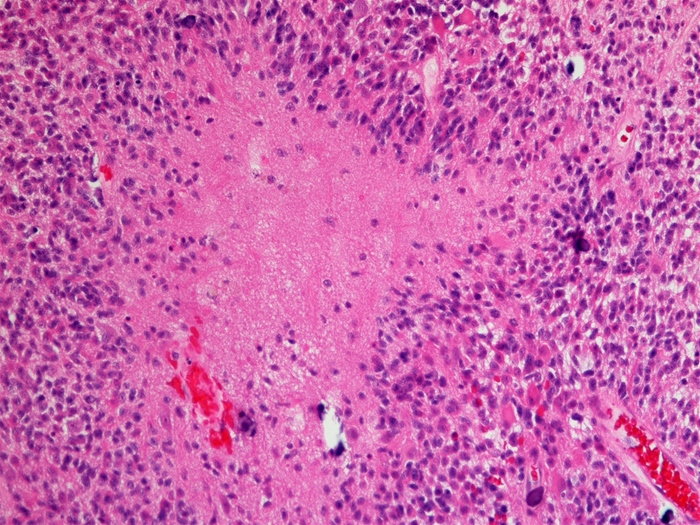 Which of the following histologic findings is most characteristic of this lesion?
 (Multiple Choice)
4.8/5 (69)
(69) The blood cultures obtained from this patient on admission grow Streptococcus species. Which of the following processes was the most likely initiating step in the pathogenesis of this patient's condition?
(Multiple Choice)
4.8/5 (71)
(71) A 67-year-old man develops severe respiratory distress and collapses. The emergency medical team finds the patient unresponsive with no pulse and he is unable to be revived despite cardiopulmonary resuscitation. A photograph of the lung as seen at autopsy is shown below. 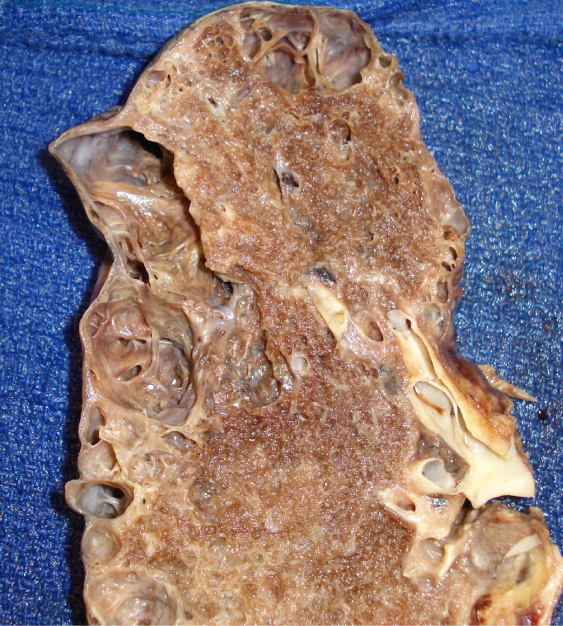 Which of the following underlying histopathological changes are most likely to be seen within this patient's lungs?
 (Multiple Choice)
4.8/5 (85)
(85) A 46-year-old woman comes to the office with persistent diarrhea, weight loss, and abdominal pain. Her diarrhea started several months ago. She has no fever, melena, or hematochezia. The patient has not traveled outside of the country and has not drunk from any untreated freshwater sources. She has had no recent hospitalizations or antibiotic use. Her sister has a history of celiac disease. Upper endoscopy reveals postbulbar duodenal and jejunal ulcers. This patient most likely has a tumor secreting which of the following molecules?
(Multiple Choice)
4.8/5 (85)
(85) A 54-year-old previously healthy man comes to the clinic after 2 months of progressive, generalized weakness and easy fatigability. He also has abdominal discomfort and early satiety. The patient works as a security advisor and has not traveled recently. He is afebrile and other vitals signs are normal. On examination, he has pallor, abdominal distension, and massive splenomegaly with the spleen tip crossing the midline. No peripheral lymphadenopathy is present. Peripheral blood cell count shows pancytopenia. Bone marrow aspiration is attempted, but no marrow can be aspirated. Which of the following findings is most likely to be seen in this patient?
(Multiple Choice)
4.9/5 (77)
(77) A 55-year-old man comes to the clinic due to headache and progressive facial weakness. The patient's headaches began 2 months ago and are characterized as throbbing. They are typically worse in the morning and when he bears down or coughs. He has had no recent head trauma or loss of consciousness. The patient has a history of hypertension for which he takes lisinopril. He does not use tobacco, alcohol, or illicit drugs. Vital signs are normal. On physical examination, there is flattening of the left nasolabial fold and drooping of the left lower lip. The patient cannot fully close his left eye. MRI of the brain reveals a well-circumscribed homogenously enhancing mass in the posterior fossa that is compressing the left facial nerve root. Which of the following additional findings is most likely present on this patient's neurologic examination?
(Multiple Choice)
4.9/5 (67)
(67) A 26-year-old woman is being evaluated for lower abdominal discomfort. Medical history is significant for mild intermittent asthma and migraines without aura. She has never been pregnant. The patient is sexually active with her husband and they use condoms for contraception. She drinks alcohol socially and does not use tobacco or illicit drugs. Her mother was diagnosed with breast cancer at age 52 and her grandfather died of colon cancer at age 77. BMI is 30 kg/m2. Ultrasound of the abdomen reveals a right-sided adnexal mass that is subsequently removed with laparoscopic surgery. Histologic findings are shown in the image below: 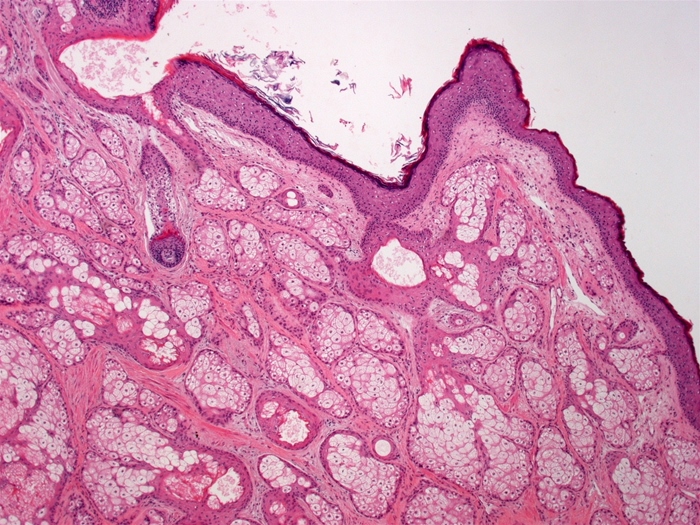 Which of the following is the most likely diagnosis?
 (Multiple Choice)
4.8/5 (86)
(86) A 60-year-old woman comes to the office with persistent, profuse mucoid diarrhea. Despite not eating much for the past 2 days, her diarrhea has not decreased, but she has no other symptoms. The patient has not had age-appropriate colon cancer screening. Family history is unremarkable. She does not use tobacco, alcohol, or illicit drugs. Vital signs and cardiopulmonary examination are normal. The abdomen is soft and nondistended. There is no hepatosplenomegaly. Laboratory studies show hypokalemia and microcytic anemia. Colonoscopy reveals a 2.5-cm, cauliflower-like mass in the sigmoid colon. The mass is resected and the histopathology of the lesion is shown in the exhibit. 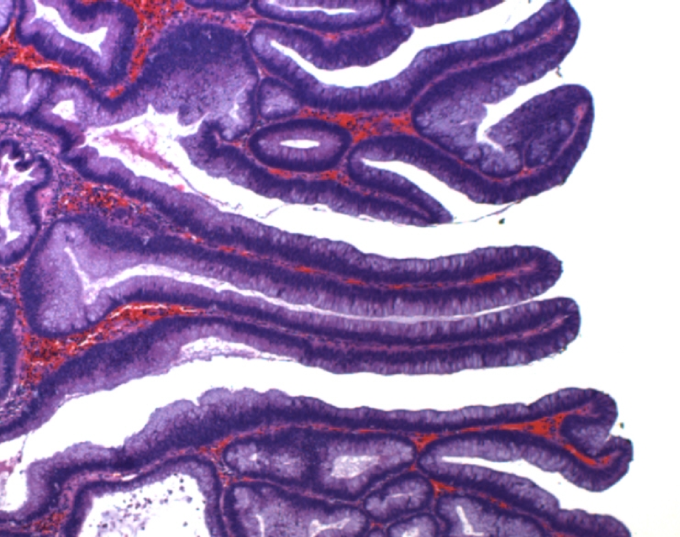 Which of the following is the most likely diagnosis in this patient?
 (Multiple Choice)
4.8/5 (73)
(73) A 65-year-old woman is treated with gentamicin for an abdominal infection complicated by multidrug-resistant organisms. After a week of treatment, the patient's urine output decreases noticeably, and serum creatinine rises to 2.3 mg/dL. She has no previous kidney disease, and baseline kidney function was normal prior to the initiation of therapy. The patient has remained afebrile for 24 hours. Blood pressure is 130/80 mm Hg and pulse is 80/min. Examination shows moist mucous membranes. There is no rash. Results of urinalysis are as follows: 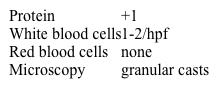 Fractional excretion of sodium is >2%. Histologic examination of the patient's kidneys would most likely show which of the following?
 (Multiple Choice)
5.0/5 (79)
(79) The pancreas of a 22-year-old Caucasian male with recurrent pulmonary infections and finger clubbing shows extensive exocrine gland atrophy and fibrosis. The pancreatic ducts are lined with squamous epithelium with areas of keratinization. The finding of squamous metaplasia in the pancreatic ducts is most likely related to a deficiency of:
(Multiple Choice)
4.8/5 (73)
(73) A 62-year-old man dies suddenly in his sleep. The patient had a history of type 2 diabetes mellitus and hypertension, and he smoked a pack of cigarettes daily for 25 years. His adherence to medical care was poor. Autopsy is performed, and a histologic section of his left ventricular myocardium is shown below: 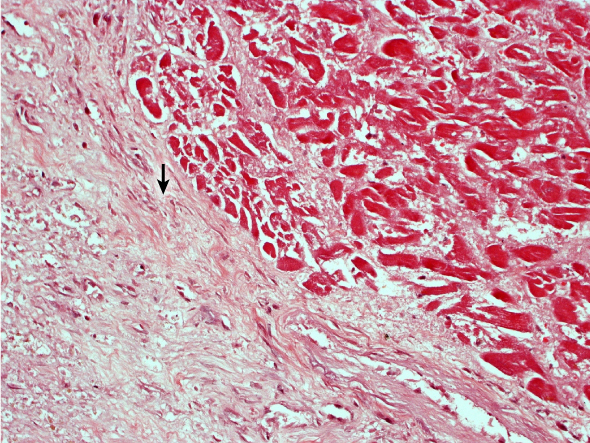 Which of the following directly promotes the formation of the tissue indicated by the arrow?
 (Multiple Choice)
4.7/5 (82)
(82) Rats exposed to high concentrations of carbon tetrachloride suffer rapid and extensive liver damage. Light microscopic examination of affected liver specimens shows fatty change and hepatocyte necrosis. These changes are the result of:
(Multiple Choice)
4.9/5 (70)
(70) A newborn undergoes an abdominal ultrasound that shows kidneys of normal size, structure, and location. The patient does not appear to be in distress and physical examination reveals no abnormalities. If this patient were to be diagnosed with renal disease later in life, it would most likely be which of the following?
(Multiple Choice)
4.8/5 (80)
(80) A 21-year-old woman comes to the office due to a long history of episodic headaches, dizziness, and gait imbalance. The headaches are located in the occipital region, are characterized as dull, and last for several hours. Physical examination reveals gait ataxia but no focal weakness or sensory loss. MRI of the brain shows low-lying cerebellar tonsils extending below the plane of the foramen magnum into the vertebral canal. Which of the following is the most likely cause of this patient's condition?
(Multiple Choice)
4.8/5 (66)
(66) A 6-year-old boy is brought to the clinic due to recurrent nosebleeds over the last couple of weeks. The patient has no chronic medical conditions and takes no medications. Vital signs are normal. On physical examination, there is conjunctival pallor. The nares have dried, crusted blood with no active bleeding. The oropharynx is clear. Neck examination shows enlarged, palpable lymph nodes bilaterally. Cardiopulmonary examination is unremarkable. The abdomen is soft and nontender, with the liver measuring 4 cm below the costal margin. There are scattered petechiae along the trunk. Complete blood count is as follows: 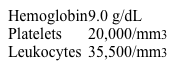 Flow cytometry of the peripheral blood demonstrates a distinct population of cells that express terminal deoxynucleotidyl transferase (TdT), CD10, and CD19. Myeloperoxidase (MPO) is negative. Which of the following is the most likely diagnosis?
 (Multiple Choice)
4.8/5 (91)
(91) A 24-year-old woman comes to the office due to recurrent bloody diarrhea and right-sided abdominal pain. She has had these symptoms intermittently for several years but has not sought medical attention until now. Colonoscopy shows evidence of inflammation and dysplasia. The patient is started on appropriate medical therapy but her symptoms fail to respond adequately. She subsequently undergoes a colectomy of the involved region; findings are shown in the image. 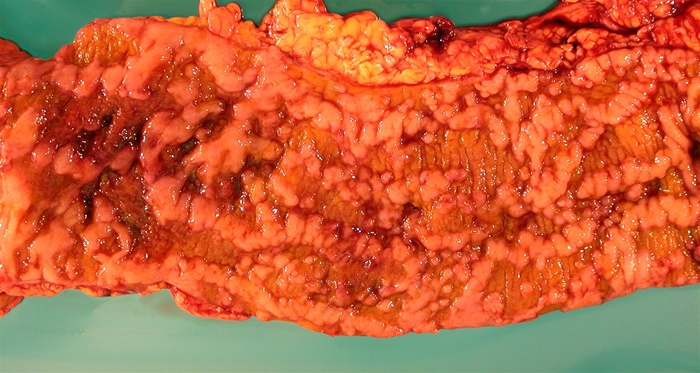 The intestinal wall appears thickened. Which of the following is the most likely diagnosis?
 (Multiple Choice)
4.9/5 (77)
(77) A 34-year-old woman comes to the office for follow-up after 2 abnormal Papanicolaou test results. The patient has had 4 lifetime sex partners, uses oral contraceptive pills, and has never been pregnant. She has no other medical problems and does not use tobacco, alcohol, or illicit drugs. Her mother has breast cancer. Physical examination is normal. A cervical biopsy reveals high-grade cervical intraepithelial neoplasia. Which of the following is the most likely finding on histopathology?
(Multiple Choice)
4.8/5 (77)
(77) 
Filters
- Essay(0)
- Multiple Choice(0)
- Short Answer(0)
- True False(0)
- Matching(0)