



 Chat with AI
Exam 10: Pathology

Exam 1: Anatomy291 Questions
Exam 2: Behavioral science240 Questions
Exam 3: Biochemistry156 Questions
Exam 4: Biostatistics117 Questions
Exam 5: Embryology52 Questions
Exam 6: Genetics103 Questions
Exam 7: Histology24 Questions
Exam 8: Immunology129 Questions
Exam 9: Microbiology336 Questions
Exam 10: Pathology816 Questions
Exam 11: Pathophysiology464 Questions
Exam 12: Pharmacology538 Questions
Exam 13: Physiology272 Questions
Select questions type


A 68-year-old man comes to the office due to persistent back pain for the past several months. He is a retired veteran and has not seen a doctor for many years. He has smoked a pack of cigarettes daily for 36 years. His blood pressure is 145/85 mm Hg and pulse is 88/min and regular. Cardiopulmonary examination is unremarkable. The abdomen is soft and nontender. There is focal tenderness over the 10th rib and L1-L2 vertebral region. Neurologic examination is normal. Radionuclide bone imaging reveals increased activity in multiple vertebrae and ribs, corresponding to the patient's painful areas. Routine radiographs show sclerotic lesions matching the bone scan areas of increased uptake, which are highly suspicious for metastatic cancer. Which of the following additional findings is most likely to be seen in this patient?
(Multiple Choice)
4.9/5  (84)
(84) An 80-year-old man is brought to the hospital due to increasing chest pain. Over the past 6 weeks, he has had dry cough, dysphagia, and a change in voice quality. The patient has a long history of hypertension. He is an ex-smoker with a 35-pack-year history. On physical examination, the patient appears anxious, pale, and diaphoretic. Blood pressure is 80/60 mm Hg, pulse is 120/min, and respirations are 20/min. While being evaluated in the emergency department, he develops cardiac arrest with pulseless electrical activity and cannot be resuscitated. Autopsy is most likely to show which of the following findings?
(Multiple Choice)
4.8/5 (68)
(68) A 32-year-old man comes to the office due to fever, jaundice, vomiting, and decreased appetite for the past 5 days. He recently returned home from South America and reports that a couple of his travel companions have had similar symptoms. The patient does not use alcohol, tobacco, or illicit drugs and has no relevant family history. Temperature is 38.8 C (101.8 F), blood pressure is 125/80 mm Hg, pulse is 85/min. Scleral icterus and hepatomegaly are present. Laboratory results are as follows: 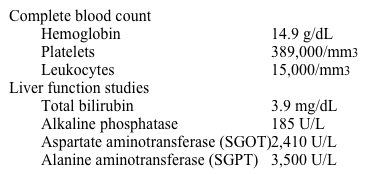 Which of the following pathophysiologic events is most likely occurring in this patient?
 (Multiple Choice)
4.9/5 (98)
(98) A 46-year-old woman comes to the office with a painful rash involving her groin and legs that has been worsening over the last 2 weeks. She was diagnosed with diabetes mellitus 6 months ago but has no other medical problems other than occasional loose stools. Physical examination shows coalescing erythematous plaques with crusting and scaling at the borders and central areas of brownish induration. Biopsy of the lesions reveals superficial necrolysis. Which of the following laboratory abnormalities is most likely to be present in this patient?
(Multiple Choice)
4.9/5 (86)
(86) A 64-year-old man comes to the office with a 4-day history of severe left-sided chest discomfort. The pain is constant and has a burning quality. Over the last day, the patient has developed a rash in the area of discomfort. He has not had similar symptoms before. Past medical history is unremarkable. The patient is afebrile and vital signs are normal. Physical examination shows a vesicular rash at the 5th left intercostal space. Which of the following pathologic findings is most likely to be found in the affected area?
(Multiple Choice)
4.9/5 (78)
(78) A 53-year-old man comes to the emergency department due to fever and progressive weakness over the last 2 weeks. Yesterday, he also developed shortness of breath. The patient emigrated from Eastern Europe 2 years ago and says he was diagnosed with "heart disease" in the distant past, but he does not recall any details. He does not use tobacco, alcohol, or illicit drugs. Despite receiving appropriate medical care, the patient expires during hospitalization. On autopsy, gross examination of his heart shows large, friable masses on the mitral valve with extensive destruction of cuspal tissue. Which of the following is the most likely predisposing factor for this patient's presenting condition?
(Multiple Choice)
4.8/5 (85)
(85) A 16-year-old boy is brought to the emergency department because of confusion, fatigue, and abdominal pain. He has also experienced excessive thirst and polyuria during the last 3 weeks. His past medical history is insignificant. Family history is unremarkable. Urine dipstick is positive for glucose and ketones. Which of the following factors most likely contributed to the development of this patient's condition?
(Multiple Choice)
4.9/5 (66)
(66) A 29-year-old nulliparous woman with HIV comes to the office for her first gynecological examination. The patient acquired HIV from her mother at birth and has been noncompliant with health maintenance visits. Menarche was at age 10, cycles occur every 28 days, and her last menstrual period was 2 weeks ago. The patient has 1 lifetime male partner with whom she has been sexually active for 7 years; they use condoms consistently. Her mother had cervical cancer at age 46 and died of AIDS-related complications at age 48. The patient drinks 3-4 cans of beer each night and does not use tobacco or illicit drugs. Papanicolaou test reveals high-grade cervical dysplasia. Which of the following is the strongest risk factor for cervical dysplasia in this patient?
(Multiple Choice)
4.8/5 (88)
(88) Researchers studying gastrointestinal pathophysiology analyze hundreds of gastric mucosal biopsy specimens taken from patients who underwent endoscopy at a local tertiary care center. They notice that colonization of the gastric antrum with S-shaped, gram-negative bacteria is associated with a decreased number of somatostatin-producing antral cells. Depletion of these cells from the gastric antrum is most likely to cause which of the following conditions?
(Multiple Choice)
4.8/5 (88)
(88) A 10-year-old boy comes to the office for a first visit. His family recently came to the United States as political refugees. The patient's mother says that he has required several blood product transfusions due to anemia, but she does not have prior records available with her. On examination, the patient's temperature is 37.1 C (98.8 F). BMI is 21 kg/m2. Examination is notable for conjunctival pallor and moderate splenomegaly. Laboratory results are as follows: 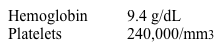 Enzyme assays performed on circulating blood cells demonstrate low pyruvate kinase activity. Which of the following is the most likely cause of this patient's splenomegaly?
 (Multiple Choice)
4.9/5 (81)
(81) A 45-year-old woman comes to the office due to unintentional loss of 6.8 kg (15 lb) over the past 6 months. She used to enjoy dining with friends but now avoids it due to excessive lower abdominal pressure and feeling full very quickly. She also has epigastric pain but no dysphagia, regurgitation, vomiting, or diarrhea. Physical examination shows bilateral adnexal fullness. A pelvic ultrasound shows bilateral complex ovarian masses with solid and cystic components. Chest x-ray is normal. CT scan shows stomach wall thickening in addition to the ovarian masses. Which of the following is most likely to be seen on histologic evaluation of the ovaries?
(Multiple Choice)
4.9/5 (80)
(80) A 32-year-old man dies suddenly in his sleep. An autopsy is performed and the heart is examined for signs of structural cardiac disease. The heart shows a left ventricle with a large area of apical thinning composed of fibrotic scar tissue. The mid and basal left ventricular segments show normal myocardial thickness. The coronary arteries show no evidence of obstructive atherosclerosis. The right ventricle appears normal in size. No apparent valve damage is present. Dilation and wall-thickening of the esophagus is also noted. Which of the following factors in this patient's medical history would be most helpful in determining the cause of death?
(Multiple Choice)
4.7/5 (84)
(84) An intracranial mass is removed from a 33-year-old patient. The mass is composed of cells that have elongated, wavy nuclei. A biphasic pattern of growth is identified, consisting of areas of dense cellularity interspersed with less dense myxoid regions. The cells show diffuse S-100 immunoreactivity. Which of the following is the most likely diagnosis?
(Multiple Choice)
4.8/5 (83)
(83) A 64-year-old man comes to the office due to 4 weeks of progressive dyspnea. For the past several months, he has had a nonproductive cough and fatigue. The patient's medical conditions include degenerative joint disease and peptic ulcer disease. He smoked 2 packs of cigarettes daily for 38 years but quit 4 years ago. On examination, there are decreased breath sounds and percussive dullness at the base of the right lung. Chest CT scan reveals a right-sided pleural effusion and diffuse nodular thickening of the pleura. On thoracentesis, bloody fluid is obtained. Pleural biopsy shows proliferation of epithelioid-type cells that are joined by desmosomes, contain abundant tonofilaments, and are studded with very long microvilli. Which of the following is the most likely diagnosis?
(Multiple Choice)
4.8/5 (80)
(80) A 35-year-old previously healthy woman comes to the hospital due to increasing shortness of breath and cough. Over the past few months, she has had arthralgias, fatigue, low-grade fever, and weight loss. Laboratory results are as follows: 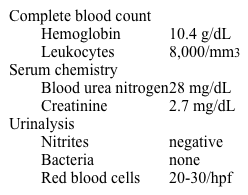 CT scan of chest is shown in the exhibit.
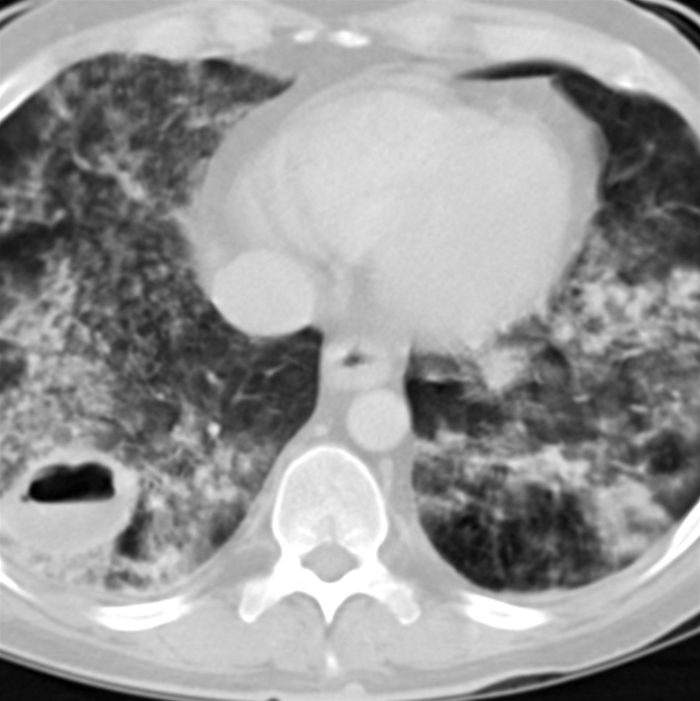 Histologic examination of the lung would most likely reveal which of the following findings?
CT scan of chest is shown in the exhibit.
Histologic examination of the lung would most likely reveal which of the following findings? (Multiple Choice)
4.8/5 (87)
(87) A 2-day-old boy was brought to the intensive care unit from the nursery with tachypnea and hypoxia. The patient was born at 33 weeks, and his mother did not receive prenatal care. Physical examination showed cyanosis. He was intubated but died 2 days later. An autopsy is performed, and a sample of the patient's lung tissue is obtained. Analysis of several large, cuboidal alveolar cells under electron microscopy reveals decreased numbers of granules containing parallel stacks of membrane lamellae. Which of the following pathological processes is most likely to result from the abnormal autopsy findings?
(Multiple Choice)
4.8/5 (75)
(75) A 30-year-old man comes to the office with a neck lump. The patient is otherwise asymptomatic and discovered the nodule incidentally while showering. His medical history is significant for a recently diagnosed pheochromocytoma, which was successfully removed. The patient's father died of thyroid cancer in his 30s. An ultrasound reveals a hypoechoic 3-cm nodule in the right lobe of the thyroid gland. Fine-needle biopsy of the nodule is consistent with a subtype of thyroid cancer. The patient undergoes total thyroidectomy with central neck dissection. Which of the following is the most likely histological finding?
(Multiple Choice)
4.9/5 (84)
(84) A 50-year-old man comes to the office due to a lump in his neck that has fluctuated in size over the past several months. The mass is nonpainful, and the patient has no associated dysphagia, chest pain, weight loss, or fever. He has no chronic medical conditions. Social history is significant for smoking a pack of cigarettes per day and occasional alcohol use. Vital signs are normal. Physical examination shows a firm, enlarged, movable, left-sided cervical lymph node. Biopsy of the mass reveals abnormal cells with a t(14;18) chromosomal translocation. This chromosomal change is most likely to cause which of the following abnormalities?
(Multiple Choice)
4.7/5 (70)
(70) A 34-year-old man comes to the physician reporting one week of inability to extend his right wrist and several of his fingers on the same hand. He first began having difficulty while trying to type his thesis for graduate school on his computer. He is right-handed and does not recall any trauma. He has a history of asthma that was diagnosed while he was in college. Physical examination demonstrates impaired dorsiflexion of the right wrist with normal strength of the left wrist. Laboratory studies show: 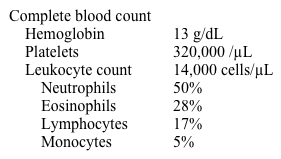 Serum antibodies against neutrophil myeloperoxidase are positive. This patient most likely has which of the following conditions?
 (Multiple Choice)
4.9/5 (66)
(66) A 52-year-old man is brought to the office due to social withdrawal and inability to care for himself. The patient is divorced and lives alone, and he was found to be living in disarray by his daughter, who is visiting from out of state. His neighbors and friends say the patient rarely comes out of the house or contacts them. During previous visits, his daughter noticed fidgety movements of his hands, but now he has marked jerky movements of his extremities with frequent facial grimaces. He has a history of depression with frequent angry outbursts that led to his divorce several years ago. The patient has no other medical conditions and does not use tobacco, alcohol, or illicit drugs. He was adopted and his family history is unknown. On physical examination, the patient is forgetful and has slowed mental processing. Involuntary, spasmodic movements of the hands and facial muscles are present. Deep tendon reflexes and sensation are normal. The loss of neurons supplying which of the following neurotransmitters is most specific for this patient's disease process?
(Multiple Choice)
4.8/5 (78)
(78) 
Filters
- Essay(0)
- Multiple Choice(0)
- Short Answer(0)
- True False(0)
- Matching(0)