



 Chat with AI
Exam 10: Pathology

Exam 1: Anatomy291 Questions
Exam 2: Behavioral science240 Questions
Exam 3: Biochemistry156 Questions
Exam 4: Biostatistics117 Questions
Exam 5: Embryology52 Questions
Exam 6: Genetics103 Questions
Exam 7: Histology24 Questions
Exam 8: Immunology129 Questions
Exam 9: Microbiology336 Questions
Exam 10: Pathology816 Questions
Exam 11: Pathophysiology464 Questions
Exam 12: Pharmacology538 Questions
Exam 13: Physiology272 Questions
Select questions type


A 45-year-old woman is evaluated for progressive exertional dyspnea and fatigue. She also reports episodic pain and bluish discoloration of the fingers and toes on cold exposure that improve with rewarming. Physical examination shows skin tightening over the fingers. Cardiac examination reveals an accentuated S2 over the upper left sternal border. The abdomen is soft with mild hepatomegaly. There is bilateral lower extremity pitting edema. Pulmonary function test results are as follows: 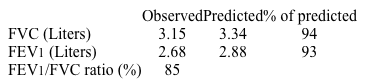 Which of the following is the most likely cause of this patient's dyspnea?
 (Multiple Choice)
4.8/5  (83)
(83) A 7-year-old boy is being evaluated for growth retardation. Brain MRI shows a 4 cm multiloculated, cystic, suprasellar lesion, which is bulging into the floor of the third ventricle and base of the brain. Calcifications are present. From which of the following structures is this mass most likely derived?
(Multiple Choice)
4.7/5 (81)
(81) A researcher is studying neuronal changes in various physiologic and pathologic states. Microscopic examination of neural tissue obtained from experimental animals reveals neurons with shrunken nuclei and eosinophilic cytoplasm lacking Nissl bodies. Which of the following is the most likely cause of these findings?
(Multiple Choice)
4.9/5 (86)
(86) A 23-year-old Caucasian male who notes recurrent severe nosebleeds is found to have pink spider-like lesions on his oral and nasal mucosa, face, and arms. The patient most likely suffers from:
(Multiple Choice)
4.9/5 (83)
(83) A 48-year-old woman comes to the office due to heavy menstrual bleeding for the last several months. The patient has monthly menses with 5-6 days of heavy bleeding and passage of large blood clots and increased abdominal cramping. She has no significant medical history and has had 2 vaginal deliveries. Her family history is significant for endometrial cancer in her mother. BMI is 24 kg/m2. Vital signs are normal. Pelvic ultrasound shows a uterine mass. The patient undergoes a total abdominal hysterectomy; gross examination of the uterus is shown below: 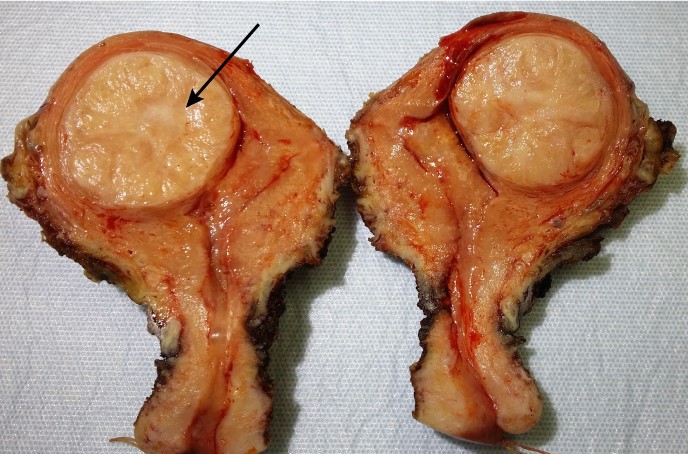 The abnormal region indicated by the arrow is most likely to display which of the following microscopic findings?
 (Multiple Choice)
4.8/5 (82)
(82) A 54-year-old man is admitted to the hospital following a high-speed motor vehicle accident. He is found to have right leg long bone fractures requiring open reduction/internal fixation. After the patient is stabilized, he is transferred to a skilled nursing facility for an extended rehabilitation period. During his stay at the facility, his right leg is immobilized for several weeks. The patient's management is complicated by decreased nutritional intake due to side effects from opioid pain medications. Measurement of his thigh following removal of casting materials finds a 2-centimeter decrease in diameter during the time of immobilization. This change in body measurement is due to a pathologic process similar to that seen in which of the following?
(Multiple Choice)
4.9/5 (68)
(68) A 76-year-old man comes to the office with a 2-month history of progressive low back pain. The pain is relatively constant and nagging and is unrelieved by rest or position changes. It is especially bad at night and interferes with sleep. The patient has taken acetaminophen and ibuprofen without relief. Medical history is significant for hypertension and osteoarthritis affecting the knees and hands. The patient used intravenous drugs occasionally when he was younger but not for >30 years. Which of the following processes is most likely responsible for this patient's back pain?
(Multiple Choice)
4.9/5 (81)
(81) Results of the laboratory tests show an increased anion gap metabolic acidosis. An underlying cause is established, and appropriate treatment is instituted. Within several hours, the patient's mental status improves significantly. Repeat laboratory studies show an increase in serum bicarbonate and sodium levels, a decrease in serum osmolality, and a drop in the serum potassium level. Which of the following treatments was most likely given to this patient?
(Multiple Choice)
5.0/5 (93)
(93) A research scientist injects hepatocellular carcinoma cells into the liver parenchyma of an experimental guinea pig. Serial observations show that the tumor cells progressively proliferate and invade the liver parenchyma to form a large mass. After some time, malignant cells begin to penetrate the vascular basement membrane to gain access to the circulation. During the process of basement membrane invasion, expression of which of the following substances is most likely to be increased in the tumor cells?
(Multiple Choice)
4.8/5 (74)
(74) A nephrology researcher conducts a clinical study to determine the risk factors for the development of renal calculi. He recruits a number of patients with a history of idiopathic calcium oxalate kidney stones, along with age- and sex-matched healthy subjects. Detailed medical, surgical, and nutritional histories are obtained, and several serum and urine laboratory tests are performed. Which of the following is most likely to be seen in affected patients compared with healthy individuals?
(Multiple Choice)
4.8/5 (85)
(85) A 27-year-old woman undergoes laparotomy for right lower quadrant pain and is found to have an inflamed terminal ileum. The involved segment of the intestine is removed, and the lesion observed on light microscopy is seen in the image. 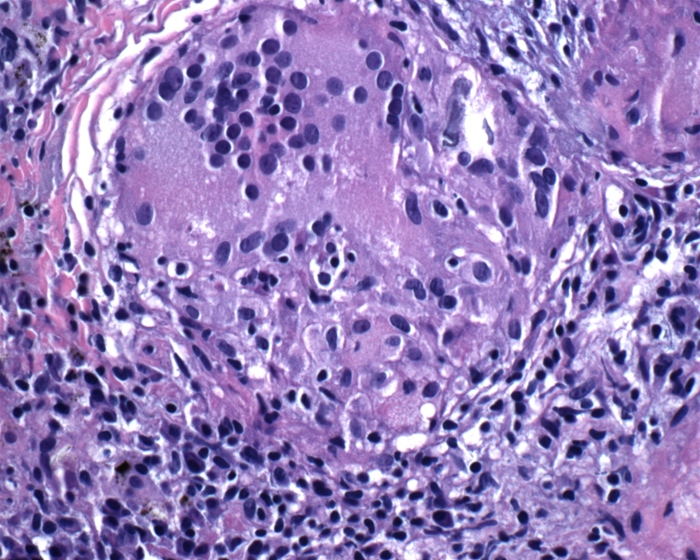 Which of the following cell types most likely mediated the formation of this patient's lesion?
 (Multiple Choice)
4.8/5 (70)
(70) A male neonate is born prematurely to 22-year-old primigravida and experiences severe respiratory distress. The distress resolves with treatment, and by two weeks of age, the patient has adequate respiratory function. Ophthalmoscopy later shows abnormal retinal vascularization that extends into the vitreous. The retinal findings in this patient are most likely related to:
(Multiple Choice)
4.8/5 (86)
(86) A 73-year-old man comes to the emergency department due to right-sided weakness and difficulty speaking. The patient woke up with the symptoms an hour before arriving but felt well when he went to bed last night. He has a history of paroxysmal atrial fibrillation but is not adherent with medical therapy. Temperature is 98.6 F (37 C), blood pressure is 130/70 mm Hg, and pulse is 110/min and irregularly irregular. Physical examination shows right-sided hemiplegia, hemisensory loss, and aphasia. Despite appropriate treatment, the patient's symptoms fail to improve. Over the next week, which of the following processes is most likely to occur in the affected brain region?
(Multiple Choice)
4.8/5 (81)
(81) A 65-year-old woman is brought to the clinic by her husband due to worsening memory problems. She has a medical history significant for long-standing hypertension, type 2 diabetes mellitus, and depression. Physical examination shows cognitive impairment but no focal neurologic deficits. Two years later, the patient dies suddenly from a massive myocardial infarction. Congo red staining of brain samples obtained from the hippocampus and cerebral arterioles reveals patchy red deposits that turn yellow-green under polarized light. This patient most likely suffered from which of the following conditions?
(Multiple Choice)
4.8/5 (90)
(90) A 24-year-old man is evaluated for recurrent episodes of abdominal pain and bloody diarrhea. The patient has also had low-grade fevers and fatigue. Physical examination reveals left lower quadrant tenderness. CT scan of the abdomen shows thickening of the distal colon and rectum. During one of the laboratory tests, the patient's anticoagulated blood is placed in an upright, thin glass tube and left undisturbed. His red blood cells form a stack and settle to the bottom at a fast rate of 50 mm/hr. Serum levels of which of the following substances is most closely associated with this observed finding?
(Multiple Choice)
4.9/5 (86)
(86) A 24-year-old woman comes to the office for the evaluation of joint pain, fatigue, edema, and weight gain for the past four weeks. She has no previous medical conditions except for recurrent oral ulcers. The patient takes no medications and does not use tobacco, alcohol, or illicit drugs. Blood pressure is 130/80 mm Hg and pulse is 80/min. Examination shows oral mucosal ulcers, facial puffiness, and 3+ peripheral edema. Swelling, erythema, and tenderness are noted over the bilateral metacarpophalangeal and proximal interphalangeal joints. Cardiopulmonary examination reveals no abnormalities. Twenty-four-hour urine protein excretion is 4.5 g. Serum antinuclear antibodies are present. Kidney biopsy shows glomerular capillary wall thickening with no increase in cellularity. When the sample is stained with methenamine silver, irregular spikes protruding from the glomerular basement membrane are seen. This patient most likely has which of the following conditions?
(Multiple Choice)
4.7/5 (87)
(87) A 45-year-old man comes to the office due to several months of diarrhea. The patient experiences watery diarrhea shortly after eating, occasional abdominal discomfort, easy fatigability, and unintentional weight loss. He has a history of Crohn disease for which he takes mesalamine. The patient also takes prednisone intermittently for disease exacerbations, and 6 months ago he was treated with metronidazole for a perianal abscess. Surgical history includes several intestinal resections due to complications of Crohn disease. He does not use tobacco or illicit drugs but drinks alcohol occasionally. Physical examination shows conjunctival pallor. The abdomen is nondistended, soft, and nontender. Vibratory and position sense are decreased in the lower extremities. Stool guaiac test is negative. Laboratory studies show macrocytic anemia and a low vitamin B12 level. Which of the following is the most likely cause of this patient's presenting symptoms?
(Multiple Choice)
4.8/5 (68)
(68) A 53-year-old female treated with high-dose folic acid for anemia experiences a moderate increase in her hemoglobin level. She returns to clinic complaining of bilateral foot numbness and difficulty in walking. The latter symptoms are most likely related to which of the following?
(Multiple Choice)
4.8/5 (90)
(90) The patient is admitted to the hospital and receives opioid analgesics and intravenous fluids. He has no evidence of active infection. His hemoglobin electrophoresis results are consistent with sickle cell disease (hemoglobin SS). Further laboratory evaluation shows a mean corpuscular volume of 113 µm3 and a reticulocyte index of 1.5, which is low given the patient's severe anemia. Which of the following is the most likely cause of this patient's macrocytosis?
(Multiple Choice)
4.9/5 (71)
(71) A 58-year-old man comes to the emergency department due to sudden right-sided weakness. He has no sensory loss, problems speaking/swallowing, or difficulty with balance. The patient was previously told that he has elevated blood pressure, but he does not routinely follow up with his physician. He takes no medications. Examination shows intact cranial nerves and sensory function. The patient has 3/5 muscle strength on the right side. Initial CT scan without contrast reveals no abnormalities. Four weeks later, repeat brain imaging shows a 9-mm, fluid-filled cavitary lesion in the left internal capsule. This patient's condition is most likely caused by which of the following?
(Multiple Choice)
4.7/5 (89)
(89) 
Filters
- Essay(0)
- Multiple Choice(0)
- Short Answer(0)
- True False(0)
- Matching(0)