



 Chat with AI
Exam 10: Pathology

Exam 1: Anatomy291 Questions
Exam 2: Behavioral science240 Questions
Exam 3: Biochemistry156 Questions
Exam 4: Biostatistics117 Questions
Exam 5: Embryology52 Questions
Exam 6: Genetics103 Questions
Exam 7: Histology24 Questions
Exam 8: Immunology129 Questions
Exam 9: Microbiology336 Questions
Exam 10: Pathology816 Questions
Exam 11: Pathophysiology464 Questions
Exam 12: Pharmacology538 Questions
Exam 13: Physiology272 Questions
Select questions type


A 37-year-old man is found unresponsive under a tree during a thunderstorm. He is not breathing when paramedics arrive on the scene. On examination, his pupils are fixed and dilated. Several cutaneous erythematous marks in a fern-leaf pattern are seen on his lower extremities. Second-degree burns are present on both arms. Cardiopulmonary resuscitation is started; however, the patient does not respond and is pronounced dead on arrival at the hospital. Which of the following is most likely to be the primary cause of his death?
(Multiple Choice)
4.8/5  (95)
(95) A 72-year-old woman comes to the office for follow-up of chronic abdominal pain. She has had several episodes of left lower quadrant pain requiring hospitalization. Despite treatment, her symptoms continue to recur. Elective surgery is performed and a segment of resected and opened sigmoid colon is shown below. 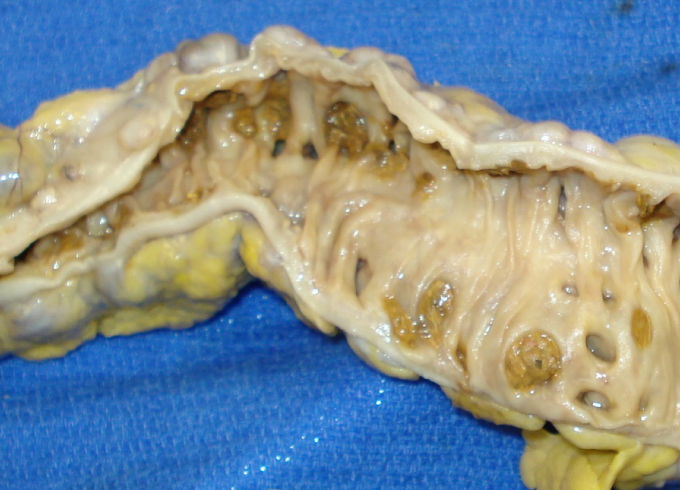 Which of the following most likely contributed to this patient's condition?
 (Multiple Choice)
4.9/5 (80)
(80) A 6-year-old girl is brought to the office due to intermittent abdominal cramps, bloating, and diarrhea for 2 months. She also has excessive flatulence, which typically occurs after meals. The patient has had no fever or vomiting. She eats a well-balanced diet and takes no medications or vitamins. Vital signs are appropriate for age. Examination shows a mildly distended abdomen with no hepatosplenomegaly or tenderness. Laboratory evaluation reveals elevated tissue transglutaminase antibodies. Which of the following locations should be biopsied to confirm the diagnosis in this patient?
(Multiple Choice)
4.9/5 (67)
(67) A 74-year-old man comes to the office for a follow-up visit for hypertension. His last visit was a year ago. He has no chest pain, shortness of breath, leg swelling, or dizziness. The patient is compliant with his medications and can tolerate a moderate level of physical activity. Blood pressure is 145/75 mm Hg and pulse is 67/min and regular. Auscultation findings at the base of the heart are depicted in the exhibit below. 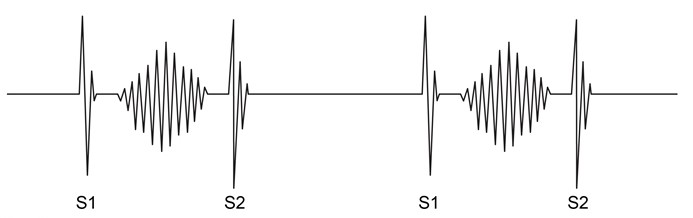 Which of the following is the most likely cause of this patient's physical findings?
 (Multiple Choice)
4.9/5 (62)
(62) A 43-year-old man comes to the office due to joint pain and stiffness in both hands for the past 6 months. He sometimes awakens with hand pain at night. Over the last year, the patient also has had chronic fatigue and poor sexual performance. He has no history of serious illness and takes no medications. The patient rarely sees a physician. He does not smoke tobacco or drink alcohol. Blood pressure is 126/80 mm Hg and pulse is 80/min. BMI is 25 kg/m2. Hand radiographs reveal bilateral erosions and joint deformities involving the second and third metacarpophalangeal joints. Which of the following is the most likely diagnosis?
(Multiple Choice)
4.8/5 (80)
(80) A 40-year-old woman comes to the office due to recurrent episodes of postprandial abdominal pain. The pain is in the right upper quadrant and is associated with nausea. The patient has no fever, jaundice, or loss of appetite. Other medical conditions include obstructive sleep apnea and obesity. The patient takes no medications. She has never had any surgeries. She does not use tobacco, alcohol, or illicit drugs. The patient is afebrile. Blood pressure is 140/90 mm Hg. BMI is 38 kg/m2. Examination shows tenderness in the right upper quadrant. Abdominal ultrasound demonstrates multiple gallstones. A gross specimen obtained from laparoscopic cholecystectomy is shown in the image below: 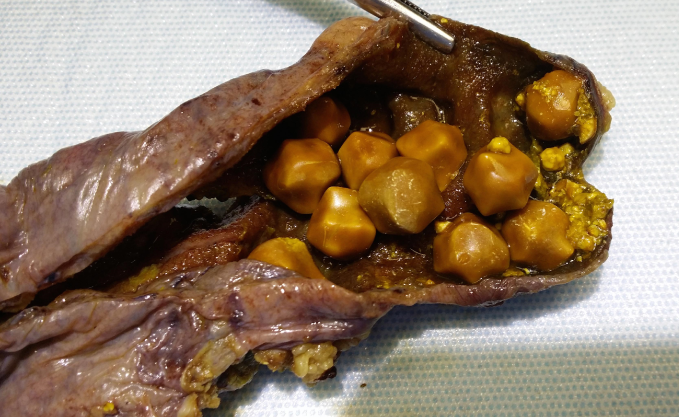 Which of the following is the most likely mechanism responsible for gallstone formation in this patient?
 (Multiple Choice)
4.8/5 (92)
(92) A 44-year-old man comes to the office due to hand tremors. The patient first noticed the tremor 2 years ago, and it has gradually worsened. He feels well most of the time, but his hands shake uncontrollably with activities such as pouring drinks or writing notes. The symptoms are most pronounced during stressful situations such as office meetings, and he keeps his hands tightly squeezed together or hidden below the table. He has had no arm stiffness, leg symptoms, or difficulty walking, but his wife has noticed that the patient occasionally keeps nodding his head while talking. Physical examination shows obvious tremors of outstretched hands that worsen during finger-nose testing. Which of the following additional factors is most likely to be present in this patient's medical history?
(Multiple Choice)
4.9/5 (74)
(74) A 21-year-old man comes to the emergency department due to 1 day of left flank pain and gross hematuria. He reports passage of small blood clots in urine but has had no dysuria or similar symptoms in the past. The patient has no other medical problems and does not take any medications. He does not use tobacco, alcohol, or illicit drugs. His younger sister has sickle cell disease. His temperature is 36.7 C (98 F), blood pressure is 126/70 mm Hg, and pulse is 100/min. Abdominal and genitourinary examination is unremarkable. There is no costovertebral angle tenderness. Which of the following is the most likely cause of this patient's hematuria?
(Multiple Choice)
4.8/5 (79)
(79) A 35-year-old woman is evaluated for a 3-month history of appetite loss, fatigue, weight loss, and abdominal pain. She has no chronic medical conditions and takes no medications. While undergoing upper gastrointestinal endoscopy, the patient develops cardiovascular collapse and dies, despite aggressive resuscitative measures. On autopsy, increased pigmentation is noted around the nipple areola and anal and vaginal mucous membranes. Which of the following additional findings are most likely to be seen on autopsy?
(Multiple Choice)
4.7/5 (90)
(90) The patient is treated with intravenous fluids and antibiotics, with improvement in fever, leukocytosis, and hypotension. On the third day of hospitalization, temperature is 36.7 C (98 F), blood pressure is 122/78 mm Hg, and pulse is 86/min. On examination, he is mildly lethargic and his voice is soft and breathy. Rhonchi are still heard over the lower right lung. There is left-sided facial droop and hemiparesis from his previous stroke. Chest x-ray demonstrates dense air space opacities in the superior region of the right lower lobe. Which of the following is the most likely underlying etiology of this patient's hospitalization?
(Multiple Choice)
4.8/5 (85)
(85) A 55-year-old man with HIV comes to the emergency department due to 3 weeks of increasing headache, fever, and vomiting. Examination shows low blood pressure and neck stiffness. The patient's condition quickly deteriorates, and he dies in the hospital despite appropriate treatment. Autopsy of the brain shows a diffuse gelatinous exudate covering the base of the brain. Cut sections of the brain show marked ventriculomegaly and frontal lobe infarcts but no intraparenchymal mass lesions. Which of the following is the most likely diagnosis?
(Multiple Choice)
4.8/5 (85)
(85) A 54-year-old man comes to the emergency department due to worsening shortness of breath for the last 3 days. His symptoms initially occurred with exertion but are now present at rest. The patient could not sleep last night because of a suffocating cough each time he tried to lie down. He considers himself generally healthy and states, "I've never had to see a doctor for any problems." Family history is remarkable for asthma and hypertension. Blood pressure is 162/86 mm Hg, pulse is 92/min, and respirations are 26/min. An x-ray of the chest is shown in the exhibit. 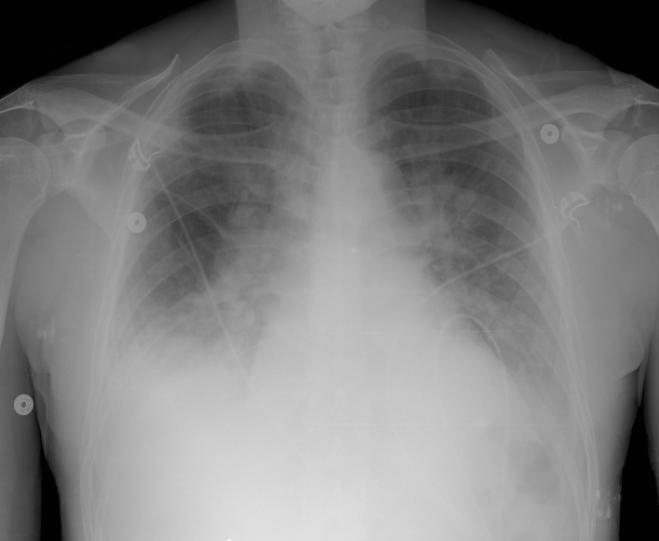 Which of the following is the most likely diagnosis?
 (Multiple Choice)
4.9/5 (76)
(76) A 69-year-old man comes to the clinic due to a squeezing pressure in his midline chest and neck that occurs when walking. He has a history of hypertension and type 2 diabetes mellitus. The patient is an ex-smoker with a 20-pack-year history. Coronary angiography shows extensive atherosclerosis and near-total occlusion of the left anterior descending artery. Further testing shows normal resting left ventricular ejection fraction with no regional wall motion abnormalities. The absence of myocardial necrosis and scarring despite vessel occlusion in this patient can be best explained by which of the following features of the occluding plaque?
(Multiple Choice)
4.7/5 (77)
(77) A 38-year-old man comes to the emergency department because he has been vomiting blood. After appropriate resuscitation measures, he undergoes upper gastrointestinal endoscopy, which reveals a bleeding duodenal ulcer. During hospital day 2, the patient develops decreased urine output. Serum creatinine rises to 3.0 mg/dL from a baseline of 1.2 mg/dL. Renal biopsy shows patchy epithelial necrosis of the tubules, tubulorrhexis, and intratubular casts. On hospital day 8, urine output significantly increases and serum creatinine levels decline. Over the next few days, this patient is at highest risk for which of the following complications?
(Multiple Choice)
4.8/5 (75)
(75) A previously healthy 16-year-old boy is evaluated for progressive headaches and blurred vision that started several months ago. The headaches are more severe upon waking up in the morning and are often accompanied by nausea and vomiting. He takes no medications and does not use tobacco, alcohol, or illicit drugs. Physical examination is notable for bilateral papilledema. MRI of the brain is shown in the exhibit. 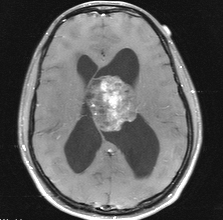 This patient's brain lesion most likely originated from which of the following cells?
 (Multiple Choice)
4.9/5 (66)
(66) A 64-year-old man dies suddenly while playing tennis. In the preceding months, the patient experienced fatigue and some exertional dyspnea. Autopsy reveals rupture of an unsuspected ascending aortic aneurysm. Heart examination shows a septal thickness of 1.1 cm (normal: ?1.1), a posterior wall thickness of 1.1 cm (normal: ?1.1), and an internal left ventricular diameter of 6.8 cm (normal: 3.5-5.9). No focal myocardial scarring is seen. Which of the following is the most likely cause of the cardiac findings seen in this individual?
(Multiple Choice)
4.9/5 (70)
(70) A 70-year-old man comes to the office due to persistent epigastric discomfort and nausea for the past several months. He has also noticed black-colored stools on several occasions. Medical history is notable for hypertension and osteoarthritis. The patient emigrated from rural China 5 years ago to live with his daughter. He does not use tobacco, alcohol, or illicit drugs. Physical examination shows a thin male with pale mucous membranes, an enlarged left supraclavicular lymph node, and epigastric tenderness on deep palpation. Stool testing for occult blood is positive. Upper gastrointestinal endoscopy reveals a 3-cm ulceration at the gastric antrum, with a heaped-up irregular border. Biopsy from the edge of the ulcer reveals glandular structures containing intestinal-like columnar cells. Which of the following most likely predisposed this patient to his current condition?
(Multiple Choice)
4.9/5 (84)
(84) A 14-month-old girl is brought to the clinic by her parents due to sores on her feet. Since she took her first steps 3 months ago, she has had blisters involving the soles of the feet, which subsequently break down and heal slowly. The patient had failure to thrive as an infant due to frequent oral ulcerations but otherwise has been healthy and has achieved normal developmental milestones. Examination shows small bullae at the soles with faint erythema and no scarring. Biopsy taken at the margin of a blister shows an intraepidermal cleavage plane. Which of the following most likely contributes to the pathogenesis of this patient's condition?
(Multiple Choice)
4.9/5 (71)
(71) A 54-year-old man comes to the office with abdominal pain, chronic diarrhea, and recent weight loss. He has had episodic abdominal pain in the past, but lately it has become persistent and worsens after eating. The patient does not use tobacco or illicit drugs but does consume alcohol regularly. An upright abdominal x-ray reveals calcifications in the epigastric area. Which of the following is the most likely cause of his diarrhea?
(Multiple Choice)
4.9/5 (85)
(85) A 55-year-old woman comes to the office due to a cough producing thick, yellowish sputum for the past 2 weeks. She has also had night sweats and increased fatigue over this time. Temperature is 38.3 C (101 F), blood pressure is 110/70 mm Hg, pulse is 88/min, and respirations are 20/min. There are crackles on lung auscultation. Chest imaging reveals a nonspecific pulmonary lesion. A transthoracic needle aspiration is performed. The specimen is cultured and grows several bacterial species, including Peptostreptococcus and Fusobacterium. Which of the following predisposing factors is most likely responsible for this patient's condition?
(Multiple Choice)
4.7/5 (80)
(80) 
Filters
- Essay(0)
- Multiple Choice(0)
- Short Answer(0)
- True False(0)
- Matching(0)