



 Chat with AI
Exam 10: Pathology

Exam 1: Anatomy291 Questions
Exam 2: Behavioral science240 Questions
Exam 3: Biochemistry156 Questions
Exam 4: Biostatistics117 Questions
Exam 5: Embryology52 Questions
Exam 6: Genetics103 Questions
Exam 7: Histology24 Questions
Exam 8: Immunology129 Questions
Exam 9: Microbiology336 Questions
Exam 10: Pathology816 Questions
Exam 11: Pathophysiology464 Questions
Exam 12: Pharmacology538 Questions
Exam 13: Physiology272 Questions
Select questions type


A 31-year-old female with new-onset generalized tonic-clonic seizures has an intracranial mass detected on head CT scan. Biopsy of the mass reveals neoplastic cells that stain positive for synaptophysin and negative for glial fibrillary acidic protein. These neoplastic cells most likely originate from the same precursor tissue as which of the following?
(Multiple Choice)
4.8/5  (76)
(76) A 3-month-old boy is brought to the office by his mother for a routine checkup. He is found to have a right-sided white pupillary reflex. His father was diagnosed with a retinal neoplasm during childhood and had his left eye enucleated. This child is at the greatest risk of developing which of the following neoplasms?
(Multiple Choice)
4.8/5 (82)
(82) A 24-year-old African-American man comes to the office after a rapid HIV test was positive at a health fair. Additional laboratory evaluation reveals a HIV viral load of 240,000 copies/mL and a CD4 count of 180 cells/mm3. The patient is given a prescription for antiretroviral therapy. He is also given dapsone for Pneumocystis jiroveci pneumonia prophylaxis due to a history of rash with trimethoprim-sulfamethoxazole. Pneumococcal and influenza vaccines are administered. A few days later, the patient returns to the office due to fatigue, jaundice, and dark urine. Laboratory results now show the following: 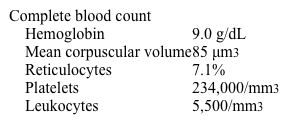 Coagulation studies are within normal limits. Peripheral smear reveals red blood cell fragments, microspherocytes, and bite cells. Which of the following is the most likely underlying cause of this patient's symptoms?
 (Multiple Choice)
4.8/5 (98)
(98) A 3-year-old boy comes to the emergency department for evaluation of oral bleeding that began 1 hour after a tooth extraction. The bleeding has persisted for approximately 30 minutes despite application of constant pressure with gauze. He has no significant past medical or surgical history. The patient takes no medications, and his vaccinations are up to date. Blood pressure is 90/60 mm Hg and pulse is 100/min. On physical examination, he has slow oozing of blood at the site of the dental extraction. Family history is significant for a maternal uncle who suffered from recurrent bleeding into his joints. Which of the following is most likely to be abnormal in this patient?
(Multiple Choice)
5.0/5 (58)
(58) After initial stabilization with intravenous fluids and blood products, the patient develops another bout of bloody emesis. Urgent upper gastrointestinal endoscopy confirms esophageal varices. Which of the following peptides is most likely to immediately decrease the portal venous pressure in this patient?
(Multiple Choice)
4.8/5 (82)
(82) A 37-year-old man comes to the office due to a rash. For the last several months, he has had numerous small lesions on the hands. The lesions are associated with occasional mild itching and bleed slightly if inadvertently struck against furniture or a wall. Examination findings are as shown in the exhibit.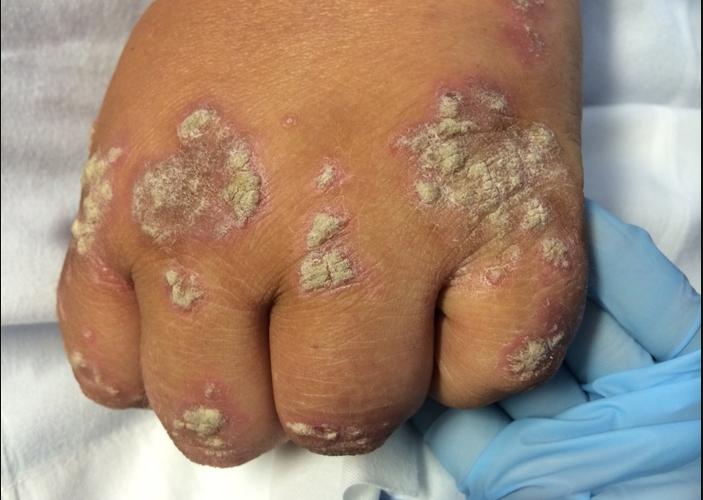 Which of the following is the most likely diagnosis?
 (Multiple Choice)
4.8/5 (78)
(78) A 12-year-old boy is brought to the emergency room due to high fever, chest pains, and dyspnea. Medical history is significant for 2 prior hospitalizations for abdominal pain that resolved with analgesics and hydration. Evaluation today shows a hematocrit of 23% and reticulocyte count of 9%. Several hours after being admitted to the hospital, the patient dies. At autopsy, the spleen is small and firm. This patient's autopsy finding is most likely related to which of the following?
(Multiple Choice)
4.9/5 (89)
(89) A 46-year-old previously healthy woman comes to the emergency department due to 4 days of intermittent fever, abdominal pain, and vomiting. For the past 2 days she has also had decreased urine output, skin rash, and progressive lethargy. Her temperature is 38.3 C (101 F), blood pressure is 130/80 mm Hg, and pulse is 100/min. There is a scattered petechial rash, facial puffiness, and 1+ bilateral pedal edema on physical examination. Laboratory studies show hemoglobin of 8.9 g/dL with elevated reticulocyte count and a platelet count of 26,000/mm3. Bleeding time is prolonged; prothrombin time and activated partial thromboplastin time are normal. The peripheral blood smear shows schistocytes and reduced platelets with presence of giant forms. Blood urea nitrogen is 46 mg/dL and serum creatinine is 2.3 mg/dL. Urinalysis is positive for proteinuria and hematuria. Which of the following is most likely to be seen on renal biopsy?
(Multiple Choice)
4.8/5 (77)
(77) A 43-year-old man with a history of HIV infection who is noncompliant with highly active antiretroviral therapy comes to the office due to progressive memory loss and cognitive decline over the last several years. The patient has problems with attention, concentration, and speech. In the past few months, he has become more apathetic and increasingly lethargic. More recently, he has had difficulty with balance and has fallen on multiple occasions. The patient has had no headache, tremor, change in vision, fever, nausea/vomiting, or urinary incontinence. His brother has a history of severe intellectual disability and epilepsy. Mini-Mental State Examination score is 18/30, and the patient appears emotionally blunted. He also has postural instability and difficulty performing fine motor tasks. Noncontrast head CT scan reveals diffuse cortical atrophy with some enlargement of the ventricles, as shown in the exhibits. 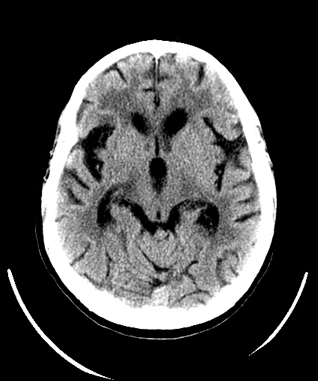
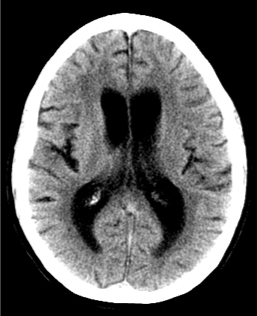 This patient's condition can be best described as which of the following?
 (Multiple Choice)
4.9/5 (75)
(75) An 87-year-old nursing home resident is brought to the emergency department with a 2-day history of fever, vomiting, and progressive lethargy. The patient's past medical history is significant for advanced dementia and stroke. Temperature is 38.3 C (101 F), blood pressure is 88/62 mm Hg, and pulse is 120/min and regular. On examination, he is lethargic but arousable. Coarse rhonchi are heard over the right midlung. Laboratory results are as follows: 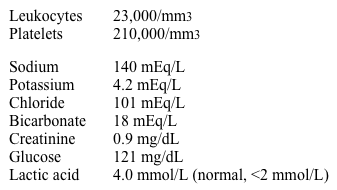 Which of the following is the most likely cause of this patient's increased anion gap?
 (Multiple Choice)
4.8/5 (85)
(85) A 55-year-old man undergoing evaluation for fatigue and exertional dyspnea is diagnosed with macrocytic anemia. Upper gastrointestinal endoscopy is consistent with atrophic gastritis. He is started on intramuscular cyanocobalamin, with the resulting changes shown in the graph below. 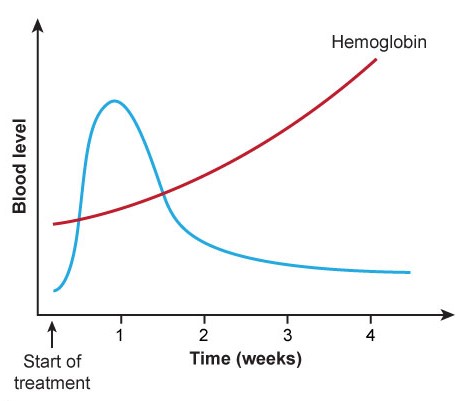 The blue curve most likely corresponds to which of the following parameters?
 (Multiple Choice)
4.8/5 (91)
(91) A 21-year-old man comes to the office due to nasal congestion and rhinorrhea. It occurs intermittently and is often accompanied by sneezing and itchy, watery eyes. It began 2 years ago and has worsened in severity. On examination, the nasal turbinates are edematous with clear rhinorrhea. There is bilateral conjunctival injection. Which of the following questions would be most helpful during further workup of this patient's condition?
(Multiple Choice)
4.8/5 (82)
(82) A 53-year-old woman comes to the physician for a routine check-up. She has no current complaints. Her past medical history is significant for osteoarthritis of the right knee. Her mother suffered from hypertension and was diagnosed with breast cancer at age 68, from which she died 4 years later. Her father had diabetes mellitus and died in a motor vehicle accident at age 56. The patient's blood pressure is 140/85 mm Hg and heart rate is 80/min. Physical examination is normal. Laboratory testing is significant for a fasting blood glucose level of 140 mg/dL on more than 2 occasions. This patient is most likely to die from which of the following conditions?
(Multiple Choice)
4.8/5 (68)
(68) A 1-month-old boy is brought to the office for follow-up of blood-streaked stools and diarrhea. The patient was born preterm at 35 weeks gestation and had no complications in the newborn nursery. He had been taking a standard cow's milk-based formula until 2 weeks ago when he developed loose stools streaked with blood and mucus. Symptoms resolved after changing the formula. If histopathologic examination had been performed when the patient was symptomatic, which of the following would most likely be seen?
(Multiple Choice)
4.9/5 (92)
(92) A 40-year-old man with end-stage renal disease due to type 1 diabetes mellitus is hospitalized for initiation of hemodialysis. A tunneled dialysis catheter is inserted into the right internal jugular vein. Before he is able to undergo dialysis treatment, the patient develops bleeding around the catheter exit site that is difficult to control. He has not been treated recently with anticoagulants. Further evaluation of this patient would most likely show which of the following laboratory abnormalities?
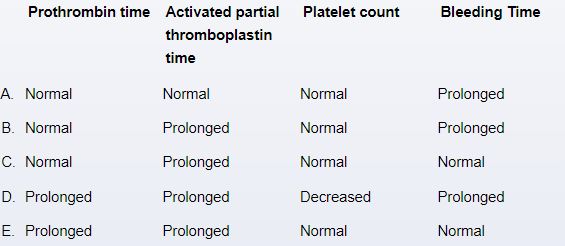
(Multiple Choice)
4.9/5 (84)
(84) Physical examination of a 23-year-old man diagnosed with chronic hepatitis shows corneal changes that are visible to the naked eye, as shown in the image below. 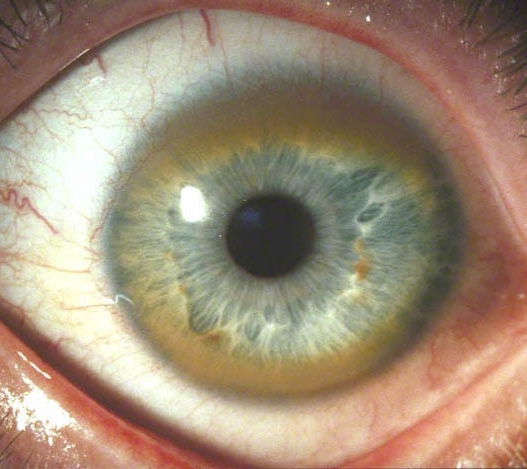 This patient is most likely to have which of the following conditions?
 (Multiple Choice)
4.8/5 (89)
(89) A 29-year-old man comes to the office due to increased sweating, heat intolerance, insomnia, and unintentional weight loss over the past 4 weeks. The patient has also noticed that his right testis feels bigger than the left but has had no scrotal pain. He has no prior medical problems and takes no medications. The patient does not use tobacco, alcohol, or illicit drugs. Blood pressure is 121/71 mm Hg and pulse is 108/min. On examination, the thyroid is mildly enlarged. Testicular examination reveals an enlarged, nontender right testicle. Laboratory testing shows elevated serum thyroxine and triiodothyronine levels. Scrotal ultrasonography demonstrates a hypoechoic mass within the right testicle. Elevated levels of which of the following substances would most likely explain this patient's symptoms?
(Multiple Choice)
4.8/5 (77)
(77) A 24-year-old, previously healthy woman comes to the hospital due to a 3-day history of fever, dyspnea, and cough productive of yellow sputum. Temperature is 38.8 C (101.8 F), blood pressure is 110/66 mm Hg, and pulse is 110/min. The patient has bronchial breath sounds and crackles over the right lower lung. Laboratory results are as follows: 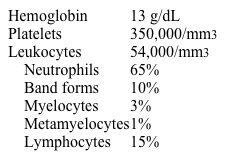 The leukocyte alkaline phosphatase test score is elevated. Which of the following is the most likely finding on this patient's peripheral blood smear?
 (Multiple Choice)
4.9/5 (78)
(78) A 62-year-old man comes to the physician because of recent weight loss, cough, and occasional hemoptysis. His past medical history is significant for poorly controlled diabetes mellitus and chronic obstructive pulmonary disease treated with bronchodilators and oral corticosteroids. Chest x-ray shows pulmonary infiltrates and an area of cavitation in the right upper lobe. Sputum microscopy shows acid-fast bacilli. Which of the following is the most accurate statement concerning this patient's pulmonary infection?
(Multiple Choice)
4.8/5 (81)
(81) A 26-year-old woman is brought to the emergency department due to acute-onset diplopia. Medical history is significant for episodes of blurry vision involving her right eye that occurred 6 months and 2 years ago. These episodes were associated with deficits in color vision and pain made worse with eye movement. The patient recovered the majority of her visual acuity after a few months in both cases. On neurologic examination, she has a visual acuity of 20/20 OS and 20/40 OD, mild right optic disk atrophy, and a relative afferent pupillary defect in the right eye. There is slowed and impaired adduction of the left eye with right lateral gaze. Convergence testing shows normal adduction in both eyes. The remainder of the neurologic examination is unremarkable. This patient's diplopia is most likely caused by which of the following mechanisms?
(Multiple Choice)
4.8/5 (69)
(69) 
Filters
- Essay(0)
- Multiple Choice(0)
- Short Answer(0)
- True False(0)
- Matching(0)