Solved

A 42-Year-Old Man Comes to the Office for Evaluation of Progressive

Question 289

Multiple Choice

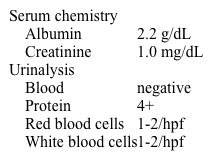
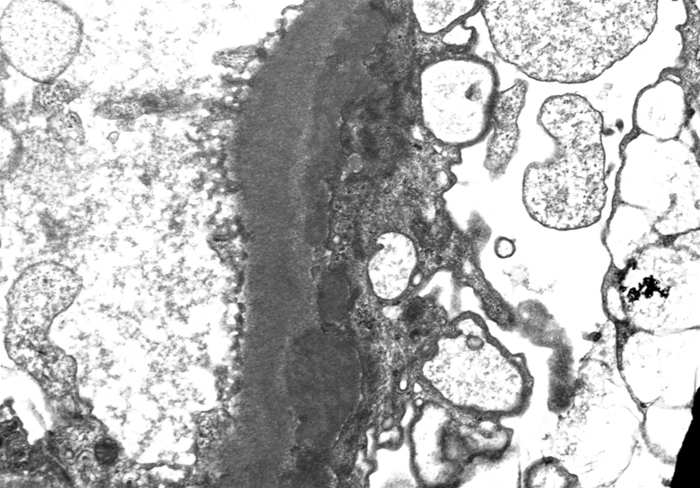
A 42-year-old man comes to the office for evaluation of progressive generalized edema and weight gain for the past several weeks.  He has no chest pain or shortness of breath.  The patient has no chronic medical conditions and takes no medications.  He last saw a physician a year ago for an upper respiratory infection.  The patient does not use tobacco, alcohol, or illicit drugs.  Blood pressure is 130/80 mm Hg and pulse is 84/min.  Mild ascites is present.  There is bilateral lower extremity pitting edema to the knees.Laboratory results are as follows: A 42-year-old man comes to the office for evaluation of progressive generalized edema and weight gain for the past several weeks.  He has no chest pain or shortness of breath.  The patient has no chronic medical conditions and takes no medications.  He last saw a physician a year ago for an upper respiratory infection.  The patient does not use tobacco, alcohol, or illicit drugs.  Blood pressure is 130/80 mm Hg and pulse is 84/min.  Mild ascites is present.  There is bilateral lower extremity pitting edema to the knees.Laboratory results are as follows:   Urinary protein excretion is 6.0 g/24 hr.  A kidney biopsy is performed, and electron microscopy of a glomerular capillary is shown below:   Which of the following is the most likely diagnosis? A) Crescentic glomerulonephritis B) Focal segmental glomerulosclerosis C) Membranous nephropathy D) Minimal change disease E) Poststreptococcal glomerulonephritis Urinary protein excretion is 6.0 g/24 hr.  A kidney biopsy is performed, and electron microscopy of a glomerular capillary is shown below: A 42-year-old man comes to the office for evaluation of progressive generalized edema and weight gain for the past several weeks.  He has no chest pain or shortness of breath.  The patient has no chronic medical conditions and takes no medications.  He last saw a physician a year ago for an upper respiratory infection.  The patient does not use tobacco, alcohol, or illicit drugs.  Blood pressure is 130/80 mm Hg and pulse is 84/min.  Mild ascites is present.  There is bilateral lower extremity pitting edema to the knees.Laboratory results are as follows:   Urinary protein excretion is 6.0 g/24 hr.  A kidney biopsy is performed, and electron microscopy of a glomerular capillary is shown below:   Which of the following is the most likely diagnosis? A) Crescentic glomerulonephritis B) Focal segmental glomerulosclerosis C) Membranous nephropathy D) Minimal change disease E) Poststreptococcal glomerulonephritis Which of the following is the most likely diagnosis?

A) Crescentic glomerulonephritis
B) Focal segmental glomerulosclerosis
C) Membranous nephropathy
D) Minimal change disease
E) Poststreptococcal glomerulonephritis

Correct Answer:

verifed

Verified

Unlock this answer now
Get Access to more Verified Answers free of charge

Related Questions