



 Chat with AI
Exam 3: Biochemistry

Exam 1: Anatomy291 Questions
Exam 2: Behavioral science240 Questions
Exam 3: Biochemistry156 Questions
Exam 4: Biostatistics117 Questions
Exam 5: Embryology52 Questions
Exam 6: Genetics103 Questions
Exam 7: Histology24 Questions
Exam 8: Immunology129 Questions
Exam 9: Microbiology336 Questions
Exam 10: Pathology816 Questions
Exam 11: Pathophysiology464 Questions
Exam 12: Pharmacology538 Questions
Exam 13: Physiology272 Questions
Select questions type


As part of an experiment, healthy volunteers undergo a 12-hour fast and then drink a solution containing radiolabeled alanine. Consecutive blood samples are drawn every 15 minutes for the next 3 hours. Initial blood samples detect the radiolabeled alanine, but analysis of later samples shows that the radiotracer is present in blood primarily in the form of glucose. Before alanine can be converted to glucose, its amino group is transferred to which of the following?
(Multiple Choice)
4.9/5  (75)
(75) A 66-year-old man comes to the office due to progressive vision impairment over the last year that has begun to affect his ability to drive. He has difficulty reading road signs at night and reports excessive glare from the headlights of oncoming cars. The patient has a long history of hypertension and type 2 diabetes mellitus. Funduscopy reveals a diminished red reflex bilaterally with obscuration of retinal detail. It is determined that the patient's condition is in part due to intracellular accumulation of sorbitol. In healthy cells, this sugar alcohol is normally metabolized into which of the following substances to facilitate excretion?
(Multiple Choice)
4.8/5 (67)
(67) A researcher is studying the role of glucose metabolites in normal cellular function. A specific human cell type is incubated in glucose-rich media. Intracellular levels of glucose metabolizing enzymes, intermediate products, and generated ATP are measured. In these cells, glycolysis of a single glucose molecule always yields pyruvate but sometimes generates no net ATP. Which of the following cells is most likely being studied in this experiment?
(Multiple Choice)
4.9/5 (77)
(77) A 54-year-old man with a history of chronic kidney disease due to hypertension develops anemia. Evaluation reveals that the cause of anemia is erythropoietin deficiency. Erythropoietin increases the numbers of erythroid precursor cells in the bone marrow and induces heme production in erythrocyte precursors. In this patient, mature erythrocytes are found that are unable to synthesize heme even though they contain detectable levels of cytoplasmic enzymes involved in heme synthesis. Lack of which of the following cellular organelles best explains this phenomenon?
(Multiple Choice)
4.9/5 (73)
(73) A 4-day-old boy is brought to the office due to a 2-day history of progressive jaundice. The patient was born at term following an uncomplicated pregnancy. He is formula fed. The patient and his mother are both blood group A, Rh-positive. Vital signs are normal. Examination shows scleral icterus and jaundice over the face and chest. Laboratory results are as follows: 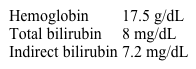 The patient is followed closely, and the jaundice resolves without intervention in 3 days. This patient's jaundice was most likely the result of which of the following changes in bilirubin metabolism compared to an adult?
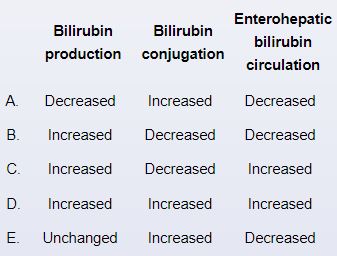
The patient is followed closely, and the jaundice resolves without intervention in 3 days. This patient's jaundice was most likely the result of which of the following changes in bilirubin metabolism compared to an adult?
(Multiple Choice)
5.0/5 (83)
(83) A 54-year-old woman is evaluated in the clinic for exertional dyspnea and easy fatigability. The patient has no chest pain, cough, or wheezing. She does not use tobacco, alcohol, or illicit drugs. On physical examination, her gait is unstable when her eyes are closed and there is impaired vibratory sensation in the lower extremities. Marked pallor of the conjunctivae, nail beds, and palms is present. Which of the following laboratory tests would help confirm the most likely diagnosis in this patient?
(Multiple Choice)
4.9/5 (81)
(81) A 54-year-old man with a history of cirrhosis is brought to the emergency department by his wife, who found him agitated and confused. She reports that he was nauseous and vomited bright red blood several times yesterday. His cirrhosis is secondary to chronic hepatitis C infection, and he has received treatment for esophageal varices in the past. Physical examination reveals abdominal distension, decreased liver span, and testicular atrophy. A jerky, irregular flexion-extension tremor involving his hands is seen with wrist extension. Which of the following is most likely to be elevated in this patient's astrocytes?
(Multiple Choice)
4.9/5 (74)
(74) A microbiologist performs a genetic experiment in which cultures of Escherichia coli are treated with a chemical that induces a high frequency of mutations. Individual bacterial colonies are isolated to identify a mutant strain that lacks a specific enzyme involved in DNA replication. This specific enzyme is responsible for removing short fragments of RNA that are base paired to the DNA template. Which of the following enzymes is most likely deficient in this strain of E coli?
(Multiple Choice)
4.8/5 (83)
(83) A 34-year-old man is found to have an LDL level of 310 mg/dL and a normal serum triglyceride level. His father suffered a myocardial infarction at age 39, and his paternal grandfather died of a heart attack at age 40. The patient's wife has a normal lipid profile. DNA samples are obtained from several family members for genetic analysis. Southern blotting of restriction fragments from a region containing the LDL receptor gene shows the following pattern: 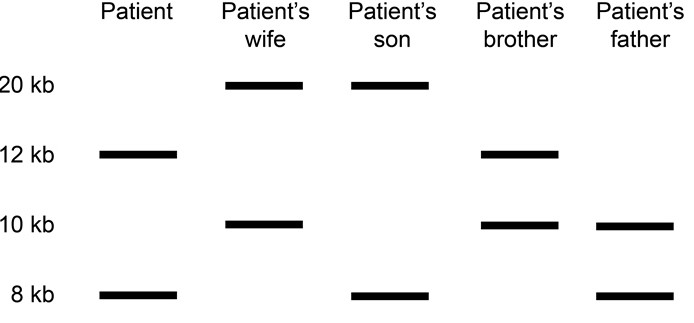 Which of the following statements best describes the DNA analysis results?
 (Multiple Choice)
4.9/5 (63)
(63) A 5-year-old girl is brought to the clinic due to several months of fatigue and difficulty walking. She ambulates normally at first but rapidly becomes weak and tired. The patient has not been ill recently and is usually happy and playful. She has a history of mild motor delays but is otherwise developmentally normal. Vital signs are within normal limits. Examination shows mildly decreased power in all extremities but no ataxia. Cardiac auscultation reveals a 1/6 systolic murmur and an S3 gallop. Laboratory results are as follows: 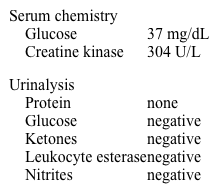 Muscle biopsy shows a very low carnitine content. This patient most likely has deficient synthesis of which of the following substances?
 (Multiple Choice)
4.8/5 (81)
(81) A 44-year-old man is evaluated due to progressive dyspnea over the past several years. The patient has no associated chest pain or palpitations. Physical examination shows a prolonged expiratory phase without wheezes or rhonchi. CT scan of the chest demonstrates bilateral lower lobe-predominant emphysema. Further testing reveals that the patient has a protease inhibitor deficiency, which has led to increased elastin fiber breakdown. Elastin fibers within alveolar walls normally allow the lung to stretch during active inspiration and recoil during passive expiration. Which of the following most likely contributes to this property of elastin?
(Multiple Choice)
5.0/5 (83)
(83) A 3-year-old boy who recently immigrated to the United States is brought to the physician by his parents because he has not yet begun to walk or speak. Assessment of his developmental milestones shows severe intellectual disability. He dies 6 months later from refractory seizures resulting in respiratory failure. Autopsy shows pallor of the substantia nigra, locus ceruleus, and vagal nucleus dorsalis. The underlying condition responsible for this patient's death is most likely caused by a deficiency of which of the following enzymes?
(Multiple Choice)
4.9/5 (62)
(62) A 7-day-old neonate born to a 28-year-old woman is brought to the office due to progressive lethargy, vomiting, and poor feeding. The mother reports an uneventful pregnancy and perinatal course. She exclusively breastfeeds the infant and has no medical problems in any of her other children. On examination, the infant is somnolent and dehydrated with decreased muscle tone. Laboratory studies reveal metabolic acidosis with an elevated anion gap, ketosis, and hypoglycemia. Further evaluation reveals a markedly elevated propionic acid level due to defective conversion of propionyl-CoA to methylmalonyl-CoA. This patient is most likely unable to use which of the following amino acids for energy production?
(Multiple Choice)
4.9/5 (79)
(79) A research scientist is studying biochemical reactions that take place in the liver. He cultures hepatocytes in a growth media enriched with glutamate labeled with nitrogen isotopes. After some time, he finds that the nitrogen isotopes are transferred to oxaloacetate, forming aspartate in the process. Which of the following substances is most likely involved in this reaction?
(Multiple Choice)
4.7/5 (68)
(68) A 55-year-old farmer is brought to the emergency department after his daughter found him confused and disoriented in the tool shed at home. He has been otherwise healthy and does not take any medications. On physical examination, blood pressure is 110/70 mm Hg and pulse is 50/min. The patient's pupils are symmetric, 2 mm, and reactive to light. His eyes are tearing considerably. There are scattered wheezes bilaterally on lung auscultation. The patient's skin is clammy and he is sweating profusely. Impairment of which of the following steps at the neuromuscular junction is most likely responsible for his presentation? 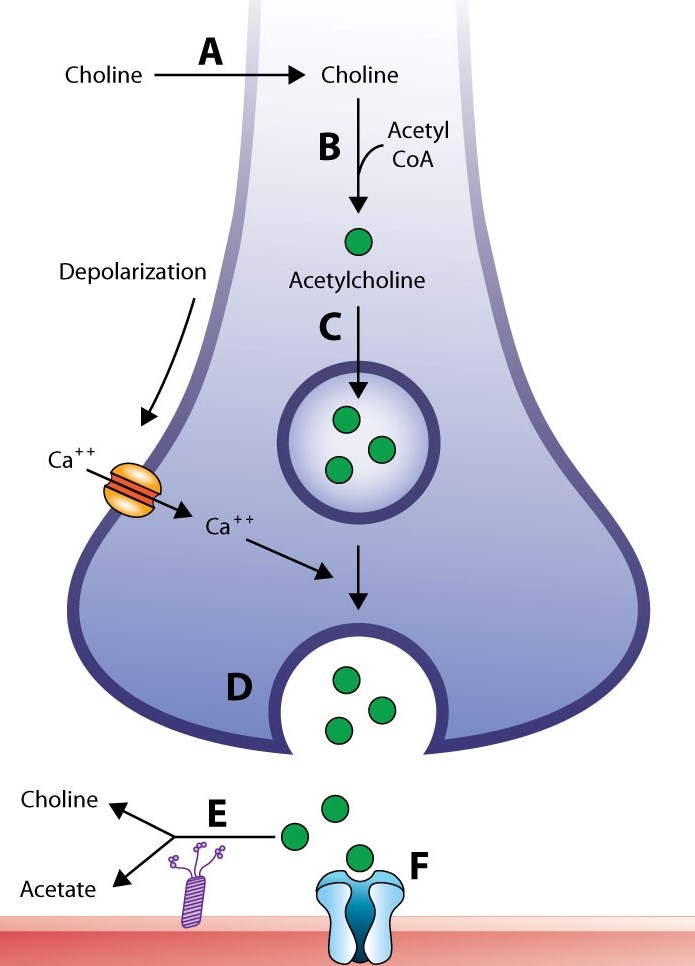
(Multiple Choice)
4.9/5 (83)
(83) A 5-day-old term newborn is brought to the emergency department for multiple episodes of emesis. The breastfed infant has been having fewer wet diapers over the last 2 days. Vital signs show tachycardia, tachypnea, and hypotension. Physical examination shows an icteric, lethargic baby with a sunken fontanelle, dry mucous membranes, and hepatomegaly. A blood culture is drawn and empiric antibiotics are initiated. Hematologic studies show leukocytosis with bandemia. Serum studies show hypoglycemia and elevated transaminases. The ammonia level is normal. Newborn screen is pending. Preliminary results from arterial blood culture show gram-negative rods. The infant is placed on a special formula and gradually improves over the next few days. Which of the following steps in metabolism is most likely impaired in this patient? 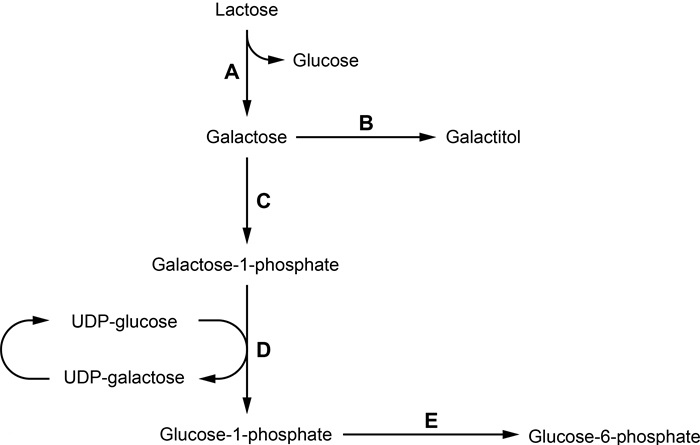
(Multiple Choice)
4.8/5 (90)
(90) An autopsy is being performed on a 4-year-old boy who recently died from a myocardial infarction. The child had a history of intellectual disability. Autopsy shows a prominent forehead and broad nose. There is a diffuse haze over the corneas bilaterally. The heart, liver, and spleen are enlarged. Sampling of the coronary arteries is most likely to reveal intimal accumulation of which of the following substances?
(Multiple Choice)
4.8/5 (77)
(77) Nutrition researchers investigating the relationship between fructose consumption and cardiovascular disease conduct a prospective cohort study on a population of randomly selected young adults. Study participants undergo semiannual measurement of waist circumference, blood pressure, and serum cholesterol and triglyceride concentrations. Dietary fructose consumption is assessed through the use of questionnaires and by measuring urinary fructose excretion. A 23-year-old man enrolled in the study is found to excrete large amounts of fructose in his urine compared to other study participants despite maintaining a moderate fructose intake. Further evaluation shows a hereditary defect in fructose metabolism, but he is asymptomatic and has no other medical problems. This patient most likely remains able to metabolize fructose due to the compensatory activity of which of the following enzymes?
(Multiple Choice)
4.9/5 (76)
(76) An investigator is studying weight regulation using experimental mouse models. Knockout mice are created with a homozygous mutation in the gene coding for the leptin receptor. This mutation prevents the receptor from binding leptin and initiating its normal signaling cascade. The knockout mice are allowed to feed at will, and their body mass index (BMI) and serum leptin levels are measured and compared with control mice. On the graph below, area C represents the normal relationship between BMI and leptin in a control mouse. 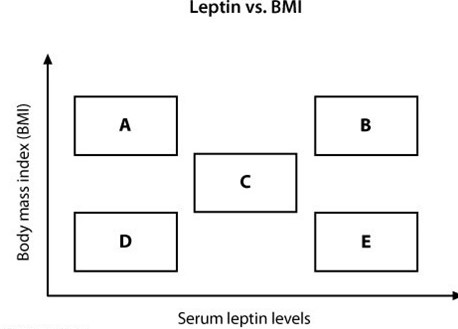 Which of the following areas represents the expected relationship between BMI and serum leptin levels in a leptin receptor mutant mouse?
 (Multiple Choice)
4.9/5 (72)
(72) A 34-year-old woman is brought to the emergency department in the early morning with confusion, tremor, and sweating. Her husband reports that she did not wake to her alarm clock and was difficult to arouse. Over the past week, the patient has had similar episodes in the morning before eating and after exercise. Past medical history is unremarkable. Blood pressure is 135/95 mm Hg, pulse is 110/min, and respirations are 24/min. The patient is arousable to voice but does not follow commands. Cranial nerve examination, muscle tone, and deep tendon reflexes are normal. A bedside fingerstick glucose level is 35 mg/dL. The patient is given an intravenous infusion of glucose, which rapidly improves her mental status. Further evaluation reveals that her episodes of hypoglycemia are due to increased levels of an endogenous hormone. This hormonal imbalance is most likely causing the patient's symptoms by stimulating which of the following conversions? 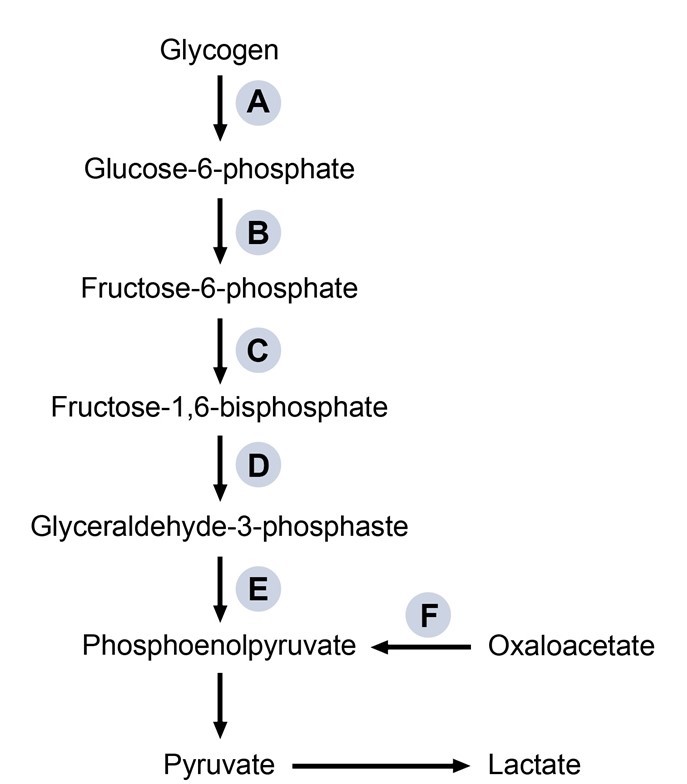
(Multiple Choice)
5.0/5 (80)
(80) 
Filters
- Essay(0)
- Multiple Choice(0)
- Short Answer(0)
- True False(0)
- Matching(0)