



 Chat with AI
Exam 3: Biochemistry

Exam 1: Anatomy291 Questions
Exam 2: Behavioral science240 Questions
Exam 3: Biochemistry156 Questions
Exam 4: Biostatistics117 Questions
Exam 5: Embryology52 Questions
Exam 6: Genetics103 Questions
Exam 7: Histology24 Questions
Exam 8: Immunology129 Questions
Exam 9: Microbiology336 Questions
Exam 10: Pathology816 Questions
Exam 11: Pathophysiology464 Questions
Exam 12: Pharmacology538 Questions
Exam 13: Physiology272 Questions
Select questions type


A 52-year-old woman comes to the office with a 2-month history of skin rash that worsens with sun exposure. Her family says that lately she has become irritable, hostile, and has had episodes of disorientation. The patient does not use tobacco or illicit drugs but has been drinking half a bottle of gin daily. Further questioning reveals poor nutritional intake and intermittent diarrhea. The patient restricts her diet for weight control. Body mass index is 17 kg/m2. On examination, she has a well-demarcated, hyperpigmented, scaly rash on the hands, forearms, and upper chest. The cause of most of her symptoms is determined to be a lack of the precursor vitamin for synthesis of NAD+ coenzyme. The compensatory pathway to synthesize this coenzyme uses which of the following as a precursor?
(Multiple Choice)
4.8/5  (89)
(89) A 20-year-old man is evaluated in the emergency department for weakness, malaise, and dark urine. The patient was treated for a bacterial skin infection several days ago. Physical examination shows scleral icterus. Laboratory results reveal anemia with an elevated reticulocyte count. Abnormal erythrocytes are seen on peripheral smear. Which of the following substrate flow pathways is most likely deficient in this patient? 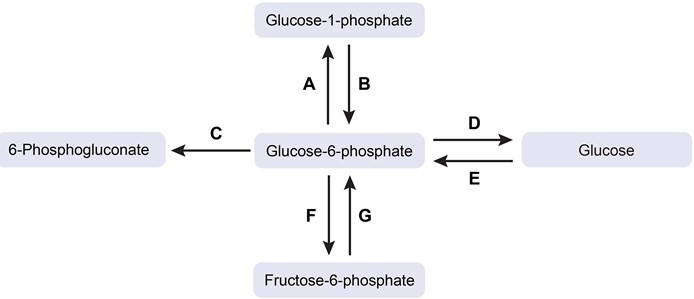
(Multiple Choice)
4.8/5 (88)
(88) A 23-year-old man is brought to the emergency department by paramedics following a motor vehicle accident. He was an unrestrained passenger in the front seat. Several days after hospitalization, his fluid volume and plasma osmolarity are measured and illustrated in the image below (solid line, normal; dotted line, patient). 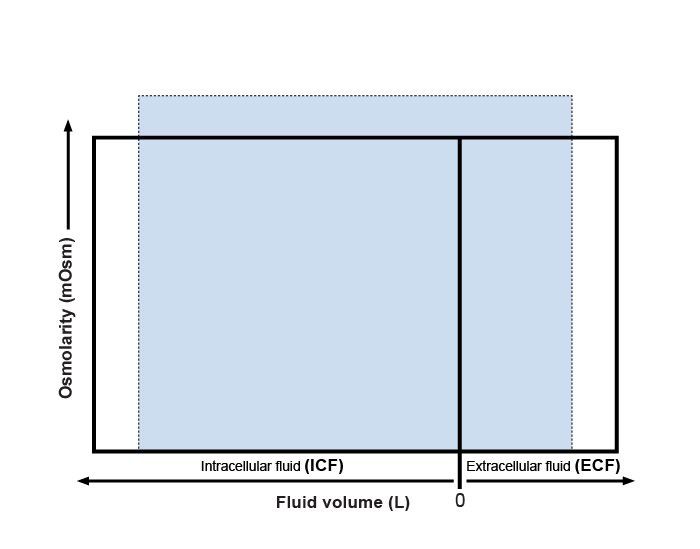 Which of the following conditions is most likely to cause the findings shown in the image?
 (Multiple Choice)
4.9/5 (92)
(92) A 34-year-old woman comes to the office after her sister was diagnosed with breast cancer. She has no nipple discharge, breast lumps, or discomfort. Breast examination is normal. Her sister was found to have a multiple base pair insertion affecting exon 11 of the BRCA1 gene that leads to a frameshift mutation. A screening test to evaluate for a similar insertion mutation in the patient's BRCA1 gene is performed. The test uses polymerase chain reaction (PCR) to amplify the target exon and gel electrophoresis to assess the size of the exon compared to the wild-type allele. Which of the following must be known in order to perform the amplification part of this analysis?
(Multiple Choice)
4.9/5 (90)
(90) A research scientist studying the metabolic pathways that contribute to obesity feeds experimental animals a high-carbohydrate, high-protein diet for a prolonged period. A sample of liver tissue is then obtained from the animals, and the activity of various enzymes involved in fatty acid metabolism is measured and recorded. It is determined that beta-oxidation of fatty acids is inhibited within these cells as a result of the diet. An increase in which of the following substances is most likely responsible for the observed effect?
(Multiple Choice)
4.9/5 (70)
(70) A 34-year-old man is admitted to the hospital after sustaining a head injury and fractures of both femurs in a motor vehicle collision. CT scan of the head reveals a left-sided extradural hematoma. He has no history of chronic illness and takes no medications. The patient receives intravenous fluid boluses and blood transfusions and is taken to the operating room for fracture repair and removal of the hematoma. On the first postoperative day, laboratory results show high plasma glucose and lactate levels. Which of the following is the primary contributor to this patient's elevated blood glucose levels?
(Multiple Choice)
4.7/5 (79)
(79) A 34-year-old previously healthy man comes to the emergency department due to a 3-hour history of chest pain, diaphoresis, and dyspnea. He does not smoke, exercises regularly, and eats a balanced diet. His father died at age 56 from a myocardial infarction. His blood pressure is 110/70 mm Hg and pulse is 110/min and regular. Physical examination is unremarkable. ECG shows ST elevation in the anterolateral leads. Coronary angiogram reveals proximal left anterior descending artery stenosis and thrombosis, which is treated with angioplasty and stent placement. Laboratory results are as follows:  Further testing reveals a homozygous mutation in the methylene tetrahydrofolate reductase gene that leads to decreased enzymatic activity. Due to this defect, the patient most likely has impairment converting homocysteine to which of the following?
 (Multiple Choice)
4.9/5 (90)
(90) An 18-month-old boy is being evaluated for neurologic regression. He had a normal neonatal course and early development until age 5 months. The boy subsequently experienced gradual regression of developmental milestones, and now has inability to sit with support, poor head control, and loss of a social smile. Weight and height are below the 5th percentile. Physical examination shows an enlarged liver and spleen, diminished deep tendon reflexes in all limbs, and hypotonia. Funduscopic findings are shown in the exhibit.
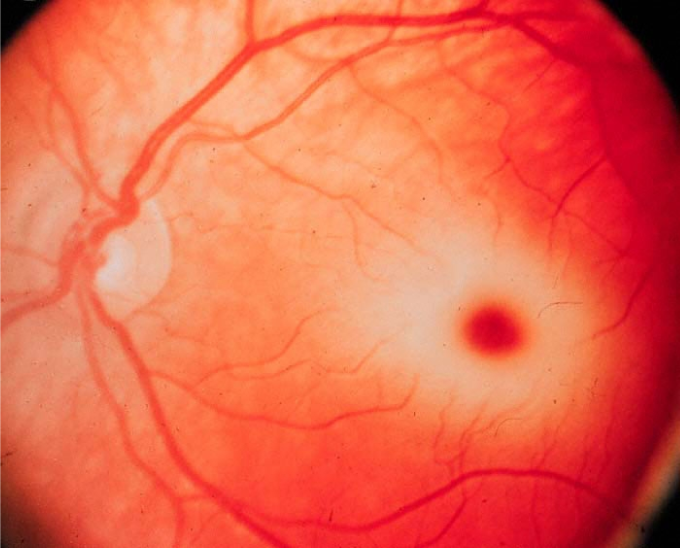 This patient most likely has an accumulation of which of the following substrates?
 (Multiple Choice)
4.9/5 (69)
(69) Two graphs illustrating the transport rate of solutes across the plasma membrane are shown on the slide below. 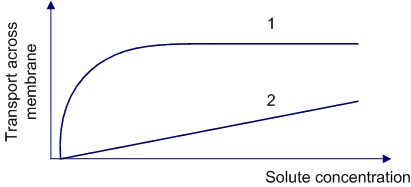 Which of the following best explains the difference in the shape of the curves?
 (Multiple Choice)
4.8/5 (65)
(65) Hemoglobin C (HbC) disease is due to a single amino acid substitution (glutamic acid → lysine) at position 6 in the beta globin chain of the hemoglobin molecule. Hemoglobin S (HbS) is similar to HbC in that it is also formed by an amino acid substitution at position 6 in the beta globin chain. However, patients homozygous for HbC have mild chronic hemolytic anemia, whereas those homozygous for HbS generally have a more severe anemia complicated by vasoocclusive pain episodes. Which of the following properties best accounts for the differing clinical severity between the two conditions?
(Multiple Choice)
4.7/5 (86)
(86) The resting membrane potential for an isolated muscle cell is -70 mV. Equilibrium potentials for important ions are given below:ENa = + 60 mV
EK = - 80 mV
ECl = - 70 mV
ECa = + 125 mVWhich of the following most likely forms the resting membrane potential of the cell?
(Multiple Choice)
4.9/5 (65)
(65) A 15-year-old boy is found to have unexplained erythrocytosis on routine laboratory analysis. Evaluation of his immediate family shows that his father and sister also have elevated red cell levels. Genetic sequencing of the β-globin gene is performed in the affected family members. The results show a single base substitution at amino acid position 82 that replaces the normal lysine residue with methionine. Further analysis shows that this amino acid replacement impairs the ionic interaction between the β-subunit and 2,3-bisphosphoglycerate. As a result of this mutation, the patient's hemoglobin will be most similar to which of the following hemoglobin types?
(Multiple Choice)
5.0/5 (74)
(74) Researchers are investigating the relationship between glucose transport proteins and insulin concentration in different types of tissues. Experiments in which cells are taken from various tissue samples and exposed to increasing concentrations of insulin are performed. The number of surface glucose transporters are then measured. The results from 2 cell samples are plotted on the graphs below. 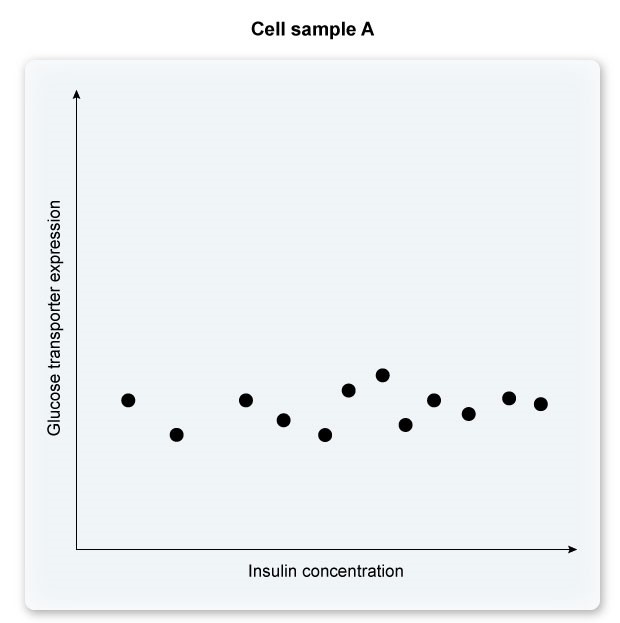
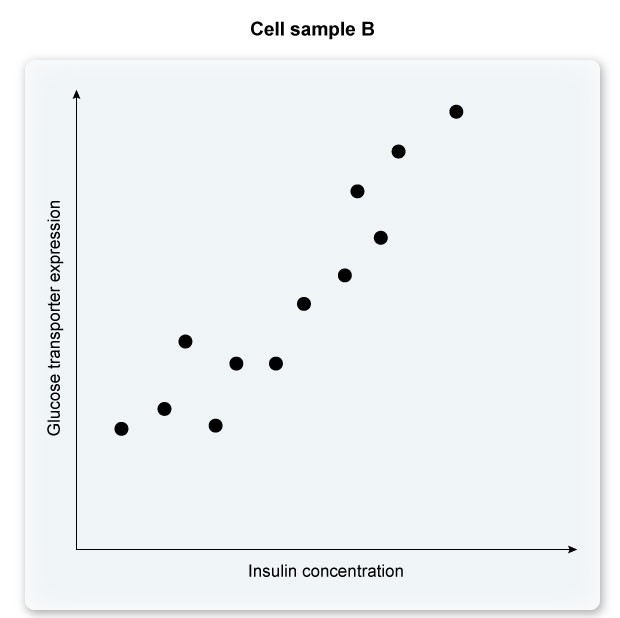 Which of the following cell types are most likely represented in cell samples A and B, respectively?
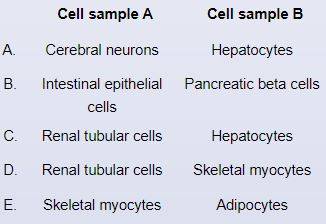
Which of the following cell types are most likely represented in cell samples A and B, respectively?
(Multiple Choice)
4.8/5 (74)
(74) A 3-day-old boy is brought to the office due to poor feeding, vomiting, and progressive lethargy. The parents also report that his diapers have a "burnt sugar smell" differing from their previous children's diapers. The mother and infant were discharged from the hospital yesterday after a normal pregnancy and spontaneous vaginal delivery. The mother is exclusively breastfeeding. Her other 2 children are healthy and have no medical problems. Physical examination shows a lethargic infant with dry mucous membranes and generalized hypertonia. Which of the following should be restricted from this infant's diet?
(Multiple Choice)
4.9/5 (75)
(75) A 31-year-old previously healthy man comes to the office due to myalgias, anorexia, and skin rash. He does not use tobacco, alcohol, or illicit drugs. The patient works as a personal trainer and is a bodybuilding enthusiast. He denies using anabolic steroids but has been consuming large amounts of raw egg whites for the past several months. Physical examination shows macular dermatitis of the extremities. A water-soluble vitamin deficiency is suspected as the cause of his condition. Which of the following biochemical conversions most likely uses the deficient vitamin as a cofactor?
(Multiple Choice)
5.0/5 (73)
(73) A 36-year-old man comes to the office due to skin lesions on his palms. The patient has yellowish skin nodules over the palmar creases that have been increasing in size and number over the past several years. He also has small clusters of yellow papules on his elbows, knees, and buttocks. His father died of a myocardial infarction at age 56. Biopsy of his lesions shows accumulation of lipid-laden macrophages. Immunoblot analysis suggests a lack of ApoE3 and ApoE4 in his circulating lipoproteins. Which of the following is most likely impaired in this patient?
(Multiple Choice)
4.8/5 (80)
(80) 
Filters
- Essay(0)
- Multiple Choice(0)
- Short Answer(0)
- True False(0)
- Matching(0)