



 Chat with AI
Exam 3: Biochemistry

Exam 1: Anatomy291 Questions
Exam 2: Behavioral science240 Questions
Exam 3: Biochemistry156 Questions
Exam 4: Biostatistics117 Questions
Exam 5: Embryology52 Questions
Exam 6: Genetics103 Questions
Exam 7: Histology24 Questions
Exam 8: Immunology129 Questions
Exam 9: Microbiology336 Questions
Exam 10: Pathology816 Questions
Exam 11: Pathophysiology464 Questions
Exam 12: Pharmacology538 Questions
Exam 13: Physiology272 Questions
Select questions type


A 42-year-old woman comes to the neurologist for enrollment in a research study. She has a 15-year history of resting tremor, bradykinesia, and cogwheel rigidity consistent with Parkinson's disease. One of her siblings recently started having similar symptoms. Genetic analysis is performed on the patient and her affected sibling. The results show a loss-of-function mutation in a gene that leads to an accumulation of misfolded proteins. Which of the following biochemical processes is most likely defective in this patient?
(Multiple Choice)
4.9/5  (70)
(70) A 23-year-old apparently healthy man who recently immigrated to the United States comes to an outpatient clinic to establish care. When asked about his past medical history, he says that he has no significant medical problems. However, his mother told him that he was born with "a problem metabolizing sugar." The patient maintains no dietary restrictions and regularly eats vegetables, fruits, meats, and processed foods. Urine samples show a repeatedly positive copper reduction test, but glucose oxidase dipstick testing is negative. Which of the following enzymes is most likely to be deficient in this patient?
(Multiple Choice)
4.8/5 (72)
(72) A 5-year-old boy is brought to the office by his parents to establish medical care. The family recently immigrated to the United States from Nigeria. Both parents have sickle cell trait, and the patient was diagnosed with homozygous sickle cell disease (HbSS) at the age of 6 months. He has had several prior vasoocclusive crises and takes folic acid and hydroxyurea. Physical examination shows no abnormalities. Hemoglobin electrophoresis in this patient is most likely to reveal which of the following predominant hemoglobin patterns?
(Multiple Choice)
4.8/5 (79)
(79) A 17-year-old boy who was recently diagnosed with type 1 diabetes mellitus is found unresponsive at home. His family reports that the patient did not feel good last night and skipped dinner, but he still took his usual dose of insulin. Paramedics find that his fingerstick blood glucose is 32 mg/dL and immediately administer intramuscular glucagon. Glucagon binds to a transmembrane receptor in hepatocytes, which promotes binding of intracellular GTP to a specific receptor-associated protein. This leads to further downstream signaling and rapid metabolic changes within hepatocytes, including a rapid decrease in intracellular glycogen stores and release of glucose into the blood. Which of the following is the most likely mediator responsible for these effects?
(Multiple Choice)
4.9/5 (81)
(81) A 46-year-old man comes to the emergency department due to recurrent nosebleeds. When interviewed for additional history, he becomes belligerent and uncooperative. The patient has a history of alcohol use disorder and chronic mental illness. He has been placed in homeless shelters on multiple occasions but has not remained there for any prolonged periods. Physical examination shows swollen gums, scattered ecchymoses, and hyperkeratosis. He also has a chronic ulcer on the left lower extremity that does not appear to be infected. Which of the following mechanisms accounts for this patient's examination findings?
(Multiple Choice)
4.7/5 (66)
(66) A 7-year-old African American boy is brought to the office by his parents. The parents state that the boy has been hospitalized several times for severe pains in his back and extremities. The patient is very active when he is not in pain but gets quite tired by the end of the day. He has no other medical problems and takes no medications except acetaminophen for pain control. On examination, the conjunctivae are pale. Blood count reveals a hemoglobin level of 7.8 mg/dL and a reticulocyte count of 15%. A valine for glutamic acid substitution at position 6 of the β globin chain of the hemoglobin molecule is suspected. This patient's hemoglobin would most likely aggregate upon which of the following?
(Multiple Choice)
4.9/5 (86)
(86) A 24-year-old woman comes to the office for a preemployment medical evaluation. The patient has no known medical problems but reports that her skin bruises and scars easily. She says that most of her family members have a very "flexible" body, and her brother works in a circus as a contortionist. The patient takes no medications and has no allergies. She does not use tobacco, alcohol, or drugs. Physical examination findings are shown in the exhibit.
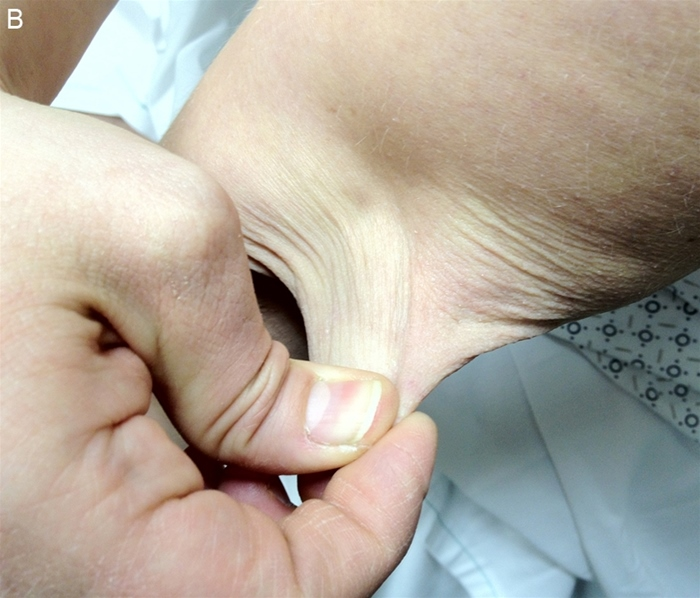
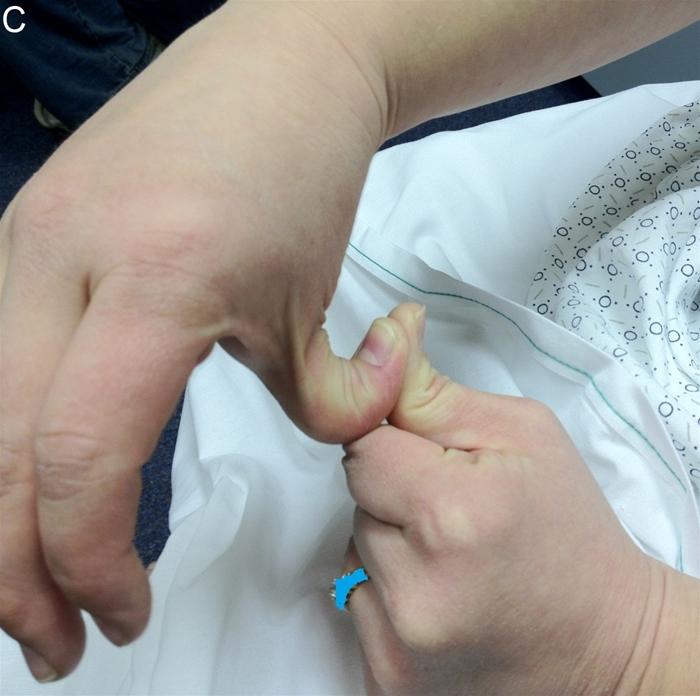 This patient most likely has an inherited defect in which of the following proteins?
 (Multiple Choice)
5.0/5 (67)
(67) A 14-month-old boy is evaluated for failure to thrive and developmental delay. His mother reports that at 12 months he could barely lift his head and had difficulty sitting unsupported. The toddler has not started babbling or forming words. He is at the 10th percentile for height and 5th percentile for weight. Laboratory results are as follows: 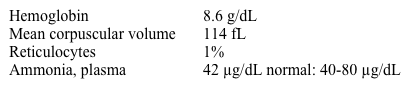 Urine specimens contain large amounts of orotic acid crystals. Supplementation with which of the following substances would most likely benefit this patient?
 (Multiple Choice)
4.9/5 (82)
(82) A 42-year-old man comes to the office due to numbness and tingling in both legs and difficulty walking for the past several months. He has also noticed that he tires more easily with physical activity. His temperature is 36.8 C (98 F), blood pressure is 122/86 mm Hg, pulse is 76 /min, and respirations are 14/min. Physical examination shows conjunctival pallor and loss of vibration and position sensation in the bilateral lower extremities with associated gait ataxia. The remainder of the examination is within normal limits. Which of the following findings is most likely to be present upon further questioning of the patient?
(Multiple Choice)
4.8/5 (66)
(66) A 79-year-old woman comes to the office for evaluation of difficulty walking due to fatigue and bilateral leg pain. The pain started in her lower legs 3 weeks ago and progressed to involve the muscles of her thighs also. In addition, she has noted red spots on her legs. The patient has lived alone since her husband died 3 years ago and is largely homebound. Her diet consists mostly of bread and canned meat products. On examination, the gums are swollen and tender. The patient's skin findings are shown in the exhibit. 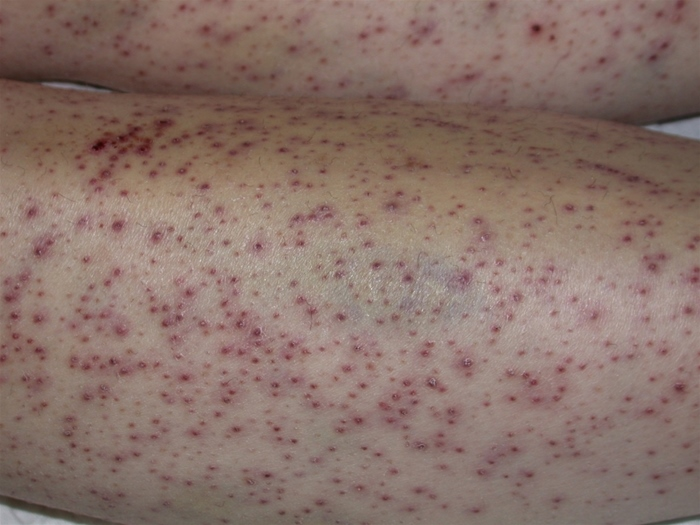 Muscles of the lower limbs are tender to palpation. Imaging studies reveal a tibial subperiosteal hematoma. Which of the following nutrient deficiencies is most likely responsible for this patient's symptoms?
 (Multiple Choice)
4.8/5 (85)
(85) A 46-year-old obese man is referred to a dietitian for evaluation of his food intake. He has been trying to lose weight but has been unsuccessful. The patient is 172.7 cm (5 ft 8 in) tall and weighs 113 kg (250 lb). Analysis of his food intake shows that he is consuming 3600 Calories a day. The dietitian recommends increasing physical activity and implementing a dietary plan. In the first phase, the patient is advised to reduce his daily dietary intake to 3,000 Calories, with 30% coming from protein. How much protein per day will this patient consume on the new dietary plan?
(Multiple Choice)
4.8/5 (84)
(84) A 24-year-old woman is admitted to the hospital with a diagnosis of acute appendicitis. She started having right lower quadrant abdominal pain approximately 30 hours earlier but did not go to the hospital because she thought the pain would subside on its own. The patient had no food, only sips of water, during that time. Blood pressure is 115/72 mm Hg and pulse is 106/min. Mucous membranes are dry and there is tenderness in the right lower quadrant of the abdomen. Laboratory evaluation shows mild leukocytosis, normal serum electrolytes, borderline low serum glucose levels, and moderate ketones in the urine. Based on the evaluation, it is suspected that this patient is utilizing ketone bodies as a significant reserve of energy. Which of the following tissues cannot use this energy source?
(Multiple Choice)
4.8/5 (93)
(93) A research scientist develops an agent that specifically blocks the interaction of inositol triphosphate with its intracellular receptor. A study is then performed in which vascular smooth muscle cells are divided into 2 groups: an experimental group treated with the receptor blocker and an untreated control group. Both groups are exposed to phenylephrine. Compared to the control cells, decreased activity of which of the following enzymes is most likely to be observed in the experimental cells?
(Multiple Choice)
4.9/5 (88)
(88) Foreign antigen recognition at the cell surface by cytotoxic T-lymphocytes stimulates a response that results in rapid cell death. Which of the following act as effectors of this response?
(Multiple Choice)
4.8/5 (75)
(75) A 4-day-old infant is brought to the emergency department with abnormal movements. The patient has had intermittent episodes of tonic posturing over the past 3 hours as well as poor feeding, vomiting, and irritability for the past 2 days. The mother also reports that his diapers smell like "caramelizing sugar." There are no known medical problems in the family, but the child's maternal aunt died "sometime in the first year" of life from unknown causes. Examination shows a lethargic infant with intermittent posturing episodes and increased generalized muscle tone. Laboratory studies of plasma and urine confirm the diagnosis. In addition to appropriate dietary restriction, supplementation with which of the following may improve this infant's condition?
(Multiple Choice)
4.9/5 (82)
(82) A 4-month-old boy is being evaluated for a hereditary metabolic disorder after presenting with failure to thrive and developmental delay. He was born outside the United States and had several seizures during the neonatal period. Physical examination reveals an abnormal head shape with a large anterior fontanelle and widely splayed cranial sutures. Profound hypotonia and hepatomegaly are also noted. Biochemical studies show elevated levels of very long chain fatty acids (VLCFAs) and phytanic acid. Cultured skin fibroblasts show impaired ability to oxidize VLCFAs. This patient's condition is best explained by dysfunction of which of the following cellular structures?
(Multiple Choice)
4.9/5 (89)
(89) A researcher is studying the structure of different hormone receptors. Receptor proteins are isolated and purified from a homogenized tissue sample. Detailed structural analysis shows that one of the proteins contains a 30-amino acid motif coordinating a zinc molecule, as shown in the image below. 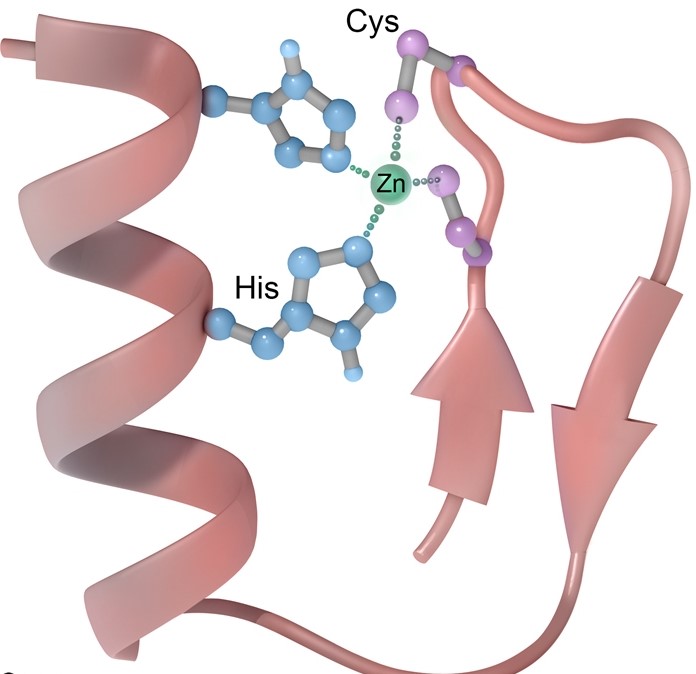 A receptor for which of the following hormones was most likely isolated in this experiment?
 (Multiple Choice)
4.8/5 (85)
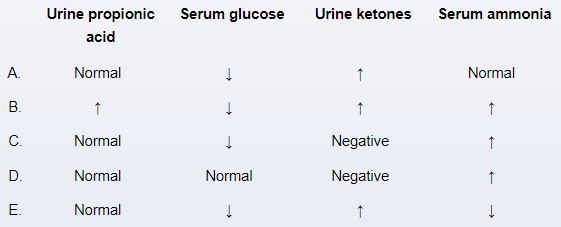
(85) A 4-day-old girl is brought to the office for a routine newborn visit. She was born at 39 weeks gestation via normal spontaneous vaginal delivery to a gravida 5 para 4 woman. The patient has been breastfed exclusively but has had increasing difficulty feeding over the past 24 hours. Her parents say that she is "too sleepy to feed" and has been vomiting. The infant has 3 healthy, living siblings and a brother who died in infancy from "low sugar in his blood." Physical examination shows tachypnea and signs of dehydration. The patient is responsive to painful stimuli only. After acute treatment and stabilization, urine testing reveals significantly elevated levels of methylmalonic acid. Which of the following sets of laboratory values would most likely result from this patient's condition?
(Multiple Choice)
4.9/5 (92)
(92) A couple comes to the clinic for preconception counseling. They are offered genetic screening because they are of Ashkenazi Jewish descent. Test results show that both are carriers for a lysosomal enzyme deficiency disorder that results in decreased metabolic degradation of a phospholipid substrate to ceramide, which leads to a buildup of the phospholipid. They are counseled about the chance that their offspring will be affected by this disorder. The couple wants to know the clinical features of an affected child. Which of the following findings would be most consistent with this condition?
(Multiple Choice)
4.9/5 (88)
(88) A 72-year-old woman is brought to the emergency department after lying on the floor in her home for the past 2 days. The patient's neighbor called police after phone calls were not answered and no one opened the door. She was found awake on the bathroom floor lying in feces and urine. The patient says she fell and injured her right hip and was unable to get up to call for help. She did not eat or drink anything during that time. On examination, the patient appears dehydrated and has right hip tenderness. Laboratory studies show serum glucose of 72 mg/dL and positive urine ketones. Radiographs of the right hip show a right femoral neck fracture. Increased activity of which of the following enzymes is most likely contributing to both the serum and urine laboratory findings?
(Multiple Choice)
4.8/5 (91)
(91) 
Filters
- Essay(0)
- Multiple Choice(0)
- Short Answer(0)
- True False(0)
- Matching(0)