



 Chat with AI
Exam 3: Biochemistry

Exam 1: Anatomy291 Questions
Exam 2: Behavioral science240 Questions
Exam 3: Biochemistry156 Questions
Exam 4: Biostatistics117 Questions
Exam 5: Embryology52 Questions
Exam 6: Genetics103 Questions
Exam 7: Histology24 Questions
Exam 8: Immunology129 Questions
Exam 9: Microbiology336 Questions
Exam 10: Pathology816 Questions
Exam 11: Pathophysiology464 Questions
Exam 12: Pharmacology538 Questions
Exam 13: Physiology272 Questions
Select questions type


A 27-year-old man is brought to the emergency department due to confusion. His roommate says that he has been binge drinking for the last 5 days and probably has had very little to eat. The patient's medical history is significant for alcohol-related seizures 1 year ago. He had been sober until 2 weeks ago, when he started drinking again. The patient's past medical history is otherwise unremarkable. On examination, he responds to voice but does not follow commands. Fingerstick glucose is 35 mg/dL and urine is strongly positive for ketones. Suppression of which of the following is the primary cause of this patient's hypoglycemia?
(Multiple Choice)
4.8/5  (69)
(69) A 5-year-old boy with developmental delay is brought to the office due to difficulty "seeing the board" at school. Examination shows a boy with a tall, thin habitus with elongated limbs. Funduscopy shows bilateral lens subluxation. Four years later, the patient dies suddenly of a massive cerebrovascular accident. Autopsy shows middle cerebral artery thrombosis and old renal infarcts. His parents wish to know if anything could have been done to have prevented his death. Which of the following would have been the most appropriate supplementation for this patient?
(Multiple Choice)
4.8/5 (80)
(80) Molecular biologists perform a series of experiments to characterize the electrophysiologic properties of human muscle cells. The resting membrane potential for an isolated muscle cell is determined to be -70 mV. The equilibrium potentials for important ions under normal physiologic conditions are as follows:ENa = + 60 mV
EK = - 90 mV
ECl = - 75 mV
ECa = + 125 mV
EMg = 0 mVIf physiologic conditions are maintained, which of the following ions would most likely flow out of the cell after opening of their respective ion channels?
(Multiple Choice)
4.7/5 (72)
(72) An 18-year-old girl with a history of type 1 diabetes mellitus comes to the emergency department after several hours of nausea, vomiting, and abdominal pain. The patient reports that she is on vacation visiting friends and has not taken insulin in the last 2 days. Physical examination shows breath with fruity odor and dry mucosal membranes. Laboratory studies show a blood glucose level of 452 mg/dL and high anion gap metabolic acidosis. Urinalysis is positive for ketones. It is determined that the patient's insulin deficiency is causing increased production of gluconeogenic precursors that are subsequently converted to glucose in the liver. Which of the following enzymes is most likely to provide these precursor substrates?
(Multiple Choice)
4.9/5 (86)
(86) An 8-month-old boy is evaluated for developmental delay, failure to thrive, and episodic seizures. Physical examination shows ophthalmoplegia and hypotonia. Laboratory studies reveal an elevated serum lactate level. Further histochemical studies show severely reduced pyruvate dehydrogenase enzyme activity in both freshly isolated peripheral blood lymphocytes and cultured fibroblasts. Increasing which of the following substances in his diet is most likely to help this patient generate energy without further elevating lactate levels?
(Multiple Choice)
4.9/5 (68)
(68) Molecular biologists studying signal transduction apply an agent to human cells that activates G-protein- dependent phospholipase C. Which of the following intracellular substances is most likely to increase immediately after exposure to this agent?
(Multiple Choice)
4.9/5 (92)
(92) An 18-month-old boy is brought to the office due to language regression. He said several words at his 1-year appointment but now no longer speaks any words at all. His moods have also become more unpredictable over the past 4 months with frequent tantrums. The parents tried to bring him in sooner for evaluation, but they live in an impoverished part of the city and experienced financial difficulties with transportation to the office. On physical examination, the boy is quiet and maintains appropriate eye contact throughout the visit. Hemoglobin is 9 g/dL. Which of the following enzymes is most likely inhibited in this patient?
(Multiple Choice)
4.8/5 (60)
(60) An infant born to a Greek immigrant appears healthy at birth but develops transfusion-dependent hemolytic anemia by the age of 6 months. His erythrocytes contain insoluble aggregates of hemoglobin subunits. The child developed normally in utero because at that time he produced high quantities of:
(Multiple Choice)
4.8/5 (84)
(84) A 54-year-old woman is evaluated for progressive constipation, anorexia, and a 5.4-kg (12-lb) weight loss over the past several months. Physical examination is unremarkable. Stool guaiac test is positive, and a colonoscopy is performed. An exophytic mass is identified in the sigmoid colon. The patient undergoes a left hemicolectomy, and histopathology of the surgical specimen is positive for adenocarcinoma. Molecular testing of the cancer cells reveals a mutation in the KRAS gene that results in constitutive activation of the Ras protein. Under normal circumstances, this protein is only active when bound to which of the following substances?
(Multiple Choice)
4.8/5 (94)
(94) A 40-year-old woman comes to the office with a 3-month history of progressively limited physical activity due to fatigue. The patient says, "I could barely walk from my car to the office." Medical history is significant for a positive tuberculin skin test 7 months ago with a normal chest radiograph. She has been compliant with the prescribed treatment despite its bitter taste. Physical examination shows a tired-appearing woman with conjunctival and palmar pallor. Complete blood count is as follows: 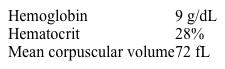 A bone marrow aspirate representative of this patient's disease process is shown below (Prussian blue stain).
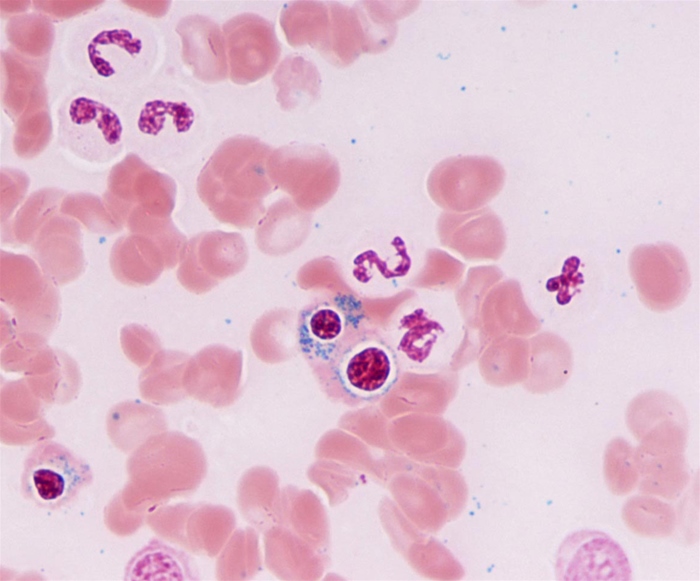 Decreased activity of which of the following enzymes most likely explains the anemia found in this patient?
A bone marrow aspirate representative of this patient's disease process is shown below (Prussian blue stain). Decreased activity of which of the following enzymes most likely explains the anemia found in this patient? (Multiple Choice)
4.9/5 (70)
(70) A 13-year-old girl is undergoing hematologic evaluation. She is found to have a hemoglobin mutation that changes the partial pressure of oxygen at which hemoglobin is 50% saturated to 20 mm Hg. In comparison, normal hemoglobin becomes 50% saturated with oxygen at 26 mm Hg. Which of the following sequelae is this patient most likely to develop as a result of her mutation?
(Multiple Choice)
4.7/5 (82)
(82) A 6-year-old African American male is brought to your office for a routine check-up. His mother remarks that he often seems uninterested in playing with his peers and appears to "run out of breath quickly." His medical records reveal that he has missed several pediatric vaccinations and has been hospitalized twice, once with a "chest infection" and once with abdominal pain. The patient mentions to you that occasionally his "bones hurt." Which of the following protein changes most likely accounts for this patient's condition?
(Multiple Choice)
4.8/5 (80)
(80) As part of a long-term cohort study, members of a large extended family undergo periodic analysis of multiple serum markers. Many male participants are found to have abnormal laboratory results despite no obvious signs of disease. Further analysis shows that these men have an X-linked mutation affecting the phosphoribosyl pyrophosphate (PRPP) synthetase gene, resulting in greatly increased substrate conversion.Which of the following organs is most likely to develop pathology secondary to this mutation?
(Multiple Choice)
4.8/5 (63)
(63) A 2-year-old boy is evaluated for easy bruising. His parents report that he develops marked bruising and open wounds following minor trauma. The skin is difficult to suture due to its extreme fragility. Physical examination reveals hyperextensible skin, multiple ecchymoses over the forearms and pretibial regions, and an umbilical hernia. A skin biopsy is performed, and histochemical evaluation of the biopsy reveals a defect in extracellular processing of collagen. Which of the following steps of collagen synthesis is most likely impaired in this patient?
(Multiple Choice)
4.9/5 (71)
(71) A 14-year-old boy is brought to the emergency department after accidental ingestion of a chicken bone that lodged in his esophagus. Upper endoscopy is performed and the bone is successfully removed. However, the patient is incidentally found to have mild hypercalcemia on laboratory testing. On follow-up with his primary care provider 2 weeks later, he has no symptoms and clinical examination is unremarkable. Further questioning reveals that several of his family members also have mild hypercalcemia. Subsequent laboratory studies show a borderline high parathyroid hormone concentration, very low urinary calcium level, and normal 25-hydroxyvitamin D level. A mutation in which of the following receptors is most likely responsible for this patient's laboratory abnormalities?
(Multiple Choice)
4.8/5 (81)
(81) A 78-year-old man comes to the office due to a one-month history of progressive dyspnea, generalized weakness, fatigue, and palpitations. He also reports tingling and numbness in both lower limbs. His daughter, who is visiting from another state, adds that since his wife's death a year ago, the patient has not been taking care of himself. Blood pressure is 105/50 mm Hg and pulse is 104/min. Cardiovascular examination shows a displaced apical impulse at the sixth intercostal space, a third heart sound, and high-volume, collapsing carotid pulses. Bilateral basal crackles, 2+ bilateral pedal edema, and mild hepatomegaly are also present. Neurologic examination shows decreased light touch and vibration sense in the feet, with decreased knee and ankle reflexes bilaterally. Laboratory evaluation shows normal blood counts. Deficiency of which of the following nutrients is most likely responsible for this patient's symptoms?
(Multiple Choice)
4.9/5 (88)
(88) A 34-year-old woman with a history of recurrent urinary tract infections comes to the physician with dysuria and increased urinary frequency. Her urine culture grows colonies of Gram-negative bacteria. The bacteria are isolated and placed in a growth-enhancing nutrient solution, where they undergo rapid cellular division. As they are actively dividing, the bacterial cells are lysed and their DNA is extracted and purified. Analysis of the partially replicated DNA fragments shows the presence of uracil. This finding is most likely mediated by which of the following enzymes?
(Multiple Choice)
4.9/5 (72)
(72) Biologists investigating the morphologic changes associated with reversible cellular injury perform a procedure on anesthetized mice to assess the effects of transient hepatic ischemia. During the experiment, they clamp the hepatic artery and obtain liver biopsy samples at varying intervals. The samples are then examined by electron microscopy. Cells that are exposed to longer ischemic periods are found to have reduced numbers of ribosomes attached to the endoplasmic reticulum. This structural change is most likely to impair which of the following cellular functions?
(Multiple Choice)
4.8/5 (85)
(85) A 4-day-old boy born to a 23-year-old woman is brought to the office for evaluation of poor feeding and vomiting. The pregnancy was uneventful and the mother had a normal delivery. Family history is noncontributory. The patient's temperature is 37.2 C (99 F), blood pressure is 60/30 mm Hg, pulse is 110/min, and respirations are 56/min. Physical examination reveals a lethargic newborn with exaggerated deep tendon reflexes and clonus. Further investigation reveals that the patient has an inherited condition that results in impaired transport of ornithine from the cytosol to the mitochondria. Nutritional restriction of which of the following substances can improve this patient's condition?
(Multiple Choice)
4.8/5 (88)
(88) Researchers analyzing eukaryotic genome structure and function perform an experiment to extract DNA from exocrine pancreatic cells. During the purification process, they isolate small circular DNA molecules that resemble a bacterial chromosome. Further analysis shows that these molecules code for proteins, transfer RNA, and ribosomal RNA. From which of the following cellular structures did these DNA molecules most likely originate? 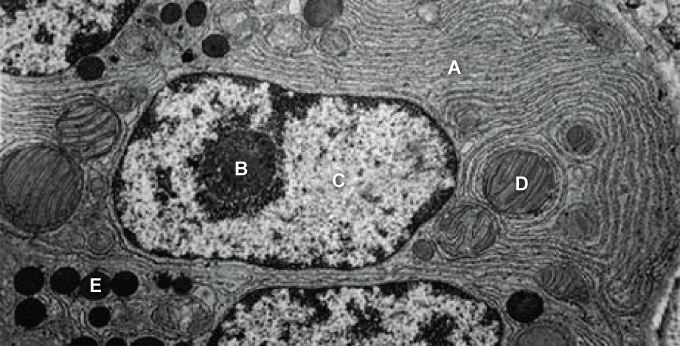
(Multiple Choice)
4.9/5 (77)
(77) 
Filters
- Essay(0)
- Multiple Choice(0)
- Short Answer(0)
- True False(0)
- Matching(0)