



 Chat with AI
Exam 12: Pharmacology

Exam 1: Anatomy291 Questions
Exam 2: Behavioral science240 Questions
Exam 3: Biochemistry156 Questions
Exam 4: Biostatistics117 Questions
Exam 5: Embryology52 Questions
Exam 6: Genetics103 Questions
Exam 7: Histology24 Questions
Exam 8: Immunology129 Questions
Exam 9: Microbiology336 Questions
Exam 10: Pathology816 Questions
Exam 11: Pathophysiology464 Questions
Exam 12: Pharmacology538 Questions
Exam 13: Physiology272 Questions
Select questions type


A 53-year-old man comes to the physician for a follow-up visit after an acute myocardial infarction. His medications include metoprolol and low-dose aspirin. He used to smoke 2 packs of cigarettes daily but quit after his myocardial infarction. The patient's father has hypertension and his mother has type 2 diabetes mellitus. He currently weighs 100 kg (220 lb) and is 178 cm (70 in) tall. Examination shows an obese male with no other abnormalities. His total serum cholesterol level is 155 mg/dL, with an HDL level of 27 mg/dL and a triglyceride level of 92 mg/dL. Which of the following lipid-lowering agents would be most effective for preventing future cardiovascular events in this patient?
(Multiple Choice)
4.8/5  (87)
(87) A 42-year-old man comes to the office due to increased abdominal girth associated with a 9-kg (19.8-lb) weight gain over the past month. He drinks a liter of vodka daily and denies smoking or using intravenous drugs. Blood pressure is 110/70 mm Hg. The abdomen is moderately distended, and a fluid wave is elicited. Multiple spider angiomas are present. Laboratory studies reveal thrombocytopenia, hypoalbuminemia, a normal sodium level, and an elevated PT. An upper endoscopy is performed, which shows no esophageal or gastric varices. Pharmacotherapy aimed at inhibiting which of the following should be considered for this patient?
(Multiple Choice)
4.8/5 (84)
(84) A 34-year-old man comes to the emergency department due to recurrent fevers, chills, and excessive sweating. The symptoms began a few days ago and seem to occur every 48 hours. The patient recently returned from a trip to India. Temperature is 38.6 C (101.5 F). Physical examination is otherwise unrevealing. Laboratory studies are notable for anemia and thrombocytopenia. A blood smear with Giemsa staining demonstrates red blood cell inclusions. The patient is prescribed chloroquine and primaquine. The addition of primaquine to the treatment regimen is most likely to have which of the following effects?
(Multiple Choice)
4.9/5 (77)
(77) A 61-year-old man comes to the hospital due to 2 days of right leg swelling. He recently flew back to the United States from Japan, where he was visiting his daughter who is spending a semester abroad. The patient has a medical history of hypertension and hyperlipidemia. Temperature is 37.2 C (99 F), blood pressure is 136/70 mm Hg, and pulse is 90/min. Pulse oximetry shows 99% on room air. Cardiopulmonary examination is within normal limits. There is tenderness and swelling of the right lower extremity up to the mid thigh. Laboratory studies, including prothrombin time and activated partial thromboplastin time, are normal. Venous doppler reveals an occluding thrombus in the right femoral and popliteal veins. The patient is started on rivaroxaban. This drug inhibits which of the following?
(Multiple Choice)
4.8/5 (81)
(81) A 5-year-old boy is brought to the emergency department due to recurrent, generalized tonic-clonic seizures over the past 24 hours. The patient has been having high fever and flulike symptoms for the past 3 days. He has a past medical history of febrile seizures at age 6 months. He takes no medications and has no family history of epilepsy. The patient's temperature is 39.4 C (103 F), blood pressure is 110/70 mm Hg, pulse is 112/min, and respirations are 10/min. He appears lethargic and does not follow simple commands consistently. His neck is supple. During the examination, the patient suddenly develops sustained, generalized tonic-clonic convulsions without fully regaining consciousness between episodes. Which of the following describes the mechanism of action of the most appropriate initial therapy for his seizures?
(Multiple Choice)
4.9/5 (71)
(71) A 66-year-old man comes to the office for follow-up of metastatic prostate cancer. He was diagnosed 12 months ago, when he was found to have a single bony metastasis. The patient declined orchiectomy and was treated with a long-acting gonadotropin-releasing hormone agonist. While on this therapy, he developed nocturnal pain in the area of the bony metastasis and was found to have a rising level of prostate-specific antigen. Flutamide was then added to his initial therapy and led to significant pain relief and a decrease in the size of the primary tumor. Which of the following mechanisms is the best explanation for the effects of flutamide in this patient?
(Multiple Choice)
4.8/5 (78)
(78) A 58-year-old man with type 2 diabetes mellitus comes to the emergency department with fever, malaise, lower abdominal discomfort, and left flank pain. The patient has a history of diabetic autonomic neuropathy with bladder dysfunction and has been hospitalized multiple times for recurrent urinary tract infections. His temperature is 39.4 C (103 F), blood pressure is 94/50 mm Hg, and pulse is 118/min. Height is 180 cm (5 ft 11 in), weight is 150 kg (331 lb), and BMI is 46 kg/m2. On examination, there is suprapubic and left costovertebral angle tenderness. After review of culture and sensitivity tests from his prior hospitalization, the patient is started on an empiric antibiotic regimen that includes an aminoglycoside. While calculating the appropriate dosage, the hospital pharmacy uses an adjusted body weight that is lower than the patient's actual body weight. Which of the following best explains the use of this adjusted parameter?
(Multiple Choice)
4.8/5 (73)
(73) A 56-year-old man comes to the emergency department due to palpitations and lightheadedness over the last 2 hours. He has a history of hypertension but no other cardiac conditions and never before had similar symptoms. The patient drinks 1 to 2 alcoholic beverages daily but does not smoke cigarettes or use illicit drugs. Blood pressure is 132/76 mm Hg and pulse is 116/min and irregular. Cardiopulmonary examination is normal, except for tachycardia. Resting ECG shows atrial fibrillation. The patient undergoes transesophageal echocardiography, which reveals normal cardiac anatomy and no intracardiac thrombi. Electrical cardioversion is performed. After the intervention, sinus rhythm is restored, and amiodarone therapy is begun to maintain normal sinus rhythm. Which of the following cardiac electrophysiologic changes are most likely to occur in this patient due to the medication?
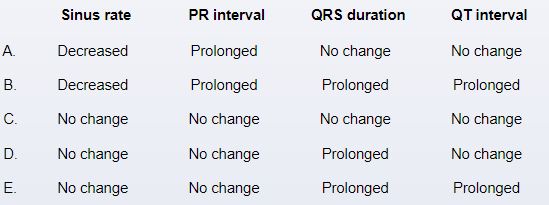
(Multiple Choice)
4.8/5 (93)
(93) A 39-year-old woman comes to the office due to a nagging cough. Two weeks ago, the patient had a mild upper respiratory illness which resolved spontaneously after several days. Since then, she has had cough that is productive of minimal clear sputum. The patient has had no shortness of breath or chest pain. She took unexpired, leftover dextromethorphan for 2 days. The patient's only other medical condition is major depression, for which she takes sertraline. She does not use tobacco, alcohol, or illicit drugs. Vital signs and physical examination show no abnormalities. Use of dextromethorphan is most concerning for which of the following in this patient?
(Multiple Choice)
5.0/5 (80)
(80) A 24-year-old man comes to the emergency department due to a persistent, painful erection that has lasted for more than 8 hours. He had 3 similar episodes in the past 2 years that were less than 30 minutes in duration and resolved with ice packs at home. The patient has had no trauma to the perineal or genital area. He has no other medical conditions and takes no prescription, over-the-counter, or herbal medications. The patient does not use tobacco, alcohol, or illicit drugs. Temperature is 37 C (98.6 F), blood pressure is 124/82 mm Hg, pulse is 84/min, and respirations are 16/min. Examination shows an engorged corpora cavernosa and a rigid, tender penis. The testicles are normal, and the remainder of the examination shows no abnormalities. Penile injection with a medication having which of the following mechanisms would most likely relieve this patient's symptoms?
(Multiple Choice)
4.7/5 (85)
(85) A 70-year-old man comes to the office due to increasing headaches, nausea, and vomiting. The patient has never had these symptoms before. Medical history is significant for a transient ischemic attack that led to a right carotid endarterectomy 5 years ago. He has no other medical conditions, and his only medications are aspirin and atorvastatin. The patient smoked a pack of cigarettes a day for 20 years but quit 20 years ago. Blood pressure is 220/120 mm Hg and pulse is 70/min. Neurologic examination shows no focal lesions. Bilateral abdominal bruits are present. Blood testing in this patient would most likely show which of the following?
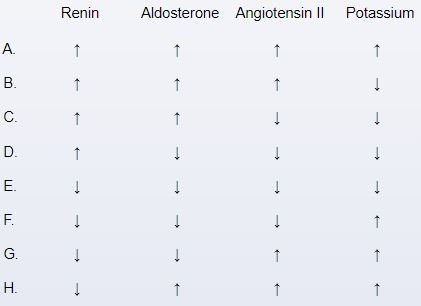
(Multiple Choice)
4.9/5 (82)
(82) A 45-year-old woman is hospitalized due to severe Pneumocystis pneumonia. The patient has a history of injection drug use and was diagnosed with HIV 10 years ago. She does not adhere to antiretroviral therapy and has developed resistance to multiple antiretroviral medications. Laboratory evaluation reveals severe immunosuppression with a high HIV viral load. After the patient is adequately treated for pneumonia, HIV genotypic analysis is performed. The viral isolates are found to have a mutation in the variable (V3) region of the env gene, which makes the virus capable of infecting T cells with a specific surface receptor, but infection of macrophages is inefficient. Which of the following antiretroviral medications is most likely to be ineffective in this patient?
(Multiple Choice)
4.8/5 (75)
(75) A 52-year-old woman comes to the office due to episodic incontinence for the last several months. She states that these episodes occur almost every day and are very embarrassing. They begin as an urge to urinate, and most of the time she cannot make it to the bathroom before urinating on herself. Physical examination, including pelvic examination, is unremarkable. A urinalysis is within normal limits. Urodynamic evaluation is significant for detrusor instability. Initial non-pharmacologic measures are unsuccessful and pharmacologic therapy is considered. The appropriate treatment for this patient's condition includes an agent with which of the following effects?
(Multiple Choice)
4.9/5 (87)
(87) A 57-year-old man is seen in the office after an episode of acute pancreatitis. Hospital evaluation found no evidence of gallstones. The patient does not consume alcohol, but he does have a history of severe hypertriglyceridemia. He was treated with a fibrate medication in the past but could not tolerate it due to liver toxicity. He has no history of diabetes mellitus or hypertension. On examination, the patient has no abdominal tenderness. Laboratory studies show normal hepatic and pancreatic enzyme levels, but the patient again has a severely elevated triglyceride level. The physician prescribes the appropriate medications and explains that the patient is likely to experience skin flushing and warmth after taking the pills. Which of the following is the primary agent mediating these side effects?
(Multiple Choice)
4.9/5 (85)
(85) A 62-year-old woman comes to the office due to a month of progressive right chest and back pain. The patient also noticed a right breast lump several months ago, which has grown over time. She has no prior medical issues, has not seen a physician for many years, and has had no cancer screenings. Physical examination reveals a hard, 5-cm right breast mass, enlarged axillary lymph nodes, and point tenderness along the right-sided ribs and 10th thoracic vertebra. Biopsy of the breast mass shows hormone receptor-positive, HER2-negative, invasive ductal carcinoma. Skeletal survey demonstrates lytic lesions of the ribs and thoracic vertebrae. As part of the treatment regimen, the patient receives a medication that is a potent inhibitor of cyclin-dependent kinase. Which of the following is the most likely dose-limiting toxicity of this medication?
(Multiple Choice)
4.8/5 (85)
(85) A 25-year-old previously healthy man comes to the office due to penile lesions. The patient first noticed a nontender papule on his penis a month ago, and it has progressively increased in size and number. He reports no fever, dysuria, or penile discharge. The patient is sexually active with multiple partners and uses condoms inconsistently. Physical examination reveals 3 soft, flesh-colored, papillary lesions measuring <1 cm on the dorsum of the penis. There are no enlarged inguinal lymph nodes, and the remainder of the examination is normal. Treatment is started with a topical agent that acts as a toll-like receptor agonist to increase antiviral cytokine production. Which of the following medications was most likely prescribed to this patient?
(Multiple Choice)
4.7/5 (77)
(77) Researchers are developing a new glycopeptide antibiotic similar to vancomycin. Susceptibility testing reveals that the new drug is bactericidal against gram-positive organisms at serum concentrations above 15 µg/mL. Two different dosage regimens are developed to achieve a target serum trough concentration of 15-20 µg/mL: one administered as 1 gram every 6 hours and the other as 2 grams every 12 hours. The two regimens are tested in healthy volunteers during an early-phase clinical trial, and the following pharmacokinetic profiles are obtained. 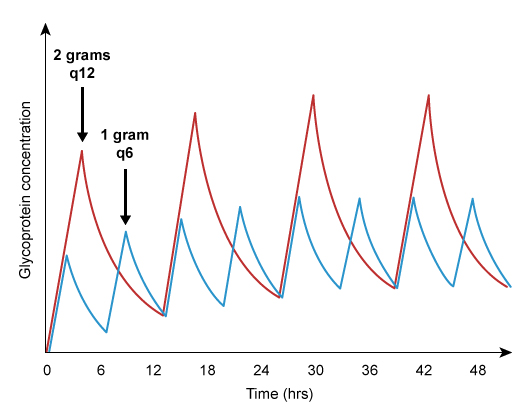 Compared to the 12-hour dosing regimen, the 6-hour regimen is most likely to exhibit which of the following features?
 (Multiple Choice)
4.8/5 (87)
(87) A 42-year-old man is brought to the emergency department due to nausea, vomiting, and blurred vision. He was making his own whiskey with a home moonshine still and started feeling sick after sampling the first several ounces of distillate. Funduscopic evaluation reveals optic disc hyperemia. Laboratory results show a high anion gap metabolic acidosis. It is determined that the patient's symptoms are due to enzymatic conversion of methanol into formate by alcohol dehydrogenase. He is started on fomepizole, a medication that transiently binds to alcohol dehydrogenase and prevents methanol from accessing the enzyme's active site. Which of the following graphs most accurately portrays the change in enzyme kinetics after administration of the antidote?(Black curves = before treatment)
(Multiple Choice)
4.8/5 (94)
(94) A 58-year-old woman comes to the office with new-onset low back pain. The patient was helping her friend move yesterday and strained her back. She does not drink alcohol or use illicit substances. Medical history includes hypertension and major depressive disorder currently treated with captopril and citalopram. A short course of medication is prescribed, and the patient is asked to monitor for development of diaphoresis, restlessness, tremors, and diarrhea. The patient was most likely prescribed which of the following medications?
(Multiple Choice)
4.8/5 (68)
(68) A 55-year-old man comes to the emergency department with recurrent episodes of retrosternal chest pain. The episodes occur during physical activity, usually when he climbs stairs or walks uphill. The patient has no known medical problems and does not use tobacco, alcohol, or illicit drugs. He is given a sublingual tablet and reports rapid relief of the pain. This drug most likely improved this patient's symptoms by causing which of the following hemodynamic changes?
(Multiple Choice)
4.8/5 (79)
(79) 
Filters
- Essay(0)
- Multiple Choice(0)
- Short Answer(0)
- True False(0)
- Matching(0)