



 Chat with AI
Exam 12: Pharmacology

Exam 1: Anatomy291 Questions
Exam 2: Behavioral science240 Questions
Exam 3: Biochemistry156 Questions
Exam 4: Biostatistics117 Questions
Exam 5: Embryology52 Questions
Exam 6: Genetics103 Questions
Exam 7: Histology24 Questions
Exam 8: Immunology129 Questions
Exam 9: Microbiology336 Questions
Exam 10: Pathology816 Questions
Exam 11: Pathophysiology464 Questions
Exam 12: Pharmacology538 Questions
Exam 13: Physiology272 Questions
Select questions type


A 44-year-old man comes to the office due to paresthesia and pain in his feet. The patient began experiencing tingling and numbness in his toes several months ago, which gradually progressed to the rest of both feet. He has also had burning pain on the soles, which frequently disrupts his sleep at night. The patient has a 6-year history of HIV infection. He was not adherent to treatment initially but now takes antiretroviral therapy regularly. His most recent CD4 cell count was 550/mm3. Vital signs are within normal limits. Foot examination shows decreased pain and touch sensation and loss of ankle reflexes bilaterally. There are no other focal neurologic deficits. Medication review shows no neurotoxic drugs and laboratory studies are within normal limits. Treatment with duloxetine is planned. This medication is most likely to improve this patient's symptoms via which of the following mechanisms?
(Multiple Choice)
4.8/5  (86)
(86) A 60-year-old man comes to the office for follow-up due to persistent atrial fibrillation. He reports occasional palpitations and poor exercise tolerance. For the past year, the patient's atrial fibrillation has been managed with a rate-control strategy using metoprolol. Three months ago, his metoprolol dosage was increased for improved rate control, but today in the office, he reports that he was unable to tolerate the new dosage due to dizziness. Blood pressure is 110/70 mm Hg and pulse is 105/min and irregular. Examination shows no abnormalities. Echocardiography reveals left atrial enlargement, an ejection fraction of 59%, and no significant valvular disease. The patient is advised to remain on his previously tolerated metoprolol dose, and digoxin is added to the medication regimen. Four weeks later, he reports symptom improvement. Resting pulse is 84/min and irregular. Which of the following best explains digoxin's effect on heart rate in this patient?
(Multiple Choice)
5.0/5 (75)
(75) A 71-year-old woman comes to the office for follow-up. She has a history of systolic heart failure and was hospitalized 2 weeks ago for an exacerbation, which was treated with intravenous diuretics. Since discharge the patient has been taking oral diuretics and says her shortness of breath has improved, but she is now experiencing muscle weakness and cramping. Blood pressure is 128/72 mm Hg and pulse is 80/min. Physical examination shows mildly decreased muscle strength in the lower extremities. Laboratory evaluation reveals a serum potassium level of 2.2 mEq/L. The patient receives potassium supplements, which improve the weakness. Another diuretic is added to her medical regimen to help prevent this adverse effect in the future. This additional medication predominantly acts on which of the following nephron segments? 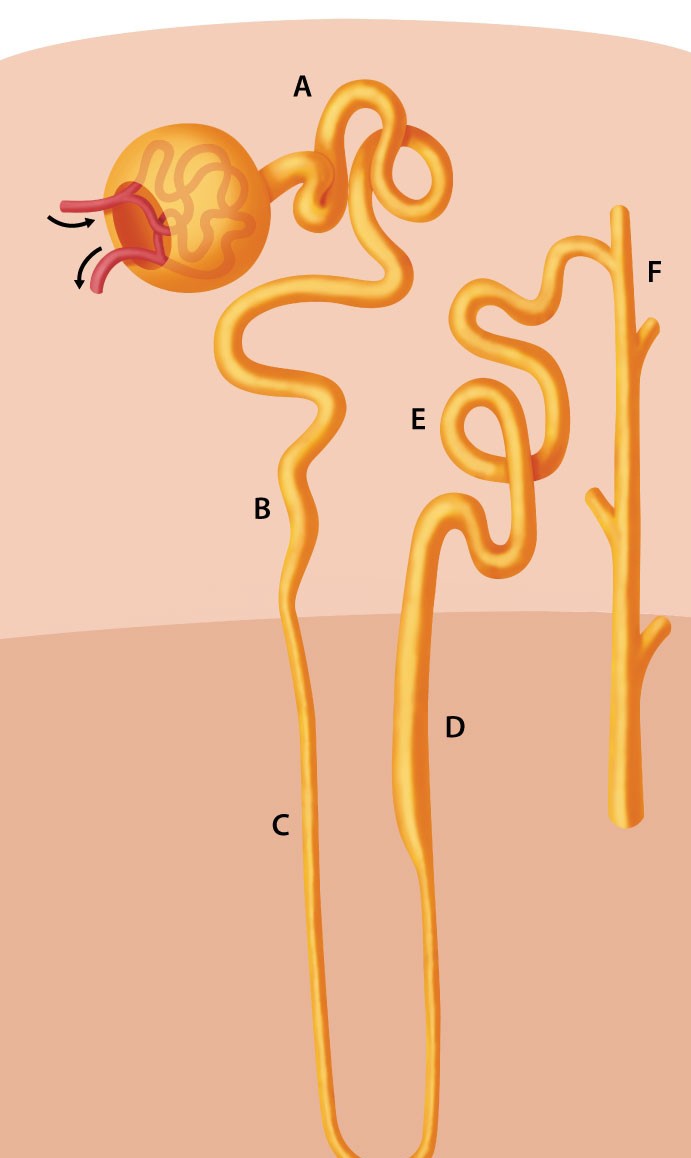
(Multiple Choice)
4.9/5 (76)
(76) A 65-year-old man with type 2 diabetes mellitus comes to the office due to decreased sexual performance over the last 6 months. The patient says his libido, muscle strength, and energy level are normal, but his erections are inconsistent, weak, and of inadequate duration for sexual activity. Past medical history is positive for hypertension, but he has no history of coronary artery disease and no suspicious chest pain. Bilateral ankle brachial index testing is within normal limits. The patient is treated with sildenafil, which gives significant improvement in his sexual performance. The intracellular signaling of this drug is most similar to that of which of the following substances?
(Multiple Choice)
4.8/5 (81)
(81) A newborn boy is in the neonatal intensive care unit for mechanical ventilation due to pulmonary hypoplasia. He was born via spontaneous vaginal delivery at 30 weeks gestation to a 41-year-old woman who did not receive prenatal care. The mother had assumed her amenorrhea was due to early menopause, which runs in her family. She took multiple medications for poorly controlled hypertension before realizing she was pregnant. Prenatal ultrasound demonstrated severe oligohydramnios for which delivery was induced. Examination of the infant shows an intubated and sedated boy whose weight is at the third percentile. The temporal, occipital, and parietal bones are underdeveloped, and the right lower limb is shortened and contracted. Which of the following mechanisms is the most likely cause of this neonate's abnormalities?
(Multiple Choice)
4.9/5 (79)
(79) A 48-year-old woman comes to the office due to lower extremity discomfort. The patient reports no pain but describes an uncomfortable sensation in her legs, particularly in the evening and at night. The symptoms are relieved by leg movements or walking. She reports no behavioral or mood changes. The patient intermittently experiences mild migraines, and during a recent episode, antiemetic therapy worsened the leg discomfort. She has no other medical conditions and does not use tobacco, alcohol, or illicit drugs. Vital signs are within normal limits, and physical examination shows no abnormalities. Blood cell counts, serum chemistry studies, and serum iron levels are within normal limits. Pharmacotherapy with which of the following mechanisms of action is most likely to relieve this patient's symptoms?
(Multiple Choice)
4.7/5 (92)
(92) A 62-year-old man comes to the office for follow-up of hypertension. He was diagnosed with hypertension 10 years ago and has been treated with a number of different medications. However, the patient has had to discontinue several medications due to side effects such as dizziness, palpitations, and headaches. Currently he takes ramipril and chlorthalidone and is tolerating them well. Blood pressure is 160/92 mm Hg and was 158/89 mm Hg at his most recent prior visit. ECG shows sinus bradycardia (55/min) with PR interval prolongation (280 msec). Which of the following medications would be most effective for lowering this patient's blood pressure without worsening his ECG abnormalities?
(Multiple Choice)
4.7/5 (74)
(74) A 64-year-old man with a long-standing history of hypertension is brought to the emergency department with a dry cough and shortness of breath. The patient has been unable to sleep in the flat position for the past 2 days. Blood pressure is 192/102 mm Hg and pulse is 92/min and regular. Physical examination reveals an S4 and bibasilar crackles. He is started on intravenous nitroglycerin infusion and soon after reports significant symptomatic relief. Which of the following physiologic changes are most likely to occur following administration of this medication?
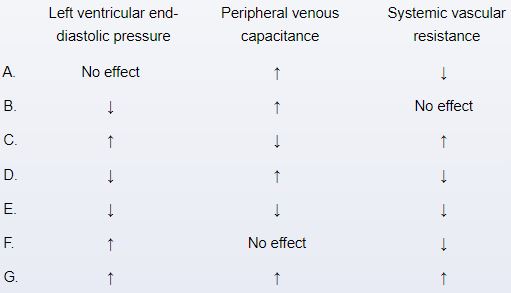
(Multiple Choice)
4.8/5 (70)
(70) A 42-year-old previously healthy man comes to the office due to an enlarging mole. The patient has had a mole on his forearm for the past several years, and it has rapidly increased in size over the past 4 months. Physical examination shows an 8-mm raised lesion with variegated pigmentation and ill-defined borders on the right forearm. Excisional biopsy of the lesion is planned. Local anesthesia is administered via an infiltrating injection of lidocaine mixed with epinephrine. Which of the following is the most likely impact of mixing the latter medication with the anesthetic agent?
(Multiple Choice)
4.8/5 (76)
(76) A 39-year-old woman is brought to the emergency department after her husband found her confused. The patient was unable to answer questions about why she did not go to work that day and could not remember the day of the week. She has a history of bipolar disorder and has taken the same dose of lithium for the past 10 years. Over the past week, the patient started taking several daily doses of a new medication following a dental extraction. Yesterday, she felt nauseated and vomited twice, and earlier today, she started having diarrhea. Vital signs are within normal limits. The patient is alert and oriented to self only. The abdomen is soft and nontender with increased bowel sounds. Coarse tremors are noted in the upper extremities. Deep tendon reflexes are 2+ in the bilateral extremities. Gait is mildly ataxic. A drug interaction involving which of the following medications is most likely causing this patient's symptoms?
(Multiple Choice)
4.9/5 (65)
(65) A 35-year-old man comes to the physician because of a 2-week history of nasal congestion. He has used a topical decongestant every few hours since his symptoms began. He experienced relief for almost 1 week, but then his nasal congestion returned. The patient has a history of allergic rhinitis and has had episodes of rhinorrhea in the past, but none of them lasted longer than a few days. He denies fever, throat pain, headaches, cough, and lymph node enlargement. Aside from his allergic rhinitis, the patient has no other medical problems. Physical examination shows nasal mucosa that appears edematous and red with a few areas of punctate bleeding. The remainder of the examination reveals no abnormalities. Which of the following is the most appropriate next step in the management of this patient?
(Multiple Choice)
4.9/5 (83)
(83) A 24-year-old man is hospitalized after a violent episode in which he destroyed his television with a baseball bat. Over the past year, the patient was convinced that people on television were monitoring his thoughts and movements and that certain newscasters were laughing at him. At night, he was unable to sleep and reported hearing the voices of demons threatening to kill him. The patient was diagnosed with schizophrenia and initially treated with chlorpromazine. He now is reluctant to take the medication, saying, "I don't like how it makes me feel." His medication is subsequently changed to fluphenazine. Compared to the patient's initial treatment, fluphenazine is more likely to cause which of the following?
(Multiple Choice)
4.8/5 (80)
(80) A 43-year-old man comes to the office due to occasional dyspnea that awakens him at night. This symptom started approximately a year ago after a severe upper respiratory tract infection, and since then he has also had an episodic cough. The patient has no other medical problems and takes no medications. He has no drug allergies and does not use tobacco, alcohol, or illicit drugs. His older brother has atopic dermatitis. Vital signs are normal. Lung auscultation reveals bilateral normal breath sounds with no wheezing or crackles. Heart sounds are normal, and there is no extremity edema. Pulmonary function tests are as follows:  Administration of which of the following medications would be most useful during further diagnostic evaluation of this patient?
 (Multiple Choice)
4.7/5 (85)
(85) A 68-year-old man comes to the office due to thigh and leg pain that worsens with exertion. He is unable to walk through the local mall with his wife without discomfort. Past medical history is significant for hypertension and diabetes mellitus. The patient smokes 2 packs of cigarettes a day and consumes alcohol occasionally. Physical examination of the extremities shows weak dorsalis pedis pulses in both feet. Further evaluation confirms moderate peripheral arterial disease involving both lower extremities. Which of the following drugs would best provide symptomatic improvement due to direct dilation of arteries and inhibition of platelet aggregation?
(Multiple Choice)
4.9/5 (79)
(79) A 78-year-old woman comes to the office due to fever, headache, sore throat, cough, and severe myalgias for 24 hours. Her medical problems include hypertension and Alzheimer dementia. Her family came to visit over the weekend, and her grandson had symptoms of a cold. The patient's temperature is 38.9 C (102 F). Lung examination is unremarkable. A nasal specimen swab is positive for influenza. The patient is started on oseltamivir. Which of the following is most likely impaired in the patient's infected cells as a result of the treatment?
(Multiple Choice)
4.8/5 (76)
(76) A 53-year-old man comes to the office due to uncontrolled type 2 diabetes mellitus. Three years ago, the patient was diagnosed with diabetes and started on metformin and lifestyle modification. In the past year, his hemoglobin A1c level has been steadily rising. Blood pressure is 145/90 mm Hg. BMI is 37 kg/m2. Laboratory results are normal except for a fasting plasma glucose of 155 mg/dL and a hemoglobin A1c level of 8%. Additional treatment with canagliflozin is initiated. Over the next several days, which of the following changes are most likely to occur in this patient due to the new medication?
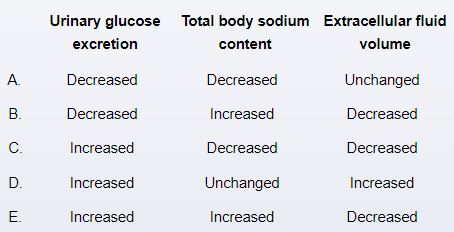
(Multiple Choice)
4.9/5 (77)
(77) A 58-year-old man comes to the emergency department due to wound dehiscence. The patient had a left subclavian catheter port placed 3 months ago to begin bevacizumab infusions for recurrent glioblastoma. The incision wound closed completely but has now partially reopened. Vital signs are normal. Examination of the left side of the chest reveals that 50% of the incision has opened; subcutaneous tissue and part of the port are visible, but there is no drainage from the wound or erythema of the surrounding skin. A complication of bevacizumab is suspected. Which of the following is the most likely primary mechanism of this patient's wound dehiscence?
(Multiple Choice)
4.7/5 (74)
(74) A 72-year-old woman is brought to the emergency department due to severe shortness of breath, tachypnea, and pleuritic-type chest pain. She had a similar episode 3 weeks ago and has been treated with warfarin since then. The patient has several other medical conditions and is taking all her medications as recommended. On examination, her temperature is 36.7 C (98 F), blood pressure is 120/60 mm Hg, pulse is 118/min, and respirations are 28/min. Pulse oximetry is 93% on room air. Laboratory results are notable for the following: 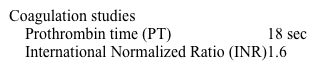 The patient's INR is subtherapeutic compared to her target INR range of 2.0-3.0 with warfarin. This patient is most likely taking which of the following additional medications?
 (Multiple Choice)
4.8/5 (67)
(67) A 48-year-old man with type 2 diabetes mellitus comes to the office for a follow-up appointment. The patient was diagnosed 4 years ago and was initially managed with metformin, but that medication had to be discontinued due to diarrhea. He is currently being treated with the maximum therapeutic dose of glipizide, but has persistently elevated blood glucose levels. Laboratory results show a fasting blood glucose of 180 mg/dL and hemoglobin A1c of 8.6%. The patient does not want to take insulin or other injectable diabetic medications. After discussing various treatment options, canagliflozin is added to his current regimen. Which of the following tests should be ordered prior to initiating the new therapy in this patient?
(Multiple Choice)
5.0/5 (87)
(87) A 23-year-old woman comes to the emergency department with vaginal bleeding and lower abdominal cramps. Her last menstrual period was 6 weeks ago, and a home pregnancy test was positive. She has no medical history and does not use tobacco or alcohol. Pelvic ultrasonography reveals a gestational sac in the left fallopian tube without evidence of rupture. A single dose of methotrexate is administered to treat her condition. Which of the following substances will most likely accumulate in embryonic tissues as a result of treatment?
(Multiple Choice)
4.9/5 (93)
(93) 
Filters
- Essay(0)
- Multiple Choice(0)
- Short Answer(0)
- True False(0)
- Matching(0)