



 Chat with AI
Exam 12: Pharmacology

Exam 1: Anatomy291 Questions
Exam 2: Behavioral science240 Questions
Exam 3: Biochemistry156 Questions
Exam 4: Biostatistics117 Questions
Exam 5: Embryology52 Questions
Exam 6: Genetics103 Questions
Exam 7: Histology24 Questions
Exam 8: Immunology129 Questions
Exam 9: Microbiology336 Questions
Exam 10: Pathology816 Questions
Exam 11: Pathophysiology464 Questions
Exam 12: Pharmacology538 Questions
Exam 13: Physiology272 Questions
Select questions type


A 48-year-old man comes to the office for a follow-up visit. He was diagnosed with hypercholesterolemia 6 months ago and has been strictly following dietary and lifestyle modifications as advised. The patient has no other medical problems. He does not use tobacco, alcohol, or illicit drugs. His father has diabetes mellitus and coronary artery disease. The patient's blood pressure is 126/70 mm Hg and BMI is 33.1 kg/m2. Physical examination is normal. Laboratory studies show a current LDL level of 190 mg/dL. Which of the following should be obtained before starting statin therapy in this patient?
(Multiple Choice)
4.9/5  (80)
(80) A 30-year-old Caucasian male presents to your office with fatigue, muscle weakness and occasional headaches. His blood pressure is 180/110 mmHg and his heart rate is 80/min. Laboratory evaluation reveals low serum potassium, severely depressed plasma renin activity, and a CT scan demonstrates a right-sided adrenal mass. After treatment for several weeks, the patient's symptoms resolve, his blood pressure is decreased to 130/70 mmHg and his heart rate is 75/min. Which of the following drugs was most likely used in this patient?
(Multiple Choice)
4.8/5 (71)
(71) A group of investigators is performing an experiment designed to assess genetic variability in drug biotransformation. A fixed dose of isoniazid is given to a group of volunteers, and the plasma drug concentration is measured four hours following administration of the drug. The following distribution of plasma drug concentration in these subjects is obtained. 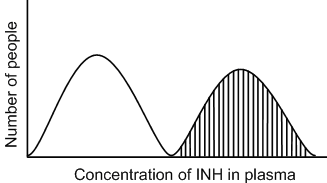 Variation of which of the following processes provides the best explanation for the shaded area of the curve?
 (Multiple Choice)
4.7/5 (84)
(84) An 85-year-old man is transferred to the hospital from a nursing home due to fever and confusion. On arrival, the patient is admitted directly to the intensive care unit with a presumptive diagnosis of septic shock. Antibiotic therapy is initiated. The patient is unable to provide any history, but his caretakers state that he has had nonspecific symptoms, including fever, for the past few days. The patient has a history of cardiovascular disease, diverticulitis, and dementia. Blood pressure is 60/40 mm Hg despite aggressive intravenous hydration. Intravenous norepinephrine is administered in response to the patient's hypotension. Which of the following cellular changes is most likely to occur in direct response to the medication?
(Multiple Choice)
4.7/5 (80)
(80) A 14-year-old girl is brought to the emergency department following a suicide attempt. She swallowed several of her grandfather's theophylline tablets after an intense argument with her parents a few hours ago. The patient reports nausea and headache. She has no other prior medical problems and takes no medications. Her temperature is 37 C (98.6 F), blood pressure is 114/76 mm Hg, pulse is 88/min, and respirations are 16/min. This patient should be carefully monitored for which of the following?
(Multiple Choice)
4.9/5 (74)
(74) An unresponsive 62-year-old man is brought to the emergency department after sustaining multiple injuries in a major motor vehicle accident. He is obtunded but responds to painful stimuli. His blood pressure is 160/90 mm Hg, pulse is 72/min, and respirations are 10/min. A few hours after initial treatment and stabilization, he develops severe tachypnea and decreased oxygenation. His chest x-ray shows evidence of pulmonary edema. He is rapidly intubated and given oxygen but acutely worsens and dies a few hours later, despite aggressive measures. Which of the following drugs could have caused this patient's condition?
(Multiple Choice)
4.9/5 (76)
(76) A 62-year-old woman comes to the office due to a change in bowel habits. For 2 months, she has had bowel movements once every 5 or 6 days. The patient describes her stools as hard and lumpy and of small volume; defecation is uncomfortable. She has no trouble passing gas and has no other symptoms, including no nausea, vomiting, or weight changes. The patient was admitted to the hospital 3 months ago for acute diverticulitis, and her hospital course was complicated by new-onset atrial fibrillation. Colonoscopy a month after hospitalization revealed sigmoid diverticulosis but no masses or polyps. The patient takes fiber supplements, diltiazem, and apixaban. She does not use tobacco or alcohol. Vital signs are within normal limits. Cardiac auscultation reveals an irregular heart rhythm but no murmurs. Abdominal examination is significant for mild distension. Which of the following best explains this patient's symptoms?
(Multiple Choice)
4.9/5 (77)
(77) Investigators assessing the bioavailability of a new drug administer it intravenously (IV) to a volunteer and measure plasma concentrations of the drug over time. After the drug is completely cleared from the volunteer's circulation, the investigators administer the same dose of the drug orally (PO) and again measure plasma concentrations of the drug over time. The data obtained are plotted on the graph shown below. 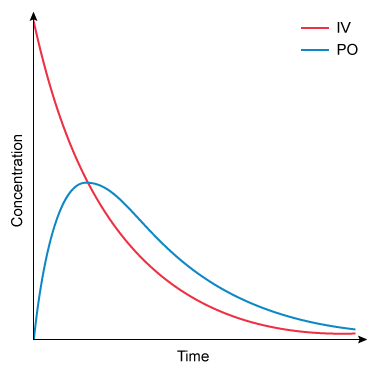 Which of the following is the best determinant of oral bioavailability of this drug?
 (Multiple Choice)
4.8/5 (79)
(79) An 18-year-old man has chronic atopic dermatitis. He has been applying a corticosteroid cream daily to the flexural areas of his skin for several years, and the treated areas have been free of pruritus, papules, vesicles, and scales during that time. Medical history is notable for asthma and allergic rhinitis. Punch biopsy of the treated skin would most likely show which of the following findings?
(Multiple Choice)
4.9/5 (79)
(79) An 8-year-old girl is brought to the office by her mother due to chronic pruritus affecting her arms. The mother states that the patient is always scratching herself. She scratches through the night, affecting her ability to sleep. Her sister has similar, but less severe, symptoms. The patient also has intermittent asthma. The rash is shown in the exhibit.
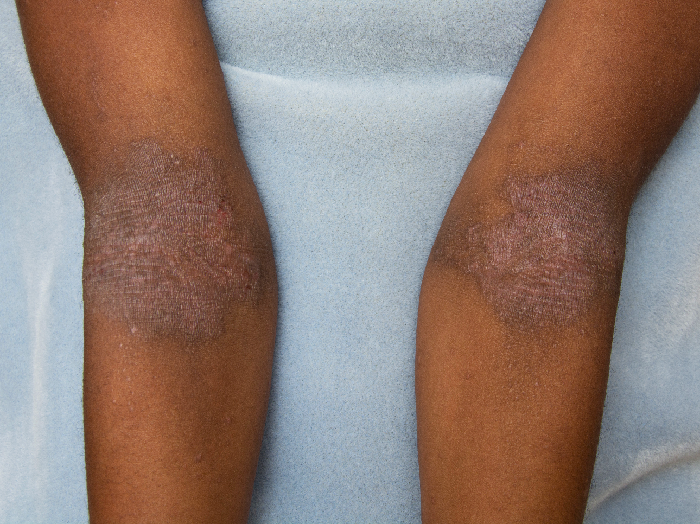 First-line therapy for this patient's condition works by which of the following mechanisms of action?
 (Multiple Choice)
4.7/5 (66)
(66) A 57‐year‐old man is brought to the emergency department due to lethargy and altered mental status. His family suspects a suicide attempt. Medical history is significant for dilated cardiomyopathy and major depressive disorder. On arrival, blood pressure is 76/46 mm Hg, pulse is 38/min, and respirations are 16/min. Pupils are 3 mm and reactive. Oropharynx is normal. Examination shows bilateral wheezing. There is no peripheral edema. Capillary refill is 3 seconds. There is no diaphoresis. Which of the following categories of medication did this patient most likely ingest?
(Multiple Choice)
4.9/5 (98)
(98) A 62-year-old woman is brought to the emergency department after a fall and is found to have a left femoral neck fracture. The patient is admitted to the hospital, and a hip arthroplasty is planned. Medical history is significant for long-standing type 2 diabetes mellitus, hypertension, hyperlipidemia, and migraines. While hospitalized, the patient receives a combination of long- and short-acting insulin for diabetes management. On the morning of surgery, fasting blood glucose level is 42 mg/dL. The patient is awake and alert and says she feels hungry but has no other symptoms of hypoglycemia. Concurrent use of which of the following medications best explains this finding?
(Multiple Choice)
4.9/5 (77)
(77) A 42-year-old woman comes to the office with persistent hyperlipidemia despite 6 months of maintaining a healthy diet and exercising regularly. Although her past medical history is significant for biliary colic secondary to gallstones, the patient has refused elective cholecystectomy. Her father died of a myocardial infarction at age 54, and her mother has diabetes mellitus. The patient's temperature is 36.1 C (97 F), blood pressure is 122/79 mm Hg, pulse is 78/min, and respirations are 14/min. Examination shows no abnormalities. Laboratory studies obtained 1 week ago show elevated serum triglycerides and LDL cholesterol levels. Drug therapy is discussed with the patient. Given this patient's preexisting gallbladder disease, which of the following drugs should be avoided?
(Multiple Choice)
4.9/5 (73)
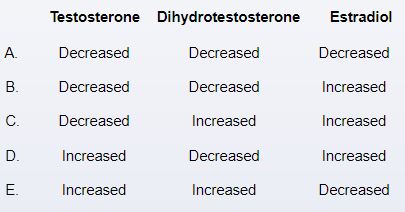
(73) A 28-year-old man comes to the office to discuss hair loss. He has hair loss primarily around the temples, which began insidiously 3 years ago. The patient is concerned because several of his family members became almost completely bald by their late 30s. He otherwise feels healthy and has normal muscle strength, libido, and erectile function. The patient is married, has 2 children, and works as a charter airplane pilot. Physical examination shows moderate thinning of hair at the anterior scalp, temporal region, and vertex. An oral medication is prescribed to treat the hair loss. After the initiation of therapy, which of the following changes would most likely occur in this patient?
(Multiple Choice)
4.8/5 (81)
(81) A 45-year-old man comes to the hospital with acute onset of severe chest pain and diaphoresis. The patient describes the pain as "squeezing," different from any discomfort he has ever had. He has a past medical history of hypertension, and his father underwent coronary artery bypass grafting at age 50. The patient is diagnosed with acute ST-elevation myocardial infarction and undergoes an urgent coronary intervention with stent placement into the right coronary artery. He is also started on high-intensity atorvastatin therapy, along with antiplatelet therapy and appropriate medications to control blood pressure. Four weeks later, the patient's total cholesterol level is 140 mg/dL, down from 200 mg/dL before discharge. Which of the following has most likely increased as the result of the therapy?
(Multiple Choice)
4.9/5 (89)
(89) A 34-year-old man is evaluated for several months of epigastric pain that is worse at night and is relieved by eating. The patient has no significant medical history and takes no medications. He does not use tobacco, alcohol, or illicit drugs. The patient immigrated to the United States from China 4 years ago. Vital signs are within normal limits. Physical examination shows mild epigastric tenderness to deep palpation. Upper gastrointestinal endoscopy reveals a 1-cm ulcer in the first portion of the duodenum. Additional testing is pending. In addition to proton pump inhibitor therapy, which of the following therapies would most likely prevent ulcer recurrence in this patient?
(Multiple Choice)
4.8/5 (83)
(83) A 58-year-old man comes to the emergency department due to vision disturbances. Over the past several weeks, the patient has had intermittent episodes in which he sees everything tinted with blue. His vision returned to normal within a few hours each time. When he woke up today, vision in the left eye was blurry. He has had no eye pain, conjunctival redness, or headache. The patient has tingling and numbness in the feet due to diabetic neuropathy, which is unchanged, and reports no other focal weakness or sensory loss. Medical history is notable for hypertension, type 2 diabetes mellitus, hyperlipidemia, and erectile dysfunction. Vital signs are within normal limits. Physical examination shows an afferent pupillary defect, decreased visual acuity, and optic disc edema in the left eye. Discontinuing which of the following medications may improve this patient's vision?
(Multiple Choice)
4.8/5 (76)
(76) A 12-year-old boy is brought to the emergency department due to a skin infection. Temperature is 38.4 C (101.1 F). Physical examination shows an area of erythema, warmth, and tenderness on his right distal leg. Laboratory results are notable for leukocytosis. The patient is started on intravenous nafcillin. Two days later, he shows limited response to antibiotic therapy. Light microscopy of pus obtained from the site shows gram-positive cocci in clusters, and sensitivity testing demonstrates little response to nafcillin but good response to vancomycin. Which of the following is the most likely explanation for nafcillin treatment failure in this patient?
(Multiple Choice)
4.8/5 (68)
(68) A 62-year-old man comes to the office for follow-up. The patient has a 10-year history of type 2 diabetes mellitus. Over the past 2 years, he has had burning pain and pins and needle sensations in his feet, which is worse at nighttime. Nortriptyline was prescribed, and the dosage was gradually increased. Currently, the patient takes the maximal recommended dose but states the symptoms are not well controlled. He reports no drug adverse effects. Other medical history includes hypertension and hyperlipidemia. Blood pressure is 124/70 mm Hg and pulse is 68/min. Physical examination shows decreased light touch and pain sensation in the feet. Ankle reflexes are decreased bilaterally. His most recent hemoglobin A1c level is 7.0%. Appropriate foot care is advised, and additional pharmacotherapy for the patient's symptoms is planned. Which of the following medications would provide additional benefit through a different mechanism with no drug-drug interaction?
(Multiple Choice)
4.9/5 (92)
(92) A group of investigators is studying the pharmacokinetic properties of the anesthetic drug propofol. A radiolabeled formulation of the drug is prepared and a single bolus is administered to adult guinea pigs. Blood and tissue samples are then collected at predetermined time intervals. Concentrations of the radioactive drug in the samples are assessed by liquid scintillation counting. The graph below demonstrates the drug concentration-time relationship in various tissues. 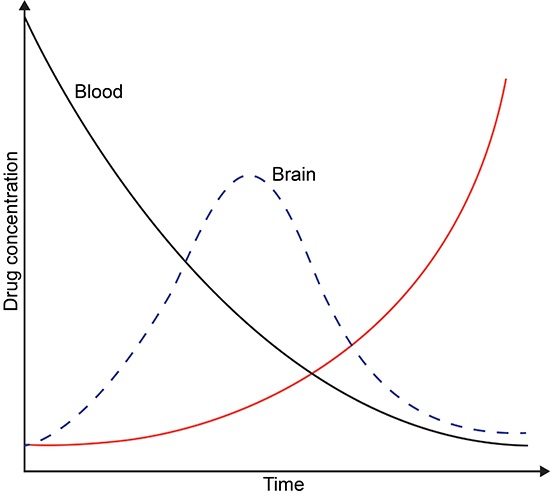 The red line on the graph most likely corresponds to which of the following tissues?
 (Multiple Choice)
4.9/5 (91)
(91) 
Filters
- Essay(0)
- Multiple Choice(0)
- Short Answer(0)
- True False(0)
- Matching(0)