



 Chat with AI
Exam 12: Pharmacology

Exam 1: Anatomy291 Questions
Exam 2: Behavioral science240 Questions
Exam 3: Biochemistry156 Questions
Exam 4: Biostatistics117 Questions
Exam 5: Embryology52 Questions
Exam 6: Genetics103 Questions
Exam 7: Histology24 Questions
Exam 8: Immunology129 Questions
Exam 9: Microbiology336 Questions
Exam 10: Pathology816 Questions
Exam 11: Pathophysiology464 Questions
Exam 12: Pharmacology538 Questions
Exam 13: Physiology272 Questions
Select questions type


A 35-year-old man with a known history of peptic ulcer disease comes to the physician with sudden onset of pain, swelling, and redness at the base of his great toe. The patient was awakened in the middle of the night by the pain and was unable to go back to sleep. He has no history of trauma to the joint. Physical examination shows swelling, erythema, and exquisite tenderness involving the right first metatarsophalangeal joint. Fine-needle aspiration of the joint shows needle-shaped, negatively birefringent crystals. After making the diagnosis, the physician prescribes an appropriate medication. Shortly after starting the medication, the patient develops nausea, vomiting, and diarrhea. Which of the following is the most likely mechanism of action of the drug prescribed to this patient?
(Multiple Choice)
4.7/5  (75)
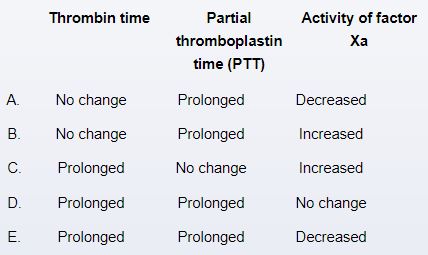
(75) A 68-year-old man is brought to the emergency department due to sudden-onset, severe right lower extremity pain. On physical examination, the right leg is pale and cold to the touch with absent distal pulses. Cardiac auscultation reveals an irregular tachycardia, and ECG shows atrial fibrillation. Right lower extremity ultrasonography reveals an arterial embolus. Intravenous heparin infusion is initiated. This medication is most likely to cause which of the following coagulation changes?
(Multiple Choice)
4.8/5 (74)
(74) A 23-year-old man is hospitalized for fever, headache, and confusion. He does not use tobacco or illicit drugs and is monogamous with his wife. The patient's cerebrospinal fluid analysis reveals lymphocytic pleocytosis, and a PCR is positive for herpesvirus. The patient is treated with intravenous high-dose acyclovir. Fever and mental status gradually improve, but on the third day of hospitalization the patient's serum creatinine level increases to 3.4 mg/dL from a baseline of 0.9 mg/dL at admission. The observed finding could have been prevented by which of the following?
(Multiple Choice)
5.0/5 (88)
(88) A 42-year-old woman with Graves disease is hospitalized for elective total thyroidectomy. Her hyperthyroid symptoms have been controlled with methimazole and propranolol, but she still has a goiter. The patient has no other medical problems. She undergoes total thyroidectomy without any immediate operative complications and feels well the next day. Laboratory results are as follows: 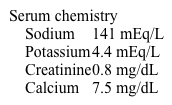 Preoperative electrolyte values were within normal limits. Which of the following medications should be started in this patient?
 (Multiple Choice)
4.7/5 (75)
(75) A 36-year-old woman with end-stage renal disease secondary to type 1 diabetes mellitus comes to the office for routine examination. The patient's medical history includes hypertension, diabetic retinopathy, and neuropathy. Hemodialysis was started 2 months ago along with an erythropoiesis-stimulating agent. She takes daily long- and short-acting insulin, lisinopril, and calcitriol. Her hemoglobin has increased from 7.4 g/dL to 10.2 g/dL over the past 2 months. Which of the following complications is most likely to be seen with the agent used to treat this patient's anemia?
(Multiple Choice)
4.9/5 (89)
(89) A 36-year-old man is evaluated due to swelling and severe pain of the right foot. Medical history is significant for kidney transplant due to focal segmental glomerulosclerosis. The patient is diagnosed with gout and treated with prednisone. Six weeks later, the patient is seen at follow-up. He has no foot pain and the swelling has subsided. Serum uric acid level is 13.5 mg/dL and creatinine level is 0.9 mg/dL. Allopurinol is prescribed. Initiation of this drug would most likely increase the activity of which of the following medications?
(Multiple Choice)
4.9/5 (71)
(71) A 52-year-old man recovering from an acute myocardial infarction develops new-onset chest pain that is relieved by leaning forward. The pain is exacerbated with deep inspiration. The patient was admitted with acute inferior myocardial infarction 2 days ago and did not undergo revascularization due to his late presentation. Since admission, he has had no chest pain until this morning. On physical examination, a friction rub is present at the left sternal border. The patient is treated with a medication that inhibits COX-1 and COX-2 enzymes via irreversible acetylation, resulting in significant relief of his symptoms. Which of the following agents was most likely used in this patient?
(Multiple Choice)
5.0/5 (86)
(86) A 32-year-old man is evaluated for recurrent nausea and vomiting. The patient has nausea and upper abdominal discomfort after meals and feels full even after eating a small amount of food. He also has experienced several episodes of vomiting of undigested food particles but has had no fever or diarrhea. The patient has a history of type 1 diabetes mellitus and diabetic neuropathy. Physical examination shows a clear oropharynx. The abdomen is soft, nondistended, and nontender with no organomegaly. Bowel sounds are normoactive. Stool testing for occult blood is negative. Upper gastrointestinal endoscopy reveals no abnormalities. Treatment with an oral medication is initiated, but it is stopped after the patient experiences abnormal involuntary movements. A macrolide antibiotic is prescribed, which improves his symptoms. Which of following mechanisms is most likely responsible for the improvement in this patient's symptoms?
(Multiple Choice)
4.8/5 (89)
(89) An 84-year-old woman is sent to the hospital from a nursing home due to 3 days of fever, abdominal pain, and progressive lethargy. The patient has a history of recurrent hospitalizations with multiple antibiotic courses for urinary tract infection, infected decubitus ulcer, and pneumonia. Her temperature is 38.2 C (101 F), blood pressure is 100/60 mm Hg, and pulse is 110/min. She has mild suprapubic and right costovertebral angle tenderness. Urine and blood cultures are obtained, and the patient is started on intravenous fluids and empiric ceftriaxone. Her urine culture shows extended-spectrum beta-lactamase (ESBL)-producing Escherichia coli. Which of the following features is most likely to be found in this organism?
(Multiple Choice)
4.8/5 (77)
(77) A 43-year-old woman volunteers for a clinical trial testing a medication for type 2 diabetes mellitus. She was diagnosed with diabetes mellitus 5 years ago, and her blood sugar has recently been uncontrolled despite taking the maximum tolerated dose of metformin. The subject's medical history is otherwise unremarkable, and she takes no concurrent medications that would disqualify her from enrolling in the trial. Initial laboratory studies show a fasting glucose of 155 mg/dL and hemoglobin A1c of 8.2%. A urine pregnancy test is negative, and other screening tests are normal. The study drug activates peroxisome proliferator-activated receptor gamma, a nuclear receptor and transcription factor. Activation of this receptor would most likely result in which of the following metabolic changes?
(Multiple Choice)
4.9/5 (78)
(78) A 66-year-old man comes to the office with diplopia that progressively worsens toward the end of the day. The patient has no shortness of breath, trouble swallowing, or generalized weakness. He is currently receiving low-dose pyridostigmine for treatment of his condition and claims good compliance without significant side effects. Physical examination reveals fatigable asymmetric ptosis and binocular horizontal diplopia. Infusion of edrophonium elicits a significant improvement in his symptoms. Which of the following is the best next step in management of this patient?
(Multiple Choice)
5.0/5 (85)
(85) In an experiment investigating vasoconstriction of the arterial wall, two samples of isolated porcine arterial vessels are studied. Vascular tone is measured in the control vessel during infusion of increasing doses of norepinephrine. The other vessel is pretreated with experimental drug A prior to infusion of norepinephrine. A graph of the study results is depicted below. 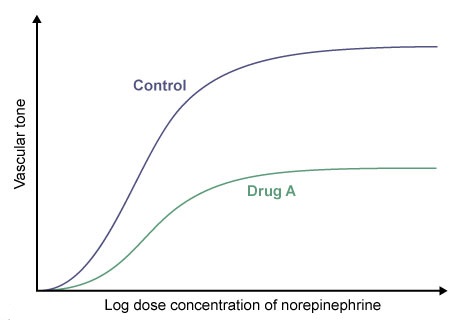 Drug A is most similar to which of the following agents?
 (Multiple Choice)
4.8/5 (83)
(83) A 52-year-old woman with a history of locally advanced breast cancer comes to the office for follow-up. The patient is undergoing trastuzumab-based chemotherapy but has not received radiation therapy. She has no symptoms except mild fatigue. Blood pressure is 120/72 mm Hg and pulse is 85/min and regular. The patient is afebrile. Transthoracic echocardiography reveals a left ventricular ejection fraction of 40% with no evidence of valvular disease. Cardiac assessment prior to chemotherapy initiation was normal. Which of the following pathologic findings is most likely to be present in this patient's heart?
(Multiple Choice)
4.9/5 (82)
(82) A 23-year-old man comes to the office due to several days of dysuria. He has had no fever or hematuria. The patient has no other medical conditions, takes no medications, and has no known allergies. Temperature is 37.1 C (98.8 F). On genitourinary examination, mucopurulent discharge is noted at the urethral meatus. Microscopy of the discharge shows numerous neutrophils, some of which contain intracellular gram-negative diplococci. A single intramuscular injection of ceftriaxone is administered. Which of the following additional medications is recommended at this time?
(Multiple Choice)
4.9/5 (71)
(71) A 63-year-old man hospitalized for chronic obstructive pulmonary disease exacerbation develops hypercapnic respiratory failure. He is transferred to the intensive care unit, where he undergoes intubation after premedication with muscle relaxant X and an appropriate sedative. The patient is then started on mechanical ventilation; however, he remains apneic longer than expected. Anesthesiology is consulted, and the patient's neuromuscular blockade is assessed by electrically stimulating a peripheral nerve 4 times in quick succession and observing the muscular response. The procedure is repeated 30 minutes later and the results are shown below. 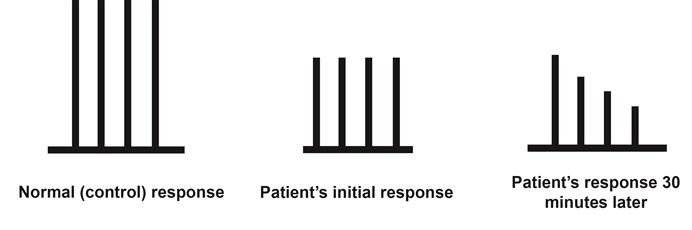 Muscle relaxant X is most likely to be which of the following medications?
 (Multiple Choice)
4.9/5 (77)
(77) A 24-year-old man comes to the emergency department after injuring his shoulder. He was standing on a ladder hanging pictures in his living room when he lost his balance and fell, impacting his left shoulder on the hardwood floor. Radiographs show an anterior dislocation of the humerus. Reduction of the patient's dislocated joint is performed under procedural sedation with intravenous propofol. A single bolus of propofol provides adequate sedation for the procedure, and he becomes clinically alert several minutes after administration. Which of the following mechanisms most likely explains this patient's rapid recovery from anesthesia?
(Multiple Choice)
4.9/5 (80)
(80) A 30-year-old man comes to the emergency department with sudden onset of severe headache and confusion. He has a history of autosomal dominant polycystic kidney disease. Neurological examination shows no meningeal signs or focal neurological deficits. CT scan of the head reveals blood in the subarachnoid space. The patient is admitted to the critical care unit for further management. On the fifth day after admission, he experiences new-onset weakness in the right arm and leg. Which of the following medications could have most likely prevented the neurological complications this patient developed in the hospital?
(Multiple Choice)
4.9/5 (78)
(78) A 76-year-old hospitalized woman is evaluated for persistent fevers. Four days ago, she was admitted to the hospital for sepsis, for which she has received broad-spectrum empiric intravenous antibiotic therapy. Her temperature is 38.9 C (102 F), blood pressure is 110/80 mm Hg, pulse is 98/min, and respirations are 18/min. Cardiac examination reveals a new diastolic murmur. Multiple blood cultures drawn at different times grow Enterococcus. Echocardiogram reveals mitral valve vegetation suggestive of endocarditis. An intravenous antibiotic is added to the patient's treatment regimen for synergy. Several days later, she develops tinnitus and hearing loss attributed to this antibiotic. The additional antibiotic most directly affects which of the following processes?
(Multiple Choice)
5.0/5 (67)
(67) A 24-year-old pregnant woman comes to the emergency department in active labor at full term. The patient has a history of HIV from injection drug use. She is not adherent with antiretroviral therapy and has had no recent testing of CD4 count or plasma viral load. Physical examination shows regular uterine contractions, ruptured amniotic membranes, and a fully dilated cervix. A decision is made to continue with the vaginal delivery due to advanced labor. Intravenous zidovudine is administered to the patient during the delivery and to the infant immediately after birth. This medication helps decrease the risk of perinatal transmission by inhibiting which of the following components of viral genome replication?
(Multiple Choice)
4.9/5 (71)
(71) An 8-year-old boy is brought to the office by his mother for a routine checkup. He was diagnosed with absence seizures a year ago and has been undergoing treatment with an appropriate antiepileptic agent. The mother says that the patient is doing well and has not had any seizures since starting the medication. His school performance has improved significantly, and he no longer gets in trouble for "staring off" in class. He eats a well-balanced diet and is at the 50th percentile for height and weight. Which of the following is the most likely mechanism of action of the medication used in this patient?
(Multiple Choice)
4.8/5 (86)
(86) 
Filters
- Essay(0)
- Multiple Choice(0)
- Short Answer(0)
- True False(0)
- Matching(0)