



 Chat with AI
Exam 12: Pharmacology

Exam 1: Anatomy291 Questions
Exam 2: Behavioral science240 Questions
Exam 3: Biochemistry156 Questions
Exam 4: Biostatistics117 Questions
Exam 5: Embryology52 Questions
Exam 6: Genetics103 Questions
Exam 7: Histology24 Questions
Exam 8: Immunology129 Questions
Exam 9: Microbiology336 Questions
Exam 10: Pathology816 Questions
Exam 11: Pathophysiology464 Questions
Exam 12: Pharmacology538 Questions
Exam 13: Physiology272 Questions
Select questions type


A 34-year-old man is found to have dyslipidemia. His other medical problems include a myocardial infarction 1 week ago. His father died of myocardial infarction at the age of 48 years. Several other family members have had myocardial infarctions and hypertension. The patient smoked cigarettes and drank alcohol occasionally but quit after his myocardial infarction. He is started on simvastatin and cholestyramine. Which of the following best describes the independent effects of simvastatin and cholestyramine, respectively, on hepatic cholesterol synthesis?
(Multiple Choice)
4.7/5  (80)
(80) A 45-year-old woman comes to the office for follow-up of type 2 diabetes mellitus. The patient was diagnosed with diabetes 3 years ago after developing polyuria, polydipsia, and recurrent vulvovaginal candidiasis. She initially tried lifestyle changes but had no significant glycemic improvement and was started on metformin. The patient is adherent with her therapy and consumes a low-carbohydrate diet. Family history is significant for an osteoporotic fracture in her mother. Blood pressure is 134/86 mm Hg and pulse is 72/min. BMI is 33 kg/m2. Physical examination shows no abnormalities. Laboratory results show a hemoglobin A1c of 8.2%. After further discussion, a sodium-glucose cotransporter-2 inhibitor is added to the patient's drug regimen. Which of the following is the most likely additional effect of the newly prescribed medication?
(Multiple Choice)
4.7/5 (94)
(94) A 55-year-old man comes to the office for a checkup. His medical history is significant for major depression treated with sertraline for the past 4 months, hypertension controlled with lisinopril, and diabetes mellitus controlled with diet. He does not use tobacco and drinks a glass of wine with dinner a few times a week. Vital signs are all within normal limits, and no abnormalities are noted on physical examination. Hemoglobin A1c is within normal limits. Which of the following is the most likely side effect of the treatment prescribed for this patient's depression?
(Multiple Choice)
4.9/5 (89)
(89) A 17-year-old girl comes to the office due to worsening acne. The patient's acne had been well controlled with oral doxycycline therapy. However, over the past month, the acne has worsened on her face and back. The patient was recently diagnosed with iron deficiency anemia due to abnormal uterine bleeding and began taking a combined oral contraceptive and an iron supplement. Physical examination shows comedones and pustules on her face and upper back. The remainder of the examination shows no abnormalities. Which of the following is the most likely cause of this patient's worsening symptoms?
(Multiple Choice)
4.7/5 (78)
(78) A 68-year-old woman comes to the office due to recurrent syncopal episodes. The most recent incident occurred 3 days ago while she was walking to her car and lasted about 1 minute. She was able to resume her normal activities afterward although she felt tired. She had no preceding chest pain or palpitations. The patient has had 2 similar syncopal episodes in the past 2 months, along with frequent episodes of intermittent dizziness. Medical history includes hypertension and chronic kidney disease. She takes lisinopril, amlodipine, and clonidine daily. Blood pressure is 155/85 mm Hg and pulse is 44/min. Heart and lung sounds are normal. After the offending medication is discontinued, she has no further syncopal episodes. The drug responsible for this patient's episodes most likely functions through which of the following mechanisms?
(Multiple Choice)
5.0/5 (79)
(79) A 76-year-old woman is brought to the emergency department by her son due to lethargy and confusion over the past 2 days. The patient has persistent atrial fibrillation and congestive heart failure and is on multiple medications. Recently, she has had nausea and decreased appetite. Today, she had 3 episodes of vomiting. The patient also reports vision difficulties. Temperature is 36.7 C (98 F) and blood pressure is 133/80 mm Hg. Laboratory results are as follows: 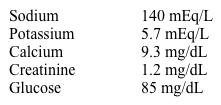 ECG shows junctional escape rhythm at a rate of 48/min with occasional ventricular premature beats. Increased blood level of which of the following medications is most likely responsible for her symptoms?
 (Multiple Choice)
4.8/5 (90)
(90) A 65-year-old man comes to the office for follow-up monitoring of type 2 diabetes mellitus. He was diagnosed with diabetes 7 years ago and follows a strict diet to control his blood sugar level. The patient takes no medications. Blood pressure is 139/88 mm Hg and pulse is 70/min. Physical examination shows decreased lower-extremity sensation with a 10-g monofilament. His most recent hemoglobin A1c is 7.4% (normal, <5.6%). Serum creatinine is 1.0 mg/dL and serum potassium is 3.8 mEq/L. Further laboratory evaluation reveals increased urinary albumin excretion, but a conventional urinalysis is within normal limits. In addition to starting antihyperglycemic treatment, which of the following is the best pharmacotherapy for this patient?
(Multiple Choice)
4.9/5 (76)
(76) A 62-year-old woman comes to the emergency department due to acute eye pain. She has a history of seasonal allergies and developed itchy, watery, red eyes after working outdoors in her garden. The patient used over-the-counter eye drops to treat her allergy symptoms, and several hours later, she began experiencing severe right eye pain and headache. On examination, the right eye appears red with a hazy cornea and dilated pupil that responds poorly to light. Palpation of the globes reveals notable firmness on the right compared to the left. Visual acuity in the affected eye is severely diminished. Tonometry reveals elevated intraocular pressure. Which of the following medications was most likely used by this patient?
(Multiple Choice)
4.8/5 (87)
(87) A 55-year-old woman is diagnosed with metastatic breast cancer. The patient is treated with an opioid analgesic for bone pain that is well controlled during the first week of therapy. The following week, the analgesic dose becomes ineffective and the patient reports nausea, itching, and constipation. She has become very weak and is unable to walk due to the pain. The opioid dose is increased. The patient is concerned about side effects with higher dosages, noting that her son has a history of opioid dependence, and "I watched him suffer a lot of bad reactions." The physician explains the concept of tolerance to opioids and that high doses are commonly required to control pain. Over the next few weeks, the patient would likely experience which of the following?
(Multiple Choice)
4.8/5 (84)
(84) A 55-year-old woman with stage IV chronic kidney disease due to type 2 diabetes mellitus comes to the office for a follow-up visit. Blood pressure is 140/90 mm Hg and pulse is 78/min. BMI is 31 kg/m2. Laboratory results are as follows: 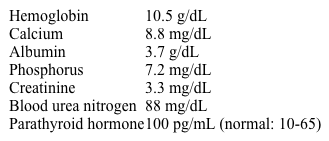 The patient's serum phosphorus has been persistently elevated despite strict dietary phosphate restriction. Treatment with sevelamer is initiated. This medication reduces the serum phosphorus level by which of the following mechanisms?
 (Multiple Choice)
4.8/5 (63)
(63) A 65-year-old man comes to the office due to advanced prostate cancer with bone metastases. For the last 4 months, he has been treated with a GnRH agonist, which has significantly reduced his bone pain. However, the patient now reports discomfort at the anterior chest wall. Physical examination reveals bilateral, mildly tender enlargement of the breast tissue behind the nipple-areolar complex. Early initiation of which of the following medications would be most appropriate for preventing this patient's breast symptoms?
(Multiple Choice)
4.9/5 (93)
(93) A 2-day-old girl is evaluated in the newborn nursery due to tachypnea, sneezing, and diarrhea. The patient was born via spontaneous vaginal delivery and had been feeding well until several hours ago, when she became tachypneic. She has also been persistently crying and difficult to console. The patient's mother did not receive prenatal care during this pregnancy. Respirations are 65/min. All other vital signs are normal for age. On physical examination, the patient is irritable and has mildly increased tone in all extremities with occasional tremors of the arms and legs. Chest radiograph reveals normal lung fields. Serum glucose and complete blood count are within normal limits, and urine toxicology is pending. Nonpharmacologic interventions do not significantly improve the patient's symptoms. Which of the following pharmacotherapies would most likely improve this patient's symptoms?
(Multiple Choice)
4.8/5 (84)
(84) A 78-year-old man was found to have a perihilar mass on screening CT scan. The patient's medical history is remarkable for chronic obstructive pulmonary disease, for which he takes albuterol inhalers as needed. He has smoked a pack of cigarettes daily for the last 50 years and does not drink alcohol or use illicit drugs. The patient is admitted for bronchoscopy and is premedicated with intramuscular atropine and becomes acutely restless, disoriented, and combative. Temperature is 38.1 C (100.5 F), blood pressure is 116/72 mm Hg, pulse is 110/min, and respirations are 15/min. Oxygen saturation is 99% on room air. On physical examination, his pupils are widely dilated and nonreactive to light. ECG shows sinus tachycardia. Which of the following agents will reverse all of this patient's signs and symptoms?
(Multiple Choice)
4.9/5 (90)
(90) Two antineoplastic drugs are shown to inhibit intracellular thymidylate formation. The chemotherapeutic effect of drug X can be overcome by N5-formyl-tetrahydrofolate supplementation, but that of drug Y is not affected. The drugs described in this scenario are most likely which of the following?
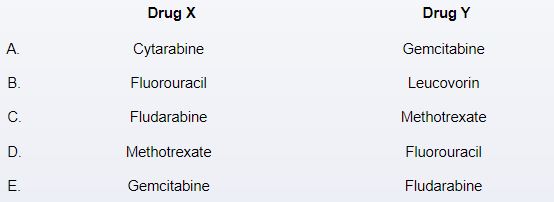
(Multiple Choice)
4.9/5 (88)
(88) A 46-year-old woman comes to the office due to episodes of headaches, nausea, sweating, and feeling like she is going to pass out. The patient has had 3 such episodes in the past 2 weeks, with symptoms occurring when she skips a meal. During the most recent episode, her fingerstick glucose was 50 mg/dL. She was diagnosed with type 2 diabetes mellitus 3 years ago and was initially treated with metformin monotherapy; glyburide was added to her regimen 3 months ago due to inadequate glycemic control. The patient has no other medical conditions. Vital signs are within normal limits, and physical examination shows no abnormalities. Laboratory results show hemoglobin A1c is 6.7%. The medication most likely causing this patient's current symptoms works by targeting which of the following?
(Multiple Choice)
5.0/5 (60)
(60) A 67-year-old man comes to the hospital due to an acute worsening of chronic back pain associated with new-onset bilateral leg weakness and numbness. He has a history of colorectal cancer with vertebral metastases for which he has received colectomy, chemotherapy, and radiation treatment. The patient takes oral morphine sulfate for his back pain. Examination shows focal vertebral tenderness, along with reduced muscular strength, decreased sensitivity to light touch, and spasticity in both legs. Imaging studies reveal a vertebral compression fracture with cord compression. Surgical decompression is planned. Which of the following drugs may precipitate opioid withdrawal symptoms if used in this patient?
(Multiple Choice)
4.8/5 (60)
(60) A 64-year-old woman comes to the hospital due to sudden-onset right arm weakness and difficulty speaking, which completely resolved within 20 minutes. The patient has had no shaking movements, headache, nausea, photophobia, or anxiety. She has a history of hypertension and hypercholesterolemia and takes amlodipine and rosuvastatin, respectively. Her blood pressure is 125/70 mm Hg and pulse is 78/min and regular. Neurologic examination is unremarkable. Fingerstick glucose is within normal limits. ECG shows normal sinus rhythm. Carotid Doppler reveals mild left common carotid artery stenosis. MRI of the brain and echocardiogram are unremarkable. If the patient is started on an additional medication that is indicated for her condition, which of the following adverse effects is most likely to occur?
(Multiple Choice)
4.8/5 (76)
(76) A pharmaceutical company in the final stages of designing a new nonsteroidal anti-inflammatory agent develops 2 different oral formulations of the drug. Two groups of volunteers are each administered a different formulation, and average plasma drug levels are monitored over the next 12 hours. The results are shown below: 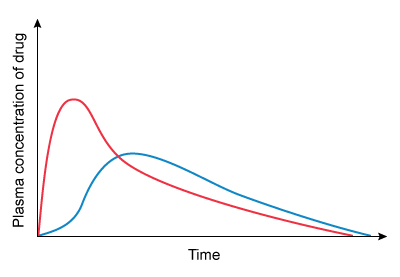 Compared to the red curve, the formulation represented by the blue curve is most likely to have which of the following characteristics?
 (Multiple Choice)
4.9/5 (73)
(73) An 83-year-old woman is sent to the emergency department from the nursing home where she resides for evaluation of mental status changes. At baseline, she has mild memory impairment but is otherwise cognitively intact, calm, and cooperative with the nursing home staff. Over the past 24 hours, she has become increasingly combative and agitated and stayed up all night. Behavioral interventions and environmental modifications have not been helpful. The patient's medical conditions include hypertension and a history of anxiety and depression. Temperature is 37.2 C (99 F), blood pressure is 110/80 mm Hg, pulse is 84/min, and respirations are 18/min. Neurological examination is normal, but the patient is unable to attend to the conversation, is mildly disoriented, and cannot state the days of the week backwards. Without provocation, she strikes out at a nurse's aide standing next to her. Laboratory results are normal except for urinalysis, which shows an increased presence of white blood cells and is positive for nitrites. Head CT scan is negative. In addition to starting antibiotic therapy, which of the following medications is most appropriate to treat this patient's behavioral symptoms?
(Multiple Choice)
5.0/5 (83)
(83) A 25-year-old man comes to the office for follow-up. He was diagnosed with HIV several weeks ago following a hospitalization for Pneumocystis pneumonia. He has no other medical problems. His HIV drug susceptibility report shows no evidence of resistance. The patient's treatment regimen includes a drug that is structurally unrelated to nucleosides and is not phosphorylated intracellularly. The drug acts within the cytoplasm of infected cells to inhibit the synthesis of viral DNA from the RNA template. Which of the following agents was most likely used in this patient?
(Multiple Choice)
4.8/5 (82)
(82) 
Filters
- Essay(0)
- Multiple Choice(0)
- Short Answer(0)
- True False(0)
- Matching(0)