



 Chat with AI
Exam 12: Pharmacology

Exam 1: Anatomy291 Questions
Exam 2: Behavioral science240 Questions
Exam 3: Biochemistry156 Questions
Exam 4: Biostatistics117 Questions
Exam 5: Embryology52 Questions
Exam 6: Genetics103 Questions
Exam 7: Histology24 Questions
Exam 8: Immunology129 Questions
Exam 9: Microbiology336 Questions
Exam 10: Pathology816 Questions
Exam 11: Pathophysiology464 Questions
Exam 12: Pharmacology538 Questions
Exam 13: Physiology272 Questions
Select questions type


A 45-year-old woman comes to the office for evaluation of dysphagia. The patient's symptoms first began 2 years ago with regurgitation and bloating after meals but have recently progressed to difficulty swallowing both solid foods and liquids. She has been using antacids without relief. The patient has no other medical history. She drinks 1 or 2 beers on weekends but does not smoke or use illicit drugs. Family history is unremarkable. Vital signs are within normal limits. BMI is 21 kg/m2. The abdomen is nontender and soft with normal active bowel sounds. The patient undergoes upper endoscopy that shows a dilated esophagus and retained food. Esophageal manometry reveals increased lower esophageal sphincter (LES) tone and incomplete relaxation. Peristalsis is absent in the distal esophagus. Injection of which of the following into the patient's LES would most likely help relieve her symptoms?
(Multiple Choice)
4.9/5  (78)
(78) A 54-year-old man with nonischemic cardiomyopathy comes to the office for a follow-up visit. He has been hospitalized frequently for acute decompensated heart failure, and currently has dyspnea on mild exertion. The patient also has a history of hypertension and takes multiple medications. Blood pressure is 116/70 mm Hg, and pulse is 72/min and regular. Physical examination shows elevated jugular venous pressure, bibasilar lung crackles, and lower extremity edema. Serum creatinine is 1.0 mg/dL and serum potassium is 4.2 mEq/L. Three weeks after starting digoxin therapy, the patient reports symptomatic improvement. Which of the following is the initial cellular event triggering this response to the new medication?
(Multiple Choice)
4.8/5 (82)
(82) A 68-year-old man comes to the emergency department due to lightheadedness, generalized weakness, and palpitations. The patient has a prolonged history of hypertension and takes amlodipine. He does not use tobacco or alcohol. His blood pressure is 110/60 mm Hg and pulse is 144/min and irregular. ECG shows an irregularly irregular rhythm and absent P waves. The patient is started on beta blocker therapy for rate control, with improvement in his heart rate. Long-term anticoagulation is initiated to prevent atrial thrombus formation, and he is eventually discharged home on warfarin. Which of the following is the best test to monitor the anticoagulation effect of warfarin in this patient?
(Multiple Choice)
4.8/5 (76)
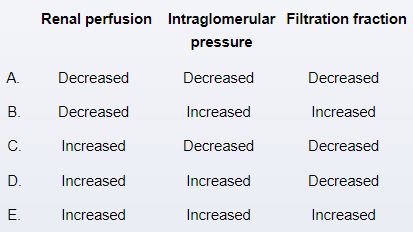
(76) A 70-year-old man comes to the office for follow-up of hypertension. He has been taking amlodipine but his recent home blood pressure readings have been elevated. The patient has a long smoking history and, despite many attempts at quitting, continues to smoke cigarettes. Blood pressure is 140/90 mm Hg and pulse is 76/min. Examination shows a bruit on auscultation of the abdomen. Further evaluation reveals bilateral renal artery stenosis. After initial discussion, the patient is started on daily lisinopril therapy. The patient is advised to return to the clinic in a few days. The close follow-up is recommended due to which of the following anticipated effects in this patient's kidney function?
(Multiple Choice)
4.9/5 (83)
(83) A 48-year-old woman with metastatic cervical cancer is brought to the emergency department due to worsening lethargy for the past several days. A year ago, the patient was diagnosed with cervical cancer, which has progressed despite chemotherapy treatment and metastasized to the liver and lungs. She has also developed bilateral hydronephrosis and renal failure due to ureteral compression by the tumor. The patient is receiving palliative care, and her pain has been adequately controlled with a stable dose of oral morphine. Temperature is 36.7 C (98 F), blood pressure is 110/62 mm Hg, pulse is 92/min, and respirations are 10/min. On physical examination, the patient is somnolent and responds to painful stimuli only. The pupils are small and sluggish to react. The lungs are clear to auscultation, and heart sounds are normal. The abdomen is soft and nondistended. Arterial blood gas analysis shows respiratory acidosis. Which of the following medication-related events most likely precipitated her current condition?
(Multiple Choice)
4.8/5 (60)
(60) A novel antiretroviral medication, Drug X, is being developed for treating patients with HIV infection. Initial studies show a high rate of treatment failure due to continued viral proliferation in the brain. However, treatment success rates improve when Drug X is combined with an adjuvant agent. Data comparing the two medication regimens is shown in the table below.  Based on the data, the adjuvant agent most likely improves viral control through which of the following mechanisms?
 (Multiple Choice)
4.9/5 (82)
(82) A 26-year-old man comes to the office due to severe headaches that are increasing in frequency. The patient describes episodic, right-sided hemicranial throbbing or pulsating headaches accompanied by nausea and photophobia. The headaches began when he was in high school, but lately they have become more frequent and are affecting his work. The patient takes nonsteroidal analgesics and sumatriptan for the pain and metoclopramide for nausea. He has no other medical conditions and no drug allergies. Vital signs are within normal limits, and physical examination shows no abnormalities. A recent brain imaging study was normal. Which of the following pharmacotherapies would be most helpful to prevent recurrences of this patient's headache?
(Multiple Choice)
4.9/5 (83)
(83) A 46-year-old woman comes to the clinic to establish primary care as a new patient. She is a marathon runner but has been unable to train due to a vertebral stress fracture diagnosed via x-ray during a recent emergency department visit. She has a history of hypothyroidism for which she takes levothyroxine. The patient's last menstrual period was a year ago. Her diet consists mainly of vegetables and fruit, and she takes a daily multivitamin. Her mother died of breast cancer at age 52. The patient is concerned that her family history puts her at risk for breast cancer. X-ray absorptiometry studies demonstrate abnormally low bone density in the lumbar vertebrae. Which of the following drugs is the most appropriate option for decreasing the risk of both bone fractures and breast cancer in this patient?
(Multiple Choice)
4.8/5 (84)
(84) An 11-year-old boy is brought to the emergency department by ambulance after he briefly lost consciousness. The patient's mother found him on the kitchen floor shaking and jerking. She believes that he was out of her sight for only a few minutes. When asked about any other abnormal behaviors, she says that her son often stares into space and does not respond to questions during these episodes. The patient has no known medical conditions or history of recent illnesses. He is afebrile with normal vital signs. The patient seems sleepy but is oriented to time and place and has no abnormalities on physical examination. Several hours later, he is alert and says that he wants to go home. Which of the following agents is the best long-term treatment for this patient?
(Multiple Choice)
4.7/5 (68)
(68) A 56-year-old Caucasian male with non-Hodgkin lymphoma is undergoing systemic chemotherapy. Vincristine is a part of the regimen, and you suspect accidental overdose of that agent. Which of the following would you most expect in this patient?
(Multiple Choice)
4.7/5 (84)
(84) A 78-year-old woman is brought to the hospital due to 2 days of nausea, vomiting, abdominal pain, and headache. She was recently hospitalized due to a stroke, and the hospitalization was complicated by a urinary tract infection and delirium. The patient has a history of chronic obstructive pulmonary disease and her treatment regimen includes theophylline. Temperature is 37 C (98.6 F), blood pressure is 110/70 mm Hg, pulse is 118/min, and respirations are 22/min. On physical examination, the patient appears agitated and restless. There is a coarse tremor of the outstretched arms. Chest auscultation reveals mild expiratory wheezing. Serum theophylline levels are markedly elevated. Treatment with which of the following agents most likely precipitated this patient's current symptoms?
(Multiple Choice)
4.8/5 (81)
(81) An 18-year-old woman comes to the office for evaluation of acne. The patient is very upset about the acne scarring, which worsened since she started college. She has been very stressed by upcoming examinations and feels "exhausted" due to lack of adequate sleep. The patient has been using topical benzoyl peroxide and tretinoin for the past year. She was also prescribed an oral antibiotic but stopped taking it several months ago due to lack of improvement. The patient is sexually active with her boyfriend and uses an intrauterine device for contraception. Her periods are regular and last 5 days. She takes no other medications and does not use tobacco, alcohol, or illicit drugs. Physical examination shows nodulocystic acne with scarring on the face, chin, and upper back. The patient is interested in isotretinoin treatment. Which of the following is the best next step in management of this patient?
(Multiple Choice)
4.9/5 (78)
(78) A 40-year-old woman is brought to the emergency department due to ataxia and tremor. The patient's symptoms started gradually 2 weeks ago and have worsened acutely over the past 2 days. She is having difficulty walking and almost fell while getting up from a chair. The patient's medical problems include bipolar disorder and recently diagnosed hypertension. Her medications include a stable dose of lithium for many years and a new blood pressure medication that was started several weeks ago. Vital signs are within normal limits. Neurologic examination reveals a resting tremor and difficulty with balance. Physical examination is otherwise normal. A drug interaction involving which of the following medications is most likely causing this patient's condition?
(Multiple Choice)
4.9/5 (74)
(74) A 62-year-old woman is admitted to the hospital for a living-donor kidney transplant. She has a history of end-stage kidney disease due to diabetic nephropathy and has been undergoing hemodialysis for the last 2 years. The transplant surgery is performed without complication, and the patient demonstrates good urine output afterward. To help prevent rejection, she is given a medication that inhibits the conversion of inosine monophosphate to guanosine monophosphate primarily in lymphocytes, causing reduced proliferation of activated lymphocytes. Which of the following medications is most likely being used in this patient?
(Multiple Choice)
4.9/5 (75)
(75) A 26-year-old woman comes to the emergency department for pelvic pain and vaginal bleeding over the past 2 days. Today, the pain has increased, but she has had no nausea, vomiting, or orthostasis. The patient was treated for chlamydia cervicitis 3 years ago. She takes no medications and has no known drug allergies. On pelvic examination, the uterus is small and mobile and there is left adnexal tenderness. Pelvic ultrasound reveals a complex, 2-cm left adnexal mass with a gestational sac and yolk sac; there is no intrauterine pregnancy or free fluid. The patient is counseled on recommended medical treatment. Which of the following is the mechanism of action of the agent of choice for this patient?
(Multiple Choice)
4.9/5 (87)
(87) A 12-year-old boy has prolonged oral bleeding immediately after a tooth extraction. Despite several interventions, the bleeding persists for hours and stops only after desmopressin (DDAVP) administration. The patient has several dental caries due to excessive juice intake and inconsistent oral hygiene. He has no other medical problems and takes no medications. His father and paternal grandmother have also had excessive bleeding after dental procedures. Review of systems is positive for mild bruising on his legs. Which of the following is the most likely therapeutic mechanism of desmopressin for this patient's condition?
(Multiple Choice)
4.8/5 (78)
(78) A 30-year-old woman comes to the office due to chronic anxiety and tension. The patient says she worries constantly about multiple issues involving her work, finances, and family. At work, she has difficulty concentrating as she repeatedly calls to check on the whereabouts and safety of her husband and children. The patient also describes frequent tension headaches, back pain, and fatigue. She does not feel depressed and says that her sleep and appetite are normal. Laboratory studies, including thyroid function tests, are within normal limits. In addition to a recommendation of psychotherapy, pharmacotherapy with buspirone is initiated. This medication is associated with which of the following properties?
(Multiple Choice)
4.8/5 (99)
(99) A nuclear waste disposal plant suffers a containment failure and several grams of iodine-131 are released into the local environment. A number of workers are believed to have been exposed to dangerous levels of the radioactive material. Which of the following should be immediately administered to help prevent tissue damage in these individuals?
(Multiple Choice)
4.9/5 (87)
(87) A 63-year-old man comes to the emergency department due to muscle weakness with severe cramping in the lower extremities. The cramps are severe enough to disrupt his sleep. The patient also exercises daily but has had to suspend his exercise regimen in the last 3 days due to the symptoms. Past medical history is notable for hypertension, for which he was started on chlorthalidone and amlodipine 4 weeks ago. Blood pressure in the emergency department is 140/86 mm Hg and pulse is 90/min. The heart has a regular rate and rhythm, and he has palpable pedal pulses with no peripheral edema. Which of the following is the most likely cause of this patient's muscular symptoms?
(Multiple Choice)
4.9/5 (86)
(86) An elderly immigrant from the Middle East presents to your office complaining of numbness and tingling of his hands and feet. He was diagnosed with pulmonary tuberculosis several months ago and is currently receiving isoniazid and rifampin. Neurologic testing demonstrates sensory ataxia and decreased pain sensation in the distal extremities. This patient's condition is most likely caused by:
(Multiple Choice)
4.9/5 (85)
(85) 
Filters
- Essay(0)
- Multiple Choice(0)
- Short Answer(0)
- True False(0)
- Matching(0)