



 Chat with AI
Exam 12: Pharmacology

Exam 1: Anatomy291 Questions
Exam 2: Behavioral science240 Questions
Exam 3: Biochemistry156 Questions
Exam 4: Biostatistics117 Questions
Exam 5: Embryology52 Questions
Exam 6: Genetics103 Questions
Exam 7: Histology24 Questions
Exam 8: Immunology129 Questions
Exam 9: Microbiology336 Questions
Exam 10: Pathology816 Questions
Exam 11: Pathophysiology464 Questions
Exam 12: Pharmacology538 Questions
Exam 13: Physiology272 Questions
Select questions type


A 59-year-old man who is being treated for hypercholesterolemia, diabetes, and hypertension comes to the physician for a scheduled follow-up visit three weeks after starting a new medication. He has no new complaints. Blood work drawn yesterday shows an interim increase in potassium from 4.8 mEq/L to 5.2 mEq/L and a creatinine elevation from 1.2 mg/dL to 1.6 mg/dL. Administration of which of the following drugs is most likely responsible for the change in this patient's renal function?
(Multiple Choice)
5.0/5  (84)
(84) A 55-year-old man comes to the emergency department due to progressive weakness and lethargy. The patient says that over the past 3 months he has been excessively thirsty and waking up several times at night to urinate. He has also lost 5 kg (11 lb) during this time despite no change in appetite. The patient has not seen a doctor in several years. Family history is significant for type 2 diabetes mellitus in his mother and father. Blood pressure is 108/60 mm Hg, and pulse is 98/min. BMI is 38 kg/m2. Physical examination shows dry mucous membranes and poor skin turgor. Laboratory testing reveals a blood glucose concentration of 600 mg/dL. Serum beta-hydroxybutyrate is normal, and hemoglobin A1c is 14%. The patient is admitted, and intravenous fluids and insulin infusion are begun. The next day, his symptoms significantly improve, and the blood glucose levels normalize. In preparation for discharge, his insulin infusion is changed to a subcutaneous regimen that closely mimics the physiologic pattern of insulin release. This patient's insulin therapy was most likely transitioned to which of the following regimens?
(Multiple Choice)
4.8/5 (84)
(84) A 12-year-old boy is evaluated due to fever, fatigue, and easy bruising. Physical examination shows pallor, generalized lymphadenopathy, and bone tenderness. Laboratory evaluation reveals anemia, thrombocytopenia, and leukocytosis with atypical lymphoblasts. Bone marrow biopsy is consistent with acute lymphoblastic leukemia. The patient is treated with combination chemotherapy, and 6-mercaptopurine is administered for maintenance of remission. Which of the following enzymes inactivates this drug?
(Multiple Choice)
5.0/5 (101)
(101) A 76-year-old woman with type 2 diabetes mellitus is brought to the hospital after her family found her unresponsive in the morning. Her daughter reports that they were busy the previous day with many activities that required extensive walking. The patient ate less dinner than usual because she felt tired. She has discontinued several antidiabetic medications in the past due to medication intolerance but recently has had good glycemic control with a single medication. Blood pressure is 140/80 mm Hg and pulse is 102/min. The patient is diaphoretic and responds only to pain. Pupils are equal, round, and reactive to light. Cardiopulmonary examination is normal. Blood glucose is 34 mg/dL. The patient's condition rapidly improves after administration of an intravenous bolus of dextrose, but she becomes confused again several hours later. Repeat blood glucose is 39 mg/dL. Which of the following medications is the most likely cause of this patient's current condition?
(Multiple Choice)
4.9/5 (78)
(78) A 65-year-old man is brought to the emergency department with new-onset confusion, suprapubic discomfort, and lack of urine output. His past medical history is significant for benign prostatic hyperplasia, hypertension, hyperlipidemia, and type 2 diabetes mellitus complicated by neuropathy. The patient also has a history of chronic insomnia and has been treated with several medications with little benefit. He does not know his current medications. On examination, the patient is afebrile, confused, and oriented only to self. Suprapubic fullness is present, but abdominal examination is otherwise unremarkable. A urinary catheter is placed and immediately drains 1000 mL of urine. Which of the following medications most likely has contributed to this patient's current condition?
(Multiple Choice)
4.9/5 (88)
(88) A 52-year-old postmenopausal woman comes to the office for evaluation of several months of episodic abdominal discomfort and nausea, especially after a fatty meal. She has no past medical history and does not use tobacco, alcohol, or illicit drugs. Her BMI is 33 kg/m2. Physical examination shows a soft, nontender abdomen with normal bowel sounds. Liver span is 8 cm. Murphy sign is negative. Abdominal x-ray reveals no calcifications, but abdominal ultrasound shows a small, non-obstructing gallstone. The patient prefers nonoperative management. Which of the following would best treat this patient's condition?
(Multiple Choice)
4.8/5 (72)
(72) A group of researchers investigates why individuals who have undergone gastrectomy lose more weight than can be explained by dietary changes alone. They recruit several subjects who have had distal gastrectomy for benign gastric-outlet obstruction for a clinical study. Control subjects with matching baseline weight are also enrolled and are instructed to follow a diet similar to that of the postgastrectomy subjects during the study period. Plasma levels of several hormones are serially measured over 24 hours in both groups. Levels of one of the hormones are shown in the graph below: 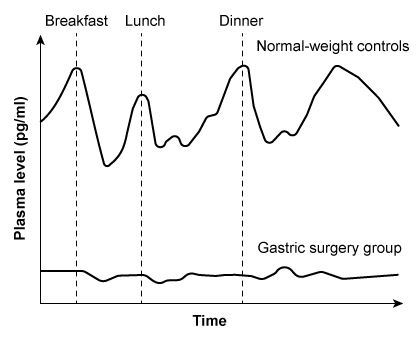 This profile most likely represents which of the following hormones?
 (Multiple Choice)
4.9/5 (78)
(78) A 62-year-old man comes to the physician for a follow-up appointment. He experienced acute myocardial infarction 2 years ago and has a long history of hypertension. After physical examination and laboratory testing, the physician decides to increase the dose of his diuretic. Repeat laboratory studies indicate that his serum calcium level increases after this adjustment. The diuretic used in this patient acts predominantly on which of the following nephron segments? 
(Multiple Choice)
4.9/5 (91)
(91) A 64-year-old man comes to the emergency department due to fever, anorexia, and nausea. He recently immigrated to the United States to live with his son. Several weeks ago, on routine testing, the patient was found to have a positive purified protein derivative test. He had no respiratory symptoms, and a chest x-ray was unremarkable. A month ago, he started isoniazid therapy with pyridoxine supplementation. Currently, temperature is 38.3 C (100.9 F). On physical examination, there is mild abdominal discomfort. Laboratory studies are pending. Which of the following is the most likely cause of this patient's current symptoms?
(Multiple Choice)
4.8/5 (76)
(76) A 50-year-old man is brought to the ER with severe dizziness and confusion. He states that he had an episode of chest pain and took several tablets of nitroglycerin. His current medications include a daily aspirin for heart attack prevention, an occasional acetaminophen for headaches and occasionally tadalafil for erectile dysfunction. His blood pressure is 50/20 mmHg and his heart rate is 120 beats/min. Which of the following cellular changes is most likely responsible for this patient's symptoms?
(Multiple Choice)
4.8/5 (73)
(73) A 28-year-old man comes to the emergency department due to progressive abdominal pain. Although he has had mild abdominal cramps in the past, he has never before experienced anything this severe. The patient has 8-10 watery stools a day, weight loss, fatigue, and lethargy. Temperature is 38.3 C (100.9 F), blood pressure is 125/82 mm Hg, pulse is 95/min, and respirations are 14/min. The abdomen is tender to palpation without rebound or guarding. Abdominal CT scan reveals inflammatory changes affecting the ascending colon, sigmoid colon, and terminal ileum. Intestinal biopsy reveals the following: 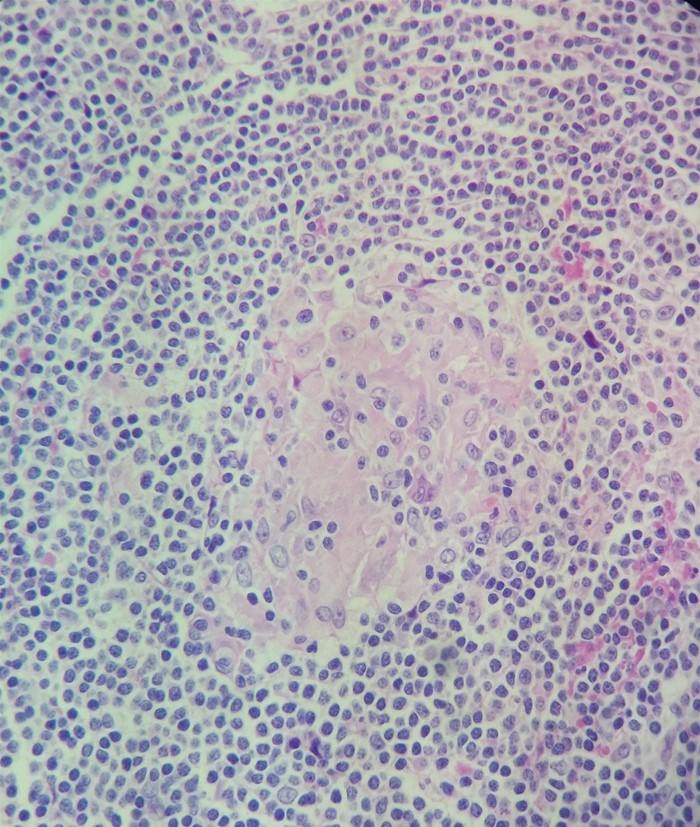 Effective treatment of this patient's condition could be achieved by targeting which of the following molecules?
 (Multiple Choice)
4.8/5 (78)
(78) A 78-year-old man is found unresponsive and is brought by ambulance to the emergency department. Upon arrival, the family says he has a complicated medical history and takes multiple medications but has no known drug allergies. Noncontrast CT scan of the head reveals intracranial hemorrhage. The patient is given a recombinant biologic agent that has antigen homology with factor Xa but no catalytic effect. The agent is most likely to antagonize the effects of which of the following drugs?
(Multiple Choice)
4.8/5 (88)
(88) A 33-year-old homeless man is hospitalized due to recent weight loss, odynophagia, and progressive cough. He is found to be HIV-positive and his CD4 count is 45/mm3. The patient's condition improves on a newly instituted treatment, but 4 weeks later at outpatient follow-up he is found to have significantly elevated fasting blood glucose. Which of the following medications is most likely responsible for his hyperglycemia?
(Multiple Choice)
4.7/5 (84)
(84) A 42-year-old man comes to the emergency department due to an episode of syncope. He was standing in his kitchen this morning when he felt palpitations for about 3 seconds; the next thing he remembers is waking up on the floor. The patient has had intermittent palpitations for the last few weeks, sometimes with associated lightheadedness. He has no significant medical history other than chronic lower back pain that began following a fall from a ladder 3 years ago. The patient fractured several lumbar vertebrae in that fall and required a surgical lumbar fusion. His back pain was uncontrolled with conservative measures, and he has been treated with escalating doses of methadone for the past year. He does not smoke or drink alcohol. The patient has a remote history of intravenous heroin abuse but has not used it for 20 years. He has no family history of early-onset heart disease, blood clots, or sudden death. Blood pressure is 120/70 mm Hg when supine and 125/75 mm Hg when standing. Physical examination is unremarkable. Which of the following ECG findings is most likely in this patient?
(Multiple Choice)
4.7/5 (78)
(78) A 49-year-old man comes to the emergency department with severe shortness of breath. The patient has a history of hypertension and medication nonadherence. Blood pressure is 260/144 mm Hg and pulse is 100/min. Chest examination demonstrates bibasilar crackles. There are no heart murmurs. Serum creatinine is 1.6 mg/dL. Intravenous furosemide and continuous nitroprusside infusion are started, along with noninvasive positive pressure ventilation, and he experiences improvement in his symptoms. The next morning, the patient is confused and lethargic, and he suffers a generalized tonic-clonic seizure. The skin appears flushed, and serum lactic acid level is elevated. The nitroprusside infusion rate is found to be higher than recommended. Which of the following mechanisms is most likely responsible for the drug toxicity seen in this patient?
(Multiple Choice)
4.8/5 (96)
(96) A study is conducted to assess the effect of parathyroid hormone (PTH) on bone remodeling. Half of the study subjects receive intermittent PTH injections and the other half receive a continuous infusion of PTH. The results show that the effects on bone metabolism of intermittent PTH injections are different from those of continuous infusion. Which of the following is most likely to be the predominant bone effect with intermittent injections?
(Multiple Choice)
4.8/5 (73)
(73) A 34-year-old man is brought to the emergency department by his wife after she found him running around the yard in his underwear shouting, "I am going to change the world." She reports that he has a lot of energy despite hardly sleeping for the past 7 days, and that he recently quit his job to write a 500-page novel that he says "explains everything about the universe." The patient's history is significant for epilepsy with generalized seizures since childhood and a psychiatric hospitalization a year ago for a major depressive episode. Family history is significant for alcoholism and hypertension in his father and schizophrenia in his grandmother. Which of the following medications would be most helpful for long-term treatment of this patient's psychiatric condition as well as his seizure disorder?
(Multiple Choice)
4.7/5 (73)
(73) A 38-year-old woman comes to the office to discuss motion sickness. She is currently feeling well. The patient is planning a vacation cruise and has previously experienced severe nausea and vomiting while sailing. She has 4 children, and her past medical history is notable only for a tubal ligation. The patient does not smoke and drinks only moderate quantities of alcohol. She is not currently taking any medications. Physical examination, including otologic and neurologic examinations, is normal. After the appropriate drug therapy is recommended, this patient should be counseled regarding which of the following side effects?
(Multiple Choice)
4.9/5 (85)
(85) A 38-year-old woman comes to the office due to breast tenderness and absence of menstrual periods over the last 3 months. The patient has a history of schizophrenia and familial hypercholesterolemia. Medications include risperidone, which has led to significant improvement in psychotic symptoms, and atorvastatin. BMI is 26 kg/m2, down from 30 kg/m2 6 months ago after following a strict dietary plan. Basic serum chemistry panel and thyroid function tests are normal, and urine pregnancy test is negative. Which of the following is the most likely explanation for this patient's amenorrhea?
(Multiple Choice)
4.9/5 (76)
(76) A 25-year-old man is brought to the emergency department after being found unresponsive. He has a history of schizoaffective disorder and previous suicide attempts by prescription medication overdose. The patient was recently started on haloperidol and sertraline. Temperature is 40.6 C (105 F), blood pressure is 180/98 mm Hg, and pulse is 112/min. On examination, the patient is obtunded and diffusely rigid without clonus. Laboratory studies show serum creatinine of 3.2 mg/dL, creatine kinase of 75,000 U/L, and leukocytes of 16,000/mm3. The antidote for this patient's current condition most likely has which of the following mechanisms of action?
(Multiple Choice)
4.9/5 (91)
(91) 
Filters
- Essay(0)
- Multiple Choice(0)
- Short Answer(0)
- True False(0)
- Matching(0)