



 Chat with AI
Exam 12: Pharmacology

Exam 1: Anatomy291 Questions
Exam 2: Behavioral science240 Questions
Exam 3: Biochemistry156 Questions
Exam 4: Biostatistics117 Questions
Exam 5: Embryology52 Questions
Exam 6: Genetics103 Questions
Exam 7: Histology24 Questions
Exam 8: Immunology129 Questions
Exam 9: Microbiology336 Questions
Exam 10: Pathology816 Questions
Exam 11: Pathophysiology464 Questions
Exam 12: Pharmacology538 Questions
Exam 13: Physiology272 Questions
Select questions type


A medical student is observing a pharmacology experiment where drug A is being intravenously administered to a pregnant dog. Some parameters that are being recorded during the experiment include heart rate, blood pressure, pupil size, and uterine contractions. The following diagrams illustrate the measured parameters and observed changes after infusing drug A. 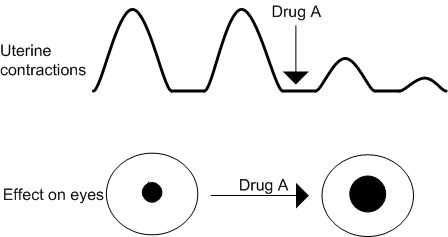 Which of the following best characterizes drug A?
 (Multiple Choice)
4.8/5  (86)
(86) A 36-year-old man comes to the office after he was found to have an abnormal lipid panel during employee wellness testing at his company. He has no prior medical problems and takes no medications. The patient is a software technician and has a sedentary lifestyle. He eats mostly fast foods, rarely exercises, and drinks 2-3 cans of beer daily. His BMI is 31 kg/m2. Physical examination is unremarkable. Results of laboratory studies performed in the office are as follows: 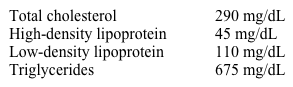 Lifestyle modification with a balanced diet, regular exercise, and reduced alcohol intake is advised. He is also started on fenofibrate therapy. This medication is most likely to help the patient by which of the following mechanisms?
 (Multiple Choice)
4.8/5 (83)
(83) A 6-month-old boy is brought to the office for a well-child visit. He is babbling, sitting with support, and rolling over. The patient is exclusively breastfed and has not yet started solid foods. The parents note that he has been straining while passing stool, which has been hard in consistency, over the last few weeks. The patient was diagnosed with congenital hypothyroidism based on newborn screening results, and levothyroxine was initiated at age 2 weeks. He also takes daily vitamin D and iron supplements. The patient has no other chronic medical conditions. Vital signs are normal for age. Weight gain is appropriate for age, but length has decreased from the 60th to the 40th percentile since the last visit. Physical examination is unremarkable. Thyroid function testing at age 4 months was normal. Results of routine follow-up laboratory testing are as follows:  Which of the following is the most likely mechanism for this patient's abnormal thyroid function tests?
 (Multiple Choice)
4.9/5 (74)
(74) A 58-year-old man comes to the office due to lower extremity pain. The patient began experiencing tingly discomfort in his toes a year ago, especially at night when the sheets touched his skin. Since then, the symptoms have progressed to a burning and stabbing pain in his feet and lower legs. He was diagnosed with diabetes mellitus 8 years ago and hypertension 3 years ago. The patient quit smoking 20 years ago and does not use alcohol. Blood pressure is 126/70 mm Hg and pulse is 68/min. Lower extremity examination shows normal-appearing skin. Touching the feet elicits a sensation of burning pain. There is loss of vibration sensation in the toes, and the ankle reflex is absent bilaterally. Which of the following is the best initial pharmacotherapy for this patient's symptoms?
(Multiple Choice)
4.8/5 (81)
(81) A 28-year-old man comes to the office due to a rash. He has a history of seizure disorder and has been taking phenytoin for 6 years. Examination shows a diffuse, macular rash and lymphadenopathy. Biopsy of a lymph node is shown in the exhibit.
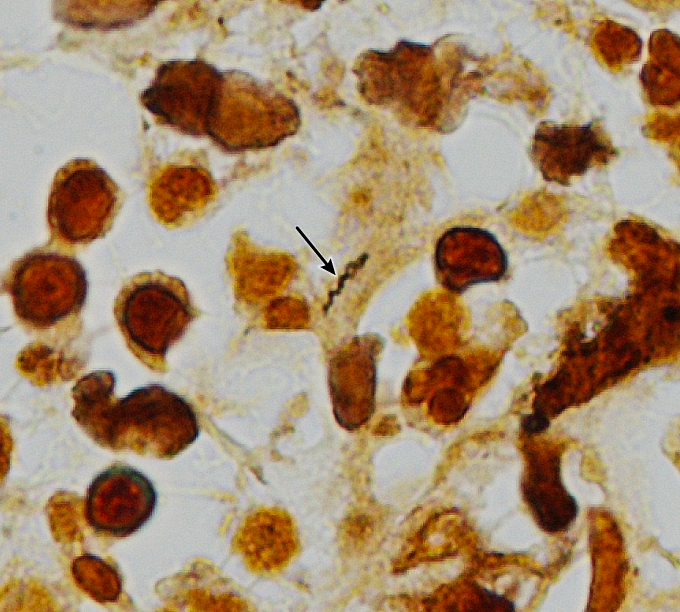 Treatment of this patient's condition is most likely to involve which of the following?
 (Multiple Choice)
4.8/5 (86)
(86) A 56-year-old man comes to the emergency department because of sudden onset of severe, diffuse abdominal pain. The patient has experienced 3 months of epigastric pain that has been refractive to proton-pump inhibitor therapy. Physical examination reveals an exquisitely tender, rigid abdomen with rebound tenderness. Abdominal radiographs reveal free air under the diaphragm. Supportive therapy is initiated. Exploratory laparotomy reveals a large, perforated gastric ulcer with features suggestive of malignancy. He undergoes partial gastrectomy with gastrojejunostomy. Long-term supplementation with which of the following is most important in this patient?
(Multiple Choice)
4.7/5 (83)
(83) A 9-year-old boy with a history of sickle cell disease is brought to the office due to fatigue. The patient takes penicillin, hydroxyurea, and folic acid daily. Temperature is 37.1 C (98.8 F), blood pressure is 102/68 mm Hg, pulse is 130/min, and respirations are 20/min. Examination shows conjunctival pallor. The oropharynx is clear and the neck is supple. The lungs are clear to auscultation bilaterally, and the abdomen is soft with normal bowel sounds; there is no organomegaly. Skin examination is unremarkable. Laboratory results are as follows: 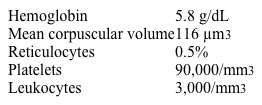 Which of the following is the most likely cause of this patient's findings?
 (Multiple Choice)
4.8/5 (85)
(85) A 56-year-old woman comes to the emergency department due to 3 days of frequent urination, suprapubic pain, dysuria, and progressive hematuria. She has had no fevers or chills. The patient has a history of lymph-node-positive breast cancer that was diagnosed following a routine mammogram. A month ago, she began treatment with systemic chemotherapy. Temperature is 37.1 C (98.8 F). Suprapubic tenderness is present on abdominal examination. Hemoglobin is 9.8 g/dL. Urinalysis shows numerous red blood cells but no leukocyte esterase or bacteria. Which of the following could have prevented this patient's current condition?
(Multiple Choice)
4.9/5 (83)
(83) A 60-year-old man comes to the emergency department with dizziness and palpitations. He woke up this morning with an intermittent pounding sensation in his chest. The patient has occasionally experienced a similar sensation in the past and did not think it was serious. Later, while mowing the lawn, he became lightheaded and had to sit down to avoid passing out. After receiving the appropriate workup, the patient is diagnosed with a cardiac arrhythmia and started on a medication known to prolong the QT interval. However, the drug is associated with a lower incidence of torsade de pointes than other QT-prolonging agents. Which of the following medications was most likely used in this patient?
(Multiple Choice)
4.9/5 (64)
(64) A 6-year-old girl is brought to the clinic due to an itchy rash on her face. The patient's mother says the rash began approximately 3 weeks ago as dry skin on both of her cheeks. Over the past few days, it has progressed with areas of weeping and increased redness, and the patient has had to wear mittens to limit irritation from constant scratching. The patient has a history of similar rashs involving the flexural areas of her elbows and knees that resolved following treatment with topical corticosteroids. Vital signs are normal. Physical examination shows erythema of the bilateral cheeks and chin with crusting and oozing. The patient is prescribed a course of topical tacrolimus. Which of the following is the most likely mechanism of action of this drug?
(Multiple Choice)
4.9/5 (70)
(70) A 44-year-old man hospitalized for acute cholecystitis is being evaluated for anxiety and agitation. He underwent an open cholecystectomy without having any operative complications. Two days after admission, the patient experiences anxiety and tremulousness, and he becomes irritable, severely agitated, and verbally abusive to the nursing staff. He has no other medical problems. The patient does not use tobacco or illicit drugs but admits to drinking 6-8 beers daily for the last several years. He has no known drug allergies, and family history is insignificant. Blood pressure is 160/90 mm Hg and pulse is 110/min. Examination shows hand tremors bilaterally. Which of the following is the most appropriate pharmacotherapy for this patient?
(Multiple Choice)
4.9/5 (90)
(90) A 65-year-old man with benign prostatic hyperplasia has moderately severe symptoms and is started on finasteride. After six months of treatment with finasteride, his symptoms improve markedly and his prostate has regressed in size. Which of the following histological patterns was most likely present at the time of initiation of treatment?
(Multiple Choice)
4.7/5 (86)
(86) Researchers investigating the effects of heart failure on the pharmacokinetics of antidiabetic medications develop a cohort of experimental animals with anthracycline-induced heart failure. The experimental animals are then administered an oral dose of metformin, and serum levels are monitored over time. The test is repeated in control animals with normal heart function and the results are shown below: 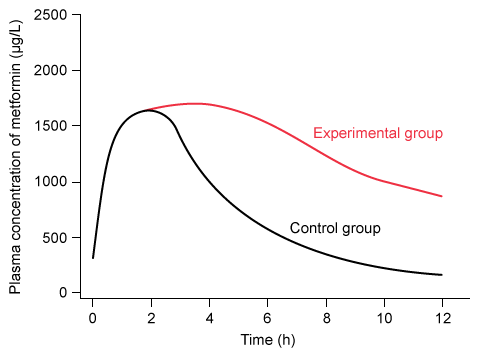 Which of the following best explains the change in serum metformin levels seen in the experimental animals?
 (Multiple Choice)
4.9/5 (74)
(74) A 54-year-old woman comes to the office for evaluation of elevated blood glucose. The patient was recently seen at an urgent care center, where she was found to have a nonfasting blood glucose level of 190 mg/dL. Medical history is insignificant, although she has not seen a physician for several years. She does not use tobacco or alcohol. BMI is 31.5 kg/m2. Physical examination shows no abnormalities. Hemoglobin A1c is 8.5% and fasting plasma glucose level is 146 mg/dL. Recommendations for dietary modification and exercise are provided, and pharmacotherapy with metformin is planned. Which of the following laboratory tests should be obtained prior to starting this medication?
(Multiple Choice)
4.9/5 (72)
(72) A 66-year-old postmenopausal woman comes to the office to discuss her bone densitometry results. She has a history of hypertension and has smoked a pack of cigarettes daily for 30 years. BMI is 20.1 kg/m2. Physical examination is unremarkable. Bone densitometry reveals low bone density consistent with osteoporosis. The patient is prescribed risedronate. Repeat bone densitometry 2 years later reveals no further loss of bone mineral density. Which of the following mechanisms most likely explains the drug's effect on bone mineral density?
(Multiple Choice)
4.9/5 (70)
(70) A 64-year-old man comes to the office for follow-up of hypertension. At the last 2 visits, his blood pressure was persistently elevated. The patient has been treated with lisinopril for the past 5 years, but his other blood pressure medications have been changed several times due to various adverse effects. Medical history is significant for type 2 diabetes mellitus, coronary artery disease with stable angina, and moderately increased albuminuria. Blood pressure is 145/87 mm Hg and pulse is 70/min. BMI is 31 kg/m2. Physical examination shows trace bilateral lower extremity edema. ECG is unremarkable. Serum laboratory results are as follows: 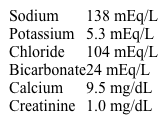 Review of the patient's medical records shows similar serum laboratory results 6 months ago. Which of the following medications should be avoided in this patient?
 (Multiple Choice)
4.9/5 (76)
(76) A large, multinational drug corporation conducts a phase I clinical trial to evaluate the safety profile and pharmacokinetic properties of a new drug designed to treat refractory epilepsy. Initial studies in animals showed that the drug undergoes extensive metabolism by the liver into glucuronidation byproducts that are primarily excreted by the kidneys. The curve below demonstrates the glucuronidation rate of the drug over a wide range of doses. 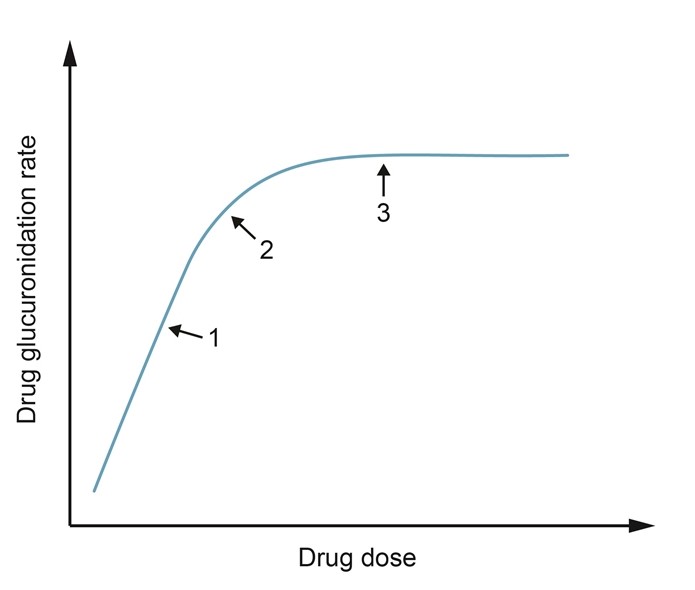 Which of the following is the most accurate statement about this drug's metabolism?
 (Multiple Choice)
4.8/5 (78)
(78) A new inhaled anesthetic under development by a pharmaceutical company is tested in a series of experiments to determine its pharmacokinetic properties. During one of the experiments, the anesthetic agent is administered at a constant partial pressure while arterial and venous concentrations are monitored. The study results show that the anesthetic has a very large arteriovenous concentration gradient shortly after beginning inhalation. Which of the following best describes the properties of the new anesthetic?
(Multiple Choice)
4.7/5 (79)
(79) 
Filters
- Essay(0)
- Multiple Choice(0)
- Short Answer(0)
- True False(0)
- Matching(0)