



 Chat with AI
Exam 12: Pharmacology

Exam 1: Anatomy291 Questions
Exam 2: Behavioral science240 Questions
Exam 3: Biochemistry156 Questions
Exam 4: Biostatistics117 Questions
Exam 5: Embryology52 Questions
Exam 6: Genetics103 Questions
Exam 7: Histology24 Questions
Exam 8: Immunology129 Questions
Exam 9: Microbiology336 Questions
Exam 10: Pathology816 Questions
Exam 11: Pathophysiology464 Questions
Exam 12: Pharmacology538 Questions
Exam 13: Physiology272 Questions
Select questions type


A 24-year-old man comes to the emergency department due to the sudden onset of palpitations. The patient says it feels like "my heart is racing." He had an episode similar to this a year ago that resolved spontaneously. Blood pressure is 126/74 mm Hg and pulse is 164/min. Rapid intravenous administration of a medication to this patient results in instantaneous resolution of the arrhythmia but is accompanied by short-lived flushing, burning in the chest, and shortness of breath. Which of the following medications was used to treat this patient's condition?
(Multiple Choice)
4.7/5  (79)
(79) A 23-year-old woman comes to the office describing restlessness in her legs and inability to lie or sit still. The patient was diagnosed with schizophrenia a month ago and medication therapy was initiated. Her dose was increased after 2 weeks. She says, "I haven't heard any voices since a few days after the medication was increased." Blood pressure is 140/90 mm Hg and pulse is 90/min. The patient is alert, oriented, fidgety, and anxious. Which of the following is the most likely diagnosis in this patient?
(Multiple Choice)
5.0/5 (76)
(76) A new antibiotic developed for the treatment of infections caused by resistant gram-positive cocci has a volume of distribution of 11L. It is eliminated by first-order kinetics and has a half-life of 10 hours. If given by a continuous infusion, approximately how much time would it require for the drug to achieve a 95% plasma steady state concentration?
(Multiple Choice)
4.8/5 (85)
(85) A 62-year-old man comes to the office due to decreased libido and failure to achieve satisfactory erections. The patient has coronary artery disease and heart failure with reduced ejection fraction and was prescribed spironolactone therapy several months ago. Other medications include aspirin, lisinopril, furosemide, and metoprolol. Blood pressure is 110/70 mm Hg and pulse is 70/min. Oxygen saturation is 95% on room air. Examination shows a left ventricular S3 and trace pitting ankle edema. Breast examination demonstrates bilateral enlargement with mild tenderness. Which of the following is the most likely cause of this patient's current symptoms?
(Multiple Choice)
4.9/5 (86)
(86) A 72-year-old man is brought to the hospital due to severe substernal chest pain and shortness of breath for the last several hours. The pain started suddenly when he was outside working in the garden. Medical history includes diet-controlled diabetes mellitus and hypertension. Physical examination reveals bilateral crackles and a third heart sound. ECG shows ST elevation in multiple leads. The patient is diagnosed with an acute myocardial infarction complicated by acute severe heart failure. He is started on dobutamine infusion and prepared for coronary catheterization. Which of the following is most likely to be increased due to the medication used in this patient?
(Multiple Choice)
5.0/5 (91)
(91) A 12-year-old girl is being evaluated for recurrent episodes of self-limited colicky abdominal pain and nausea lasting several days. She was also recently hospitalized for an episode of difficulty breathing. The patient has no significant past medical history, but her mother has a history of attacks of severe abdominal pain and diarrhea. Physical examination is unremarkable. Laboratory evaluation reveals decreased serum complement C4 and C1 esterase inhibitor levels. Which of the following drugs is contraindicated in this patient?
(Multiple Choice)
4.9/5 (76)
(76) A 32-year-old man is brought to the emergency department by police after an altercation at a local pub. He is agitated and says that his chest hurts. Blood pressure is 170/100 mm Hg and pulse is 130/min and regular. On physical examination, the patient is combative and uncooperative. There are no signs of physical injury. His pupils are dilated and reactive to light. Examination shows nasal perforation. ECG reveals myocardial ischemia. Inhibition of which of the following processes is most likely responsible for this patient's presentation? 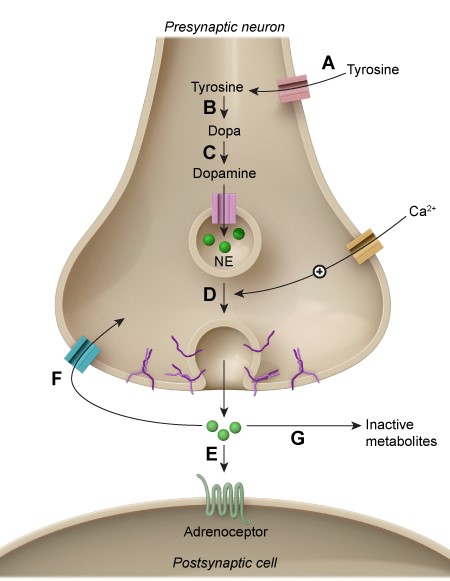
(Multiple Choice)
4.8/5 (72)
(72) A new antiarrhythmic medication (drug A) is tested in a series of experiments that measure the flow of ions responsible for producing an action potential in cardiac muscle cells. Ion flow is measured before and after the drug is administered, and the results are shown in the chart below (each colored line represents a different type of ion). 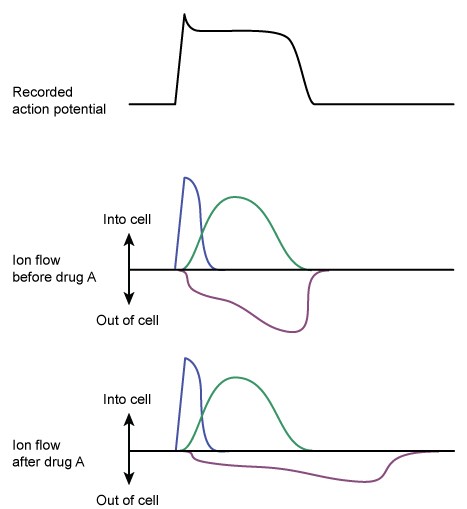 Drug A has an antiarrhythmic effect most similar to which of the following drugs?
 (Multiple Choice)
4.9/5 (71)
(71) A 78-year-old male nursing home resident is brought to the physician because of abdominal pain and discomfort. He has a history of advanced dementia and is only partially able to verbalize his symptoms. He has had intermittent abdominal discomfort for years, with no other related symptoms. He denies diarrhea and rectal bleeding but has not had a bowel movement in approximately 5 days. The patient is largely bed-bound, and only has minimal activity with the help of nurses and physical therapists. Past regular colonoscopies have shown only benign lesions. His other medical problems include dementia, coronary artery disease, hypertension, spinal stenosis, and osteoarthritis of his hips and knees. Abdominal examination does not show tenderness, masses, or hepatosplenomegaly, although fullness is appreciated. The remainder of the examination shows no abnormalities. Polyethylene glycol is administered and produces a bowel movement within 24 hours. The mechanism of action of polyethylene glycol in this patient is most similar to the pathophysiology of which of the following disorders?
(Multiple Choice)
4.8/5 (67)
(67) Researchers analyze the HIV viral structure and replication cycle for new drug targets. They find the virus encodes a large glycoprotein, which gets cleaved into 2 subunits, the surface and transmembrane subunits. These subunits remain noncovalently bound to each other in the virion. Upon activation of the surface protein, conformational changes occur in the transmembrane subunit exposing the functional inner core. A novel drug is developed that selectively binds and prevents normal functioning of the transmembrane subunit, interfering with the normal viral replication cycle. This agent most likely directly inhibits which of the following viral processes?
(Multiple Choice)
5.0/5 (74)
(74) A 65-year-old woman comes to the emergency department due to left leg pain and swelling for the past day. She has had no trauma or fever. The patient has a history of hypertension, congestive heart failure, type 2 diabetes mellitus, and osteoporosis. Family history is notable for breast cancer in her mother and sister. She takes multiple medications. Temperature is 37.8 C (100 F), blood pressure is 130/80 mm Hg, and pulse is 99/min. Pulse oximetry shows 98% on ambient air. The lungs are clear to auscultation, and heart sounds are normal without murmur. There is tenderness and edema of the left lower extremity up to the mid thigh. Venous Doppler ultrasonography reveals an occluding thrombus in the left femoral and popliteal veins. Which of the following pharmacotherapies most likely contributed to this patient's current condition?
(Multiple Choice)
4.9/5 (75)
(75) A 12-year-old boy is brought to the emergency department due to a peritonsillar abscess. In preparation for incision and drainage, the patient is given a topical anesthetic, an anxiolytic, pain medications, and antibiotics. He develops a headache and becomes lethargic. Temperature is 38 C (100.8 F), pulse is 110/min, and respirations are 16/min. The lungs are clear to auscultation bilaterally. The lips and fingertips appear blue and the oxygen saturation is 84%. Supplemental oxygen is started but does not improve peripheral oxygen saturation. Which of the following is the most likely cause of this patient's hypoxemia?
(Multiple Choice)
4.8/5 (87)
(87) A mother brings her 4-year-old son to see you because he has been experiencing decreased appetite, fever, and right-sided ear discharge for the past 24 hours. His past medical history is significant for three episodes of otitis media over the last year. You prescribe amoxicillin. Adding clavulanic acid to this treatment regimen would serve which of the following purposes?
(Multiple Choice)
5.0/5 (85)
(85) A 35-year-old woman who is being treated for bipolar disorder complains of excessive thirst and frequent urination. She awakens 3-4 times nightly to void. A urinalysis performed after 8 hours of nothing to eat or drink shows the following: 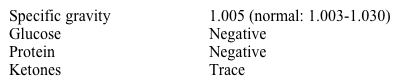 Which of the following parts of the nephron is most likely impaired in this patient?
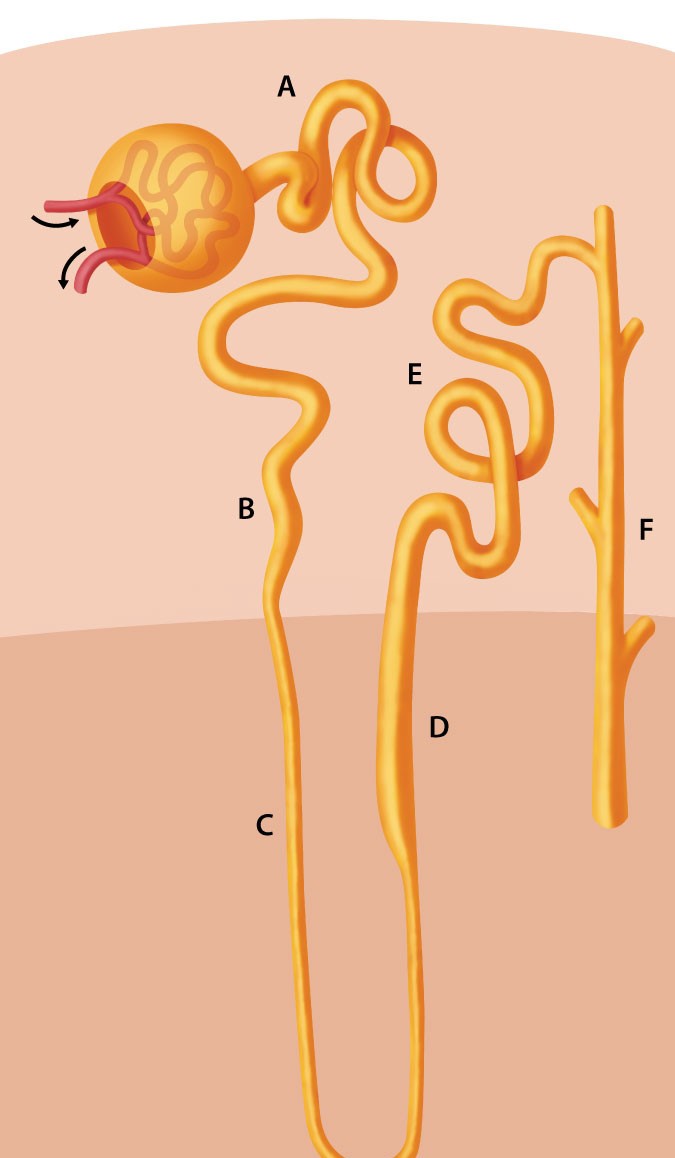
Which of the following parts of the nephron is most likely impaired in this patient? (Multiple Choice)
4.9/5 (66)
(66) A 56-year-old man is hospitalized due to worsening fever, chills, and perirectal pain. Physical examination reveals a large perirectal abscess. Empiric antibiotics are begun, and surgical drainage is planned. The patient receives succinylcholine and propofol prior to the procedure. The intraoperative course is uneventful, but postoperative spontaneous recovery of respiration and voluntary muscle activity does not occur. Mechanical respiratory support is continued, and several hours later, the patient is successfully weaned from the ventilator. Which of the following is the most likely underlying cause of this patient's postoperative complications?
(Multiple Choice)
4.8/5 (78)
(78) A 45-year-old man comes to the clinic due to recurrent palpitations accompanied by chest discomfort and shortness of breath. A year ago, he was diagnosed with paroxysmal atrial fibrillation treated with rate control using a beta blocker. Past medical history is also significant for hypertension and obesity. Echocardiogram shows left atrial enlargement, normal left ventricular ejection fraction, and no significant valvular disease. 24-hour Holter monitoring reveals bursts of atrial fibrillation associated with the patient's symptoms. He is initiated on dofetilide to maintain normal sinus rhythm. This medication exerts its main effect on which portion of the action potential curve? 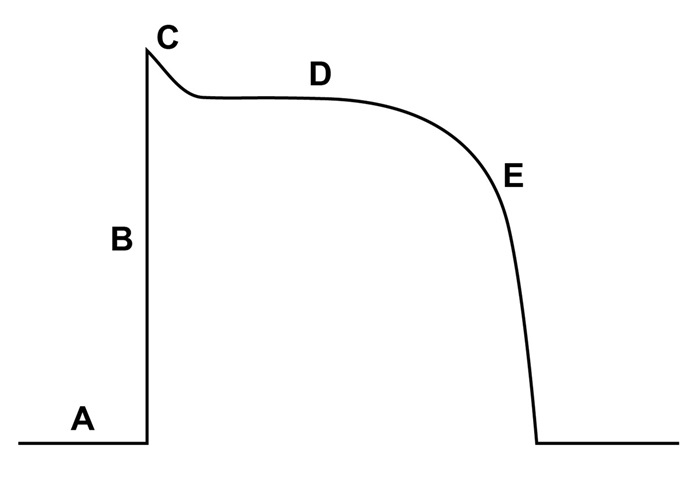
(Multiple Choice)
4.9/5 (86)
(86) A 56-year-old man comes to the emergency department due to right lower extremity pain and swelling. The symptoms began shortly after he flew back to the United States from a 7-day cruise in Indonesia. Doppler ultrasonography reveals a femoropopliteal venous thrombosis, and the patient is given anticoagulation with rivaroxaban. Compared to vitamin K antagonists, this patient's treatment is most likely to have which of the following benefits?
(Multiple Choice)
4.7/5 (71)
(71) A 32-year-old previously healthy woman comes to the office due to several weeks of anxiety, palpitations, excessive sweating, and thinning hair. The symptoms have progressively worsened and interfered significantly with her daily activities. The patient does not use tobacco, alcohol, or illicit drugs. Blood pressure is 130/70 mm Hg and pulse is 104/min. On physical examination, there is lid lag, moderate exophthalmos, and fine tremors of the outstretched hands. After the diagnosis is made, she is prescribed propranolol for immediate symptom control. Which of the following findings is most likely to persist in this patient despite this therapy?
(Multiple Choice)
4.8/5 (69)
(69) A 68-year-old man comes to the office with a 6-week history of muscle pain and fatigue. He has achy pain that is not related to activity. The patient has tried warm compresses and over-the-counter analgesics without relief. Past medical history is significant for hypertension, mixed hyperlipidemia, and coronary artery disease with an acute myocardial infarction 2 years ago. Physical examination shows diffuse tenderness in the proximal muscles of the upper and lower extremities. Serum creatine kinase activity is elevated. Which of the following drug combinations is most likely responsible for this patient's condition?
(Multiple Choice)
4.8/5 (81)
(81) A 46-year-old man comes to the emergency department with flank pain and hematuria. The pain is similar to several previous episodes of kidney stones. Abdominal imaging reveals a radiopaque calculus in the right ureter. The patient is admitted to the hospital and given intravenous hydration and analgesics. He subsequently passes the stone with rapid relief of his symptoms. Chemical analysis reveals that the stone is composed primarily of calcium oxalate. Which of the following medications is most likely to prevent recurrent stone formation in this patient?
(Multiple Choice)
4.8/5 (74)
(74) 
Filters
- Essay(0)
- Multiple Choice(0)
- Short Answer(0)
- True False(0)
- Matching(0)