



 Chat with AI
Exam 12: Pharmacology

Exam 1: Anatomy291 Questions
Exam 2: Behavioral science240 Questions
Exam 3: Biochemistry156 Questions
Exam 4: Biostatistics117 Questions
Exam 5: Embryology52 Questions
Exam 6: Genetics103 Questions
Exam 7: Histology24 Questions
Exam 8: Immunology129 Questions
Exam 9: Microbiology336 Questions
Exam 10: Pathology816 Questions
Exam 11: Pathophysiology464 Questions
Exam 12: Pharmacology538 Questions
Exam 13: Physiology272 Questions
Select questions type


A 56-year-old Caucasian female presents to your office with chronic cough. She says that the cough is dry and affects quality of her life significantly. She denies chest pain, hemoptysis and shortness of breath. Her past medical history is significant for long-standing hypertension, diabetes and myocardial infarction experienced two months ago. She does not smoke or consume alcohol. Her blood pressure is 130/70 mmHg and heart rate is 70/min. Which of the following is the best next step in the management of this patient?
(Multiple Choice)
5.0/5  (71)
(71) A 45-year-old man comes to the emergency department due to 2 days of left knee swelling and pain. The patient has no significant past medical history apart from an episode of facial palsy 3 months ago. Six months ago, he went on a hiking trip to New Hampshire but has no other travel history. The patient is in a long-standing monogamous relationship with his wife and has had no other sexual partners. Temperature is 37.1 C (98.8 F). Examination shows left knee joint swelling with no surrounding erythema. The remainder of the musculoskeletal examination is unremarkable. There is no heart murmur. Which of the following might have prevented this patient's knee condition?
(Multiple Choice)
4.9/5 (73)
(73) A 54-year-old man is hospitalized after a planned abdominal surgery. One of his physicians administers a new drug whose mechanism of action you do not know. Shortly after administration of the drug the patient develops flushing, diaphoresis and nausea. His blood pressure is 100/70 mmHg and heart rate is 55/min. His pupils are constricted but reactive to light. This medication is most likely given for which of the following conditions?
(Multiple Choice)
5.0/5 (90)
(90) A 65-year-old man is brought to the emergency department after developing sudden-onset right-side weakness and difficulty speaking. He has a history of paroxysmal atrial fibrillation and has been taking warfarin for the past several years with a stable prothrombin time. His wife adds that he started taking a new drug 2 weeks ago, but she does not remember its name. Physical examination shows right hemiplegia, right hemisensory loss, expressive aphasia, and right homonymous hemianopia. MRI of the head shows a left middle cerebral artery territory infarct. Transesophageal echocardiogram reveals a small thrombus in the left atrium. This patient most likely started taking which of the following drugs recently?
(Multiple Choice)
4.7/5 (83)
(83) A 48-year-old man comes to the office due to several hours of severe right knee pain. The patient has a history of peptic ulcer disease and gastroesophageal reflux disease. His right knee is swollen, erythematous, and tender. Arthrocentesis is performed and synovial fluid analysis shows needle-shaped, negatively birefringent crystals with many neutrophils. The medication given to this patient selectively binds to an interleukin-1 inducible enzyme that is highly expressed by inflammatory cells and undetectable in the surrounding normal tissue. Which of the following is most likely the drug used in this patient's treatment?
(Multiple Choice)
4.9/5 (83)
(83) A 52-year-old woman comes to the emergency department due to recurrent right lower extremity swelling, pain, and erythema. The patient's medical history includes type 2 diabetes mellitus and depression. Her medications include metformin, paroxetine, and a multivitamin. The patient is diagnosed with cellulitis, admitted to the hospital, and started on antibiotics. She is continued on her home medications. Three days later, the patient becomes agitated and delirious with severe abdominal cramps and diarrhea. Her temperature is 39.2 C (102.6 F), blood pressure is 180/100 mm Hg, and heart rate is 120/min and regular. On examination, the patient is diaphoretic and tremulous, and her pupils are dilated. Bilateral hyperreflexia and ankle clonus are present. She begins to have seizures. Which of the following antibiotics was the patient most likely given to treat the cellulitis?
(Multiple Choice)
4.9/5 (77)
(77) A 26-year-old man is being evaluated for recurrent boils and skin abscesses. Anterior nares swab culture is performed to determine colonization by the culprit bacteria, which yields gram-positive cocci in clusters. The bacteria are able to grow in a media containing oxacillin. PCR testing reveals the pathogen has acquired the mecA gene. These bacteria are most likely to be resistant to which of the following antibiotics?
(Multiple Choice)
4.8/5 (76)
(76) A 43-year-old woman comes to the emergency department due to low-grade fevers and malaise. She has a history of lung transplantation due to cystic fibrosis and had 2 episodes of cytomegalovirus (CMV) viremia over the past few months, which were treated with ganciclovir. Temperature is 37.6 C (99.7 F). Physical examination is unrevealing. Chest x-ray and urinalysis are negative for infection. Polymerase chain reaction testing for CMV in blood shows elevated CMV levels consistent with CMV viremia. Given the recurrent episodes of viremia, genotype analysis is performed and demonstrates ganciclovir-resistant CMV. The patient is started on an alternate intravenous antiviral agent. She develops hypocalcemia and hypomagnesemia. Which of the following agents is the most likely cause of these side effects?
(Multiple Choice)
4.9/5 (76)
(76) A 45-year-old woman comes to the office due to progressive visual difficulty with night driving and reading road signs and fine print. The patient has systemic lupus erythematosus, which is treated with hydroxychloroquine and prednisone. She avoids sun exposure due to photosensitivity and has vitamin D deficiency for which she takes a vitamin D supplement. Examination shows opacities on the posterior side of the lenses in both eyes. Optic discs are normal. Ocular movements are full. The remainder of the examination shows no abnormalities. Which of the following is the most significant contributing factor for the eye findings in this patient?
(Multiple Choice)
4.9/5 (90)
(90) A 56-year-old woman comes to clinic for follow-up of heart failure with reduced ejection fraction. Over the last 3 months, the patient has been hospitalized twice due to acute decompensation of heart failure that required treatment with intravenous furosemide. Since her most recent discharge, she has been taking high doses of oral furosemide, but she continues to have progressive lower extremity edema and weight gain. Serum creatinine is 1.2 mg/dL and serum potassium is 4.1 mEq/L. The patient is started on metolazone. The addition of metolazone is likely to assist in treating this patient because of which of the following effects of furosemide?
(Multiple Choice)
4.7/5 (88)
(88) Physiologists conduct a series of experiments on hypophysectomized animals to investigate the effects of cortisol on vascular reactivity. Their initial tests show that administration of cortisol alone does not elicit a vascular response. Next, the researchers measure vascular reactivity to an infusion of norepinephrine both with and without pretreatment with cortisol. The results of their experiments are shown in the graph below. 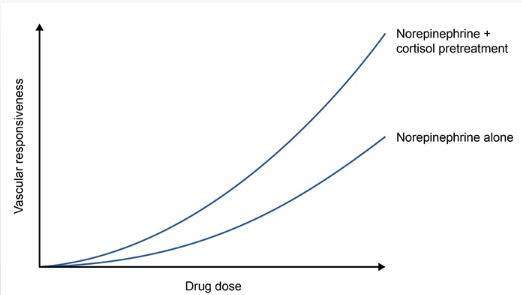 Which of the following pharmacologic principles best describes the effect of cortisol in this experiment?
 (Multiple Choice)
4.8/5 (74)
(74) A 23-year-old woman comes to the emergency department due to 2 hours of fever, chills, headache, and myalgias. Earlier in the day, the patient saw her primary care physician for a genital ulcer. She underwent testing for sexually transmitted infections and was found to have a positive VDRL and fluorescent treponemal antibody absorption test. The remainder of her testing was negative. The patient received an intramuscular injection of benzathine penicillin G, and several hours later her current symptoms began. Temperature is 38 C (100.4 F), blood pressure is 120/70 mm Hg, and pulse is 92/min and regular. Lung sounds are normal. There is an indurated, nontender vulval ulcer and several enlarged inguinal lymph nodes. No other skin rash is present. Which of the following is the most likely cause of this patient's current symptoms?
(Multiple Choice)
4.8/5 (88)
(88) A 71-year-old woman comes to the emergency department due to progressive dyspnea and orthopnea for the last week. She has a history of myocardial infarction and systolic heart failure with a left ventricular ejection fraction of 15%. The patient is compliant with her medications, which include carvedilol, furosemide, aspirin, lisinopril, and atorvastatin. Blood pressure is 118/74 mm Hg and pulse is 72/min. Examination reveals elevated jugular venous pressure, bibasilar crackles, an S3 heart sound, and bilateral lower extremity pitting edema. The patient is started on dobutamine infusion, which provides significant symptom relief. Echocardiogram shows mild improvement in cardiac contractility. Which of the following is the likely mechanism underlying this patient's clinical improvement?
(Multiple Choice)
5.0/5 (74)
(74) A 64-year-old man comes to the office after learning at the dentist's office that he has elevated blood pressure. The patient is a combat veteran and has always been "fit as a bull." He has undergone various minor surgical procedures for wartime injuries. He reports many years of tobacco and alcohol use but currently uses neither. On careful questioning, he describes chest pain on exertion. Blood pressure is 155/90 mm Hg and pulse is 76/min. Physical examination is significant for decreased pulse amplitude over the right femoral artery and a systolic bruit over the left carotid artery. Resting ECG is unremarkable, and serum creatinine is 1.1 mg/dL. Urinalysis is negative for protein. Treatment for hypertension is initiated with ramipril. On a follow-up visit 3 weeks later, blood pressure is 142/85 mm Hg but serum creatinine has increased to 2 mg/dL. This laboratory finding is best explained by an effect of the drug on which of the following structures (as indicated in the image)? 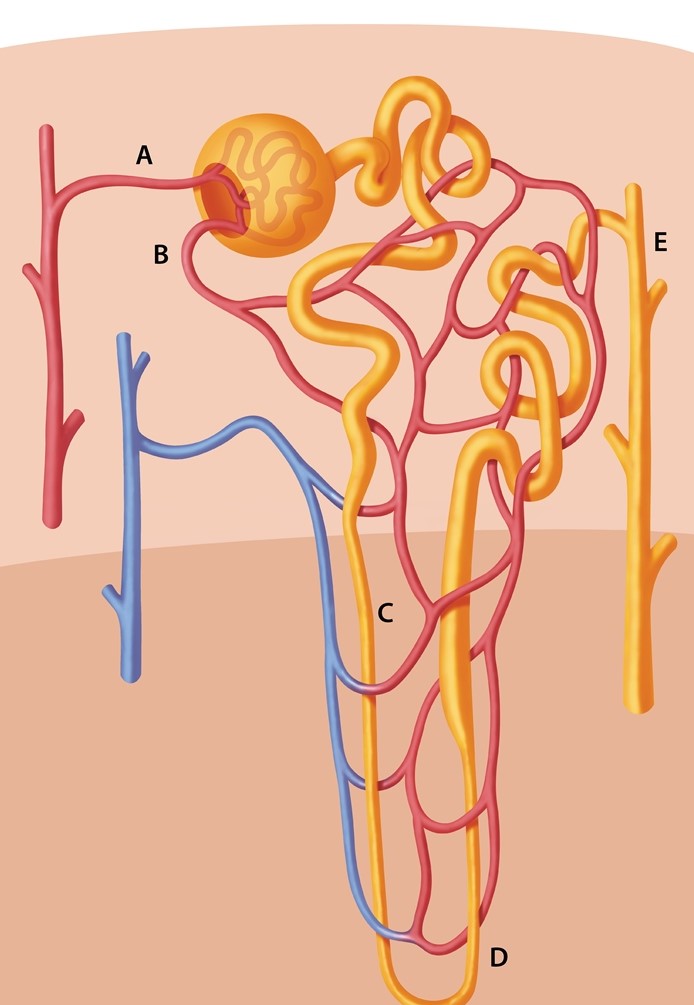
(Multiple Choice)
4.8/5 (80)
(80) A 57-year-old female presents to the emergency department after vomiting a substance that resembled "coffee grounds." She reports that she now feels lightheaded as well. Her past medical history is significant for deep venous thromboses, for which she takes warfarin, and occasional joint pain, for which she takes aspirin. Her blood pressure is 90/60 mm Hg and her pulse is 110 beats per minute. Which of the following substances would provide the fastest reversal of warfarin's effects?
(Multiple Choice)
4.8/5 (84)
(84) A 46-year-old man is diagnosed with resistant hypertension. He had a comprehensive workup for secondary hypertension, which was unrevealing. The patient has tried multiple antihypertensive medications without significant effect. Past medical history is otherwise unremarkable. He agrees to enroll in a trial of a new long-acting medication that causes selective direct relaxation of the smooth muscle of arterioles but does not affect the veins. Which of the following adverse effects is most likely to be caused by the drug during the clinical trial?
(Multiple Choice)
4.9/5 (91)
(91) A 7-year-old boy is brought to the emergency department by his older sister after being found in their mother's bathroom with an open bottle of pills. The bottle is unlabeled and the boy is unable to describe how many pills he ingested. The sister, who was babysitting, became alarmed when the boy subsequently became increasingly lethargic over the next hour. The mother takes medications for anxiety, depression, and chronic lower back pain. On arrival, the boy is somnolent and difficult to arouse. Temperature is 36.7 C (98 F), blood pressure is 100/60 mm Hg, pulse is 75/min, and respirations are 16/min. Physical examination is unremarkable. Which of the following drugs is most likely to reverse this patient's symptoms?
(Multiple Choice)
4.9/5 (86)
(86) A 55-year-old nurse was started on multidrug therapy 3 weeks ago to treat pulmonary tuberculosis contracted from a former patient. He comes to his primary care provider due to fatigue and low-grade fever for several days. He also has had muscle aches and severe joint pain in his elbows, wrists, and knees. The patient says, "I don't think it's the flu; I had the vaccine months ago." He has no current respiratory symptoms apart from pleuritic chest pain. The patient has no other significant past medical or family history. His examination is unremarkable. Laboratory results are as follows: 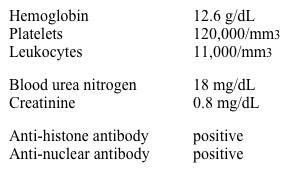 An abnormality in which of the following metabolic processes most likely underlies this patient's current condition?
 (Multiple Choice)
4.9/5 (71)
(71) A 53-year-old man comes to the emergency department with shortness of breath and chest tightness. The patient was playing in a poker tournament when his symptoms first began. He has a history of hypertension and is not compliant with his medications. His last medical follow-up was a year ago. Blood pressure is 195/115 mm Hg and pulse is 90/min and regular. Lung examination reveals bibasilar crackles. Nitroglycerin infusion is started and results in significant symptomatic improvement. Repeat blood pressure is 165/90 mm Hg. Which of the following intracellular events is most likely responsible for the beneficial effects of this patient's treatment?
(Multiple Choice)
5.0/5 (86)
(86) A 51-year-old woman comes to the office for a follow-up visit. Three weeks ago, she had a screening mammogram that was suspicious for malignancy. An ultrasound-guided needle aspiration was performed and showed invasive ductal carcinoma. The patient underwent a lumpectomy with axillary dissection and was found to have no metastatic disease. Immunohistochemical analysis of the tumor specimen was significant for the following: 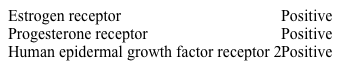 Adjuvant therapy with a monoclonal antibody is started. Which of the following is the most likely target of this drug?
 (Multiple Choice)
4.9/5 (87)
(87) 
Filters
- Essay(0)
- Multiple Choice(0)
- Short Answer(0)
- True False(0)
- Matching(0)