



 Chat with AI
Exam 12: Pharmacology

Exam 1: Anatomy291 Questions
Exam 2: Behavioral science240 Questions
Exam 3: Biochemistry156 Questions
Exam 4: Biostatistics117 Questions
Exam 5: Embryology52 Questions
Exam 6: Genetics103 Questions
Exam 7: Histology24 Questions
Exam 8: Immunology129 Questions
Exam 9: Microbiology336 Questions
Exam 10: Pathology816 Questions
Exam 11: Pathophysiology464 Questions
Exam 12: Pharmacology538 Questions
Exam 13: Physiology272 Questions
Select questions type


A 34-year-old man comes to the office for evaluation of opioid use disorder. He was prescribed oxycodone for a sports-related injury in his mid-20s, developed dependency, and began using intravenous heroin in its place. In the past few years, the patient has had multiple overdoses requiring naloxone administration. He recently tried quitting heroin on his own but experienced recurrent relapses. He has now been abstinent for 2 days but reports significant cravings. After a discussion of various treatment options, the patient is prescribed buprenorphine. The dose-response curve of this medication is shown in the image below: 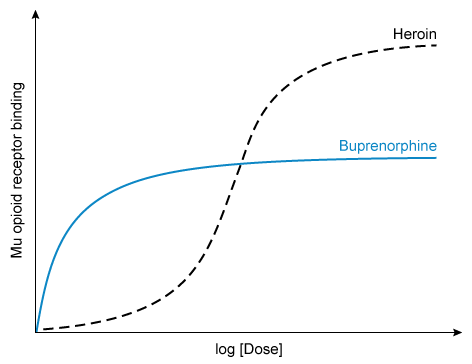 Which of the following clinical pharmacologic effects of buprenorphine is most likely?
 (Multiple Choice)
4.8/5  (82)
(82) A 70-year-old man comes to the physician with muscle rigidity that impairs his daily activities. He was diagnosed with Parkinson disease 5 years ago and takes levodopa/carbidopa. His initial response to the medication allowed him to continue all of his usual activities. Recently, the patient has been experiencing episodes of sudden restricted mobility lasting several hours, and sometimes he "freezes" altogether. These episodes alternate with symptom-free periods in which he is mobile and feels well. The patient desires relief as he believes he can still "do so much" with his life. During discussion of this patient's fluctuating mobility, which of the following should the physician emphasize?
(Multiple Choice)
4.9/5 (79)
(79) A 57-year-old man comes to the emergency department with severe right-sided eye pain and ipsilateral headache. Furthermore, the patient reports severe nausea and describes seeing "halos" around objects. After initial treatment with the appropriate medication, the severity of his pain decreases. He also experiences increased diuresis with highly alkaline urine. The drug used to treat this patient's eye condition predominantly acts on which of the following nephron segments? 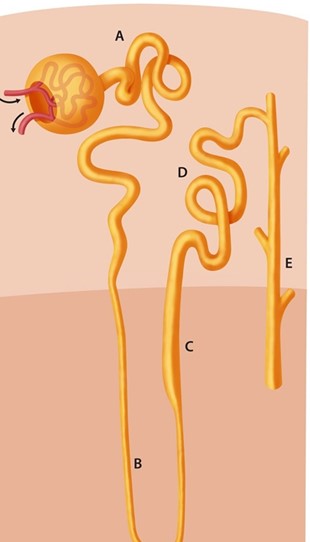
(Multiple Choice)
4.9/5 (78)
(78) A 57-year-old Caucasian male with severe pyelonephritis is admitted to the hospital. His past medical history is significant for diabetes, hypertension, and two episodes of transient ischemic attacks. His serum creatinine level is 3.2 mg/dL; therefore, he needs to be started on an antibiotic that depends mainly on non-renal clearance. Which of the following characteristics should the antibiotic also have if hepatic metabolism and clearance is desired?
(Multiple Choice)
4.8/5 (89)
(89) MPTP is a toxic substance that induces a Parkinsonism-like syndrome by destroying dopaminergic neurons in the CNS. A series of experiments demonstrated that MPTP per se is minimally toxic. Actually, it is a metabolite of MPTP, produced by MAO type B and called MPP+, that causes the neurological damage. Pretreatment by which of the following agents would minimize the damage induced by MPTP consumption?
(Multiple Choice)
4.7/5 (75)
(75) An investigator studies the effects of 2 different medications on the heart rate of patients with persistent atrial fibrillation. After participants receive therapeutic doses of medication for several days, their heart rates are measured for 24 hours at rest and during 10 minutes of moderate exercise. The results are compared against placebo and shown in the graphs below. Which of the following medications is most likely represented by the red line (drug 1)? 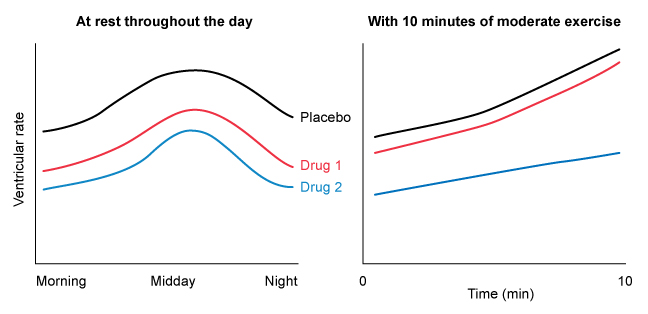
(Multiple Choice)
4.8/5 (61)
(61) A medical student is conducting a pharmacology experiment to determine the effects of a certain drug. She infuses this drug intravenously over different dose ranges and measures several important hemodynamic parameters. Graphs plotting the observed changes in renal blood flow and cardiac output are shown below. 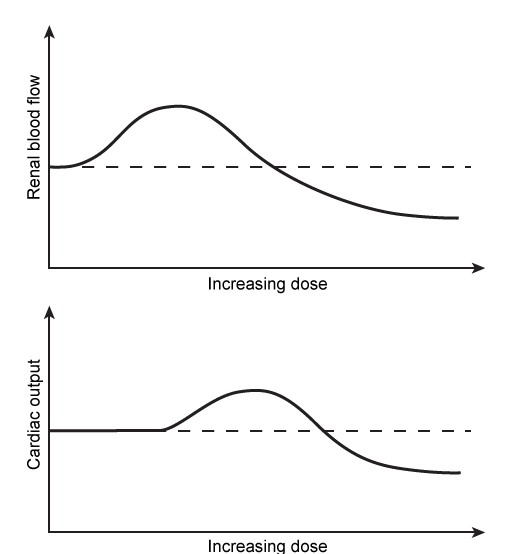 Which of the following drugs was most likely used in this experiment?
 (Multiple Choice)
4.8/5 (92)
(92) A 34-year-old woman comes to the office due to inability to lose weight despite diet and exercise. She reports that she gained a significant amount of weight after she stopped smoking 4 years ago. The patient has tried several commercial weight-loss diet programs in the last year without success. She wants to lose at least 4.5 kg (10 lb) over the next few months before she gets married. The patient does not have any other medical conditions and takes no medications. Blood pressure is 122/80 mm Hg and pulse is 78/min. BMI is 33 kg/m2. Physical examination shows an obese habitus but is otherwise unremarkable. Laboratory testing for secondary causes of weight gain is unrevealing. In addition to encouraging continued efforts at lifestyle change, the physician prescribes a short course of oral phentermine for weight loss. The weight loss induced by this medication is caused by which of the following mechanisms?
(Multiple Choice)
4.9/5 (75)
(75) A 46-year-old woman comes to the office for follow-up after an episode of alcoholic pancreatitis. She was hospitalized 4 weeks ago for abdominal pain and concurrently underwent treatment with benzodiazepines for alcohol withdrawal. Prior to hospitalization, the patient was drinking 3 L of boxed wine daily; however, she has remained abstinent since discharge. She is interested in medication for her alcohol use disorder, but lives alone and is worried that her cravings will overwhelm her self control. A medication with which of the following mechanisms of action would be most effective in this patient?
(Multiple Choice)
4.9/5 (92)
(92) A 32-year-old woman comes to the emergency department due to severe headache, nausea, and vomiting for the past several hours. The headache is pounding and localized to the left side. She also describes bright spots in her vision prior to headache onset. The patient has had similar episodes occasionally since adolescence. Physical examination shows normal pupils and fundi, but the patient has discomfort to bright light. There is no facial droop, extremity weakness, or sensory loss. The patient is treated with metoclopramide and diphenhydramine. Which of the following is the most likely reason diphenhydramine was used in this patient?
(Multiple Choice)
4.9/5 (70)
(70) A 61-year-old man comes to the office to follow up acute arthritis. He was seen at a nearby urgent care center 6 weeks ago for sudden-onset pain and swelling in the ankle. The patient was treated with an unknown analgesic with rapid relief of his pain. Since that time, his pain has resolved completely and he is now feeling well. Past medical history is notable for hypercholesterolemia, for which he takes atorvastatin. He also has a history of recurrent renal colic. On examination, his ankle appears normal with no redness, warmth, or swelling. Serum uric acid level is 9.8 mg/dL. Which of the following is the best agent for long-term management of this patient?
(Multiple Choice)
4.8/5 (70)
(70) A 52-year-old woman comes to the office due to a hand tremor that has been present for several months. It is most prominent while she is carrying out simple daily activities such as drinking from a glass or pouring from a tea kettle. When asked if anything improves the tremor, the patient mentions that it subsides somewhat when she drinks small amounts of alcohol. Family history is significant for similar problems in her mother. Vital signs are normal. Neurologic examination shows bilateral tremor in the upper extremities. Which of the following is the best treatment for this patient?
(Multiple Choice)
4.8/5 (86)
(86) A 42-year-old man comes to the emergency department due to fever, abdominal pain, and explosive diarrhea. He has a history of HIV but has not been taking any medications. BMI is 18.2 kg/m2. Abdominal examination is notable for right-sided tenderness to palpation. Laboratory results show a CD4 cell count of 38/mm3, leukopenia, and thrombocytopenia. A CT scan of the abdomen reveals colitis. Colonoscopy reveals areas of erosions and ulcerations; pathology demonstrates cells with viral intranuclear and intracytoplasmic inclusions. Antiviral therapy is initiated to treat the colitis with an intravenous agent that does not require intracellular activation and is known to bind in vitro with viral-encoded enzymes such as DNA polymerase, RNA polymerase, and reverse transcriptase. Which of the following agents did this patient most likely receive?
(Multiple Choice)
4.9/5 (87)
(87) A 3-year-old girl is brought to the office due to leg stiffness. Her mother reports that the patient is a clumsy walker and requires assistance to ambulate. The patient was born preterm and has delayed developmental skills. Physical examination shows increased knee and ankle reflexes and clonus at the ankles bilaterally. Muscle tone of the upper extremities and neck is also mildly increased. MRI of the brain reveals periventricular leukomalacia suggestive of cerebral palsy. An oral medication is prescribed that reduces the extremity stiffness. Which of the following CNS drug effects most likely resulted in this patient's improvement?
(Multiple Choice)
4.8/5 (77)
(77) A new aminoglycoside antibiotic is developed that is believed to be particularly effective against Pseudomonas. The volume of distribution of the drug is measured in a group of volunteers and is determined to be 4.5 L. This new drug is most likely to have which of the following properties?
(Multiple Choice)
4.9/5 (89)
(89) A 38-year-old Caucasian female presents to your office because of sudden episodes of severe, right-sided facial pain. She describes the pain as "a knife stabbing my face." The pain lasts several seconds and is usually instigated by a meal or teeth brushing. There is no nausea or vomiting. She denies any visual changes. Her past medical history is significant for hyperlipidemia. She drinks alcohol socially and does not use tobacco. She has no family history of facial pain. Her vital signs are within normal limits, and physical examination shows no rash. Which of the following is the best initial treatment for this patient?
(Multiple Choice)
4.8/5 (84)
(84) A 35-year-old man comes to the emergency department due to acute onset coffee-ground emesis and lightheadedness. Three weeks ago, he developed lower back pain with stiffness and was started on naproxen and cyclobenzaprine. Past medical history is notable for moderate persistent asthma, hepatitis C, and HIV. His last CD4 count was 550/mm3. The patient has a remote history of intravenous drug use but currently does not use any illicit drugs. He has an allergy to penicillin that causes a rash and pruritus. Upper gastrointestinal endoscopy reveals gastric mucosal erythema and erosions. Which of the following best explains this patient's current symptoms?
(Multiple Choice)
4.7/5 (84)
(84) A 74-year-old woman comes to the emergency department due to left hip pain and inability to walk after a fall. She is being treated by her primary care provider for various medical conditions including hypertension, congestive heart failure, chronic atrial fibrillation, type 2 diabetes mellitus, trigeminal neuralgia, depression, and gastroesophageal reflux disease. On examination, the left leg is shorter than the right and externally rotated. She is not able to move the left hip. An imaging study confirms acute femoral neck fracture. Her bone density, measured by quantitative x-ray densitometry, is consistent with osteoporosis. Which of the following drugs, had it been used as part of the medical regimen, would have had a beneficial effect on calcium homeostasis and reduced this patient's fracture risk?
(Multiple Choice)
4.8/5 (86)
(86) A 76-year-old man is brought to the emergency department with severe midsternal chest pain and diaphoresis. Past medical history is significant for hypertension, type 2 diabetes mellitus, and asymptomatic right carotid artery stenosis. His blood pressure is 120/70 mm Hg and pulse is 75/min. Lungs are clear on auscultation. ECG shows ST segment elevations greater than 1 mm in leads II, III, and aVF. The patient receives aspirin immediately upon arrival followed by alteplase and a low-dose beta blocker. A single dose of intravenous morphine is given for pain control. Several hours later, the patient is found to be comatose with asymmetric pupils and an irregular breathing pattern. What is the most likely cause of this patient's current condition?
(Multiple Choice)
4.9/5 (75)
(75) A 68-year-old woman is brought to the emergency department due to worsening lethargy. Her family states that the patient has had headache and nausea for the past several days, and today she was confused and lethargic. Medical history is significant for a previous ischemic stroke with no residual neurologic deficit, seizure disorder, hypertension, type 2 diabetes mellitus, and bipolar disorder. Vital signs are within normal limits. On physical examination, the patient is somnolent and responds to painful stimuli only. Mucous membranes are moist and jugular venous pressure is normal. The lungs are clear to auscultation and heart sounds are normal. There is no extremity edema. Laboratory evaluation reveals serum sodium of 118 mEq/L; blood urea nitrogen and serum creatinine are within normal limits. Serum osmolality is low and urine osmolality is high. Which of the following medications is the most likely cause of this patient's condition?
(Multiple Choice)
4.7/5 (73)
(73) 
Filters
- Essay(0)
- Multiple Choice(0)
- Short Answer(0)
- True False(0)
- Matching(0)