



 Chat with AI
Exam 12: Pharmacology

Exam 1: Anatomy291 Questions
Exam 2: Behavioral science240 Questions
Exam 3: Biochemistry156 Questions
Exam 4: Biostatistics117 Questions
Exam 5: Embryology52 Questions
Exam 6: Genetics103 Questions
Exam 7: Histology24 Questions
Exam 8: Immunology129 Questions
Exam 9: Microbiology336 Questions
Exam 10: Pathology816 Questions
Exam 11: Pathophysiology464 Questions
Exam 12: Pharmacology538 Questions
Exam 13: Physiology272 Questions
Select questions type


A 64-year-old man comes to the office due to a 6-month history of difficulty urinating, with frequent straining and dribbling. His symptoms have increased over time and affect his quality of life significantly. The physician prescribes a drug that gives the patient moderate symptomatic relief. However, he also experiences a decrease in libido and impaired erectile function. Which of the following is the most likely mechanism of action of this patient's medication?
(Multiple Choice)
4.8/5  (81)
(81) A 44-year-old male is hospitalized with unstable angina. On the fourth day of hospitalization he develops severe foot pain and right toe paleness. His laboratory testing is significant for platelet count of 60,000/mm3. Treatment with argatroban is initiated immediately. The drug (argatroban) used to treat this patient's current condition has which mechanism of action?
(Multiple Choice)
4.8/5 (87)
(87) A 65-year-old man comes to the emergency department due to fevers, chills, and confusion. He has a history of poorly controlled diabetes mellitus with a nonhealing ulcer of the left foot. His temperature is 38.3 C (101 F), blood pressure is 90/60 mm Hg, pulse is 112/min, and respirations are 22/min. On examination, there is slight erythema surrounding his left foot ulcer with foul-smelling discharge. No heart murmur is auscultated, the lungs are clear, and the abdomen is soft and nontender. Blood cultures are obtained, and he is started on broad-spectrum antibiotics. Twenty-four hours later, blood cultures grow β-lactamase-producing Bacteroides species. Which of the following is most likely to provide appropriate antimicrobial coverage for this patient?
(Multiple Choice)
4.9/5 (85)
(85) A 71-year-old man with chronic stable angina comes to the office for routine follow-up. He has occasional episodes of chest pain that improve after taking sublingual nitroglycerin. The patient also has a history of hypertension and hypercholesterolemia and takes multiple medications for his conditions. Blood pressure is 140/80 mm Hg and pulse is 68/min and regular. Examination reveals normal heart sounds. While discussing a plan to start isosorbide dinitrate therapy, the patient becomes concerned about the high dose of oral isosorbide dinitrate compared to sublingual nitroglycerin. Which of the following is the most likely reason for using a high dose of oral nitrate?
(Multiple Choice)
4.9/5 (79)
(79) A 67-year-old man with nonischemic cardiomyopathy comes to the office for follow-up. He recently was hospitalized for acute decompensated heart failure. The patient's symptoms have improved with multidrug treatment, but he has persistent shortness of breath on mild exertion. He has a history of hypertension and hypercholesterolemia. Blood pressure is 115/70 mm Hg and pulse is 66/min. There is a third heart sound on heart auscultation and mild lower extremity pitting edema. A recent echocardiogram showed a left ventricular ejection fraction of 30%. Which of the following diuretics would most likely improve survival if added to this patient's current regimen?
(Multiple Choice)
4.9/5 (86)
(86) A medical research center is studying therapeutic options for the treatment of neuromuscular disorders. During experimentation, scientists develop a new drug that seems to have partial agonist/antagonist activity against receptor X. When the experimental drug is applied to cells expressing receptor X, there is an immediate change in transmembrane calcium, sodium, and potassium flow secondary to the opening of the receptor channel. Receptor X is most likely which type of receptor?
(Multiple Choice)
4.8/5 (74)
(74) A 57-year-old man comes to the emergency department due to fevers and painful mouth ulcers. He recently began methotrexate therapy for psoriasis. However, the patient has mistakenly taken the medication daily instead of 3 times a week. His past medical history is also significant for hypertension and chronic kidney disease. Temperature is 38.1 C (100.6 F). Examination reveals multiple aphthous ulcers in the oral pharynx. A complete blood cell count is as follows: 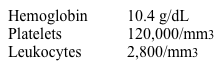 Which of the following is the best next step in management?
 (Multiple Choice)
4.9/5 (76)
(76) A 40-year-old female with a history of depression and hypertension is brought to the ER after being found obtunded in her apartment. She is hypotensive and bradycardic on physical examination. Intravenous glucagon is administered, and her condition improves. Which of the following intracellular changes is most likely responsible for the improvement in her condition?
(Multiple Choice)
4.9/5 (82)
(82) A 78-year-old man with severe dementia is brought to the emergency department due to a daylong history of lethargy, fever, and vomiting. The patient lives in a nursing home, and his caregivers report that he has had poor oral intake over the last week. Medical history is significant for emphysema, heart failure with reduced ejection fraction, hypertension, and diabetes mellitus type 2. On physical examination, the patient is lethargic but arousable. Blood pressure is 60/30 mm Hg and pulse is 120/min and regular. The extremities are warm. Coarse rhonchi are heard over the right lower lung. After receiving several intravenous fluid boluses, the patient is given an intravenous infusion of an agent that increases peripheral vascular resistance, increases blood pressure, and decreases heart rate. Which of the following agents is most likely being described?
(Multiple Choice)
5.0/5 (79)
(79) A 6-year-old girl is brought to the emergency department by her parents after they found her unresponsive in the basement. They report that her younger sister sprayed the patient with a bottle that had been filled with pesticide to help rid the house of insects. Temperature is 36.6 C (98 F), blood pressure is 110/60 mm Hg, pulse is 58/min, and respirations are 42/min. On examination, the patient is lethargic and salivating. Which of the following medications should be administered first during treatment of this patient's current condition?
(Multiple Choice)
5.0/5 (78)
(78) A 65-year-old man comes to the office due to a 6-month history of exertional dyspnea. Over the past few weeks he has also developed a nonproductive cough. Medical history is notable for hypertension and hypercholesterolemia. The patient does not use tobacco, alcohol, or illicit drugs. Temperature is 36.9 C (98.4 F), blood pressure is 130/80 mm Hg, pulse is 80/min, and respirations are 18/min. Examination shows late inspiratory crackles in both lung bases and mild digital clubbing. The patient undergoes lung biopsy; histologic examination shows areas of interstitial inflammation, foci of proliferating fibroblasts, dense collagen fibrosis, and honeycomb changes. The interstitial inflammation is patchy and consists of a lymphoplasmacytic infiltrate in the alveolar septa associated with hyperplasia of type 2 pneumocytes. Pharmacotherapy aimed at which of the following is most helpful in treating this patient's lung condition?
(Multiple Choice)
4.8/5 (78)
(78) A 22-year-old man comes to the office due to erectile dysfunction and lack of sexual desire. Medical history is unremarkable. The patient is in a stable relationship with his fiancé and does not use tobacco, alcohol, or illicit drugs. Height is 188 cm (6 ft 2 in) and weight is 88 kg (194 lb). Examination shows bilateral gynecomastia, sparse facial hair, and small, firm testes. The penis is normal in size and peripheral vision is normal on confrontation. This patient would most benefit from which of the following?
(Multiple Choice)
4.8/5 (77)
(77) A 20-year-old man is brought to the emergency department after being found confused and somnolent in his apartment. His face and upper body are covered with emesis. The patient was last seen with a normal appearance 4 hours ago. Medical history is significant for excessive alcohol use. Temperature is 36.8 C (98.2 F), blood pressure is 120/88 mm Hg, pulse is 102/min, and respirations are 26/min. The patient is barely rousable and does not answer questions. Cardiopulmonary examination is normal. The abdomen is soft and nontender. There are no focal findings on neurologic examination. Laboratory results are as follows: 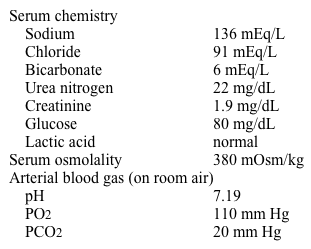 Acute poisoning is suspected and the patient is given an appropriate antidote. Which of the following is the most likely mechanism of action of the antidote?
 (Multiple Choice)
4.7/5 (69)
(69) A 30-year-old nulligravid woman and her 31-year-old husband come to the office for an infertility evaluation. They have been unable to conceive despite 2 years of unprotected intercourse. The patient has had irregular periods since menarche, ranging between 30 and 70 days each cycle. Her BMI is 34 kg/m2. Examination shows a small, anteverted uterus and bilateral enlarged ovaries. A urine pregnancy test is negative. The patient is prescribed letrozole for ovulation induction therapy. Which of the following is the mechanism of action of this medication?
(Multiple Choice)
4.8/5 (84)
(84) A 45-year-old man is brought to a rural emergency department due to severe chest pain, sweating, and nausea. The symptoms began suddenly an hour ago. He has no significant medical history. His father died at age 50 after experiencing sudden-onset chest pain. The patient smokes a pack of cigarettes daily. He does not take any medications and has no known drug allergies. Examination shows normal heart sounds and breath sounds. ECG shows sinus tachycardia with ST segment elevation in leads II, III, and aVF. Medical management for the patient's acute condition is initiated. After initial treatment, the chest pain decreases in intensity and a reperfusion complex ventricular arrhythmia emerges. The arrhythmia is asymptomatic and resolves spontaneously. Which of the following drugs is most likely responsible for rapid reperfusion in this patient?
(Multiple Choice)
4.9/5 (74)
(74) A 34-year-old man comes to the office with his girlfriend for follow-up of type 1 diabetes mellitus. He was diagnosed 15 years ago and is currently treated with a combination of basal and rapid-acting insulin injections. The patient has been experiencing intermittent episodes of hypoglycemia with a blood glucose of 35-54 mg/dL. Two weeks ago, he was taken to the emergency department after passing out due to low glucose levels. The patient is prescribed an injectable medication to be administered at home by a caregiver when hypoglycemia is associated with impaired consciousness. This medication rapidly improves hypoglycemia by which of the following mechanisms?
(Multiple Choice)
4.9/5 (80)
(80) An 82-year-old man is brought to the emergency department after a syncopal episode. He has had no chest pain or dyspnea but he has constipation of recent onset. He was hospitalized 2 weeks ago for atrial fibrillation with rapid ventricular response and was discharged home with oral medications after appropriate management. Medical history is also significant for hypertension and severe chronic obstructive pulmonary disease requiring home supplemental oxygen. Blood pressure is 105/60 mm Hg and pulse is 50/min. Examination reveals bilaterally decreased breath sounds, no wheezing, and normal heart sounds. ECG shows new-onset second-degree atrioventricular block. Which of the following drugs is the most likely cause of his current condition?
(Multiple Choice)
5.0/5 (79)
(79) A 42-year-old woman comes to the office due to frequent episodes of burning in her chest and small amounts of regurgitation after meals and at nighttime. Medical history includes hypertension. Vital signs are within normal limits. BMI is 30 kg/m2. There is no abdominal tenderness and the remainder of the physical examination is normal. The patient shows the clinician an over-the-counter antacid that she has been taking to relieve her symptoms. The preparation contains a combination of magnesium and aluminum hydroxide. Which of the following is the most likely rationale for combining both mineral salts in this antacid preparation?
(Multiple Choice)
4.8/5 (89)
(89) A 31-year-old male farm worker comes to the physician complaining of an itchy rash on his chest. Physical examination reveals an annular and scaling plaque five centimeters in diameter with central clearing on the chest. KOH preparation of skin scrapings shows branching septate hyphae, and topical application of terbinafine was prescribed. Which of the following mechanisms of action explains the antifungal activity of this drug?
(Multiple Choice)
5.0/5 (76)
(76) Healthy adult volunteers are enrolled in a phase I clinical trial investigating the properties of a newly developed oral antimicrobial agent. The drug is administered in different amounts to the volunteers over the course of several weeks to determine the best dosage that minimizes toxicity while maintaining trough levels above the minimum inhibitory concentration. While reviewing the data, the researchers note that the drug's half-life seems to vary amongst the study participants. An increase in which of the following pharmacologic parameters is most likely responsible for the longer half-life seen in certain individuals?
(Multiple Choice)
4.9/5 (83)
(83) 
Filters
- Essay(0)
- Multiple Choice(0)
- Short Answer(0)
- True False(0)
- Matching(0)