



 Chat with AI
Exam 12: Pharmacology

Exam 1: Anatomy291 Questions
Exam 2: Behavioral science240 Questions
Exam 3: Biochemistry156 Questions
Exam 4: Biostatistics117 Questions
Exam 5: Embryology52 Questions
Exam 6: Genetics103 Questions
Exam 7: Histology24 Questions
Exam 8: Immunology129 Questions
Exam 9: Microbiology336 Questions
Exam 10: Pathology816 Questions
Exam 11: Pathophysiology464 Questions
Exam 12: Pharmacology538 Questions
Exam 13: Physiology272 Questions
Select questions type


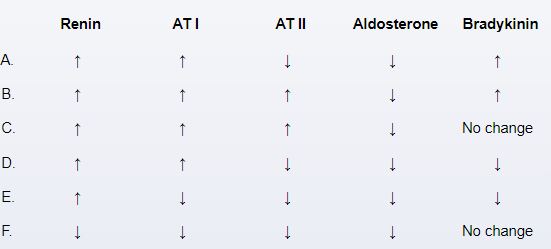
A 55-year-old woman is treated with ramipril for primary (essential) hypertension. Her blood pressure decreases to normal value over several weeks of treatment. The patient seems to be compliant with her medication and experiences no significant side effects. She has no other medical issues and takes no other medications. She does not use tobacco, alcohol, or illicit drugs. Physical examination shows no abnormalities. Which of the following is the most likely combination of changes in response to this patient's treatment (AT = angiotensin)?
(Multiple Choice)
4.8/5  (82)
(82) A 62-year-old woman comes to the office due to a painless neck mass that has gradually enlarged over several months. She also has had fatigue, night sweats, and unintentional weight loss. Physical examination shows rubbery, nontender, bilateral cervical lymphadenopathy. Imaging studies reveal mediastinal and abdominal lymphadenopathy, and subsequent excisional lymph node biopsy is consistent with diffuse large B cell lymphoma. The patient receives combination chemotherapy, which leads to rapid lysis of neoplastic cells. She also receives rasburicase prior to and during treatment. This medication helps to protect normal organs by which of the following mechanisms?
(Multiple Choice)
4.7/5 (64)
(64) A 13-year-old boy is brought to the clinic by his parents due to a change in behavior. His special education teacher reported that for the last several weeks he has frequently taken off his shoes to scratch his feet during class. The patient has a history of learning disability but is otherwise healthy. Examination shows erythema and excoriations between the toes of both feet. Microscopy of skin scrapings from the rash is shown in the exhibit.
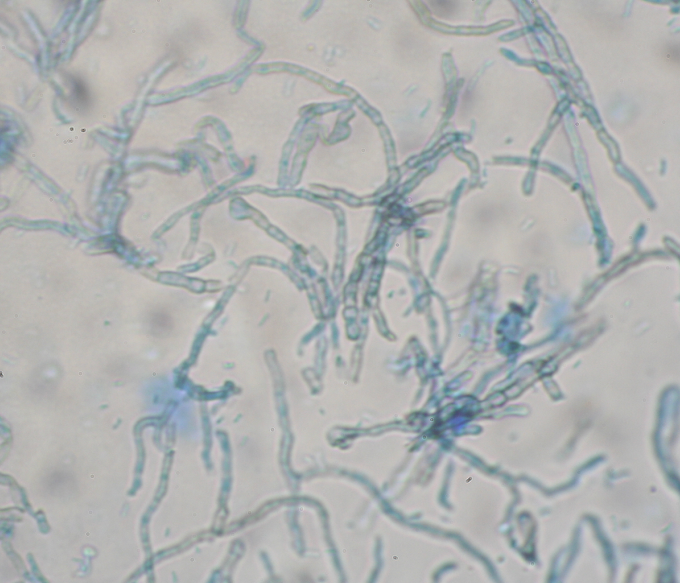 Which of the following antimicrobial drugs is likely to be the most effective against the pathogen causing this patient's condition?
 (Multiple Choice)
4.8/5 (90)
(90) A 65-year-old woman is concerned about her risk of fracture as her mother was recently hospitalized for osteoporotic hip fracture. The patient walks her dog for a mile on most days and has no problems with balance or falling. She has a history of hypertension, hyperlipidemia, coronary artery disease, seizure disorder, and gastroesophageal reflux disease. The patient underwent menopause at age 52. She has smoked a pack of cigarettes daily for 24 years but does not drink alcohol. Weight is 56 kg (123.5 lb). Long-term use of which of the following medications may increase this patient's risk of osteoporosis and hip fracture?
(Multiple Choice)
4.8/5 (87)
(87) A 62-year-old man is hospitalized with severe abdominal pain and diarrhea after a recent urinary tract infection. Six months ago, the patient had an episode of Clostridium difficile colitis after being treated for pneumonia. Medical history is also significant for diverticulitis and upper gastrointestinal tract bleeding. The patient is allergic to penicillin. An appropriate workup confirms C difficile colitis. The patient is placed on an oral macrocyclic antibiotic that inhibits the sigma subunit of RNA polymerase. Which of the following agents was most likely administered to this patient?
(Multiple Choice)
4.7/5 (78)
(78) A 34-year-old woman has recurrent throbbing headaches that occur several times a month and cause significant distress. They are accompanied by nausea and photophobia. She has had 5 emergency department visits for these headaches over the last 6 months. During office visits, her blood pressure ranges from 140/90 mm Hg to 150/95 mm Hg. Neurologic examination is unremarkable. The patient is prescribed metoprolol and is advised that the medication is expected to decrease the frequency of headaches and also lower blood pressure in the long term. Which of the following best explains this medication's effect on blood pressure?
(Multiple Choice)
4.8/5 (71)
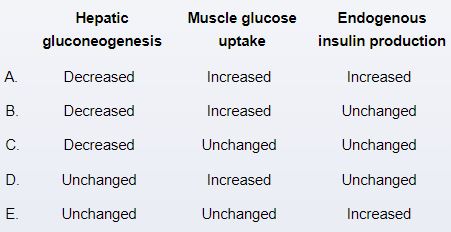
(71) A 52-year-old woman comes to the office for follow-up of type 2 diabetes mellitus. The patient was diagnosed with diabetes 6 months ago and initiated intensive lifestyle modification with increased exercise and a calorie-restricted diet; since that time, she has felt better subjectively but has lost only 2 kg (4.4 lb). Vital signs are normal. BMI is 35 kg/m2. Fasting glucose is 155 mg/dL and hemoglobin A1c is 8.0%. Serum renal and liver function markers are normal. After discussion with the patient, metformin therapy is initiated. Which of the following physiologic changes are most likely to result as a direct effect of this medication?
(Multiple Choice)
4.7/5 (68)
(68) A 78-year-old woman comes to the emergency department due to acute vision loss. She had rapid-onset monocular vision loss in the left eye that developed over an hour. There is no associated pain in the eye, but the patient has had left-sided headaches most days for the last 3 weeks. She also has had achy pain in the shoulders that has slowly worsened over the last month. Examination shows decreased pupillary light reflex in the left eye with severely impaired visual acuity. Which of the following is the most appropriate treatment for this patient's condition?
(Multiple Choice)
4.9/5 (75)
(75) A 60-year-old man comes to the hospital with chest pain. He has had intermittent, squeezing substernal pain over the last 3 days that is now sustained. The patient has no associated palpitations, lightheadedness, or shortness of breath. Medical history is notable for moderate chronic obstructive pulmonary disease with a recent admission for an exacerbation. Blood pressure is 145/90 mm Hg and pulse is 93/min. Oxygen saturation by pulse oximetry is 98% on room air. Physical examination shows no heart murmurs, and lungs are clear to auscultation. ECG shows sinus rhythm with 2-mm anterior ST segment elevation. Cardiac troponin I levels are elevated. Which of the following is the most appropriate treatment for this patient?
(Multiple Choice)
4.8/5 (78)
(78) A 25-year-old woman comes to the office because of jitteriness, frequent mood swings, and palpitations for the past 2 months. At times, her symptoms make her worry that she may be having a heart attack. The patient has no prior medical conditions. Temperature is 37 C (98.6 F), blood pressure is 120/82 mm Hg, pulse is 102/min, and respirations are 12/min. Examination shows warm, moist skin and a fine tremor of the fingers. Which of the following would most likely provide the fastest relief of this patient's symptoms?
(Multiple Choice)
5.0/5 (89)
(89) A 65-year-old man comes to the emergency department due to substernal chest discomfort and intermittent palpitations that began this morning. The patient has a history of coronary artery disease and stable angina that is managed medically. He takes high-dose metoprolol, atorvastatin, and low-dose aspirin. The patient reports that he has been traveling for the past week and ran out of his medications 2 days ago. Temperature is 37 C (98.6 F), blood pressure is 148/82 mm Hg, and pulse is 112/min. ECG reveals sinus tachycardia with a 1-mm ST segment depression in the lateral leads. Which of the following is most likely responsible for this patient's presentation?
(Multiple Choice)
4.7/5 (83)
(83) A 60-year-old farmer is brought to the emergency department due to acute-onset confusion, muscle weakness, and difficulty breathing. The patient has vomited twice and has had 3 loose bowel movements over the past 2 hours. His medical history is insignificant and he currently takes no medications. Blood pressure is 110/70 mm Hg, pulse is 58/min, and respirations are 26/min. His pupils are constricted, symmetric, and reactive to light. Examination reveals excessive sweating, lacrimation, and wheezing. He is incontinent of urine. Intravenous atropine is administered. Which of the following findings is most likely to persist in this patient without additional therapy?
(Multiple Choice)
4.8/5 (68)
(68) A 35-year-old woman comes to the emergency department due to a "racing heart" and shortness of breath. She has had insomnia and increasing anxiety for the past several weeks. The patient has no prior medical problems and takes no medications. She has no drug allergies and does not use tobacco, alcohol, or illicit drugs. Blood pressure is 140/70 mm Hg and pulse is 120/min. Physical examination shows a diffusely enlarged, warm thyroid gland. There is a fine tremor in her outstretched hands. ECG shows sinus tachycardia. Serum TSH is decreased and free thyroxine (T4) is increased. The patient is treated with multiple drugs, including propranolol. In addition to its beta-adrenergic receptor-blocking activity, this drug is likely to decrease which of the following?
(Multiple Choice)
4.8/5 (67)
(67) A group of investigators examined the effects of different muscarinic agonists and antagonists on the bladder musculature. The curves presented below were constructed after application of different agents. Curve A represents the effect of bethanechol, a pure cholinergic agonist. 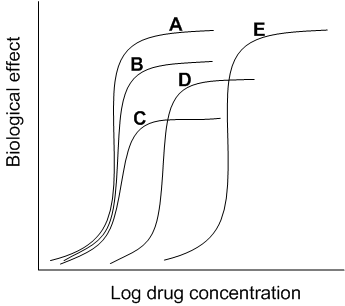 Which of the curves most likely represents the effect of bethanechol after application of a reversible competitive antagonist?
 (Multiple Choice)
4.9/5 (77)
(77) A 25-year-old man is brought to the emergency department due to severe agitation and aggressive behavior. He speaks loudly and rapidly, stating that he has "superpowers" of mind control and that violence is the only way to defend against "the conspiracy." The patient has a history of bipolar disorder and is prescribed olanzapine, lithium, and fluoxetine, although it is unclear if he has been compliant. The patient requires several doses of medication in the emergency department to calm down and is subsequently admitted to the hospital for further psychiatric evaluation. The following night he is found lying very still on his bed and does not respond to questions. Temperature is 40.6 C (105.1 F), blood pressure is 157/90 mm Hg, pulse is 102/min, and respirations are 20/min. Examination is significant for diaphoresis and diffuse rigidity in upper and lower extremities. Which of the following is the most likely explanation for this patient's current symptoms?
(Multiple Choice)
4.9/5 (83)
(83) A 64-year-old man comes to the office due to slowing of his movements and gait instability that has been the cause of several recent falls. The patient was diagnosed with Parkinson disease a year ago. On examination, there is a resting tremor involving the right hand and rigidity during passive flexion and extension of the right upper limb. The patient is started on therapy with pramipexole. Which of the following best describes the mechanism of action of this medication?
(Multiple Choice)
4.8/5 (77)
(77) Researchers are conducting a study to determine the effectiveness of a novel humanized monoclonal antibody in patients with metastatic colorectal cancer. This medication works by binding to the programmed cell death-1 receptor on T cells to block its ligands from binding. They find this therapy is most effective in patients with a high degree of microsatellite instability or defects in DNA mismatch repairs. Which of the following best explains the favorable drug effect in this subset of patients?
(Multiple Choice)
4.8/5 (77)
(77) A 56-year-old man comes to the hospital due to 24 hours of burning substernal chest pain. The most intense pain occurred approximately 6 hours ago, and it has started to subside. The patient has a history of diabetes mellitus. ECG shows sinus rhythm with ST-segment elevation in leads V3 to V5. In the cardiac catheterization laboratory, he is found to have total occlusion of the left anterior descending artery. Successful intervention is performed to restore blood flow in the artery. The next day, the patient's echocardiogram shows a normal-sized left ventricle with no evidence of hypertrophy; there is apical and anterior akinesia with a reduced left ventricular ejection fraction of 38%. Which of the following is the most likely long-term effect of ACE inhibitor therapy in this patient?
(Multiple Choice)
4.8/5 (78)
(78) A 35-year-old woman is hospitalized following a high-speed motor vehicle collision in which she was an unrestrained passenger. She sustained multiple deep lacerations on her extremities, rib contusions, and a complex humerus fracture requiring surgical fixation. Over the next 2 days, the patient's pain is treated with oral morphine every 6 hours and nonsteroidal anti-inflammatory drugs (NSAIDs) every 4 hours. Her pain is controlled with this regimen but recurs if the interval between morphine doses is extended to 8 hours. The patient is otherwise medically stable for discharge. She is concerned about continuing to use narcotics at home to treat her pain because her cousin had a history of opioid use disorder and passed away several years earlier due to an overdose. Which of the following actions by the physician is most appropriate?
(Multiple Choice)
4.8/5 (75)
(75) A 58-year-old woman comes to the office with left knee pain. The pain began a year ago and has progressively become more severe. The pain is worse later in the day and is now limiting her normal day-to-day activities. She has no history of injury to the joint and has no significant pain in any other joints. The patient has attempted treatment with acetaminophen, but that has not provided adequate relief. She does not use tobacco, alcohol, or illicit drugs and works as a school bus driver. Her BMI is 34 kg/m2. Left knee joint examination shows a mild effusion, crepitus on movement, and joint line tenderness. The patient is started on celecoxib therapy. The presence of which of the following conditions in this patient's medical history would make this medication the preferred treatment?
(Multiple Choice)
4.8/5 (75)
(75) 
Filters
- Essay(0)
- Multiple Choice(0)
- Short Answer(0)
- True False(0)
- Matching(0)