



 Chat with AI
Exam 12: Pharmacology

Exam 1: Anatomy291 Questions
Exam 2: Behavioral science240 Questions
Exam 3: Biochemistry156 Questions
Exam 4: Biostatistics117 Questions
Exam 5: Embryology52 Questions
Exam 6: Genetics103 Questions
Exam 7: Histology24 Questions
Exam 8: Immunology129 Questions
Exam 9: Microbiology336 Questions
Exam 10: Pathology816 Questions
Exam 11: Pathophysiology464 Questions
Exam 12: Pharmacology538 Questions
Exam 13: Physiology272 Questions
Select questions type


A 28-year-old woman comes to the office due to progressively worsening eye irritation and double vision over the last 2 months. She also reports unintentional weight loss, mood swings, and palpitations. The patient has no prior medical problems and takes no medications. She has no known drug allergies and does not use tobacco, alcohol, or illicit drugs. Blood pressure is 140/70 mm Hg, and pulse is 110/min and regular. Physical examination shows bilateral conjunctival redness and severe proptosis. Appropriate therapy is begun. On a follow-up visit 4 weeks later, her eye symptoms have improved, and examination reveals a small decrease in proptosis with no redness. The drug that improved her ocular symptoms most likely did so by affecting which of the following?
(Multiple Choice)
4.8/5  (82)
(82) A 64-year-old woman comes to the emergency department due to intractable nausea and vomiting. She has not been able to keep anything down and feels weak and tired. The patient has had no diarrhea, constipation, or abdominal pain. She was diagnosed with breast cancer 4 weeks ago and received her first cycle of chemotherapy 1 week ago. Vital signs are within normal limits. Mucous membranes are dry. Cardiopulmonary examination is normal. Bowel sounds are normal. Which of the following agents would be most helpful in treating this patient's symptoms?
(Multiple Choice)
4.8/5 (80)
(80) A 40-year-old man comes to the office due to erectile dysfunction and loss of libido. The patient's history is notable for Hodgkin lymphoma that was treated with chemotherapy. Physical examination is normal except for small testes. Laboratory evaluation shows consistently low total and free early morning testosterone levels and elevated serum LH. Transdermal testosterone therapy is prescribed. Which of the following should be periodically monitored during this patient's treatment?
(Multiple Choice)
4.9/5 (74)
(74) A 31-year-old man is hospitalized after sustaining multiple injuries during a motor vehicle collision. The patient is not conscious initially, and no information is available regarding his medical history. Two days after initial hospitalization, he experiences palpitations and difficulty sleeping. Shortly thereafter, the patient suffers a generalized tonic-clonic seizure. When he recovers, he tells the physician that he usually takes medications for anxiety, bipolar disorder, and chronic low back pain. Temperature is 36.7 C (98.1 F), blood pressure is 129/82 mm Hg, pulse is 92/min, and respirations are 14/min. He appears anxious, tremulous, and diaphoretic. Withdrawal from which of the following medications is the most likely explanation for this patient's presentation?
(Multiple Choice)
4.7/5 (87)
(87) A 23-year-old female is brought to the ER after having a tonic-clonic seizure. She has a history of seizures and takes phenytoin. She does not use tobacco, alcohol or illicit drugs. On physical examination, no focal abnormalities are noted. Blood tests reveal her plasma phenytoin level to be low. She states that she has been compliant with her medication. Which of the following drugs may be responsible for this patient's condition if co-administered with phenytoin?
(Multiple Choice)
4.8/5 (70)
(70) A 45-year-old woman comes to the office for follow-up of arthritis. For the last year, she has had fatigue, weight loss, and progressive joint pain in the hands associated with prolonged morning stiffness. Past medical history includes hypothyroidism, for which she takes levothyroxine. The patient does not use tobacco or alcohol. Examination shows doughy swelling involving multiple metacarpophalangeal joints in both hands. Following initial diagnostic testing, a multidrug treatment regimen is started. Soon after treatment begins, she develops painful mouth ulcers and nausea. Liver function tests show new aspartate transaminase and alanine transaminase elevations. Which of the following medications is most likely responsible for the adverse effects seen in this patient?
(Multiple Choice)
4.8/5 (70)
(70) A clinical trial is conducted to assess the effectiveness of a novel formulation of cisplatin for treating advanced non-small cell lung cancer. Study participants are randomly assigned to 2 different cisplatin-based chemotherapy regimens. Subjects in the control arm are administered conventional cisplatin chemotherapy, whereas those in the experimental arm are given a formulation of cisplatin encapsulated in liposomes coated with anti-epidermal growth factor receptor (EGFR) antibodies. Patients in the experimental group are found to have a statistically significant decrease in residual tumor burden compared with those in the control group. The incidence of adverse effects was also lower in the experimental group. Compared to conventional cisplatin chemotherapy, the new formulation is most likely to have which of the following effects?
(Multiple Choice)
4.7/5 (87)
(87) A 28-year-old woman comes to the clinic for follow-up after recent hospitalization due to autoimmune hepatitis. High-dose glucocorticoids improved the hepatitis, and on discharge, the patient continued prednisone therapy. Today, she feels well and has no other medical concerns. Physical examination shows no abdominal tenderness or jaundice. Prednisone is tapered and azathioprine is prescribed for continued management of autoimmune hepatitis. Which of the following should be periodically monitored while the patient is taking this new medication?
(Multiple Choice)
4.9/5 (76)
(76) A 65-year-old woman comes to the clinic for follow up of type 2 diabetes mellitus. Medical history is notable for hypertension, stable coronary artery disease, and heart failure with preserved ejection fraction. Blood pressure is 144/95 mm Hg. Physical examination shows no murmurs, and the lungs are clear on auscultation. Fasting glucose is 122 mg/dL and hemoglobin A1c is 7.8%. The remainder of the laboratory results, including hepatic and renal markers, are normal. The patient is given a prescription for canagliflozin. She should be counseled on which of the following potential complications prior to initiation of this medication?
(Multiple Choice)
4.8/5 (67)
(67) A 67-year-old man admitted for right lower lobe pneumonia subsequently develops hypotension and lactic acidosis. He is started on a norepinephrine intravenous drip. A few hours later, the antecubital vein being used for the infusion blanches and the tissues surrounding the IV site become cold, hard, and pale. Local injection of the affected tissues with which of the following agents is most likely to be of greatest benefit?
(Multiple Choice)
4.9/5 (84)
(84) A 62-year-old woman is brought to the emergency department because of acute chest pain. She also complains of diaphoresis, nausea, and lightheadedness. Her blood pressure is 90/60 mm Hg and pulse is 42/min. An ECG reveals ST-segment elevation in the inferior leads. The appropriate therapy is initiated, including a medication to treat her bradycardia. After initial treatment, her blood pressure is 120/70 mm Hg and pulse is 76/min. However, she now complains of severe right-sided eye pain. Which of the following is the most likely cause for this patient's eye pain?
(Multiple Choice)
4.8/5 (72)
(72) A 44-year-old man comes to the office for follow-up of type 2 diabetes mellitus. He was diagnosed with diabetes 4 years ago and has been taking metformin since then. Six months ago, a new antidiabetic agent was added due to suboptimal glycemic control. Today, the patient is happy because he has lost 7 kg (15.4 lb) without any changes in diet or activity since the new therapy was started. His only symptoms are occasional nausea, vomiting, and a prolonged sensation of fullness after eating. Vital signs are within normal limits with no orthostatic changes. BMI is 34 kg/m2. Physical examination shows normal heart and lung sounds, a nontender abdomen, and normal deep tendon reflexes and sensory examination. Laboratory testing reveals normal renal function studies and hemoglobin A1c of 7.2%. If this patient's weight loss is due to the new medication, which of the following agents is most likely responsible?
(Multiple Choice)
4.9/5 (98)
(98) A 78-year-old woman is admitted to the hospital due to altered mental status. Medical history is significant for pyelonephritis, type 2 diabetes mellitus, coronary artery disease, and heart failure with reduced ejection fraction. Temperature is 36.2 C (97.2 F), blood pressure is 80/50 mm Hg, pulse is 120/min, and respirations are 24/min. Oxygen saturation is 90% on room air. Examination shows bilateral crackles. After she is started on appropriate treatment, including initiation of norepinephrine infusion, her blood pressure increases and her heart rate slightly decreases. This patient's change in heart rate is most likely due to norepinephrine's effect on which of the following receptors?
(Multiple Choice)
4.8/5 (71)
(71) A 25-year-old graduate student comes to the office for evaluation of anxiety. She describes episodes of sudden-onset palpitations, shortness of breath, and diaphoresis during which she wants to "run away before anyone notices." The patient arrives early for her classes to get a seat close to the door and has left during lectures due to feeling "out of control." There are no specific triggers for these events, but she is worried about having another episode next week during her final examinations. She does not drink alcohol or use illicit drugs. Physical examination, ECG, and laboratory evaluation are normal. The patient is diagnosed with panic disorder. After discussion of treatment options, she decides to pursue cognitive-behavioral therapy and start a short-term anxiolytic medication that also has muscle-relaxant and anticonvulsant properties. Which of the following best describes the mechanism of action of this medication?
(Multiple Choice)
4.8/5 (84)
(84) A 29-year-old woman comes to the office with malaise, fever, and extremely painful genital lesions. She has never had such symptoms before. She is sexually active with a new partner. On examination, the patient has several tiny, thin-walled vesicles on an erythematous base and exquisitely tender, shallow ulcers on the labia. Tender inguinal lymphadenopathy is present. Tzanck smear of the genital lesions shows multinucleated giant cells. A drug is prescribed that can be used to manage this acute episode and prevent future episodes of this patient's condition. This drug most likely works by which of the following mechanisms?
(Multiple Choice)
5.0/5 (76)
(76) A 44-year-old man comes to the office for a routine check-up. Past medical history is significant for hypercholesterolemia, which he has controlled through diet. His father died of a myocardial infarction at age 56, and his mother, who is still living, has a history of stroke. On physical examination, the patient's blood pressure is 160/100 mm Hg and heart rate is 70/min. He is started on enalapril. During the first 7 days of therapy, the patient's glomerular filtration rate (GFR) adjusts as shown in the graph below. 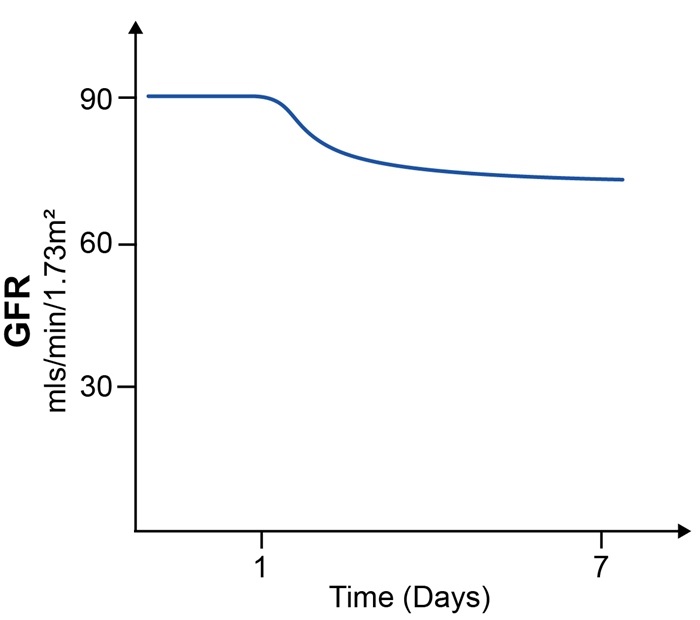 Which of the following structures was most likely affected by a downstream effect of enalapril and is therefore responsible for this patient's renal response?
 (Multiple Choice)
4.8/5 (80)
(80) A 21-year-old woman comes to the office due to burning on urination and increased urinary frequency for the past 2 days. She has no hematuria, vaginal discharge, or irritation. The patient has no other medical problems. Her temperature is 37 C (98.6 F). Physical examination reveals mild suprapubic tenderness on deep palpation; there is no costovertebral angle tenderness. Urine dipstick is positive for leukocyte esterase and nitrites. The patient is started on trimethoprim, which leads to rapid resolution of her symptoms. Which of the following drugs has the same intracellular target as the drug used to treat this patient?
(Multiple Choice)
4.9/5 (81)
(81) Researchers develop a novel glycopeptide antibiotic similar to vancomycin that is bactericidal against many gram-positive bacteria. From animal studies, they determine that the effective drug dosage is 5 mg/kg/day administered intravenously in divided doses. In a clinical trial, the antibiotic is administered to adult and neonatal patients with gram-positive infections. The drug is found to be effective in adults but not in neonates. During further analysis, plasma concentrations of the drug are measured in both groups, with the results shown in the image below: 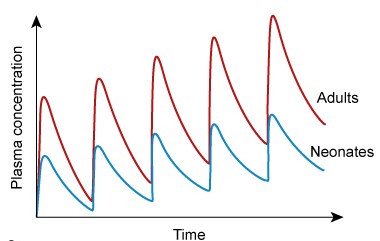 Compared to adults, which of the following neonatal factors is the most likely cause of the difference in drug effectiveness?
 (Multiple Choice)
4.9/5 (84)
(84) A 62-year-old woman is evaluated for refractory nausea and vomiting. She was recently diagnosed with ovarian cancer and underwent total hysterectomy with bilateral salpingo-oophorectomy and pelvic lymph node dissection. The patient was started on highly emetogenic adjuvant chemotherapy. Despite taking ondansetron around the clock, she continues to have nausea and vomiting. She has no abdominal pain or constipation. Vital signs are normal. Examination shows a well-healed abdominal scar. There is no tenderness or abnormal masses. Bowel sounds are normal. Additional therapy blocking which of the following receptors would most likely be helpful in this patient?
(Multiple Choice)
4.8/5 (64)
(64) A 52-year-old, post-menopausal woman comes to the office for a follow-up appointment. Six months ago, the patient was evaluated for recurrent, brief episodes of excessive warmth and sweating, which were interfering with her usual activities. Thyroid hormone levels were normal, and the patient was subsequently diagnosed with menopausal hot flashes. Treatment with estrogen-containing hormone replacement therapy was begun with significant symptom improvement. She has no other medical conditions and takes no other medications. Which of the following most likely occurred in this patient as a result of her medication use?
(Multiple Choice)
4.9/5 (80)
(80) 
Filters
- Essay(0)
- Multiple Choice(0)
- Short Answer(0)
- True False(0)
- Matching(0)