



 Chat with AI
Exam 12: Pharmacology

Exam 1: Anatomy291 Questions
Exam 2: Behavioral science240 Questions
Exam 3: Biochemistry156 Questions
Exam 4: Biostatistics117 Questions
Exam 5: Embryology52 Questions
Exam 6: Genetics103 Questions
Exam 7: Histology24 Questions
Exam 8: Immunology129 Questions
Exam 9: Microbiology336 Questions
Exam 10: Pathology816 Questions
Exam 11: Pathophysiology464 Questions
Exam 12: Pharmacology538 Questions
Exam 13: Physiology272 Questions
Select questions type


A 79-year-old man is brought to the hospital due to confusion for the past 2 days. The patient has had nausea, decreased appetite, and poor oral intake for several weeks. He has also mentioned that everything around him has "a yellow tint." He has no abdominal pain. Medical history includes long-standing heart failure with reduced ejection fraction and atrial fibrillation. Medications include metoprolol, digoxin, lisinopril, and apixaban. The patient is afebrile. Blood pressure is 130/80 mm Hg and pulse is 58/min. The abdomen is soft and nontender; there is no rigidity or rebound and no masses are present. Age-related changes in which of the following factors most likely accounts for this patient's symptoms?
(Multiple Choice)
5.0/5  (71)
(71) A 45-year-old man comes to the office due to 3 months of night sweats, productive cough, decreased appetite, and a 5-kg (10-lb) weight loss. He travels frequently to Vietnam. Vital signs are normal. Examination reveals crackles in the right upper lobe of the lung. Chest x-ray reveals a right upper lobe infiltrate. Acid-fast bacilli are present on sputum smear. The patient is started on combination therapy with isoniazid, ethambutol, rifampin, pyrazinamide, and pyridoxine. One month later, he returns to the office reporting blurring of vision. Examination shows bilateral central scotomas. Which of the following is most likely responsible for this patient's visual symptoms?
(Multiple Choice)
4.8/5 (75)
(75) A 64-year-old woman is hospitalized for elective hip replacement surgery. She has osteoarthritis and is experiencing progressive right hip pain that limits her daily activities. The patient also has a history of hypertension and hypothyroidism. Her blood pressure is 130/80 mm Hg and pulse is 90/min. BMI is 31.5 kg/m2. Her serum creatinine is 0.9 mg/dL. She undergoes surgery without complications and is postoperatively started on a medication that is a low molecular weight fraction of a negatively charged chemical stored in mast cell granules. Which of the following is the most likely mechanism of action of the medication used?
(Multiple Choice)
4.8/5 (92)
(92) A 41-year-old man comes to the emergency department due to 3 weeks of low-grade fever, productive cough, and a 4.5-kg (10-lb) weight loss. The patient drinks 10-12 beers a day. On physical examination, he appears cachectic. Poor dentition and clubbing of the fingers are noted. A foul-smelling sputum sample is expectorated and sent for Gram stain and culture. CT scan of the chest is shown in the image below: 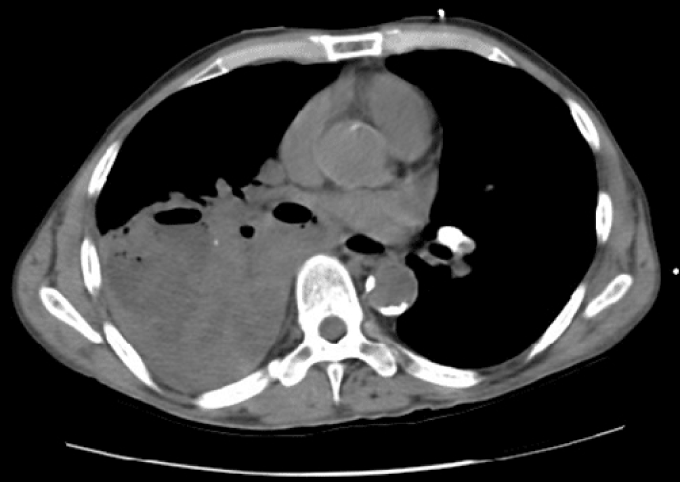 Empiric antimicrobial therapy should include coverage against which of the following pathogens?
 (Multiple Choice)
4.9/5 (80)
(80) A new drug has been developed to treat cardiac arrhythmias. The drug has high affinity for activated and inactivated sodium channels but relatively little affinity for resting sodium channels. An experiment is devised to maintain sodium channels in the inactivated state for a prolonged period, during which they are exposed to the new drug. After allowing the sodium channels to return to the resting state, the speed of the drug's dissociation from the sodium channels is recorded and shown below. The dissociation curve for quinidine is given for comparison. 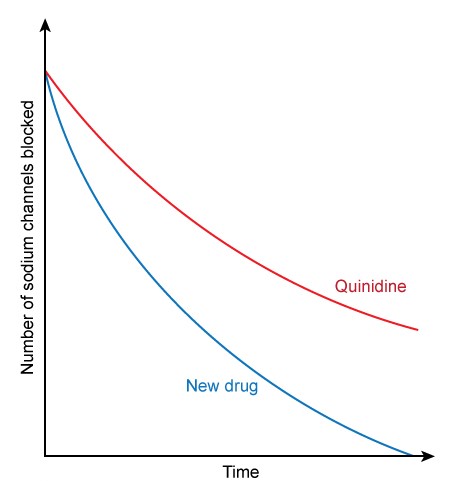 The pharmacologic action of the new drug is most similar to which of the following drugs?
 (Multiple Choice)
4.9/5 (94)
(94) A 6-year-old boy is brought to the office by his mother due to difficulty with his behavior in school. She says that his teacher is concerned that he does not pay attention in class and his grades are dropping to the point he may need medication to help him focus. The patient's mother has noticed that at home he seems to stare into space for several seconds, multiple times throughout the day. This occurs even when he is watching his favorite television show, and he seems to ignore her when she calls his name. The patient has no previous medical problems and takes no medications. He has an older brother with attention-deficit hyperactivity disorder and an aunt with epilepsy. Which of the following is the most appropriate pharmacotherapy for this patient?
(Multiple Choice)
4.9/5 (82)
(82) A 54-year-old man comes to the office due to new-onset muscle cramps. The patient has a history of hypertension and was started on hydrochlorothiazide 4 weeks ago. Blood pressure is 138/86 mm Hg and pulse is 78/min. Examination shows no abnormalities. Based on his most recent laboratory results, triamterene is added to the current therapy. Which of the following best describes the mechanism of action of this medication?
(Multiple Choice)
4.8/5 (77)
(77) A 60-year-old man comes to the clinic due to a 3-week history of fatigue, shortness of breath, and fever. The patient has a 35-pack-year history of cigarette smoking but has no other significant medical history. Temperature is 38.6 C (101.5 F), blood pressure is 140/92 mm Hg, pulse is 110/min, and respirations are 24/min. There is dullness to percussion at the right lung base. Chest radiograph shows a moderate-sized loculated pleural effusion on the right side. Ultrasonography reveals multiple separate fluid pockets within the pleural space. Chest tube placement produces only a small amount of thick pus. Intrapleural administration of a medication with which of the following effects would most likely improve chest tube drainage in this patient?
(Multiple Choice)
4.8/5 (81)
(81) A 45-year-old woman with advanced HIV infection has been receiving antiretroviral therapy for several years. When treatment was first initiated, the patient's viral load rapidly decreased to undetectable levels and her CD4+ cell count remained above 200/mm3. However, recent HIV RNA levels have increased above the detection threshold. After undergoing drug resistance testing, she is started on an integrase inhibitor, and her viral load decreases precipitously. Which of the following steps of viral replication is most likely to be inhibited as a result of this patient's new treatment?
(Multiple Choice)
4.8/5 (76)
(76) A 72-year-old woman presents with difficulty hearing. She was admitted 1 week ago for dyspnea, orthopnea, and bilateral leg swelling which has been slowly improving with treatment. Her family members report that for the past 2 days, she has been turning her TV volume higher and they have to speak loudly for her to hear. Her hearing was normal prior to the hospitalization. Her medical problems include hypertension, heart failure, and chronic kidney disease. Examination shows moderate bilateral sensorineural hearing loss. Which of the following medications most likely contributed to this patient's hearing impairment?
(Multiple Choice)
4.9/5 (93)
(93) A 55-year-old man comes to the emergency department due to an hour of intense substernal chest burning accompanied by sweating. He has a history of obesity and diet-controlled type 2 diabetes mellitus. On initial evaluation, blood pressure is 110/70 mm Hg and pulse is 60/min and regular. Oxygen saturation is 98% on room air. The patient is comfortable lying flat and no heart murmurs are heard. Lungs are clear on auscultation. Immediate ECG shows normal sinus rhythm with a 2-mm ST-segment elevation in leads II, III, and aVF. Aspirin and morphine are administered. As the patient is about to be transported to the catheterization lab for urgent percutaneous coronary intervention, he develops dizziness and the telemetry monitor shows sinus bradycardia at 40/min. The patient appears pale and diaphoretic and peripheral pulses are faint. Blood pressure is 70/40 mm Hg. Which of the following is the best immediate step for managing this patient's condition?
(Multiple Choice)
4.9/5 (82)
(82) A 56-year-old man comes to the office for follow-up of type 2 diabetes mellitus. The patient has had inadequate glycemic control with metformin monotherapy, and a new medication that inhibits dipeptidyl peptidase-4 was prescribed 3 months ago. He feels well and reports no adverse effects from the new therapy. The patient also has hypertension, for which he takes ramipril. He does not use tobacco, alcohol, or illicit drugs. The patient says he is generally compliant with dietary guidance but occasionally eats fast foods. Blood pressure is 126/74 mm Hg and pulse is 76/min. BMI is 31.4 kg/m2. Physical examination shows no abnormalities. Laboratory results show a hemoglobin A1c of 6.8%. The newly prescribed medication most likely improved this patient's glycemic control through which of the following direct mechanisms?
(Multiple Choice)
4.8/5 (92)
(92) A 50-year-old woman comes to the office due to cough, shortness of breath, fatigue, and weight loss. The patient does not use tobacco or alcohol. Blood pressure is 110/70 mm Hg, pulse is 88/min and regular, and oxygen saturation on room air is 96%. Lung examination reveals scattered crackles. Serum calcium levels are elevated. Imaging studies reveal mediastinal fullness and diffuse, bilateral, ground-glass lung opacities. Biopsy of the lung lesions shows granulomas with multinucleated giant cells; no microorganisms or particulates are present. Appropriate pharmacotherapy is initiated. At follow-up a few days later, the symptoms have improved but blood glucose is elevated. Which of the following additional changes is most likely present in this patient due to her treatment?
(Multiple Choice)
5.0/5 (89)
(89) A 45-year-old woman with a history of opioid use disorder and HIV infection is brought to the emergency department due to worsening lethargy. The patient receives methadone maintenance therapy, which she recently restarted after being hospitalized for an HIV-related infection. Her infection improved after inpatient treatment, and she continues to take appropriate antimicrobials as an outpatient. Her current temperature is 37 C (98.6 F), blood pressure is 116/68 mm Hg, pulse is 90/min, and respirations are 10/min. On physical examination, the patient is somnolent and withdraws all extremities to painful stimuli. The pupils are small and sluggish to react. Brain imaging reveals no new findings, and renal function tests are within normal limits. Use of which of the following medications most likely contributed to this patient's current condition?
(Multiple Choice)
4.7/5 (81)
(81) A 37-year-old man comes the emergency department due to fever, chills, and malaise. He has no significant medical history but he uses illicit intravenous drugs on a regular basis. The patient is febrile, tachycardic, and hypotensive. Auscultation reveals a heart murmur. A preliminary diagnosis of infective endocarditis is established. Blood cultures grow methicillin-resistant Staphylococcus aureus, and the patient is prescribed an intravenous antibiotic administered every 12 hours. Calculation of the maintenance dose will most likely require which of the following parameters?
(Multiple Choice)
4.9/5 (86)
(86) A 68-year-old man comes to the office for follow-up. The patient underwent radical prostatectomy for prostate adenocarcinoma 6 months ago, which decreased his serum prostate-specific antigen (PSA) level from 16 ng/mL at the time of surgery to 1 ng/mL 6 weeks after surgery. Initial staging evaluation revealed no evidence of metastatic disease. PSA level is now 8 ng/dL, and repeat imaging reveals regional lymphadenopathy. The patient is prescribed combination therapy with buserelin and bicalutamide. Which of the following is the main reason for adding bicalutamide to this patient's treatment regimen?
(Multiple Choice)
4.8/5 (73)
(73) A 62-year-old woman undergoes hip replacement surgery. The patient has a history of advanced hip osteoarthritis that limits her daily activities. She has no other medical conditions and no known drug allergies. After appropriate preoperative evaluation, total hip arthroplasty is performed under general anesthesia. The intraoperative course is uncomplicated, and after recovery from anesthesia, patient-controlled intravenous morphine is started for pain control. Several minutes later, the patient reports generalized itching. Physical examination reveals hypotension, tachycardia, and mild bilateral wheezing but no rashes. Which of the following drug effects is most likely responsible for this patient's current condition?
(Multiple Choice)
4.8/5 (86)
(86) A 57-year-old male with suspected bacterial pneumonia is admitted to the hospital and given ceftriaxone and azithromycin for treatment. Soon after the first dose of ceftriaxone, he complains of difficulty breathing, abdominal cramps, and lightheadedness. His current blood pressure is 70/50 mmHg, while his heart rate is 120/min. Physical examination reveals a diffuse maculopapular rash. Which of the following drugs should be administered next to this patient?
(Multiple Choice)
5.0/5 (80)
(80) A 5-year-old girl is brought to the physician by her parents due to intense perianal itching, especially during the night. The patient is otherwise healthy and her development has been normal. Physical examination shows perianal excoriation. Cellulose adhesive tape is applied to the perianal area shortly after she wakes in the morning. Microscopic analysis of the tape reveals the presence of eggs that are asymmetrically flattened on one side. Which of the following is the most appropriate treatment for this patient's condition?
(Multiple Choice)
4.9/5 (88)
(88) A 28-year-old man is undergoing a laparoscopic appendectomy for acute appendicitis. Shortly after induction of anesthesia, the surgeon reports difficulty maintaining abdominal insufflation due to severe muscle rigidity. Pulse is 130/min and the ECG tracing shows sinus tachycardia. Physical examination reveals diffuse muscle stiffness. Inhibition of which of the following is most likely to improve this patient's condition?
(Multiple Choice)
4.9/5 (79)
(79) 
Filters
- Essay(0)
- Multiple Choice(0)
- Short Answer(0)
- True False(0)
- Matching(0)