



 Chat with AI
Exam 12: Pharmacology

Exam 1: Anatomy291 Questions
Exam 2: Behavioral science240 Questions
Exam 3: Biochemistry156 Questions
Exam 4: Biostatistics117 Questions
Exam 5: Embryology52 Questions
Exam 6: Genetics103 Questions
Exam 7: Histology24 Questions
Exam 8: Immunology129 Questions
Exam 9: Microbiology336 Questions
Exam 10: Pathology816 Questions
Exam 11: Pathophysiology464 Questions
Exam 12: Pharmacology538 Questions
Exam 13: Physiology272 Questions
Select questions type


A 23-year-old woman comes to the emergency department due to chest pain, dyspnea, palpitations, perioral numbness, and sweating. She is extremely anxious and explains that her symptoms came on suddenly for no apparent reason. The patient has had similar episodes 2 or 3 times a week for the past several months. Her blood pressure is 150/90 mm Hg, pulse is 100/min, and respirations are 28/min. Cardiac enzymes are normal, and an ECG shows normal sinus rhythm with no ST-segment or T-wave abnormalities. The patient is diagnosed with panic disorder. She receives medication and feels better within an hour. Which of the following best describes the mechanism of action of the medication she received?
(Multiple Choice)
4.8/5  (85)
(85) A 56-year-old man with type 2 diabetes mellitus, hypertension, and hyperlipidemia comes to the office due to elevated blood glucose levels. The patient's current medications include metformin, lisinopril, and simvastatin. Blood pressure is 150/90 mm Hg and pulse is 88/min. BMI is 37 kg/m2. Physical examination is unremarkable. Laboratory studies show a fasting glucose level of 156 mg/dL, serum creatinine of 1.1 mg/dL, hemoglobin A1c of 8.1%, and urine albumin-creatinine ratio of 200 mg/g (normal: <30). Treatment with empagliflozin is initiated. Which of the following effects is most likely to be seen with this new treatment?
(Multiple Choice)
4.9/5 (59)
(59) A 44-year-old woman with a history of breast cancer comes to the office due to persistent back pain. The patient was recently started on radiation treatment for several vertebral metastases. She has taken acetaminophen and nonsteroidal anti-inflammatory drugs but continues to have severe pain. On physical examination, she has tenderness over several lumbar vertebrae. Neurologic examination is unremarkable. The patient is started on oral morphine therapy. Which of the following is the most likely direct effect of this medication on the spinal cord neurons of this patient?
(Multiple Choice)
4.8/5 (77)
(77) A 23-year-old woman comes to the physician due to acute nausea and vomiting. She recently returned from a vacation to Mexico and started to feel "queasy" on the last day of her trip. The patient then developed nausea with frequent vomiting and intermittent bouts of watery diarrhea. She has no visible blood in her stools. Her temperature is 36.8 C (98 F), blood pressure is 118/70 mm Hg, pulse is 86/min, and respirations are 12/min. Abdominal examination shows mild tenderness and increased bowel sounds. Improvement of this patient's vomiting would best be achieved by a medication targeting which of the following receptors?
(Multiple Choice)
4.8/5 (91)
(91) A 27-year-old man comes to the office for evaluation of a rash on both knees. The patient first noticed the rash 2 months ago. He has no other medical conditions and takes no medications. The patient smokes a half pack of cigarettes daily. Vital signs are normal. His knee is shown in the image below: 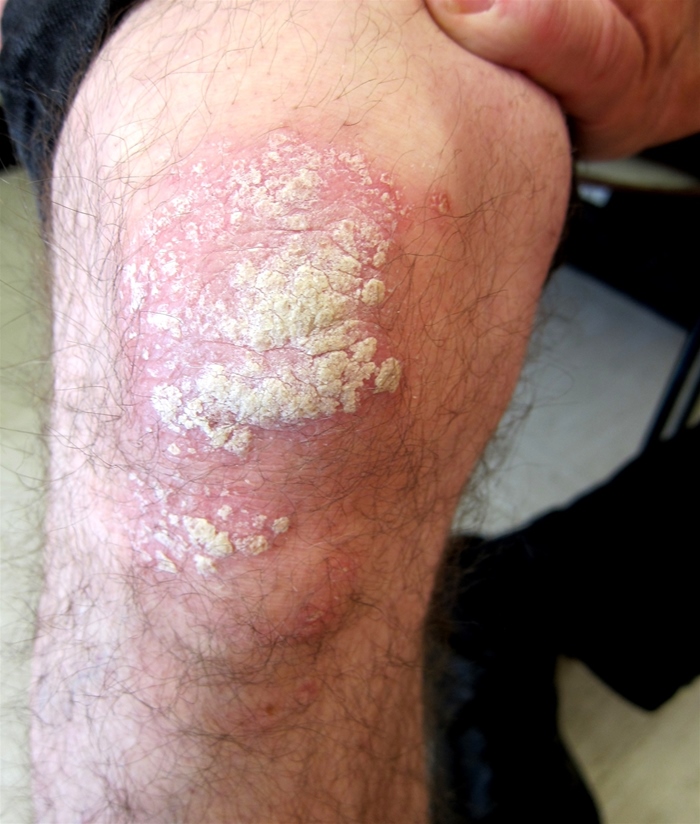 Removal of the scale results in small bleeding points. As part of the treatment regimen, a topical vitamin D analog is prescribed. This medication is most likely to improve this patient's condition via which of the following mechanisms?
 (Multiple Choice)
4.8/5 (74)
(74) A 37-year-old man with no significant medical history comes to the office due to intermittent palpitations. He has a healthy lifestyle, exercises daily, and does not use tobacco, alcohol, or illicit drugs. ECG shows atrial fibrillation with rapid ventricular response. Echocardiogram reveals normal heart function with no significant valvular disease. The patient is started on an antiarrhythmic medication that is known to be effective against both atrial and ventricular arrhythmias. On ECG, this medication causes QRS prolongation with only minimal increase in QT interval duration. Which of the following regions of the action potential curve is most affected by this drug? 
(Multiple Choice)
4.9/5 (75)
(75) A 56-year-old woman comes to the office for follow-up of type 2 diabetes mellitus. She is managing her condition with a healthy diet and regular exercise and is on the maximum tolerated dose of metformin. Despite this, the patient's diabetes has been inadequately controlled for the last 6 months, with an average fasting glucose level of 170 mg/dL and a hemoglobin A1c of 8.0%. She has no known diabetes-related complications. Medical history includes hypertension, for which she takes lisinopril and amlodipine. After discussing various medication options, it is decided to add pioglitazone to her current regime. Before starting this medication, this patient should be educated about which of the following adverse drug effects?
(Multiple Choice)
4.8/5 (71)
(71) A 75-year-old man comes to the urgent care center with acute onset of a pruritic rash after eating strawberries. The patient has no associated swelling in or around the mouth, no wheezing, and no difficulty breathing. Past medical history is notable for coronary artery disease, for which he takes atorvastatin, lisinopril, aspirin, and metoprolol. He also has a history of allergy to dog and cat dander. The patient does not use alcohol or tobacco. His family reports that he lives alone and his functional status has been declining. He walks with a cane, has poor vision, and is frequently forgetful. The patient also has occasional dizziness when standing up and a history of frequent falls. Which of the following would be the most appropriate medication to treat this patient's acute symptoms?
(Multiple Choice)
4.9/5 (91)
(91) A 24-year-old woman comes to the emergency department due to bloody emesis. She had 2 episodes of vomiting bright red blood and feels lightheaded and dizzy. The patient was recently diagnosed with factitious disorder after being hospitalized multiple times for a myriad of symptoms and undergoing several invasive procedures. Physical examination shows scattered ecchymoses. The abdomen is soft and nontender. Rectal examination shows maroon-colored, guaiac-positive stool. After much questioning, she admits to having ingested rat poison several days ago. Immediate treatment of this patient should include which of the following?
(Multiple Choice)
5.0/5 (78)
(78) A 45-year-old-woman comes to the office for follow-up 2 weeks after hospitalization for acute pyelonephritis. The patient was treated with morphine for pain and a course of broad-spectrum antibiotics, which she has completed. Her symptoms have now resolved. The patient also has a history of mechanical mitral valve replacement and takes warfarin. Physical examination shows no new findings. Her INR was 2.5 at the time of hospital discharge but is 6.2 today despite no change to warfarin dosage. Which of the following best explains the laboratory findings in this patient?
(Multiple Choice)
4.9/5 (69)
(69) A 75-year-old man is brought to the emergency department after a syncopal episode at his assisted living facility. The event occurred an hour ago, when he was eating lunch with other residents of the facility. The patient suddenly slumped over onto the table and awakened spontaneously after about 30 seconds. He appeared pale afterwards but was not confused, and fingerstick blood glucose was normal. Medical history includes hypertension, type 2 diabetes mellitus, benign prostatic hyperplasia, and Alzheimer disease. Temperature is 37 C (98.6 F), supine and standing blood pressure is 110/68 mm Hg, and pulse is 62/min. The oropharyngeal mucosa is moist and jugular venous pressure is normal. The lungs are clear on auscultation and heart sounds are normal. The patient is hospitalized for observation and is found to have an episodic bradyarrhythmia and atrioventricular block. If this patient's condition is due to a medication, which of the following is the most likely cause?
(Multiple Choice)
4.8/5 (76)
(76) A 24-year-old man is found unconscious in the basement of his house. His mother calls emergency responders and informs them that the patient has a history of substance abuse and was recently hospitalized for major depressive disorder. In the emergency department, the patient is found to be cyanotic and unresponsive to painful stimuli. Temperature is 36.7 C (98.1 F), blood pressure is 101/62 mm Hg, pulse is 61/min, and respirations are 4/min. His pupils are constricted and minimally responsive to light. Resuscitation efforts are initiated. The patient receives intravenous medication and regains consciousness 2 minutes later. The drug most likely used to treat this patient has the greatest affinity for which of the following receptors?
(Multiple Choice)
4.7/5 (84)
(84) A 43-year-old man comes to the emergency department due to fever, chest pain, and hemoptysis. He has a history of a hematologic malignancy for which he recently underwent a cycle of chemotherapy. Laboratory studies show neutropenia due to the chemotherapeutic agents. A nodule with surrounding hypoattenuation is revealed on chest CT. Galactomannan and beta-D-glucan assays are elevated. Sputum cultures grow Aspergillus. The patient is placed on intravenous amphotericin B. During the infusion, he develops headaches, rigors, and hypotension. Over the next few days, there is a decline in renal function attributed to amphotericin. These toxic effects are likely due to binding of the antifungal agent to which of the following?
(Multiple Choice)
4.9/5 (73)
(73) A 43-year-old man comes to the office after a recent hospitalization for Pneumocystis pneumonia. The patient is taking trimethoprim-sulfamethoxazole and says that his pulmonary symptoms are better. He has a history of HIV and was on highly active antiretroviral therapy until self-discontinuing treatment 2 years ago. On physical examination, the patient appears to be in no acute distress. BMI is 20 kg/m2. A few crackles are heard at the lung bases. His most recent CD4 count is 122/mm3. After discussing medical compliance and the need to resume antiretroviral therapy, HIV genotyping assay is performed. Additional testing for HLA-B*57:01 yields positive results. Which of the following medications is contraindicated in this patient due to the risk of a potentially fatal hypersensitivity reaction?
(Multiple Choice)
4.9/5 (83)
(83) A 62-year-old man comes to the office due to watery diarrhea. He has also been having episodes of dyspnea and wheezing. His wife has noticed that he sometimes becomes very flushed and red. The patient has no abdominal pain, vomiting, cough, or fever. He has a history of hypertension and takes amlodipine. He does not use tobacco, alcohol, or illicit drugs. His blood pressure is 140/70 mm Hg and pulse is 82/min. Cardiopulmonary examination is unremarkable. The abdomen is soft and nontender. Chest x-ray is normal, and the abdominal CT scan reveals mass lesions in the right liver lobe and ileum. Surgery is scheduled to resect the tumors. Which of the following medications can be used to relieve this patient's symptoms prior to surgery?
(Multiple Choice)
4.8/5 (88)
(88) A 65-year-old Caucasian male presents to your office with increasing muscle rigidity and gait instability. He was diagnosed with Parkinson disease two years ago and has been treated with selegiline. His past medical history is otherwise insignificant. His father suffered from Parkinson disease and his mother died of an extensive stroke. You consider switching to levodopa to control this patient's symptoms adequately and discuss the adverse effect profile of levodopa with him. Which of the following adverse effects is most likely to persist after adding carbidopa to levodopa treatment?
(Multiple Choice)
4.9/5 (80)
(80) A 16-year-old girl is brought to the emergency department from home due to altered mental status. Her parents note that she was in her usual state of health at lunch, which was about 6 hours ago. Temperature is 38.3 C (100.9 F), blood pressure is 120/70 mm Hg, pulse is 104/min, and respirations are 30/min. Pulse oximetry is 97% on room air. The girl is disoriented and drowsy. Physical examination shows normal-sized reactive pupils and clear lungs. There is tenderness over the epigastric area. Laboratory studies are as follows: 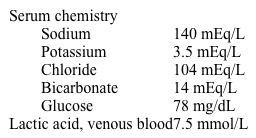 Which of the following is the most likely cause of this patient's findings?
 (Multiple Choice)
4.8/5 (72)
(72) A 15-year-old boy is brought to the office because of 3 months of sudden, brief jerking movements involving both arms. The episodes usually occur shortly after awakening in the morning and are aggravated by sleep deprivation. The movements are neither suppressible nor preceded by an urge to make a movement. The patient has never lost consciousness and has no known medical conditions. Family history includes a seizure disorder in his uncle. Vital signs are within normal limits. Physical examination shows normal development with no abnormalities. Which of the following is the best initial treatment for this patient?
(Multiple Choice)
4.8/5 (88)
(88) In vitro studies demonstrate that tumor cell lines can become resistant after exposure to various anticancer agents. These cells express a specific cell surface glycoprotein that has which of the following functions?
(Multiple Choice)
4.7/5 (79)
(79) A 24-year-old man comes to the emergency department due to a painful erection for the past 6 hours. He has never had this condition before and says it is unrelated to sexual excitement. Medical history is significant for treatment-resistant major depressive disorder, obsessive-compulsive disorder, and insomnia. The patient has smoked a pack of cigarettes a day for 2 years and drinks 1 or 2 cans of beer daily. Examination reveals engorged corpora cavernosa but otherwise shows no abnormalities. Which of the following drugs is the most likely cause of this patient's condition?
(Multiple Choice)
4.8/5 (76)
(76) 
Filters
- Essay(0)
- Multiple Choice(0)
- Short Answer(0)
- True False(0)
- Matching(0)